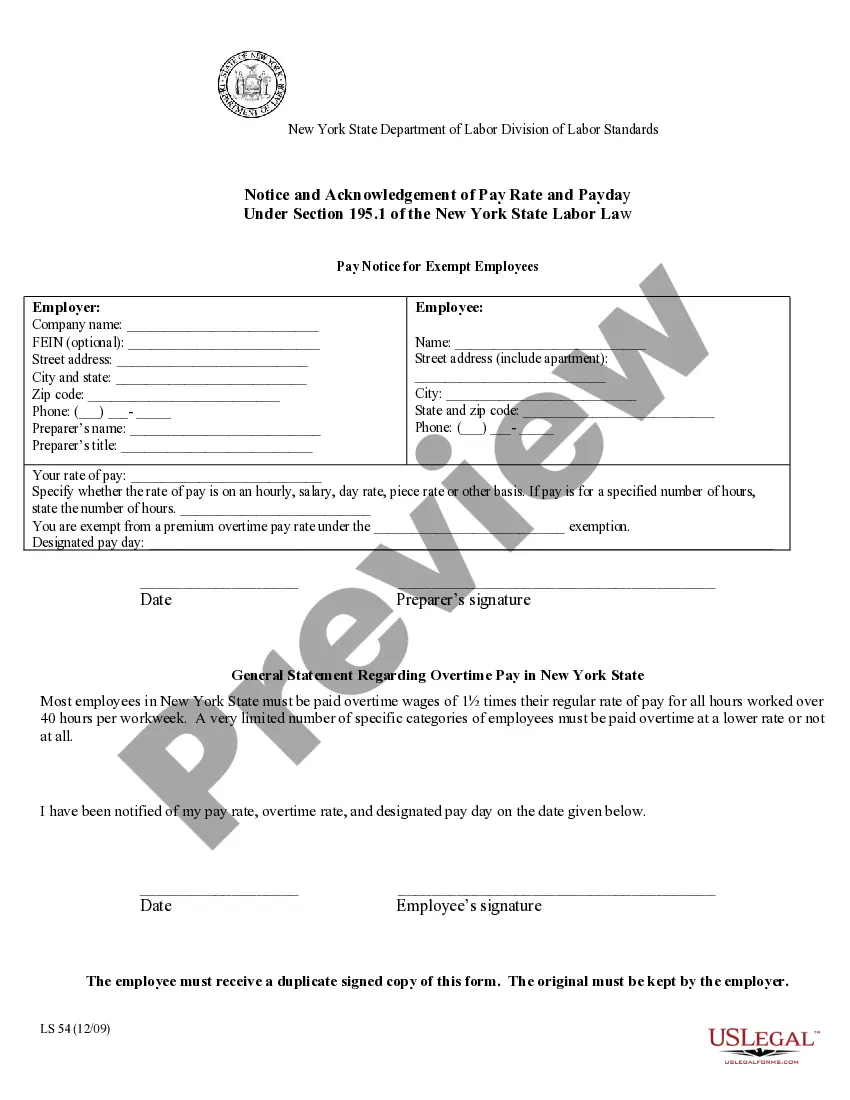
New York Pay Notice for Exempt Employees - Notice and Acknowledgement of Pay Rate and Payday
What this document covers
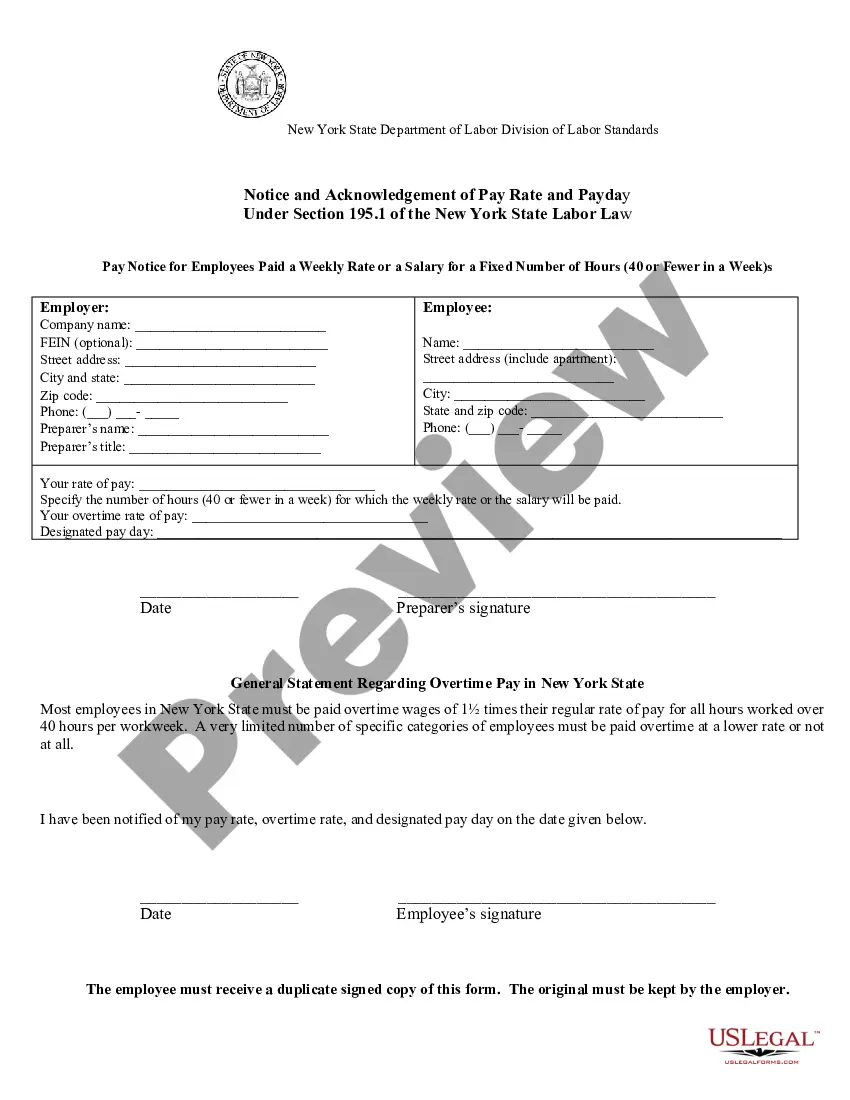
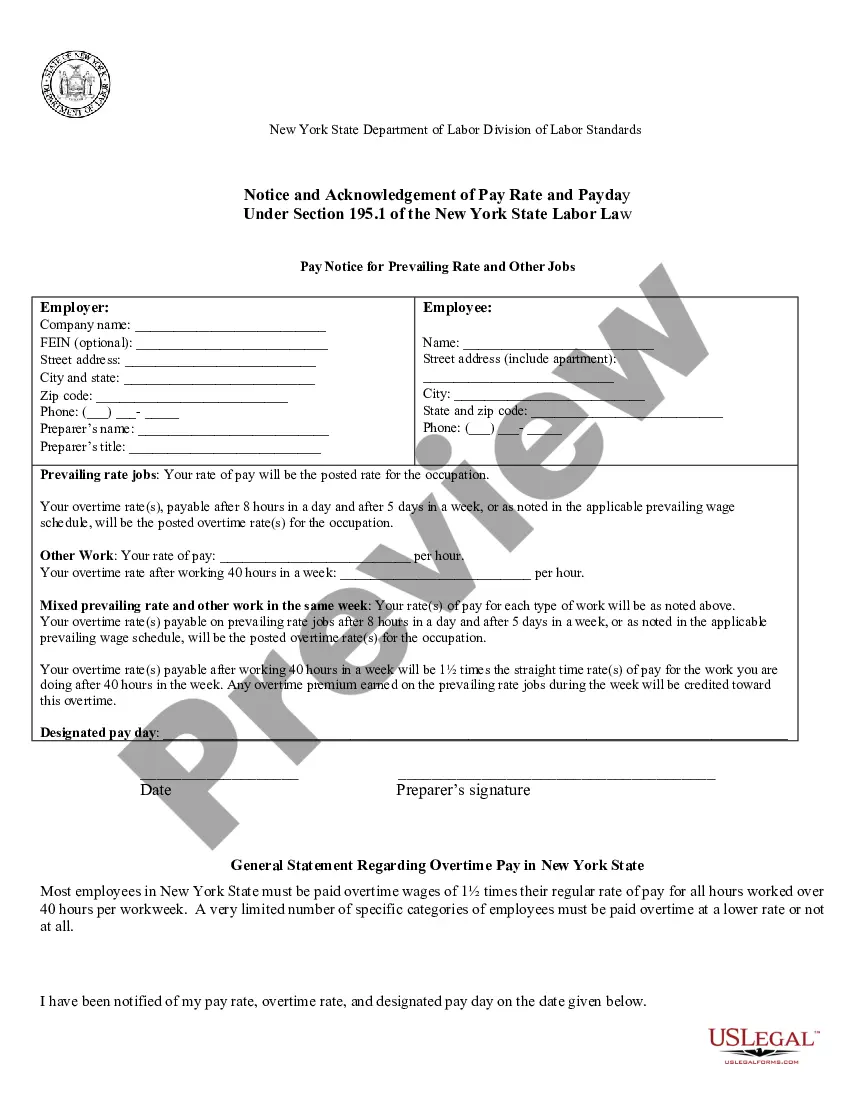
The Pay Notice for Exempt Employees - Notice and Acknowledgement of Pay Rate and Payday is an official form required by New York State under Section 195.1 of the New York State Labor Law. This form informs exempt employees of their pay rate, payday, and relevant exemptions pertaining to overtime pay. It's crucial for compliance purposes and provides both employers and employees clarity regarding payment terms.
Form components explained
- Employer's name and contact information
- Employee's name and contact information
- Rate of pay and payment schedule
- Identification of the exemption type for overtime pay
- Preparation details including the preparer's name and title
- Signatures of the employee and preparer with dates
When to use this form
This form should be used when hiring exempt employees in New York State. It is necessary when an employer needs to notify an employee of their pay rate and payday as per legal requirements. Using this form ensures that both parties are on the same page regarding compensation and work conditions.
Who needs this form
- Employers in New York State who hire exempt employees
- Human resources professionals responsible for payroll
- Small business owners who need to comply with state labor laws
- Employees who want to understand their pay details and legal rights
Completing this form step by step
- Enter the employer's name, Federal Employer Identification Number (FEIN), and contact information.
- Fill in the employee's name and address details.
- Specify the rate of pay and the basis for this rate (hourly, salary, etc.).
- Indicate the applicable exemption type under which the employee falls.
- Document the designated pay day.
- Obtain signatures from both the preparer and the employee with corresponding dates.
Notarization guidance
Notarization is not commonly needed for this form. However, certain documents or local rules may make it necessary. Our notarization service, powered by Notarize, allows you to finalize it securely online anytime, day or night.
Get your form ready online
Our built-in tools help you complete, sign, share, and store your documents in one place.
Make edits, fill in missing information, and update formatting in US Legal Forms—just like you would in MS Word.
Download a copy, print it, send it by email, or mail it via USPS—whatever works best for your next step.
Sign and collect signatures with our SignNow integration. Send to multiple recipients, set reminders, and more. Go Premium to unlock E-Sign.
If this form requires notarization, complete it online through a secure video call—no need to meet a notary in person or wait for an appointment.
We protect your documents and personal data by following strict security and privacy standards.

Make edits, fill in missing information, and update formatting in US Legal Forms—just like you would in MS Word.

Download a copy, print it, send it by email, or mail it via USPS—whatever works best for your next step.

Sign and collect signatures with our SignNow integration. Send to multiple recipients, set reminders, and more. Go Premium to unlock E-Sign.

If this form requires notarization, complete it online through a secure video call—no need to meet a notary in person or wait for an appointment.

We protect your documents and personal data by following strict security and privacy standards.
Avoid these common issues
- Failing to provide accurate employee information.
- Not specifying the correct pay rate basis (e.g., hourly, salary).
- Omitting the employee's signature after completion.
- Leaving the exemption type blank or incorrectly identified.
Why complete this form online
- Convenient access to the form anytime and anywhere.
- Editable templates that allow for customization to meet specific needs.
- Reliability with attorney-approved language ensuring compliance with state laws.
- Immediate downloads save time and enhance organizational efficiency.
Legal use & context
- This form complies with the New York State Labor Law requirements.
- It helps protect employee rights by ensuring they are informed of their pay and related exemptions.
Summary of main points
- The Pay Notice for Exempt Employees is critical for compliance with New York labor laws.
- Completing and providing this form protects both employer and employee interests.
- Clear documentation of pay rates and schedules helps prevent disputes.
Looking for another form?
Form popularity
FAQ
Key takeaway: The advantages of hiring exempt employees include no overtime pay and more knowledge and responsibility. Downsides include higher pay rates and no ability to deduct pay for hours not worked.
In order to be classified as exempt, an employee must be paid a minimum of $23,000 per year, or $455 per week. However, that isn't the only test. There are many people who earn more than this amount and are still classified as non-exempt.
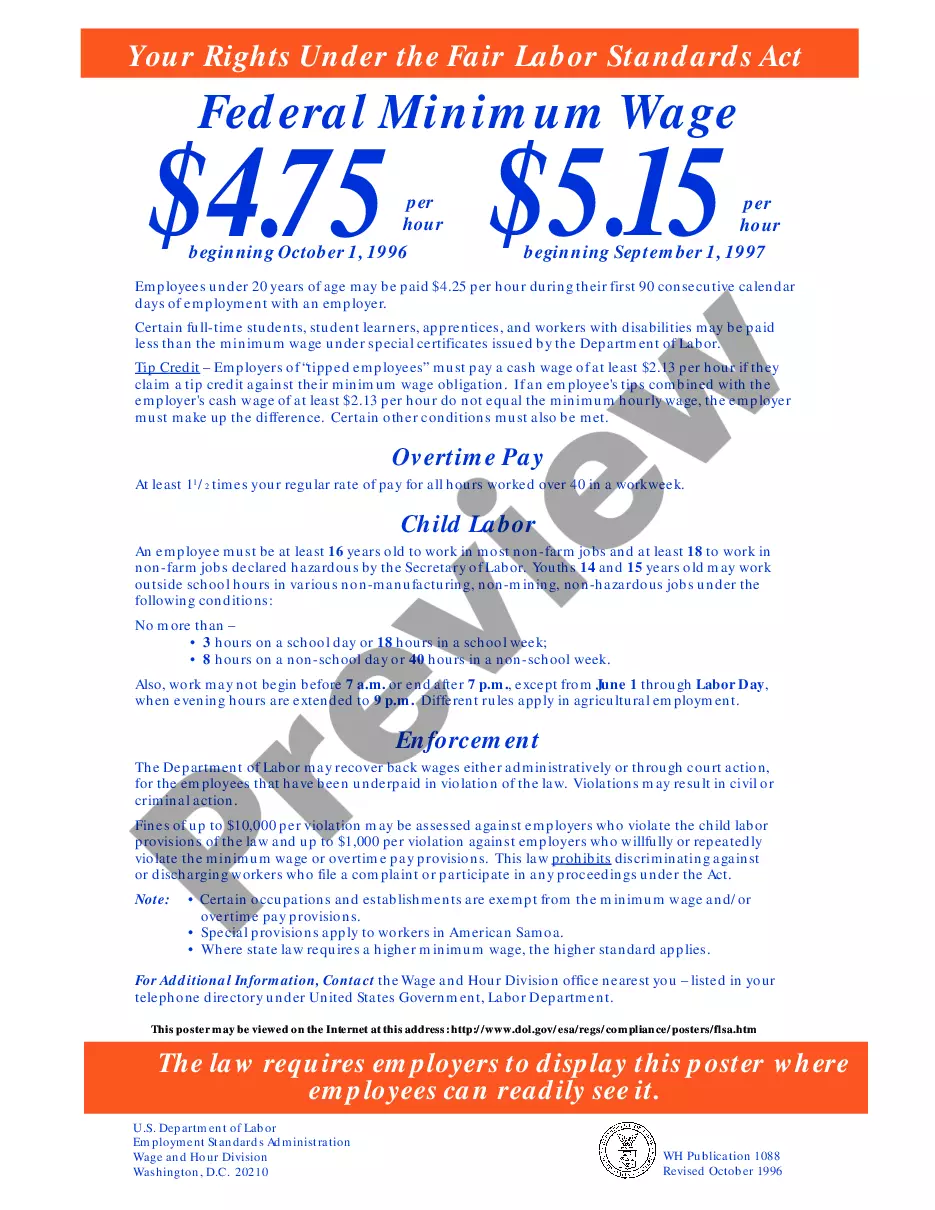
An exempt employee is not entitled overtime pay by the Fair Labor Standards Act (FLSA). These salaried employees receive the same amount of pay per pay period, even if they put in overtime hours. A nonexempt employee is eligible to be paid overtime for work in excess of 40 hours per week, per federal guidelines.
If the worker meets all the requirements of the duties test as an exempt employee, their minimum salary can be no less than the requirement for 2020: $35,568. An employee who doesn't meet the duties requirements and the salary minimum must be classified as nonexempt, or eligible for overtime pay.
1. Employees who are exempt can work over 40 hours without additional compensation. Here's why: the FLSA and state fair labor standards legislation requires employees who work more than 40 hours in any work week to be paid time-and-a-half for those hours.
The term exempt employee refers to a category of employees set out in the Fair Labor Standards Act (FLSA). Exempt employees do not receive overtime pay, nor do they qualify for the minimum wage. When an employee is exempt, it primarily means that they are exempt from receiving overtime pay.
Under the FLSA, exempt workers qualify for time and a half, their normal hourly wage plus half that wage, when they work overtime. Workers who volunteer for overtime or have mandatory overtime can benefit significantly from their status as non-exempt employees, as they can make a large amount of money in overtime pay.
Salaried employees enjoy the security of steady paychecks, and they tend to pull in higher overall income than hourly workers. And they typically have greater access to benefits packages, bonuses, and paid vacation time.
As an exempt employee, an employer could require the employee to work more than 40-hours per week without overtime pay. An employer would also not have to provide rest breaks and meal breaks to an exempt employee. An employer may intentionally or unintentionally classify a non-exempt employee as an exempt employee.