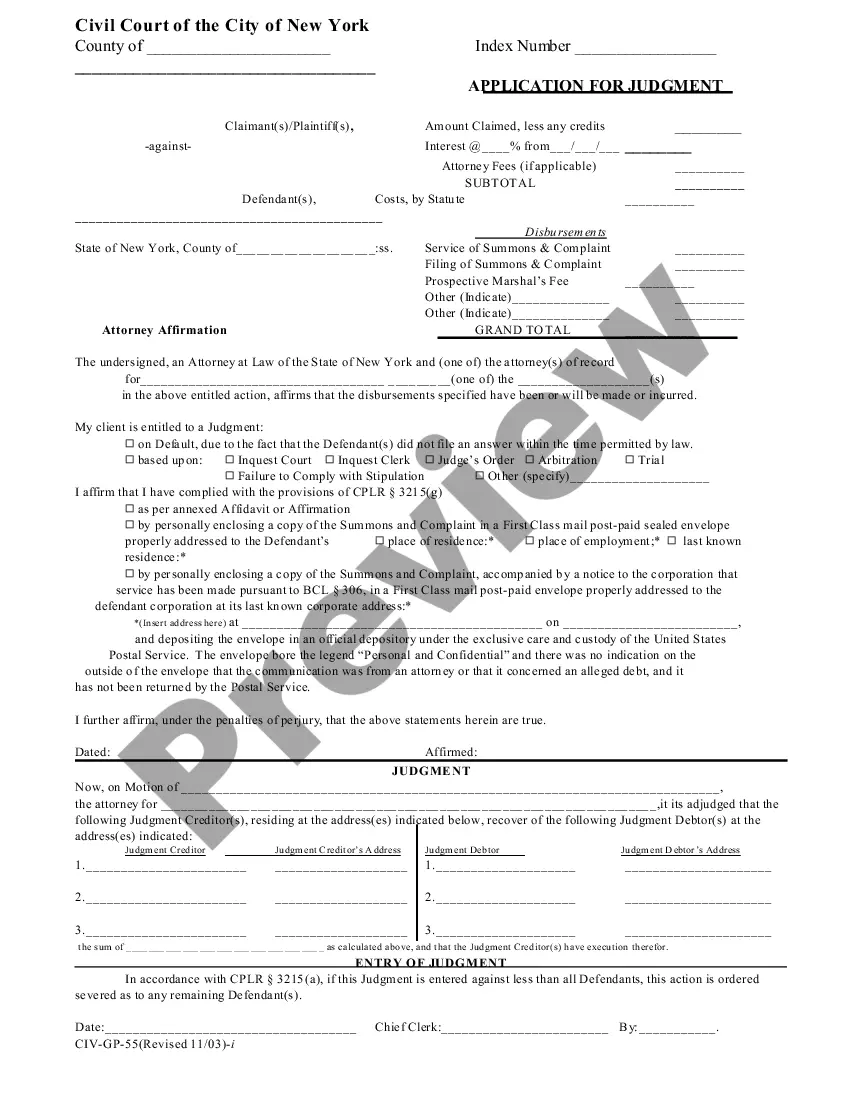
Application for Default Judgment in the State of New York - Civil Case
What is this form?
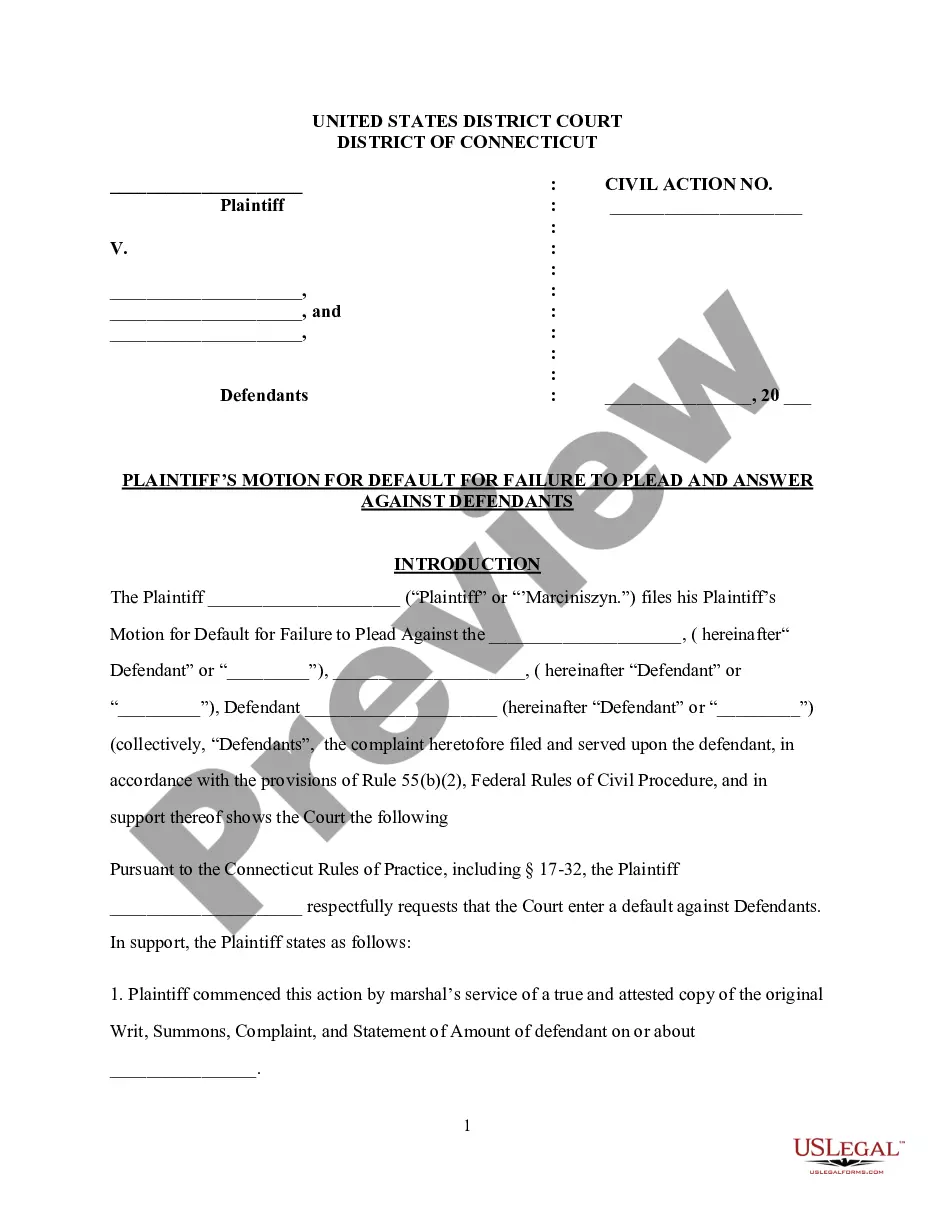
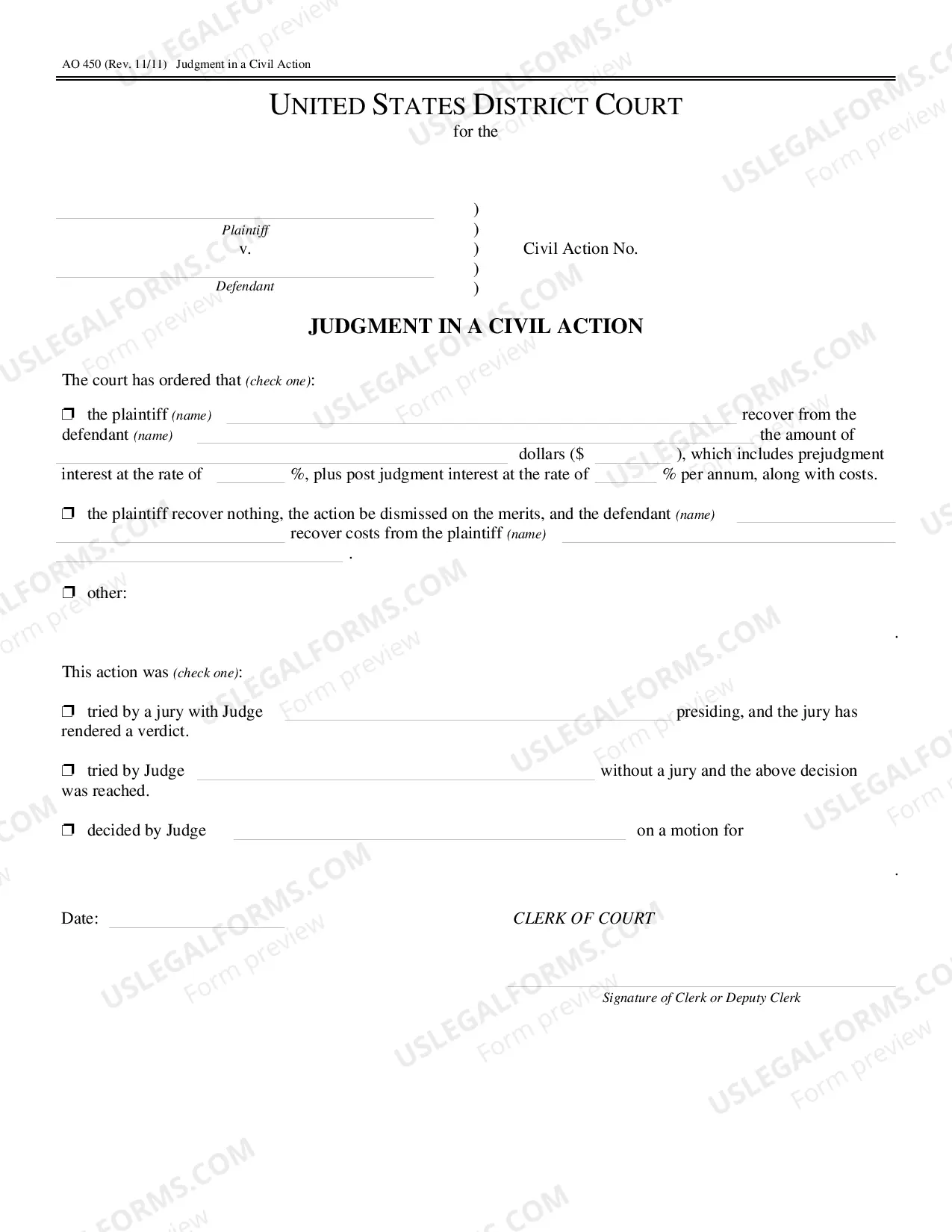
The Application for Default Judgment in the State of New York is a legal document that allows a plaintiff to request a judgment when a defendant fails to respond to a lawsuit. This form is applicable in civil cases where the defendant has not appeared in court or filed an answer, making it essential for plaintiffs seeking to enforce their rights when the defendant neglects their responsibilities. Unlike other forms, this specific application is tailored for obtaining a default judgment, streamlining the process for plaintiffs to secure a ruling without the defendant's direct involvement.
Key parts of this document
- Claimant and defendant information, including addresses and index number.
- Details of the claim, including the amount claimed, interest, and attorney fees.
- Affirmations confirming compliance with legal requirements for service and notification.
- Sections for judgment entry specifying the amounts to be recovered.
- Signature lines for the attorney and chief clerk.
When to use this form
This form should be used when a plaintiff has initiated a civil lawsuit, but the defendant has failed to appear or file an answer within the specified timeframe. If the plaintiff seeks judgment based on nonpayment of a contractual obligation and the defendant has not engaged in the process, this application is crucial for moving forward with a default judgment. Common situations include disputes involving unpaid debts, damages from a contract breach, or other civil claims where the defendant has not responded.
Who should use this form
- Individuals or businesses acting as plaintiffs in civil cases in New York.
- Attorneys representing clients who need to obtain a judgment after a defendant has failed to respond.
- Anyone who has filed a civil action and wishes to enforce a claim due to a defendant's nonappearance.
Completing this form step by step
- Identify the claimant and defendant, entering their details and addresses in the appropriate sections.
- Specify the amount claimed, including details on interest and any attorney fees.
- Complete the affirmation section to confirm that the defendant was properly served.
- Fill in the judgment creditor and debtor information as required.
- Ensure that the form is signed and dated by the attorney handling the case.
Is notarization required?
This form does not typically require notarization unless specified by local law. However, it is important to verify local regulations as some jurisdictions may have different requirements regarding witness signatures or attestations.
Get your form ready online
Our built-in tools help you complete, sign, share, and store your documents in one place.
Make edits, fill in missing information, and update formatting in US Legal Forms—just like you would in MS Word.
Download a copy, print it, send it by email, or mail it via USPS—whatever works best for your next step.
Sign and collect signatures with our SignNow integration. Send to multiple recipients, set reminders, and more. Go Premium to unlock E-Sign.
If this form requires notarization, complete it online through a secure video call—no need to meet a notary in person or wait for an appointment.
We protect your documents and personal data by following strict security and privacy standards.

Make edits, fill in missing information, and update formatting in US Legal Forms—just like you would in MS Word.

Download a copy, print it, send it by email, or mail it via USPS—whatever works best for your next step.

Sign and collect signatures with our SignNow integration. Send to multiple recipients, set reminders, and more. Go Premium to unlock E-Sign.

If this form requires notarization, complete it online through a secure video call—no need to meet a notary in person or wait for an appointment.

We protect your documents and personal data by following strict security and privacy standards.
Mistakes to watch out for
- Failing to provide proof of service to the court.
- Incorrectly calculating the total amount owed or including improper fees.
- Not ensuring that all attorney affirmations are complete and accurate.
- Neglecting to timely file the application within the one-year period following the default.
Why use this form online
- Convenience of downloading the form at any time to speed up legal processes.
- Editable fields allow for personalized information entry without the hassle of physical paperwork.
- Access to forms drafted and reviewed by licensed attorneys, ensuring compliance with legal standards.
Looking for another form?
Form popularity
FAQ
The danger of allowing a default judgment against you is once this occurs the debt buyer can garnish your wages and your bank accounts.If you don't submit a written answer to the lawsuit the court can enter a default judgment giving the debt buyer everything they are asking for.
In order to start enforcing a judgment, the judgment must be entered. Entry occurs after the clerk of the court signs and files the judgment. If you appeared in person (without an attorney) and you are the winner, you may ask the clerk to prepare and enter (record) a judgment in your favor.
Step 1: Make Sure You've Met the Requirements for a Default. Step 2: Decide How You Wish to Proceed. Step 3: Complete the Necessary Forms. Step 4: Complete Your Declaration in Support of Default Judgment. Step 5: Calculate Prejudgment Interest, if Appropriate. Step 6: Copy and Assemble Your Documents.
Default judgment is a binding judgment in favor of either party based on some failure to take action by the other party. Most often, it is a judgment in favor of a plaintiff when the defendant has not responded to a summons or has failed to appear before a court of law.
In most cases, however, default judgment can be obtained through an administrative process, simply by filing a request with the court, and even where an application is required it can in some circumstances be made without notice to the defendant.
Generally, if a defendant fails to respond to a complaint you can get a default judgment after 45 days. However, the court system is very slow these days and it can take several months to get the court to issue the default judgment.
Default judgments happen when you don't respond to a lawsuit often from a debt collector and a judge resolves the case without hearing your side. In effect, you're found guilty because you never entered a defense. Default judgments are sometimes called automatic judgments because of how fast they can happen.
When a default is entered, the party who requested the entry of default must obtain a default judgment against the defaulting party within 45 days after the default was entered, unless the court has granted an extension of time.
A very important fact you should keep in mind is that California courts do impose a timeline for seeking entry of a default judgment. Specifically, a request for entry of default must be filed within 10 days following a defendant's failure to timely file and serve a responsive pleading.