Nevada Last Will and Testament for Domestic Partner with Minor Children from Prior Marriage
Overview of this form
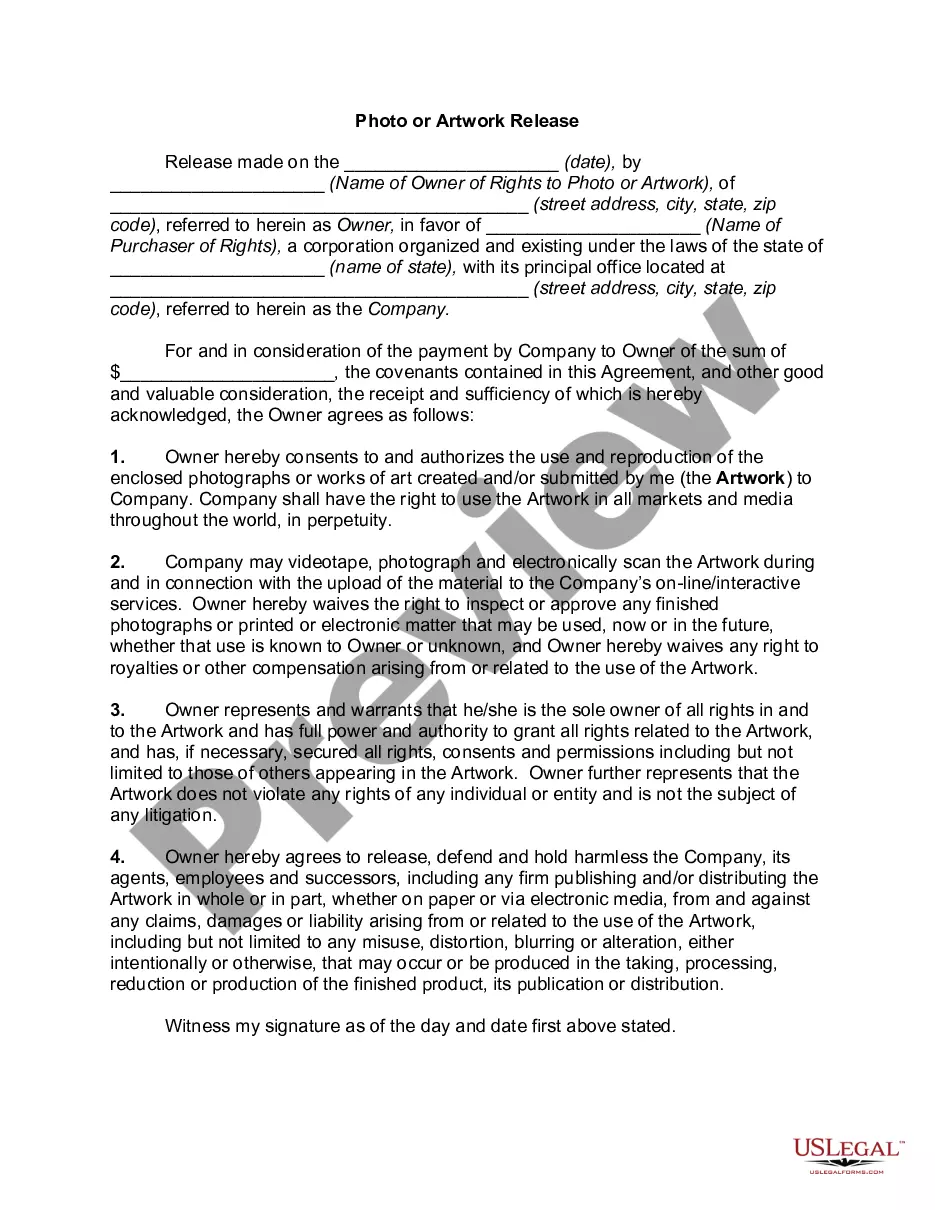
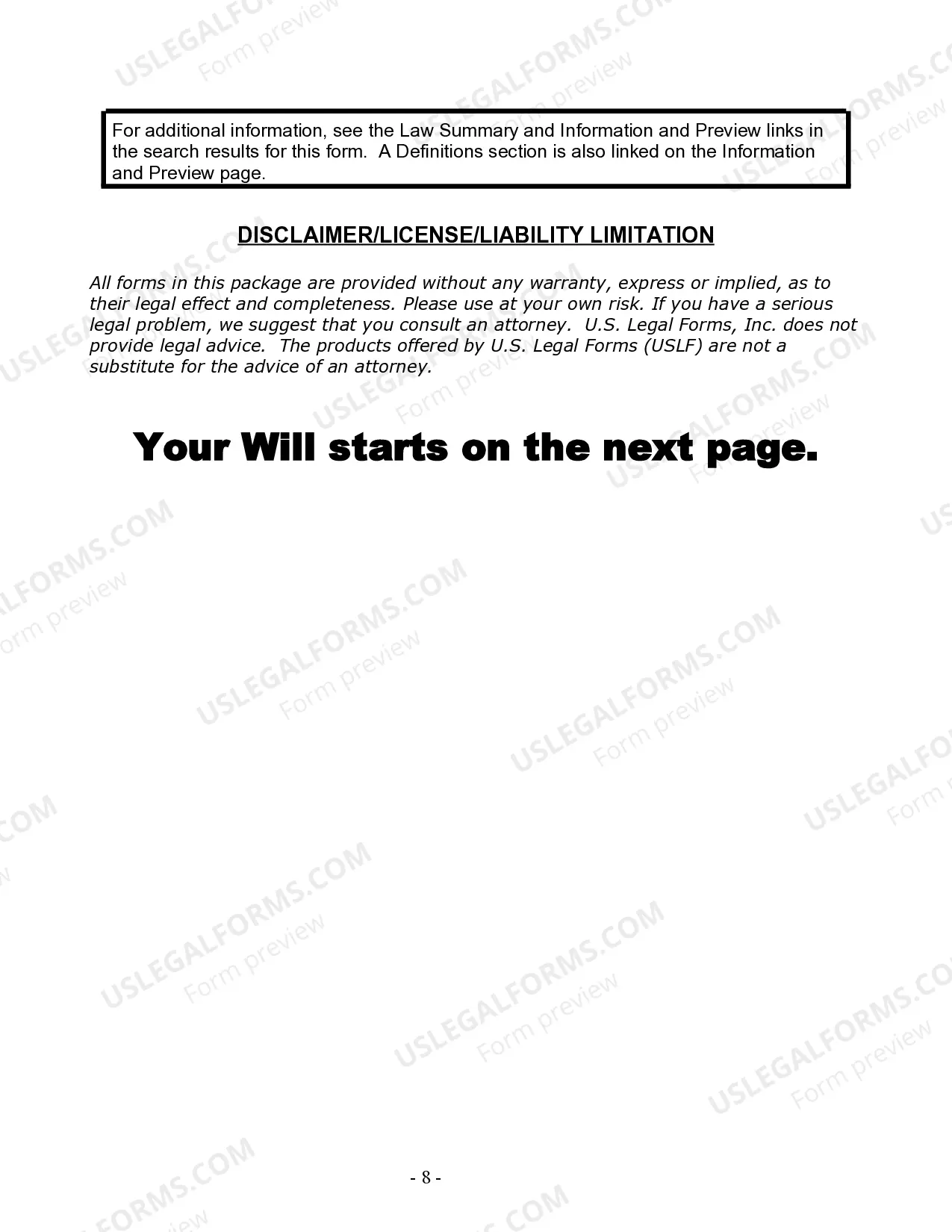
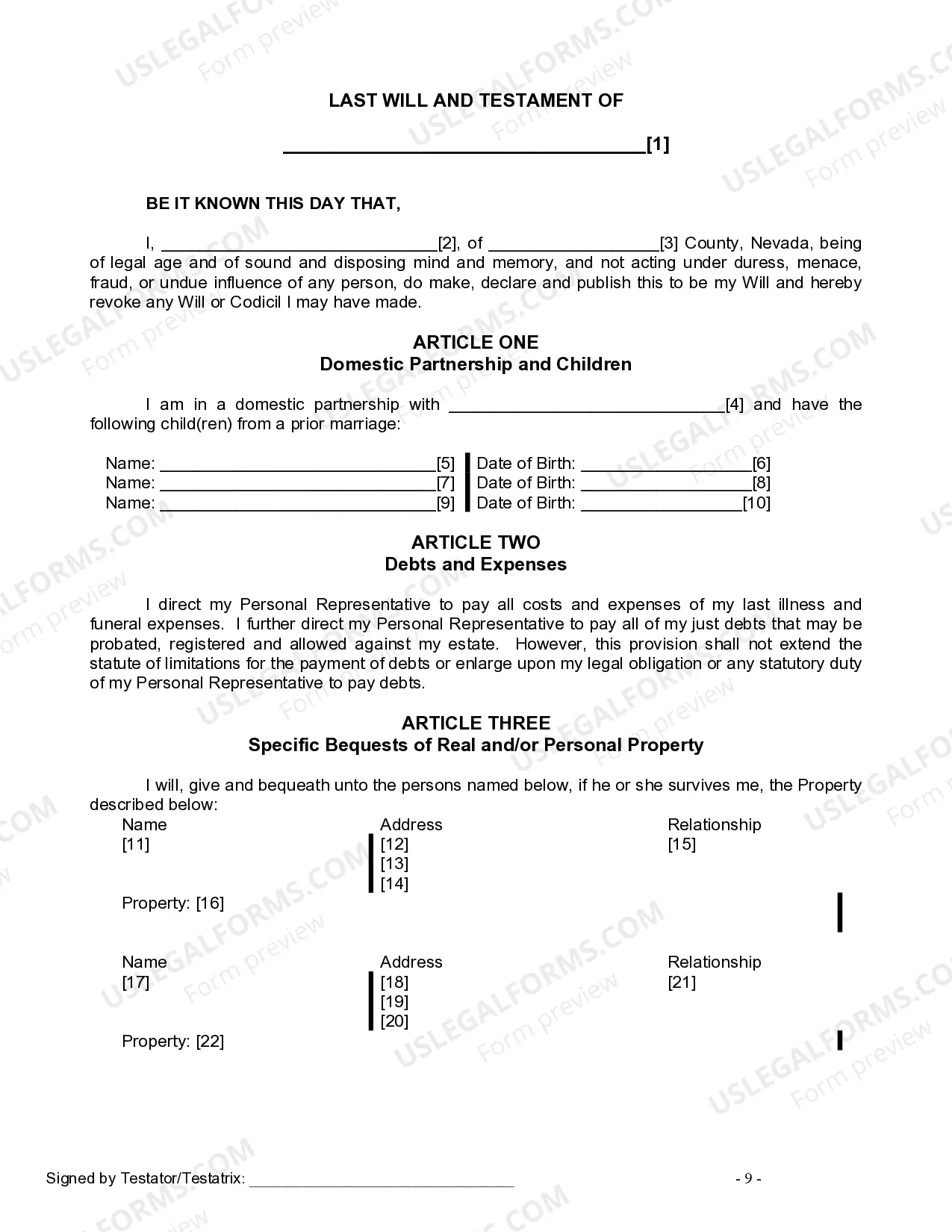
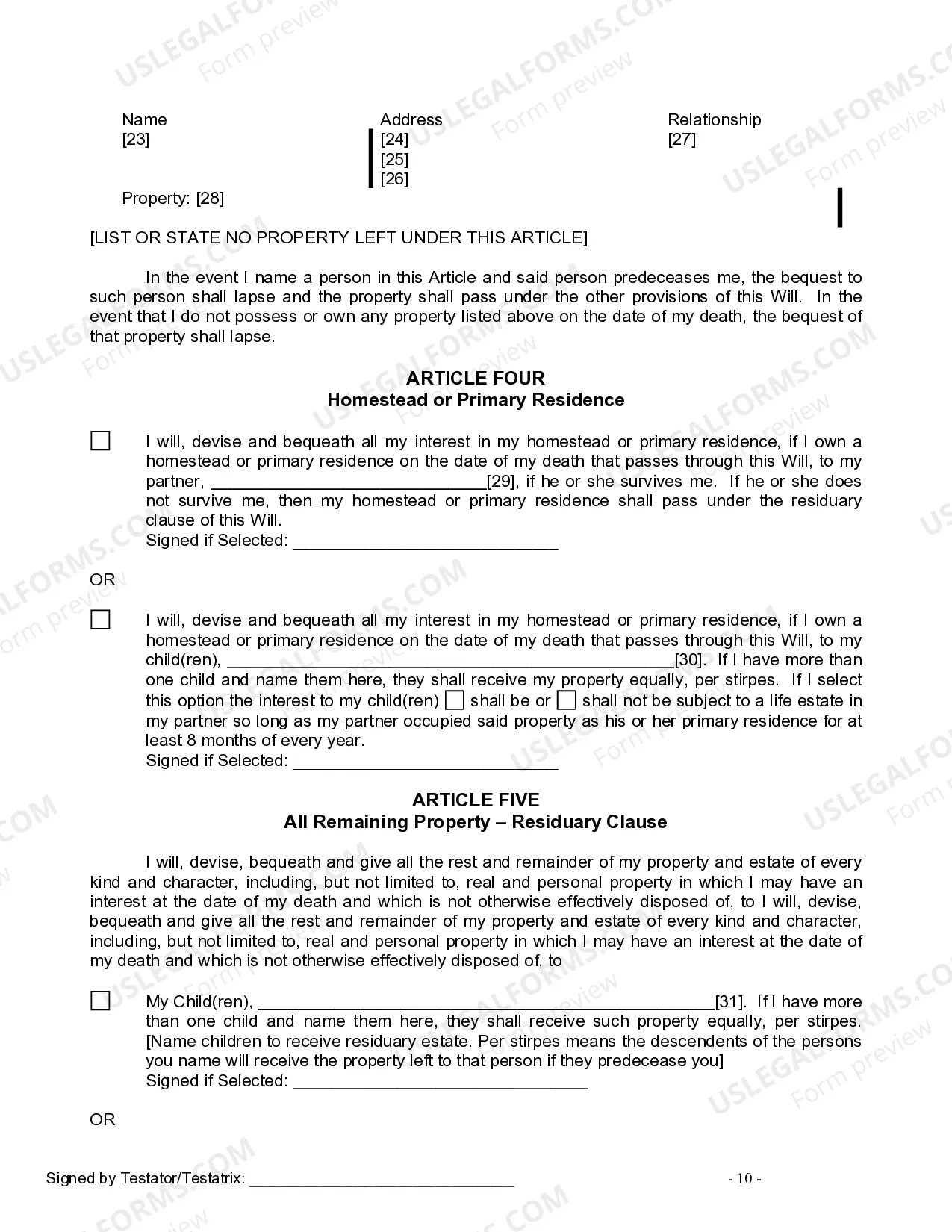
This Last Will and Testament for Domestic Partners with Minor Children from a Prior Marriage is a legal document that specifies how your property will be distributed after your death. It is designed for individuals in a domestic partnership who have children from a previous marriage. This form allows you to appoint a personal representative, designate beneficiaries, and make provisions for minor children, such as establishing a trust for their inheritance. Unlike standard wills, this form specifically accommodates the complexities of domestic partnerships and blended families.
What’s included in this form
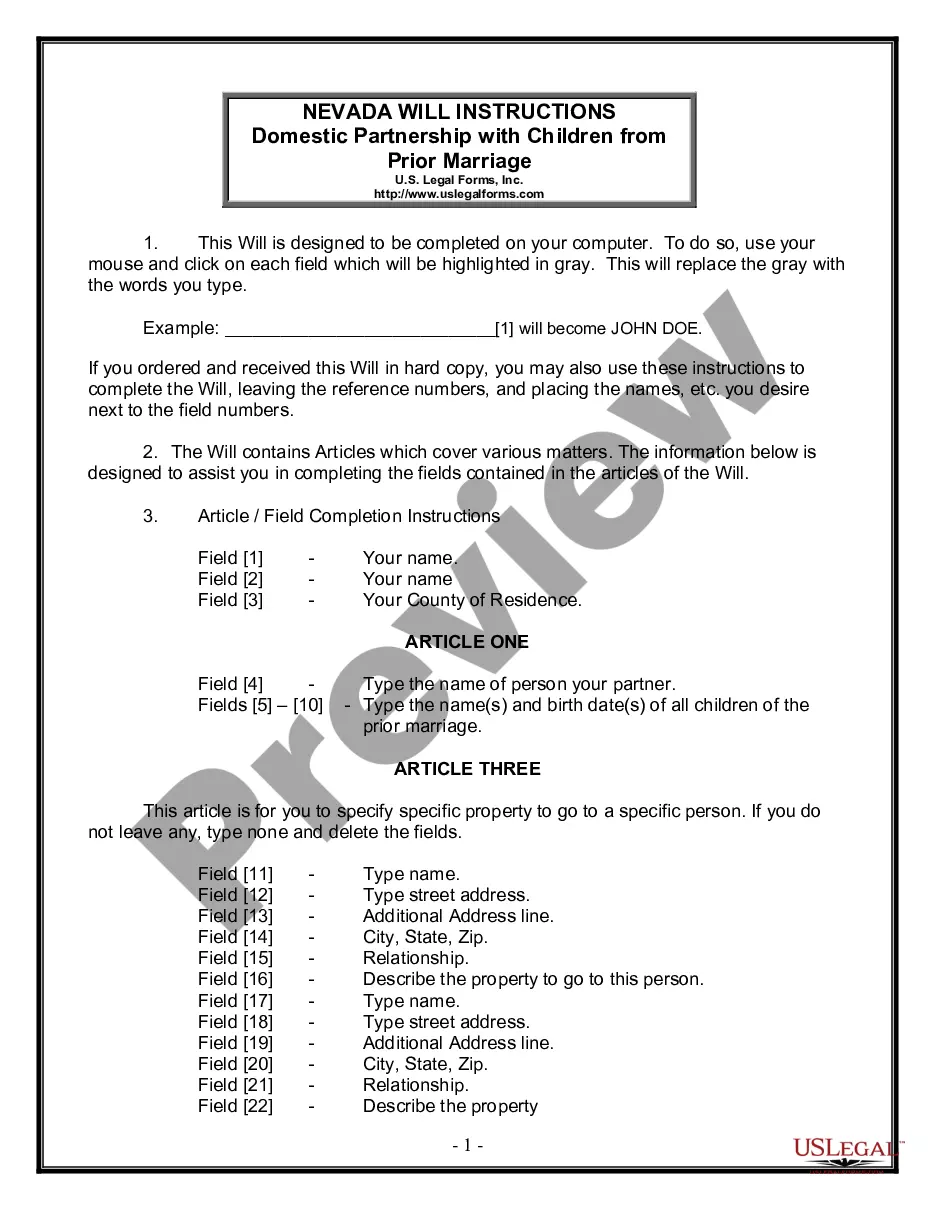
- Personal information: Names of the testator, domestic partner, and minor children.
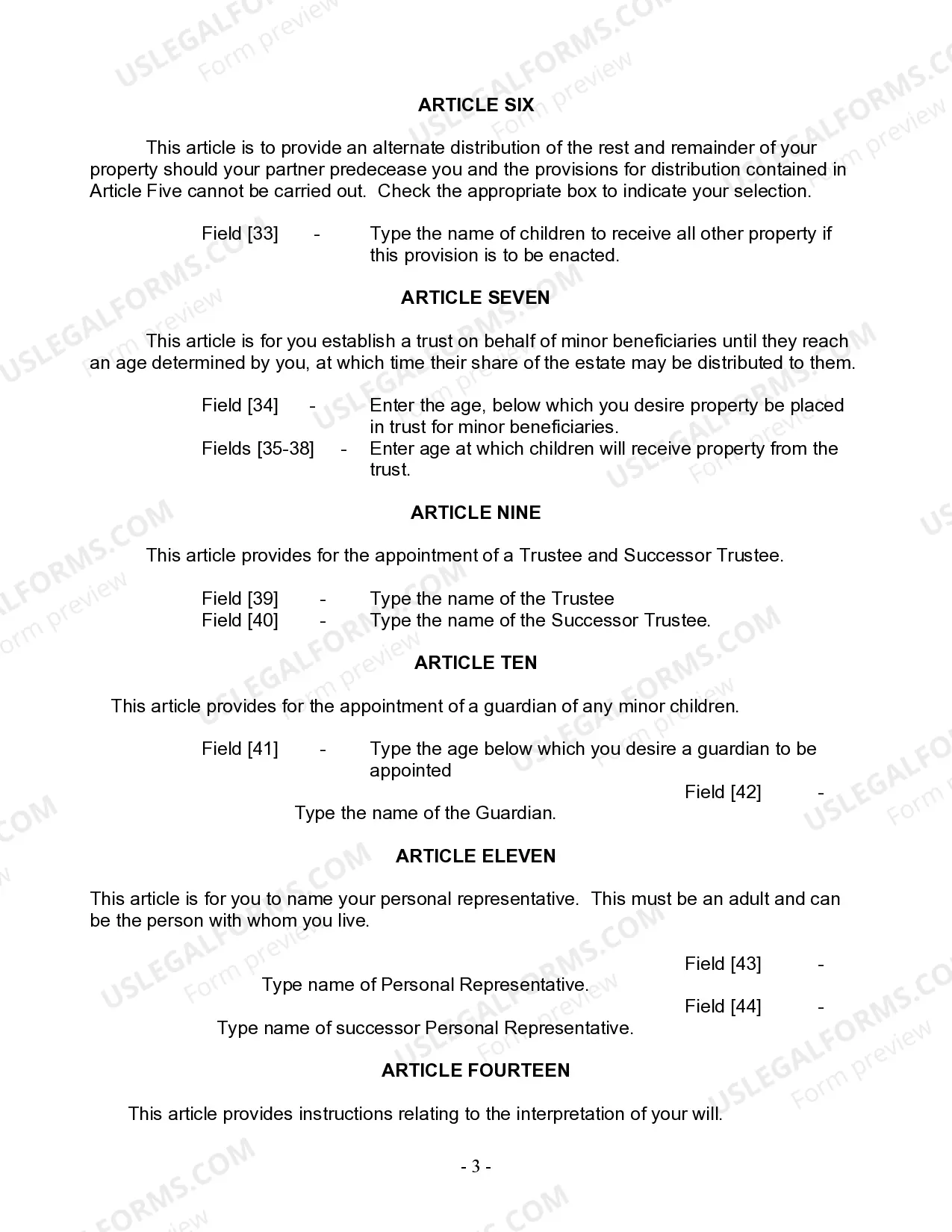
- Appointment of personal representative: Designation of an executor to oversee the estate.
- Specific bequests: Details on specific property distributions to named beneficiaries.
- Trust provisions: Establishment of a trust for minor children until they reach a specified age.
- Guardian appointment: Naming a guardian for minor children, if necessary.
- Signature requirements: Instructions for signing in front of witnesses and a notary.



Situations where this form applies
This form is necessary if you are in a domestic partnership and have minor children from a previous relationship. You should complete this will when you want to ensure that your wishes regarding the distribution of your assets are honored and that your children are cared for according to your desires. If your circumstances change, such as the birth of additional children or changes in relationships, it is wise to update your will accordingly.
Who needs this form
- Individuals in a domestic partnership.
- Parents with minor children from a prior marriage.
- Those who wish to appoint a guardian for their children.
- People looking to create a trust for their children's inheritance.
Completing this form step by step
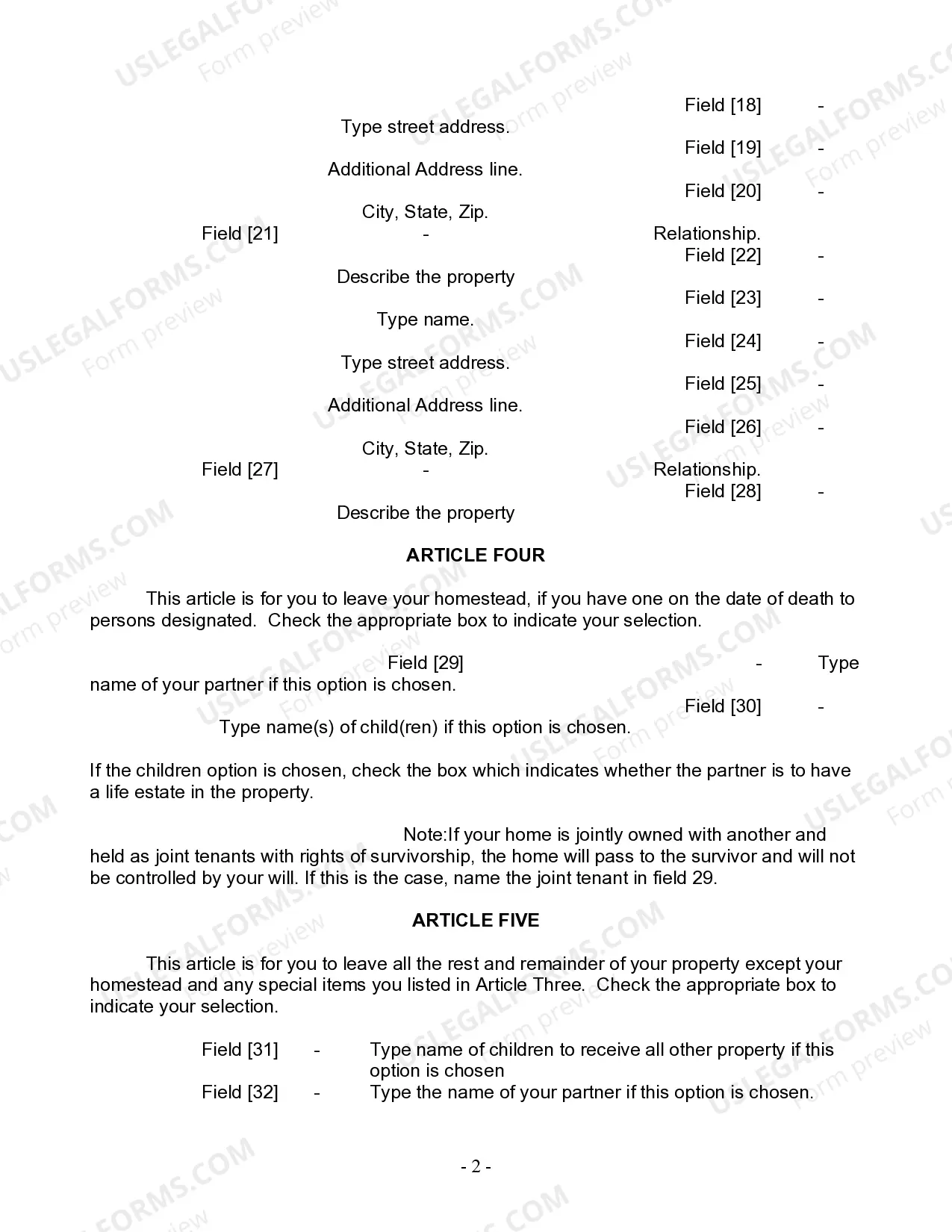
- Enter your name and personal information, including your county of residence.
- Specify the name of your domestic partner and list the names and birth dates of any minor children from prior marriages.
- Detail any specific property you wish to bequeath in the appropriate sections.
- Indicate your preferences regarding your homestead and other remaining property.
- Sign the will in the presence of two witnesses and a notary public, if required.
Does this form need to be notarized?
Yes, this form must be notarized to be legally valid if your state requires a self-proving affidavit. Having a notary public present ensures that the affidavit can be completed securely and that your will is easily admitted to probate.
Get your form ready online
Our built-in tools help you complete, sign, share, and store your documents in one place.
Make edits, fill in missing information, and update formatting in US Legal Forms—just like you would in MS Word.
Download a copy, print it, send it by email, or mail it via USPS—whatever works best for your next step.
Sign and collect signatures with our SignNow integration. Send to multiple recipients, set reminders, and more. Go Premium to unlock E-Sign.
If this form requires notarization, complete it online through a secure video call—no need to meet a notary in person or wait for an appointment.
We protect your documents and personal data by following strict security and privacy standards.

Make edits, fill in missing information, and update formatting in US Legal Forms—just like you would in MS Word.

Download a copy, print it, send it by email, or mail it via USPS—whatever works best for your next step.

Sign and collect signatures with our SignNow integration. Send to multiple recipients, set reminders, and more. Go Premium to unlock E-Sign.

If this form requires notarization, complete it online through a secure video call—no need to meet a notary in person or wait for an appointment.

We protect your documents and personal data by following strict security and privacy standards.
Common mistakes to avoid
- Not updating the will after significant life changes (e.g., new children, divorce).
- Failing to have the will signed in the presence of necessary witnesses.
- Assuming that joint property will pass according to the will.
- Neglecting to include provisions for minor childrenâs guardianship.
Benefits of using this form online
- Convenience: Complete your will from home at your own pace.
- Editability: Easy to update as your circumstances change.
- Accessibility: Downloadable templates drafted by licensed attorneys ensure legal reliability.
What to keep in mind
- This will is specifically designed for domestic partners with minor children from prior relationships.
- It includes provisions for property distribution, guardianship, and trusts for children.
- Proper signing procedures include two witnesses and notarization for legal validity.
- Using this form online offers convenience, ease of editing, and legal assurance.
Looking for another form?
Form popularity
FAQ
Right to receive marriage or family rate on health, car and/or liability insurance. right to inherit spouse's property upon death. right to sue for spouse's wrongful death or loss of consortium, and. right to receive spouse's Social Security, pension, worker's compensation, or disability benefits.
At common law, the spouse typically the husband was legally liable for the support of the other spouse.Today, some states have established statutes that require a spouse to be responsible for necessary or family expenses, even in the absence of an express agreement to pay such a debt.
Today, the underlying concept that marriage is a legal contract still remains, but due to changes in society the legal obligations are not the same. Marriage is chiefly regulated by the states.Entering into a marriage changes the legal status of both parties and gives both husband and wife new rights and obligations.
The husband has a right to file a petition for divorce with or without mutual consent. For the latter, the grounds remain the same as that for a wife. These include cruelty, desertion, conversion, adultery, disease, mental disorder, renunciation and presumption of death.
Definition. The legal union of a couple as spouses. The basic elements of a marriage are: (1) the parties' legal ability to marry each other, (2) mutual consent of the parties, and (3) a marriage contract as required by law. See also Common-Law Marriage.
Penalties and Bonuses. The Tax Cuts and Jobs Act. Health Insurance Benefits. Auto and Home Insurance Benefits. Better Loans for Married People. Speaking of Credit. Financial Protection. Other Benefits of Marriage.
In California, you need to get a marriage license and exchange vows in a ceremony - either civil or religious in order to be legally married. Although common law marriage isn't legal in California, unmarried partners may assert some of the same rights as divorcing spouses when they break up.
Same-Sex Marriage, Civil Unions, and Domestic Partnerships If you are in a same-sex marriage, your union will be legally recognized everywhere in the United States, and you are entitled to all of the same state and federal benefits as opposite-sex married couples.
Right to live with dignity and self-respect According to this, every Indian married woman has a right to have the same lifestyle as her husband and in-laws. It is also her right to be free of torture - mental and physical.