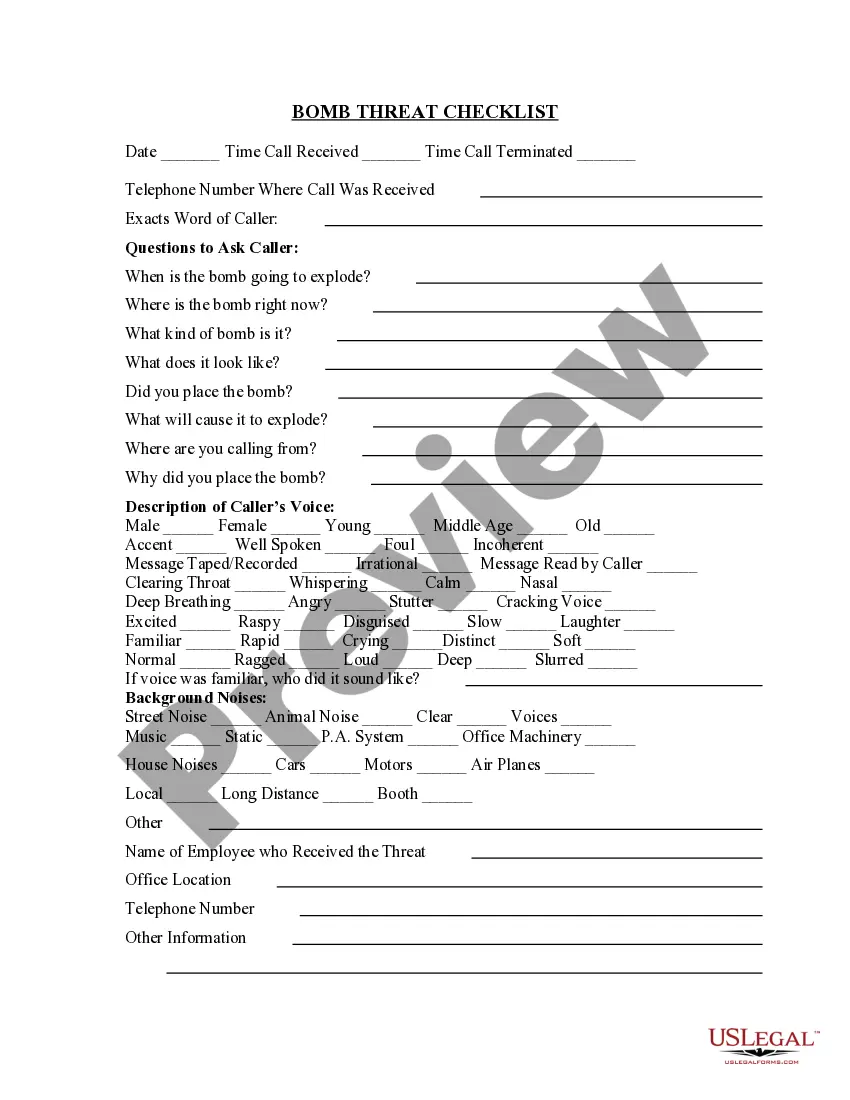
Nevada Bomb Threat Checklist
Description






How to fill out Bomb Threat Checklist?
Finding the appropriate official document template can be quite challenging. Naturally, there is a multitude of templates accessible online, but how can you find the official form you need.
Utilize the US Legal Forms website. The platform offers a vast collection of templates, including the Nevada Bomb Threat Checklist, suitable for both professional and personal needs. All documents are reviewed by experts and comply with federal and state regulations.
If you are already registered, Log In to your account and click the Download button to obtain the Nevada Bomb Threat Checklist. Use your account to browse through the legal forms you have previously acquired. Navigate to the My documents tab in your account to retrieve another copy of the document you require.
Complete, edit, print, and sign the obtained Nevada Bomb Threat Checklist. US Legal Forms boasts the largest repository of legal templates from which you can find various document formats. Utilize the service to obtain professionally crafted paperwork that complies with state regulations.
- If you are a new user of US Legal Forms, here are simple instructions to follow.
- First, ensure you have selected the correct form for your city/state. You can review the form using the Review button and read the form details to confirm it is the right choice for you.
- If the form does not meet your requirements, use the Search section to find the appropriate form.
- Once you are confident the form is suitable, click the Buy Now button to purchase the form.
- Select the price plan you prefer and provide the necessary information. Create your account and complete your order using your PayPal account or credit card.
- Choose the file format and download the legal document template to your device.
Form popularity
FAQ
A bomb threat is defined as a threat to detonate an explosive or incendiary device to cause property damage, death, or injuries, whether or not such a device actually exists. All bomb threats are to be taken seriously.
Public address system jargon for. (1) A deceased person admitted to an ER. (2) An emergency situation involving personal threats to safety of one or more persons in a hospital or other public place, including assaults, confrontations, hostage situations and threats of personal injury or attack.
Code Green: emergency activation. Code Black: bomb threat.
A bomb threat shall be known as a Code Black. In the event a bomb threat is received through a telephone call, the person receiving the call should: Keep calm. Note and write down the extension/phone number of incoming call if displayed.
Remain calm -- Gather information from the caller -- Advise the Principal. FIRST QUESTIONS DETAILS Where did you put the bomb? When is it going to explode? What does it look like?
Bomb threat overview Check for a caller ID number. Write down all the information you receive. After the call is complete, immediately call IUPD on a landline phone to relay the information to the dispatcher. Take no further action until you are advised to do so by police.
QUESTIONS TO ASK:When is the bomb going to explode?Where is it right now?What does it look like?What kind of bomb is it?What will cause it to explode?Did you place the bomb?Why?What is your address?More items...
Code black most often indicates a bomb threat. Code black may be activated if there has been a threat made to the facility from an internal or external source, or if staff or law enforcement officials have identified a possible bomb in or near the facility.
Keep the caller on the line as long as possible. Be polite and show interest to keep them talking. DO NOT HANG UP, even if the caller does. If possible, signal or pass a note to other staff to listen and help notify authorities.
Threatening Phone Call / Bomb Threat Checklist The following is a checklist to be utilized by the person receiving a call which threatens the safety or security. Leave your phone OFF the hook and DON'T HANG UP when the call is over. The call can be traced if you don't disconnect.