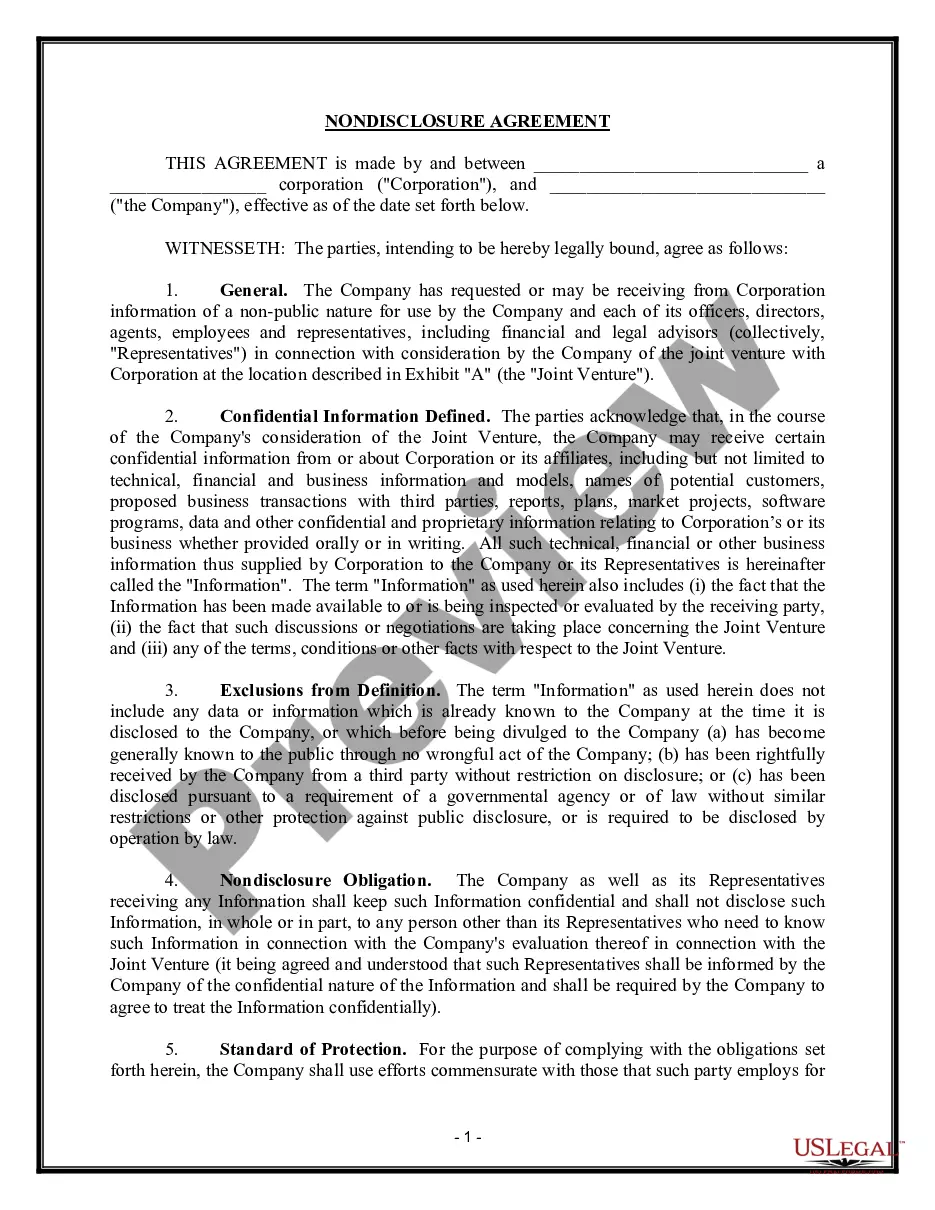
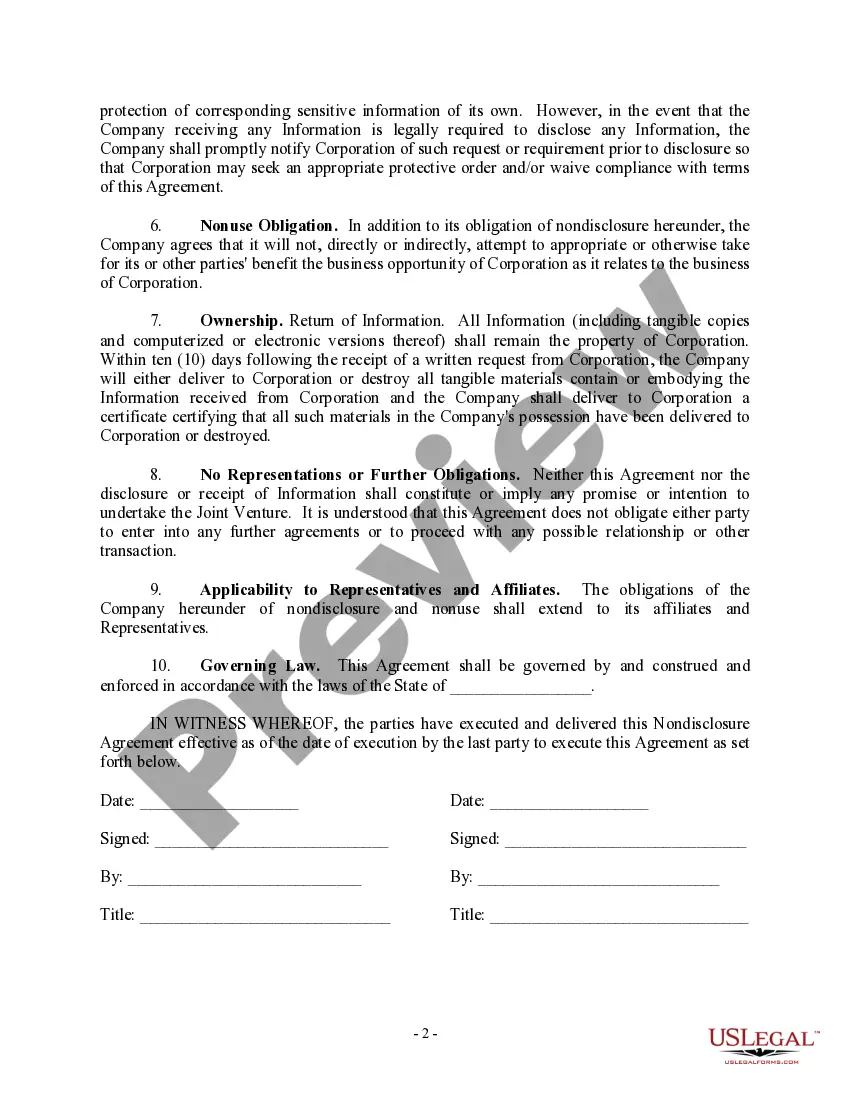
A company has requested or may be receiving from a corporation information of a non-public nature for use by the company in connection with a joint venture with the corporation at the location described in the agreement. The company as well as its representatives receiving any information will keep such information confidential and will not disclose such information, in whole or in part, to any person other than its representatives who need to know such information in connection with the company's evaluation in connection with the joint venture.
Nevada Company Nondisclosure Agreement - Company to Company
State:
Multi-State
Control #:
US-00570
Format:
Word;
Rich Text
359 downloads
Description
Free preview
Get your form ready online
Our built-in tools help you complete, sign, share, and store your documents in one place.
Built-in online Word editor
Make edits, fill in missing information, and update formatting in US Legal Forms—just like you would in MS Word.
Export easily
Download a copy, print it, send it by email, or mail it via USPS—whatever works best for your next step.
E-sign your document
Sign and collect signatures with our SignNow integration. Send to multiple recipients, set reminders, and more. Go Premium to unlock E-Sign.
Notarize online 24/7
If this form requires notarization, complete it online through a secure video call—no need to meet a notary in person or wait for an appointment.
Store your document securely
We protect your documents and personal data by following strict security and privacy standards.

Make edits, fill in missing information, and update formatting in US Legal Forms—just like you would in MS Word.

Download a copy, print it, send it by email, or mail it via USPS—whatever works best for your next step.

Sign and collect signatures with our SignNow integration. Send to multiple recipients, set reminders, and more. Go Premium to unlock E-Sign.

If this form requires notarization, complete it online through a secure video call—no need to meet a notary in person or wait for an appointment.

We protect your documents and personal data by following strict security and privacy standards.
Looking for another form?
How to fill out Company Nondisclosure Agreement - Company To Company?
Are you currently in the situation where you require documents for either business or personal reasons almost all the time? There are numerous legal document templates accessible online, but locating reliable ones is not easy.
US Legal Forms offers thousands of form templates, such as the Nevada Company Nondisclosure Agreement - Company to Company, which is designed to comply with both federal and state regulations.
If you are already familiar with the US Legal Forms website and have your account, simply Log In. After that, you can download the Nevada Company Nondisclosure Agreement - Company to Company template.
Access all the document templates you have purchased in the My documents menu. You can acquire another copy of the Nevada Company Nondisclosure Agreement - Company to Company at any time, if needed. Simply select the desired form to download or print the document template.
Utilize US Legal Forms, the most extensive collection of legal forms, to save time and reduce mistakes. The service provides expertly crafted legal document templates that can be utilized for a variety of purposes. Create your account on US Legal Forms and start making your life a bit easier.
- Obtain the form you need and confirm it is for your correct city/state.
- Use the Review button to check the document.
- Read the description to ensure you have selected the correct form.
- If the form does not meet your expectations, use the Search box to find the document that suits your needs and requirements.
- When you find the right form, click Acquire now.
- Select the pricing plan you prefer, fill in the necessary information to create your account, and pay for your order using your PayPal or credit card.
- Choose a convenient document format and download your copy.
Form popularity
FAQ
Yes, an NDA can certainly be between two companies. Such agreements are commonly used to protect sensitive business information shared during negotiations or collaborations. A well-drafted Nevada Company Nondisclosure Agreement - Company to Company can ensure that both parties adhere to their commitments to confidentiality and secure their proprietary interests.
Yes, an NDA can be mutual, which means both parties are obligated to protect each other's confidential information. This type of agreement is often used in collaborations where both companies share sensitive data. A mutual NDA fosters trust and reciprocity, making it a practical choice for partnerships looking to safeguard proprietary information.
An NDA between two companies is a legal contract that outlines how they will handle and protect sensitive information shared during their collaboration. This agreement establishes the obligations each company has relating to confidentiality. Utilizing a Nevada Company Nondisclosure Agreement - Company to Company helps ensure that both parties are legally bound to uphold these terms.
An NDA can be deemed invalid for several reasons, including a lack of consideration, unclear terms, or if it violates public policy. If the contents are too broad or vague, it may not be enforceable. Furthermore, if the agreement restricts a person’s right to work or conduct business excessively, courts may find it unenforceable.
The three common types of NDAs are unilateral, mutual, and multilateral agreements. A unilateral NDA protects the information of one party, a mutual NDA protects information shared by both parties, and a multilateral NDA involves more than two parties. Understanding these distinctions can help you select the appropriate format for your business needs, such as a Nevada Company Nondisclosure Agreement - Company to Company.
way confidentiality agreement, or CDA, is where only one party is obliged to protect confidential information, while the other party can use it freely. In contrast, a twoway CDA imposes mutual obligations on both parties to maintain confidentiality. Choosing the right type depends on the nature of the business relationship and the information shared, making a Nevada Company Nondisclosure Agreement Company to Company a suitable option for most collaborations.
disclosure agreement between a company and a vendor serves to protect sensitive information shared during their business relationship. This agreement ensures that confidential data remains private and outlines the consequences of any disclosure. It’s crucial for maintaining trust and protecting intellectual property, especially in transactions involving proprietary information.
To create an agreement between two companies, start with a clear outline of the terms and conditions that both parties will follow. Use a standard format or template, such as a Nevada Company Nondisclosure Agreement - Company to Company, which can provide a solid foundation. Next, involve legal counsel to ensure that the agreement complies with applicable laws and addresses the needs of both parties effectively.
When reviewing a Nevada Company Nondisclosure Agreement - Company to Company, watch for vague terms and excessive duration clauses. An unclear definition of what constitutes confidential information can lead to disputes later. Also, be cautious of clauses that seem overly restrictive, as they may hinder your business operations beyond what is reasonable.
An example of a non-disclosure statement in a Nevada Company Nondisclosure Agreement - Company to Company typically includes a clause defining the confidential information. For instance, it may state that any proprietary data shared during discussions is considered confidential. This clarity helps both parties navigate their obligations and safeguards sensitive information effectively.