Nevada Grant, Bargain and Sale Deed for Time Share - Husband and Wife to Four Individuals
What this document covers
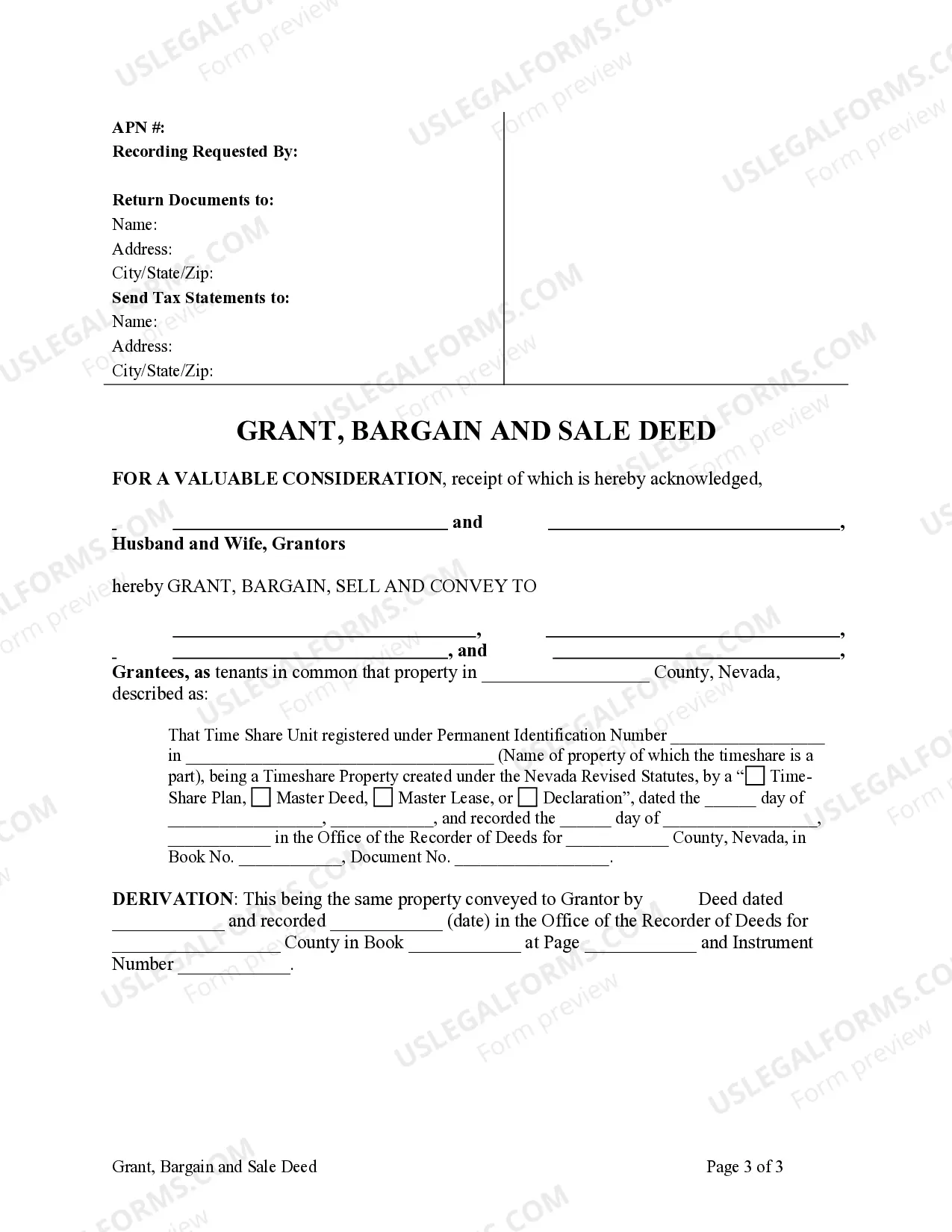
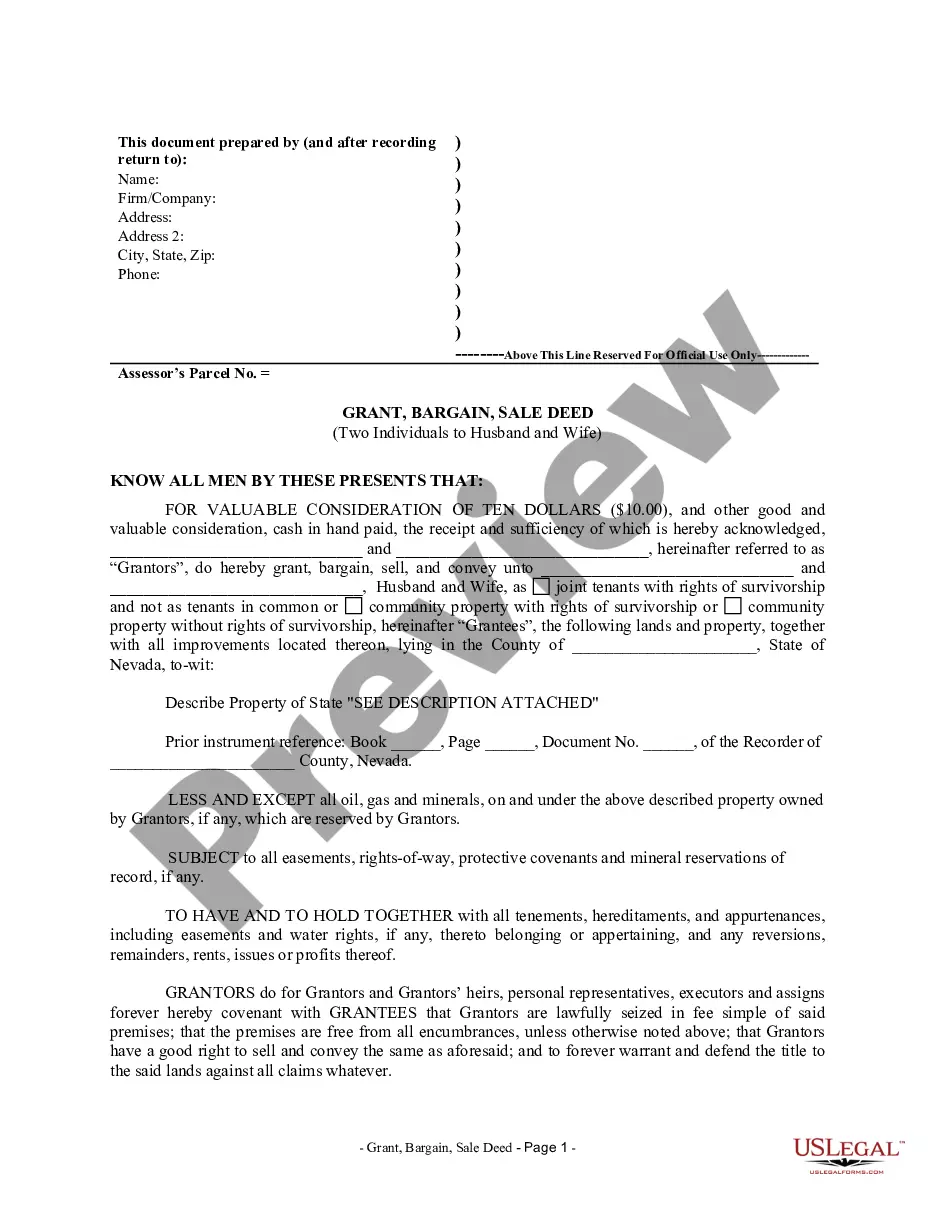
This Grant, Bargain and Sale Deed for Time Share is a legal document used when a husband and wife wish to transfer property ownership to four individuals. Unlike other types of deeds, this document specifically allows the grantees to hold the property either as tenants in common or as joint tenants with the right of survivorship, ensuring that property ownership is managed effectively among multiple parties.
Key components of this form
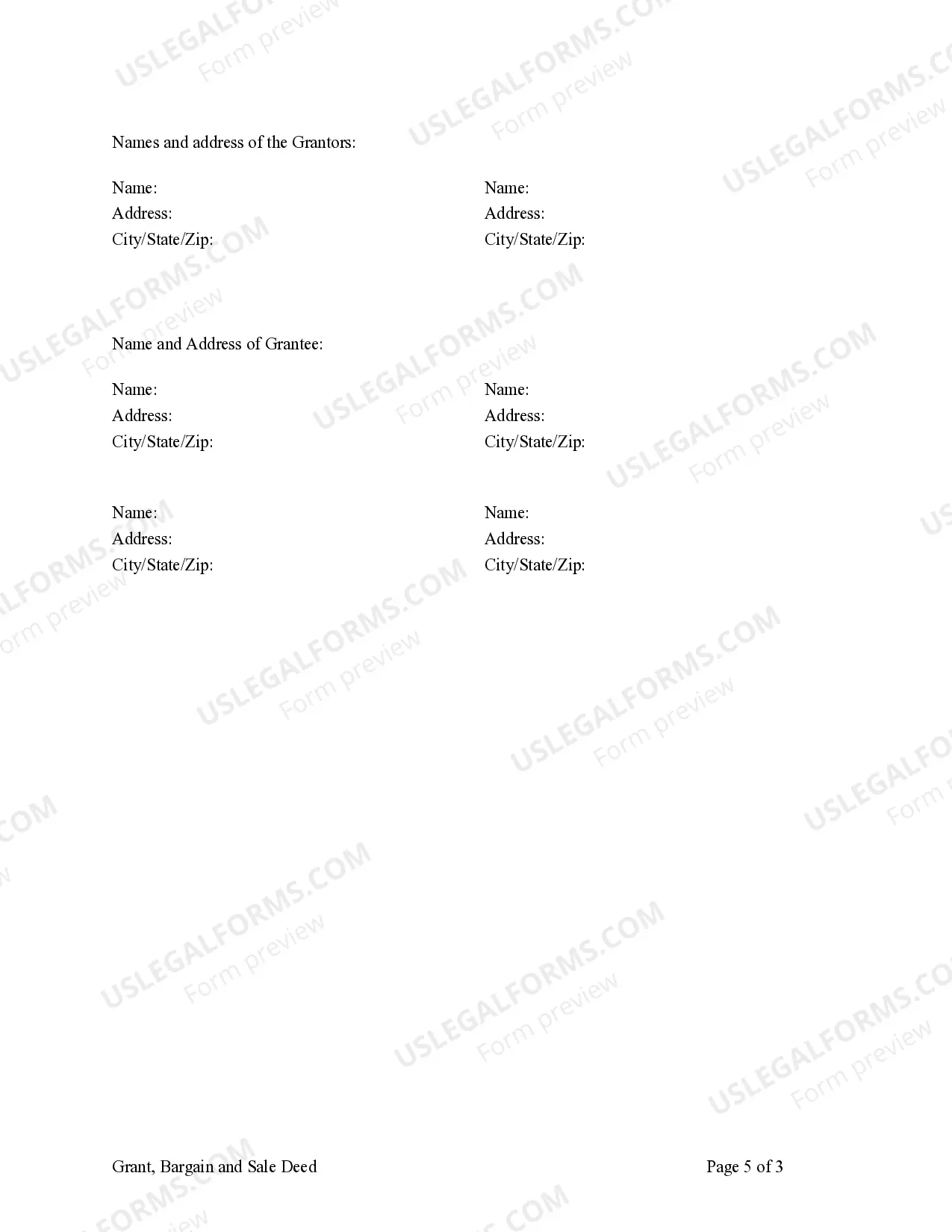
- Identification of the grantors (husband and wife) and grantees (four individuals)
- Clear description of the property being conveyed
- Specification of how the grantees will hold title to the property
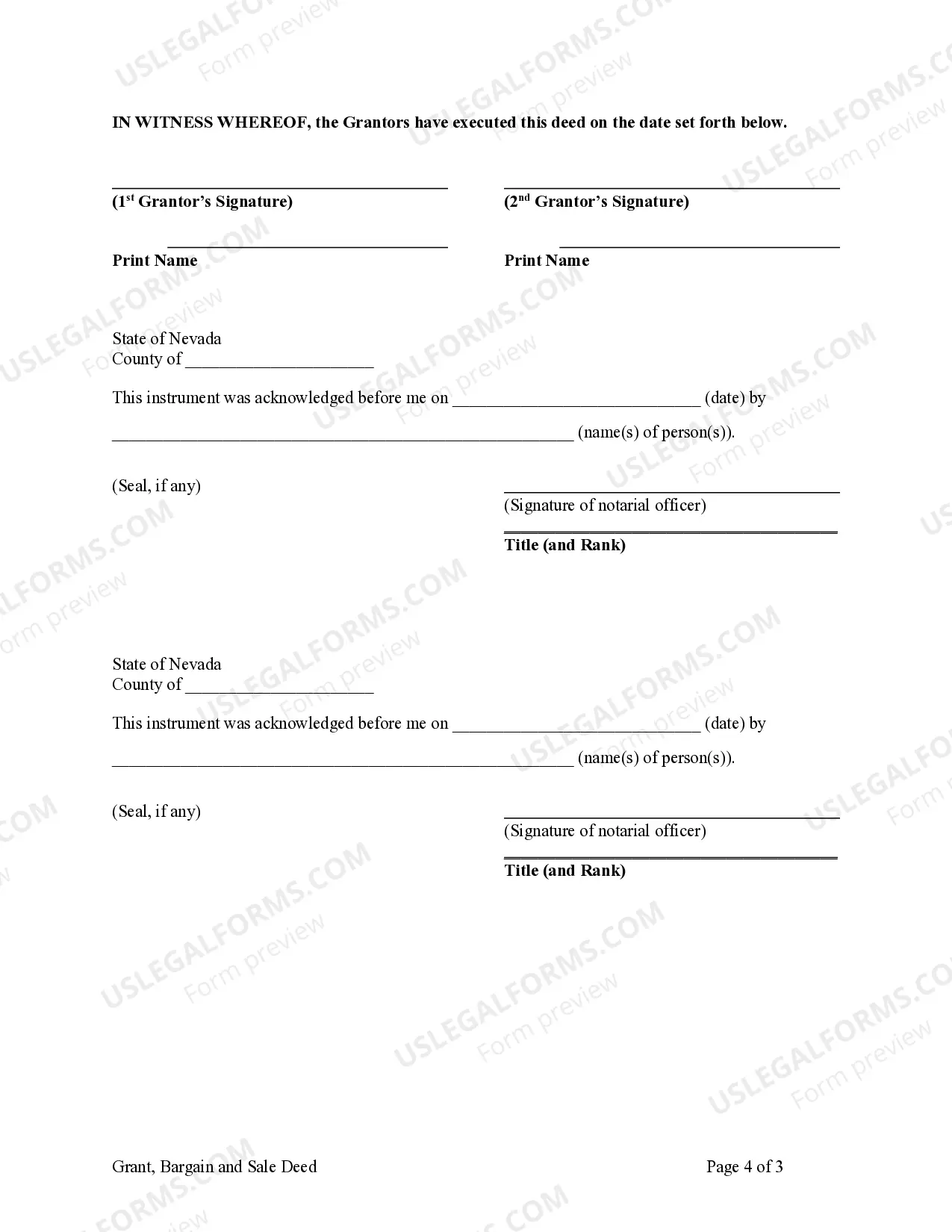
- Signatures of the grantors to validate the agreement
- Witness signatures or notarization, as required by state law


When this form is needed
You should use this Grant, Bargain and Sale Deed when a husband and wife want to legally transfer their ownership interest in a time share property to four individuals. This form is particularly useful in situations where multiple parties will share ownership and benefits from the property, ensuring a clear understanding of the ownership structure.
Intended users of this form
This form is intended for:
- Husbands and wives transferring property ownership
- Individuals acquiring shared ownership in a time share property
- Real estate professionals assisting clients with property transactions
Completing this form step by step
- Identify the parties involved: clearly list the names of the grantors and grantees.
- Specify the property: provide a detailed description of the time share being conveyed.
- Indicate the ownership structure: choose whether grantees will hold the property as tenants in common or joint tenants with rights of survivorship.
- Obtain signatures: ensure that all grantors sign the document to validate the transfer.
- Complete any necessary witnessing or notarization as required by state law.
Notarization guidance
This form does not typically require notarization unless specified by local law. It is essential to consult relevant state statutes to confirm the requirements for your specific situation.
Get your form ready online
Our built-in tools help you complete, sign, share, and store your documents in one place.
Make edits, fill in missing information, and update formatting in US Legal Forms—just like you would in MS Word.
Download a copy, print it, send it by email, or mail it via USPS—whatever works best for your next step.
Sign and collect signatures with our SignNow integration. Send to multiple recipients, set reminders, and more. Go Premium to unlock E-Sign.
If this form requires notarization, complete it online through a secure video call—no need to meet a notary in person or wait for an appointment.
We protect your documents and personal data by following strict security and privacy standards.

Make edits, fill in missing information, and update formatting in US Legal Forms—just like you would in MS Word.

Download a copy, print it, send it by email, or mail it via USPS—whatever works best for your next step.

Sign and collect signatures with our SignNow integration. Send to multiple recipients, set reminders, and more. Go Premium to unlock E-Sign.

If this form requires notarization, complete it online through a secure video call—no need to meet a notary in person or wait for an appointment.

We protect your documents and personal data by following strict security and privacy standards.
Common mistakes to avoid
- Failing to accurately describe the property.
- Not specifying the ownership structure clearly.
- Neglecting to obtain all required signatures.
- Forgetting to check local state requirements for notarization or witnessing.
Why complete this form online
- Convenient access: download the form anytime from anywhere.
- Editability: easily input information and make changes as needed.
- Compliance assurance: forms are developed by licensed attorneys, ensuring they meet legal standards.
Legal use & context
- This deed establishes clear ownership rights among multiple grantees.
- It is an enforceable document as long as it is completed correctly and complies with relevant state laws.
- Utilizing proper legal forms minimizes the risk of future disagreements regarding property ownership.
Looking for another form?
Form popularity
FAQ
In states like California and Florida, the spouses may use a quitclaim deed to transfer the property without warranting title. Other stateslike Texasrecognize a similar type of deed called a deed without warranty.
A grant, bargain, and sale deed is commonly used in Nevada for a conveyance of real property.A certificate of the acknowledgement or proof of execution, signed by the person taking the acknowledgment or proof, and under the seal or stamp of that person, will entitle the deed to be recorded (NRS 111.310).
Two of the most common ways to transfer property in a divorce are through an interspousal transfer deed or quitclaim deed. When spouses own property together, but then one spouse executes an interspousal transfer or a quitclaim deed, this is known as transmutation.
A bargain and sale deed doesn't warrant against any encumbrances. It simply implies that the grantor holds title to the property. The granteethe individual receiving titleeffectively inherits any and all liens that might exist against the property when he takes title.
To file a quitclaim deed in Nevada, you will need to contact the Recorder of Deeds in the county in which the property is located and ask about the county's specific requirements for quitclaim deeds.
The quitclaim deed provides no warranties; it conveys the interest the grantor had in the propertynothing more.The bargain and sale deed indicates that the grantor has title; but property might come with encumbrances and defects.
You may be able to transfer your interest in the property through a quitclaim deed, where you relinquish all ownership of the property to someone else. Your lender may also agree to add another name to the mortgage. In this case, someone else would be able to legally make payments on the mortgage.
Identify the donee or recipient. Discuss terms and conditions with that person. Complete a change of ownership form. Change the title on the deed. Hire a real estate attorney to prepare the deed. Notarize and file the deed.
You can gift property to spouse, child or any relative and register the same. Under section 122 of the Transfer of Property Act, 1882, you can transfer immovable property through a gift deed. The deed should contain your details as well as those of the recipient.