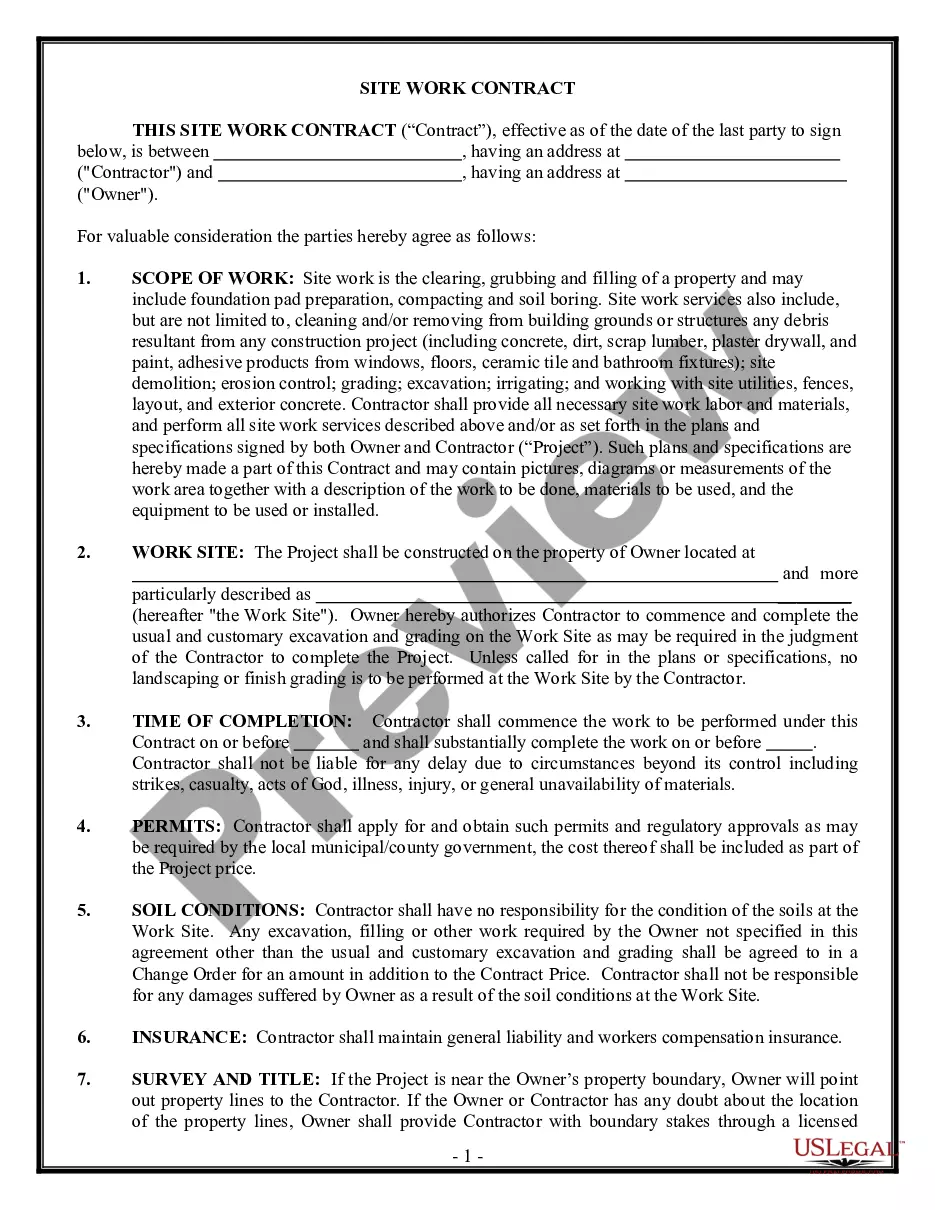
Nevada Motion for Order Allowing Examination of Judgment Debtor with Supporting Affidavit
What this document covers
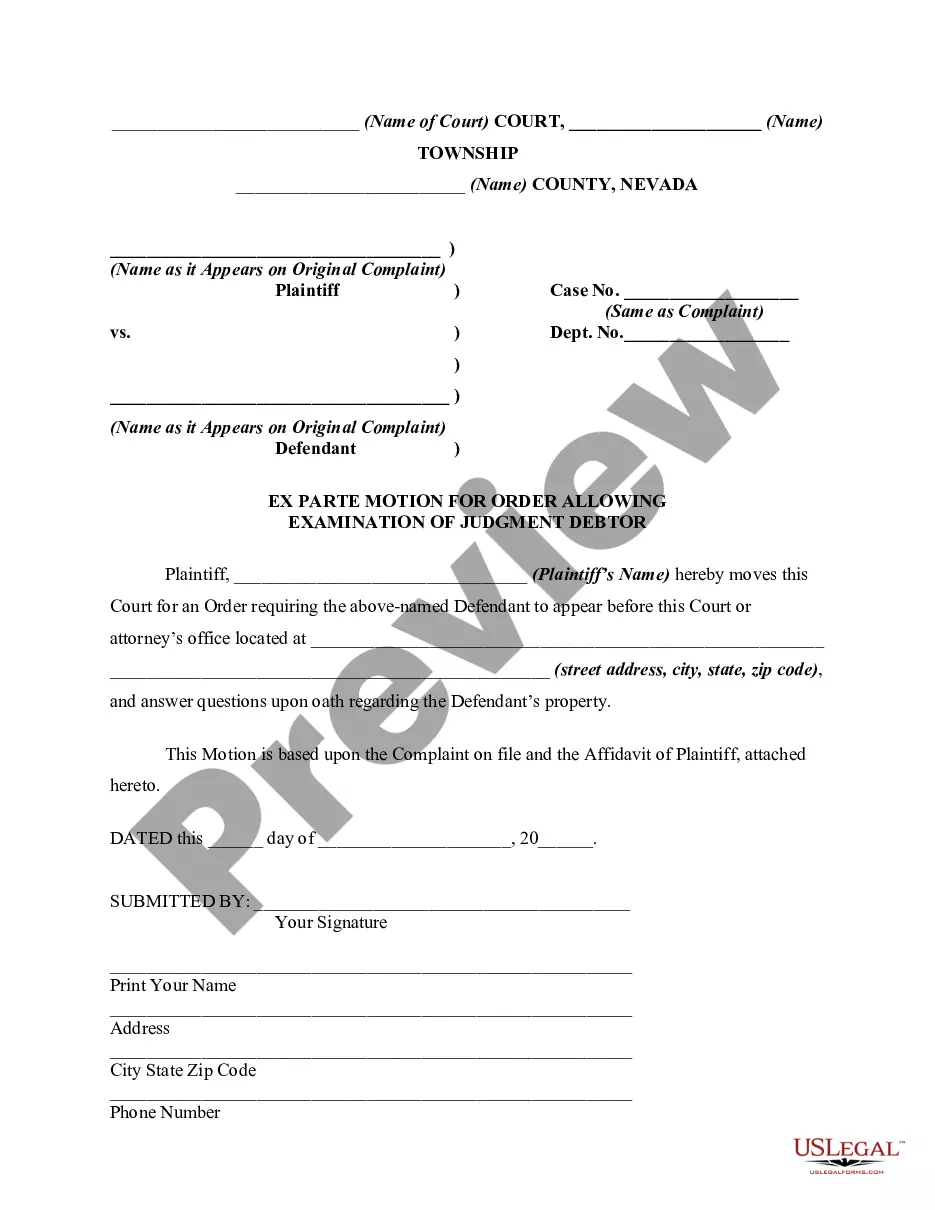
The Motion for Order Allowing Examination of Judgment Debtor is a legal document used to compel a judgment debtor to appear in court or at an attorney's office to answer questions under oath concerning their assets. This form is critical for a judgment creditor who needs to locate the debtor's property to satisfy a monetary judgment. It differs from other legal forms as it specifically targets the process of enforcing a judgment for the payment of money through direct inquiry into the debtor's financial status.
Key parts of this document
- Case information, including the names of the plaintiff and defendant.
- Motion request requiring the defendant to answer questions regarding their property.
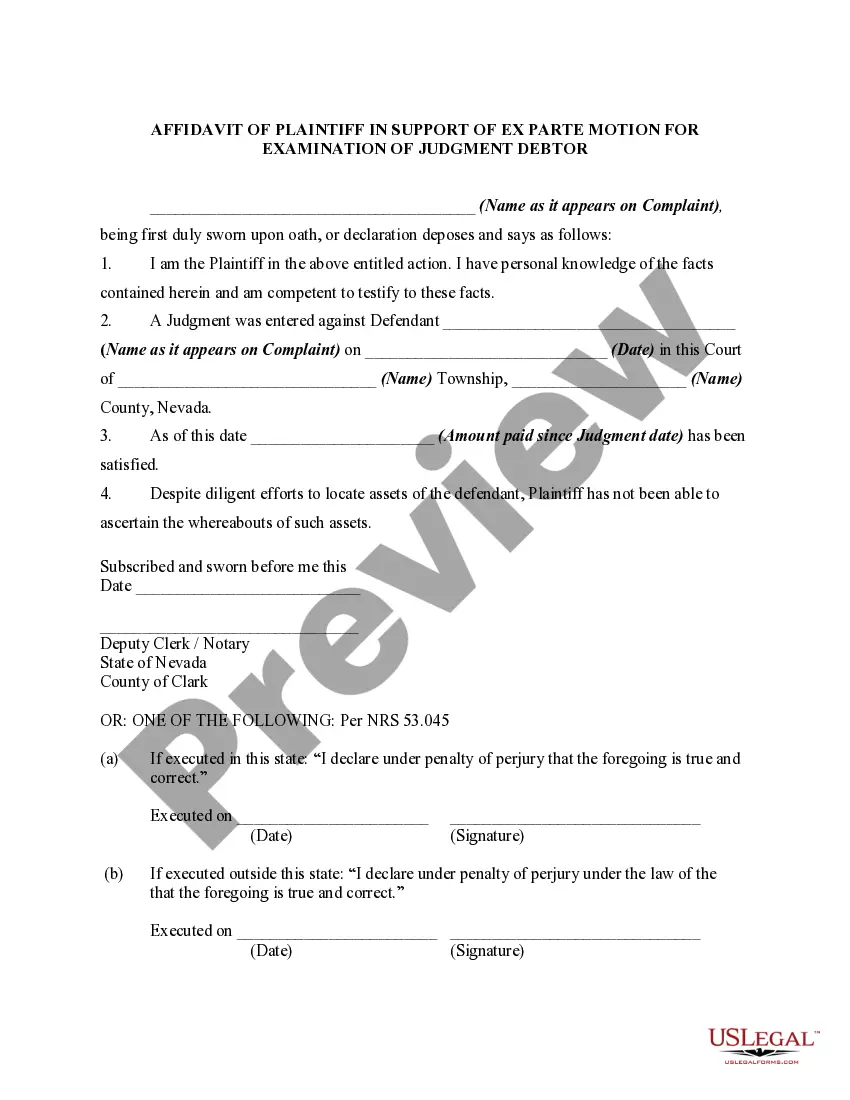
- Attached affidavit from the plaintiff providing details about the judgment and efforts made to locate the debtor's assets.
- Signature section for the plaintiff along with their contact information.
When this form is needed
This form should be used when a judgment has been entered against a defendant, and the plaintiff has made diligent efforts to locate the debtor's assets but is unable to find them. It is essential for the enforcement of the judgment, allowing the creditor to gather necessary information regarding the debtorâs financial situation through legal examination.
Intended users of this form
- Creditors seeking to enforce a monetary judgment against a debtor.
- Individuals or businesses that have won a judgment in court but need to identify the debtor's assets.
- Anyone who has filed a complaint and has the case number documented.
Steps to complete this form
- Identify the parties involved: fill in the names of the plaintiff and defendant as they appear on the original complaint.
- Enter the case number and department number as assigned in court.
- Specify the location where the examination will take place, including the street address, city, state, and zip code.
- Complete the affidavit section, including details of the judgment and any payments made.
- Sign and date the form, providing your printed name and contact information.
Does this document require notarization?
This form must be notarized to be legally valid. When completing the affidavit, you will need to sign it in front of a notary public to affirm the truthfulness of the information provided. US Legal Forms offers integrated online notarization services for your convenience, ensuring security and compliance without the need for in-person visits.
Get your form ready online
Our built-in tools help you complete, sign, share, and store your documents in one place.
Make edits, fill in missing information, and update formatting in US Legal Forms—just like you would in MS Word.
Download a copy, print it, send it by email, or mail it via USPS—whatever works best for your next step.
Sign and collect signatures with our SignNow integration. Send to multiple recipients, set reminders, and more. Go Premium to unlock E-Sign.
If this form requires notarization, complete it online through a secure video call—no need to meet a notary in person or wait for an appointment.
We protect your documents and personal data by following strict security and privacy standards.

Make edits, fill in missing information, and update formatting in US Legal Forms—just like you would in MS Word.

Download a copy, print it, send it by email, or mail it via USPS—whatever works best for your next step.

Sign and collect signatures with our SignNow integration. Send to multiple recipients, set reminders, and more. Go Premium to unlock E-Sign.

If this form requires notarization, complete it online through a secure video call—no need to meet a notary in person or wait for an appointment.

We protect your documents and personal data by following strict security and privacy standards.
Avoid these common issues
- Failing to include case numbers or complete names of parties involved.
- Not providing accurate addresses for the examination location.
- Forgetting to sign and date the motion and affidavit sections.
- Neglecting to attach supporting affidavit documentation.
Benefits of completing this form online
- Immediate access to a legally vetted template drafted by licensed attorneys.
- Convenience of filling out and downloading the form from anywhere.
- Editability allows users to tailor the form to their specific legal situation.
- Reliable format complies with specific state legal requirements, ensuring validity.
Legal use & context
- This form serves as a legal tool for creditors to extract information from debtors regarding their assets.
- It supports the enforcement of a judgment as outlined by Nevada law.
- Utilizing this form correctly can enhance the creditor's ability to recover amounts owed.
Looking for another form?

Form popularity
FAQ
A debtor's examination is a special proceeding used by judgment creditors to look into ways it can collect a judgment from you, such as using a wage garnishment or attaching funds in a bank account. However, many judgment creditors use debtor's exams to pressure you to pay a debt.
To obtain a debtor examination, the creditor must file an Application and Order for Appearance and Examination. The court will then schedule the examination for a specific date and time, and issue an order requiring the debtor's appearance.
The main ways to legally avoid appearing at a debtor examination are to pay off the debt or reach a settlement with the creditor that provides a way for paying back the debt. You also may be able to avoid the examination by filing for bankruptcy, which will trigger an automatic stay of collection efforts.
A judgment may allow creditors to seize personal property, levy bank accounts, put liens on real property, and initiate wage garnishments. Generally, judgments are valid for several years before they expire. The statute of limitations dictates how long a judgment creditor can attempt to collect the debt.
In English and American law, a judgment debtor is a person against whom a judgment ordering him to pay a sum of money has been obtained and remains unsatisfied.
An Order of Examination is a court process to aid enforcement of a monetary judgment. The party being examined will be required to furnish information to aid in the enforcement of a monetary judgment. The Judgment Creditor or their representative may ask questions relating to: Personal financial assets.
Once a creditor has a court judgment against a debtor, the creditor can ask to have an examination of the debtor. This is a hearing to gather information about the debtor's financial situation and have an order made.
You may file the judgment with the Clark County Records Office at 500 Grand Central Parkway, Las Vegas Nevada, 89155. The judgment is valid for six years and you can re-file. When the property is sold or foreclosed upon, you may receive your money.