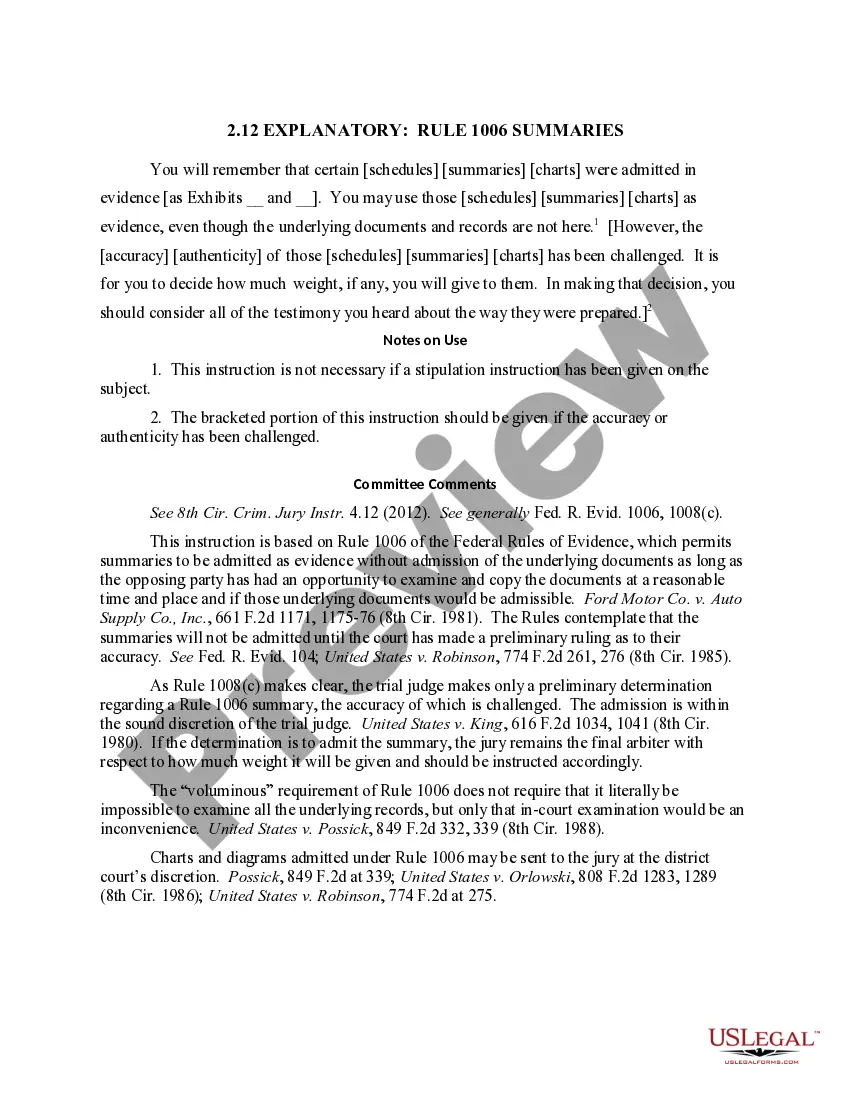
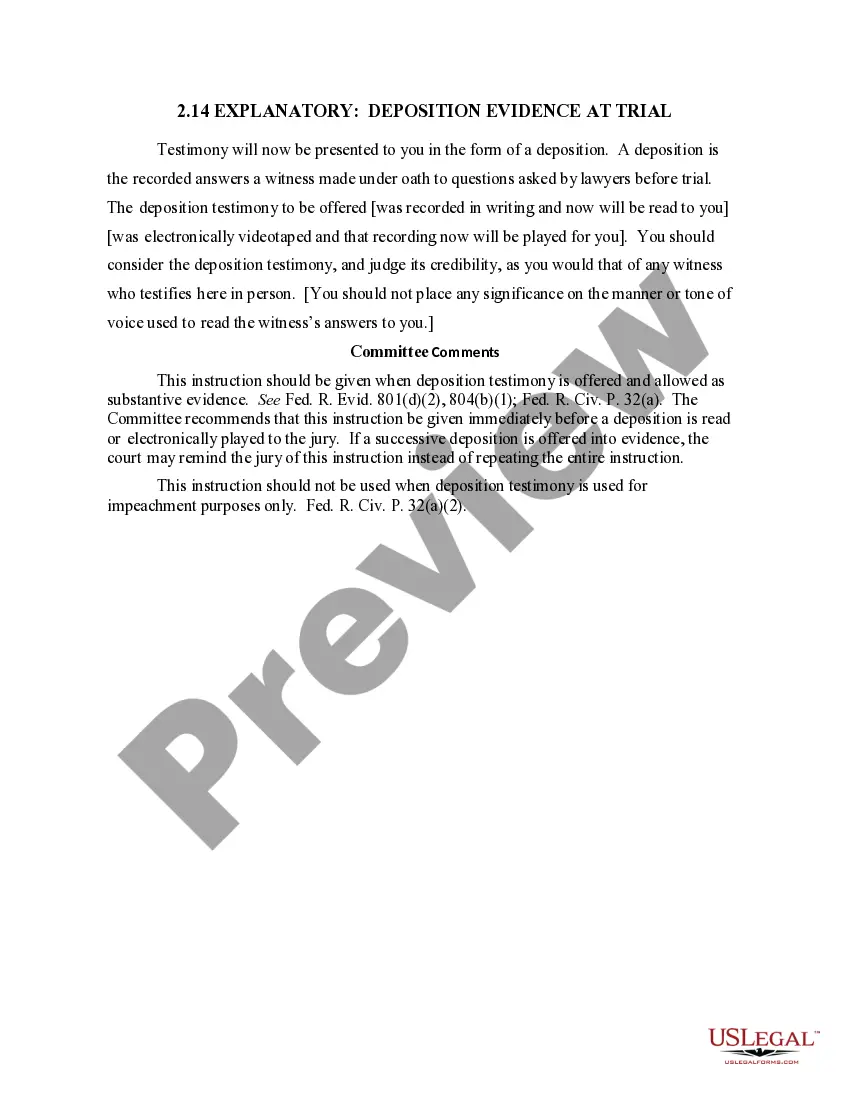
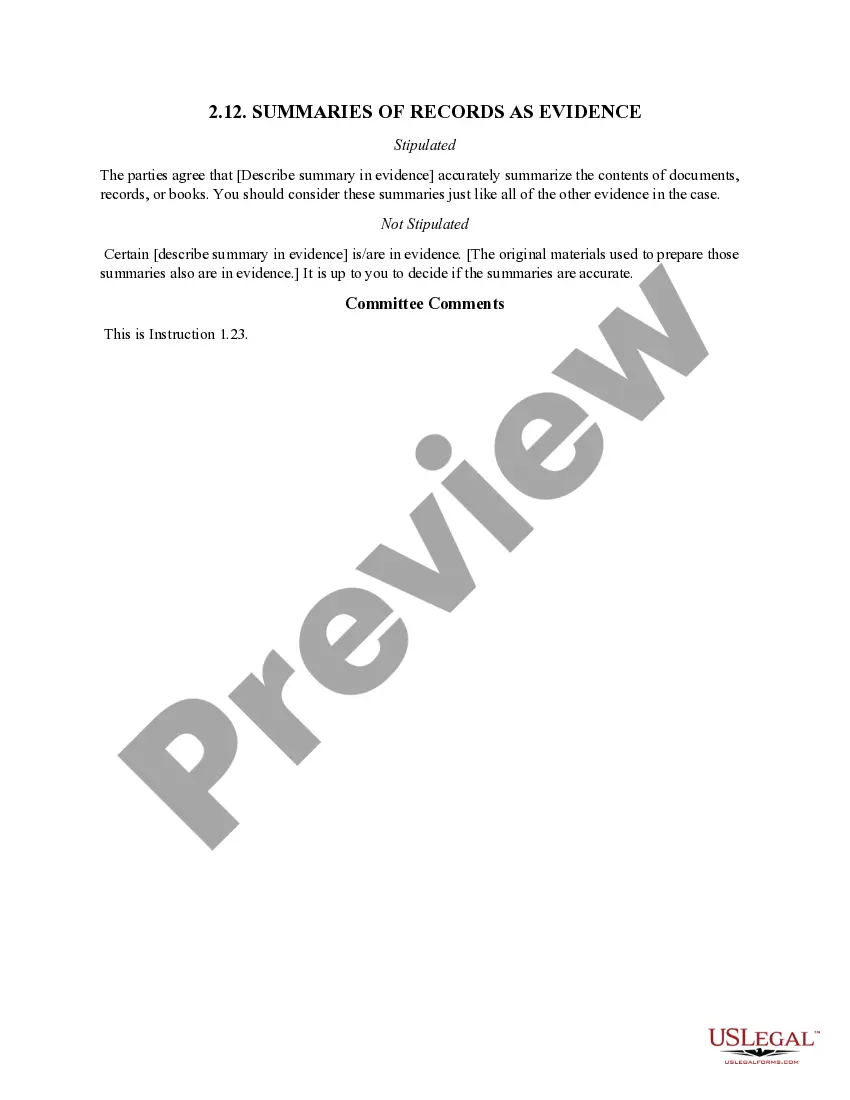
2.12 EXPLANATORY: RULE 1006 SUMMARIES
Understanding this form
The 2.12 Explanatory: Rule 1006 Summaries form provides legal guidance on the use of summaries, schedules, and charts as evidence in court. This instruction clarifies how jurors can consider these summaries even when the underlying documents are not available. It outlines the conditions under which summaries may be admitted and addresses challenges regarding their accuracy and authenticity, distinguishing it from other forms related to evidence admission.
Main sections of this form
- Instructions for jurors on using admitted summaries as evidence.
- Conditions for admitting summaries without the underlying documents.
- Guidance on evaluating the weight of summaries when authenticity is contested.
- Clarification on the judge's role in determining the admissibility of summaries.
- Note regarding necessity of this instruction given a prior stipulation.
When to use this form
This form is utilized when a trial involves evidence summaries that may help clarify complex information for jurors. It is applicable in cases where the underlying documents are too voluminous to examine in court, but a summary is necessary for understanding key facts. Use this instruction when the accuracy or authenticity of the summaries is challenged, as it guides jurors in making informed decisions about the evidence presented.
Intended users of this form
- Judges presiding over trials where Rule 1006 summaries are introduced.
- Attorneys representing either party in a civil jury trial.
- Jurors involved in cases where summary evidence is presented.
How to complete this form
- Identify whether a summary or schedule has been admitted as evidence in the case.
- Determine if there has been any challenge to the accuracy or authenticity of the summaries.
- Provide jurors with clear instructions on how to weigh the evidence presented.
- Refer to any prior stipulations that may affect the application of this instruction.
- Ensure the jury understands the judge's role in the preliminary determination of admissibility.
Does this form need to be notarized?
Notarization is not commonly needed for this form. However, certain documents or local rules may make it necessary. Our notarization service, powered by Notarize, allows you to finalize it securely online anytime, day or night.
Get your form ready online
Our built-in tools help you complete, sign, share, and store your documents in one place.
Make edits, fill in missing information, and update formatting in US Legal Forms—just like you would in MS Word.
Download a copy, print it, send it by email, or mail it via USPS—whatever works best for your next step.
Sign and collect signatures with our SignNow integration. Send to multiple recipients, set reminders, and more. Go Premium to unlock E-Sign.
If this form requires notarization, complete it online through a secure video call—no need to meet a notary in person or wait for an appointment.
We protect your documents and personal data by following strict security and privacy standards.

Make edits, fill in missing information, and update formatting in US Legal Forms—just like you would in MS Word.

Download a copy, print it, send it by email, or mail it via USPS—whatever works best for your next step.

Sign and collect signatures with our SignNow integration. Send to multiple recipients, set reminders, and more. Go Premium to unlock E-Sign.

If this form requires notarization, complete it online through a secure video call—no need to meet a notary in person or wait for an appointment.

We protect your documents and personal data by following strict security and privacy standards.
Common mistakes
- Failing to provide jurors with clear guidelines on how to evaluate challenged summaries.
- Neglecting to consider prior stipulations that may impact the use of the instruction.
- Assuming that all summaries are interchangeable without assessing their individual admissibility.
Legal use & context
- This instruction is based on Rule 1006 of the Federal Rules of Evidence, which allows summaries to serve as evidence without the underlying documents.
- Jurors retain the discretion to determine the credibility and weight of the summaries they receive.
- Trial judges have the authority to admit summaries based on their sound judgment regarding admissibility.
What to keep in mind
- Rule 1006 summaries can be critical in simplifying complex evidence for jurors.
- Jurors must be instructed on how to evaluate these summaries, especially when authenticity is contested.
- Judges play a key role in overseeing the admissibility of summary evidence in trials.
Looking for another form?
Form popularity
FAQ
To expedite trials in civil cases, upon timely motion, the court may permit the reading to the jury, or the introduction into evidence, of relevant portions of lengthy and complex documents without the necessity of having the jury hear or receive the entire document.
If scientific, technical, or other specialized knowledge will assist the trier of fact to understand the evidence or to determine a fact in issue, a witness qualified as an expert by knowledge, skill, experience, training, or education, may testify thereto in the form of an opinion or otherwise. ( Pub. L.
The contents of voluminous writings, recordings, or photographs which cannot conveniently be examined in court may be presented in the form of a chart, summary, or calculation. The originals, or duplicates, shall be made available for examination or copying, or both, by other parties at reasonable time and place.
As the Federal Rules of Evidence puts it, evidence is relevant if: ?it has any tendency to make a fact more or less probable than it would be without the evidence; and. the fact is of consequence in determining the action" (FRE 4.01).
Rule 06. examined in court may be represented in the form of a chart, summary, or calculation. Reasonably in advance of the offer of such chart, summary, or calculation, the originals or duplicates must be made available for examination or copying, or both, by other parties at a reasonable time and place.
All relevant evidence is admissible, except as otherwise provided by the Constitution of the United States, the Constitution of Virginia, statute, Rules of the Supreme Court of Virginia, or other evidentiary principles. Evidence that is not relevant is not admissible.
The requirement of authentication or identification as a condition precedent to admissibility is satisfied by evidence sufficient to support a finding that the thing in question is what its proponent claims.
In examining a witness in any civil or criminal case concerning a prior oral statement, the circumstances of the supposed statement, sufficient to designate the particular occasion, must be mentioned to the witness, and the witness must be asked whether the statement was made.