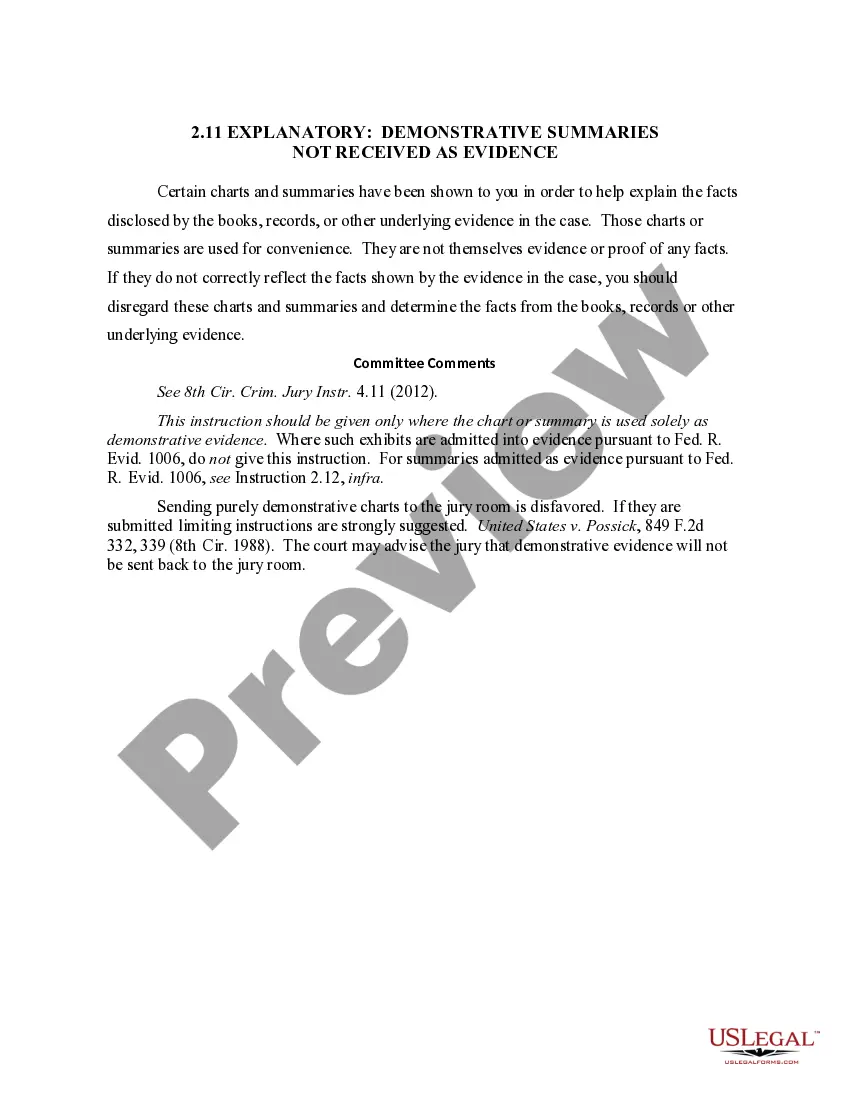
2.11 EXPLANATORY: DEMONSTRATIVE SUMMARIES NOT RECEIVED AS EVIDENCE
About this form
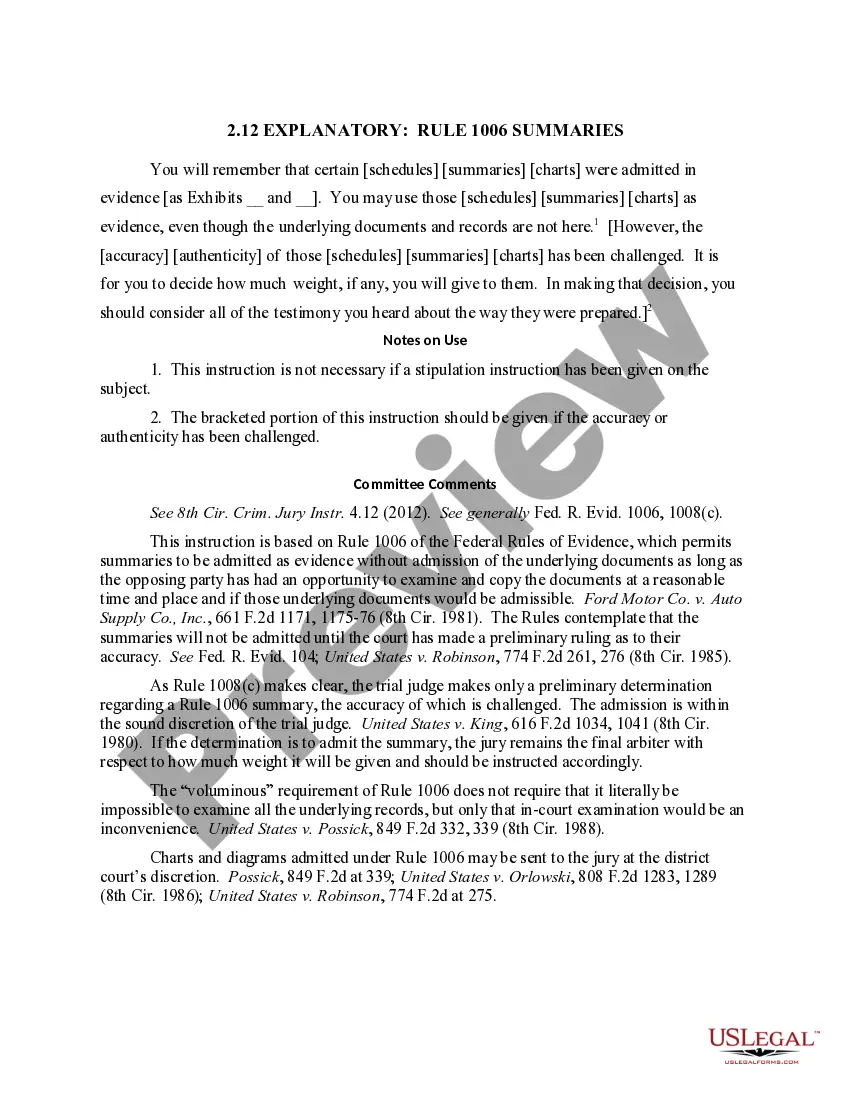
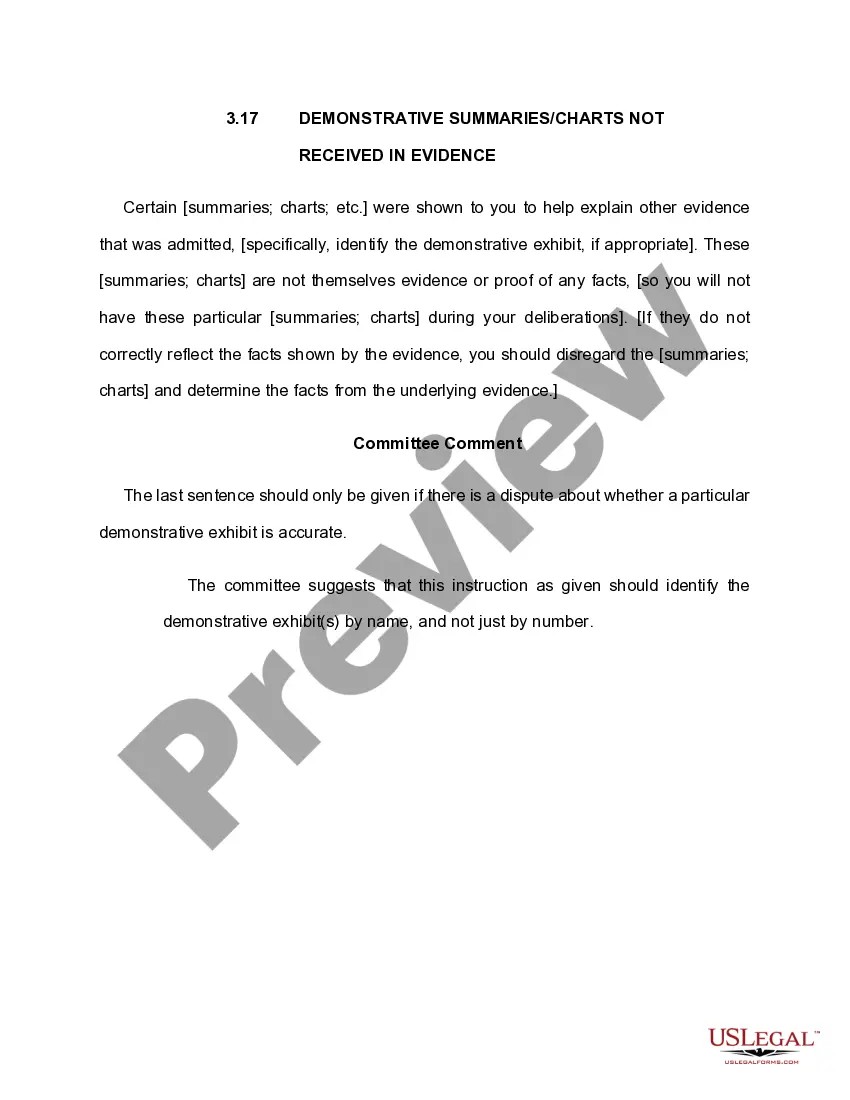
The 2.11 Explanatory: Demonstrative Summaries Not Received as Evidence form is a legal instruction used in court to clarify the nature of demonstrative evidence presented to a jury. This form emphasizes that charts and summaries provided during a trial are for explanatory purposes only and do not constitute evidence. It distinguishes these demonstrative materials from actual evidence, guiding jurors on how to interpret and rely on the underlying evidence presented in the case.
Key components of this form
- Clarification that demonstrative summaries serve only as aids and not as evidence.
- Instructions to disregard charts if they do not accurately reflect the underlying facts.
- Committee comments for additional legal context.
- Guidance on the appropriate circumstances for using this form.
- References to specific legal standards regarding the admission of demonstrative evidence.
When this form is needed
This form is used in trial proceedings when illustrative materials, such as charts or summaries, are presented to help jurors understand complex evidence. It is applicable in cases where such materials do not qualify as formal evidence under the rules of evidence. Judges may use this form to ensure jurors understand the limitations of these visual aids and to instruct them on proper evaluation of the underlying evidence.
Who this form is for
- Judges overseeing trial proceedings where demonstrative summaries are presented.
- Attorneys preparing exhibits intended for jury comprehension.
- Legal practitioners seeking to clarify the nature of evidence during trials.
How to prepare this document
- Identify the charts or summaries that will be presented to the jury.
- Clarify that these materials are for explanation purposes, not evidence.
- Ensure jurors understand they must refer to actual evidence for fact determination.
- Provide the necessary information about the underlying records or evidence.
- Deliver the instruction appropriately during trial proceedings.
Notarization guidance
This form does not typically require notarization to be legally valid. However, some jurisdictions or document types may still require it. US Legal Forms provides secure online notarization powered by Notarize, available 24/7 for added convenience.
Get your form ready online
Our built-in tools help you complete, sign, share, and store your documents in one place.
Make edits, fill in missing information, and update formatting in US Legal Forms—just like you would in MS Word.
Download a copy, print it, send it by email, or mail it via USPS—whatever works best for your next step.
Sign and collect signatures with our SignNow integration. Send to multiple recipients, set reminders, and more. Go Premium to unlock E-Sign.
If this form requires notarization, complete it online through a secure video call—no need to meet a notary in person or wait for an appointment.
We protect your documents and personal data by following strict security and privacy standards.

Make edits, fill in missing information, and update formatting in US Legal Forms—just like you would in MS Word.

Download a copy, print it, send it by email, or mail it via USPS—whatever works best for your next step.

Sign and collect signatures with our SignNow integration. Send to multiple recipients, set reminders, and more. Go Premium to unlock E-Sign.

If this form requires notarization, complete it online through a secure video call—no need to meet a notary in person or wait for an appointment.

We protect your documents and personal data by following strict security and privacy standards.
Common mistakes
- Failing to properly instruct jurors on the distinction between demonstrative and actual evidence.
- Presenting charts that do not accurately reflect the evidence, leading to confusion.
- Neglecting to provide context for the demonstrative materials.
Why use this form online
- Convenient access to a reliable legal form created by licensed attorneys.
- Easy to download and customize based on specific trial requirements.
- Guidance provided ensures correct usage, helping avoid legal pitfalls.
Legal use & context
- This form serves as a guide for judges and attorneys to correctly manage demonstrative evidence in trials.
- It is essential for maintaining the integrity of the jury's decision-making process.
- Used appropriately, it can enhance clarity and reduce misunderstandings about presented materials.
Looking for another form?

Form popularity
FAQ
?Demonstrative evidence? refers to a visual, graphic, or sound aid used to explain or illustrate a witness's testimony or the presentation of the proponent's case.
The Basic Law of Demonstrative Evidence Whether to allow the use of a demonstrative exhibit is a matter strictly within the trial court's discretion. Because its purpose is to illustrate testimony, demonstrative evidence is authenticated by the witness whose testimony is being illustrated.
A demonstration or reconstruction is real evidence.
Demonstrative evidence is used to illustrate or clarify witness testimony. Examples of this type of evidence include photographs, videotapes, models, maps, graphs, computer graphics and animations.
There are two types of evidence; namely, direct evidence and circumstantial evidence.
Demonstrative evidence can be objects, pictures, models, displays, or other devices used in a trial or hearing to support facts that the party is trying to prove.
There are two main types of evidence presented in a trial: demonstrative and substantive (impeachment is a third, but that is discussed elsewhere). Demonstrative evidence usually explains other evidence or testimony. It is not directly relevant, rather it relies on other evidence that is material.