Nevada Renunciation And Disclaimer Property - Intestate Succession
Understanding this form
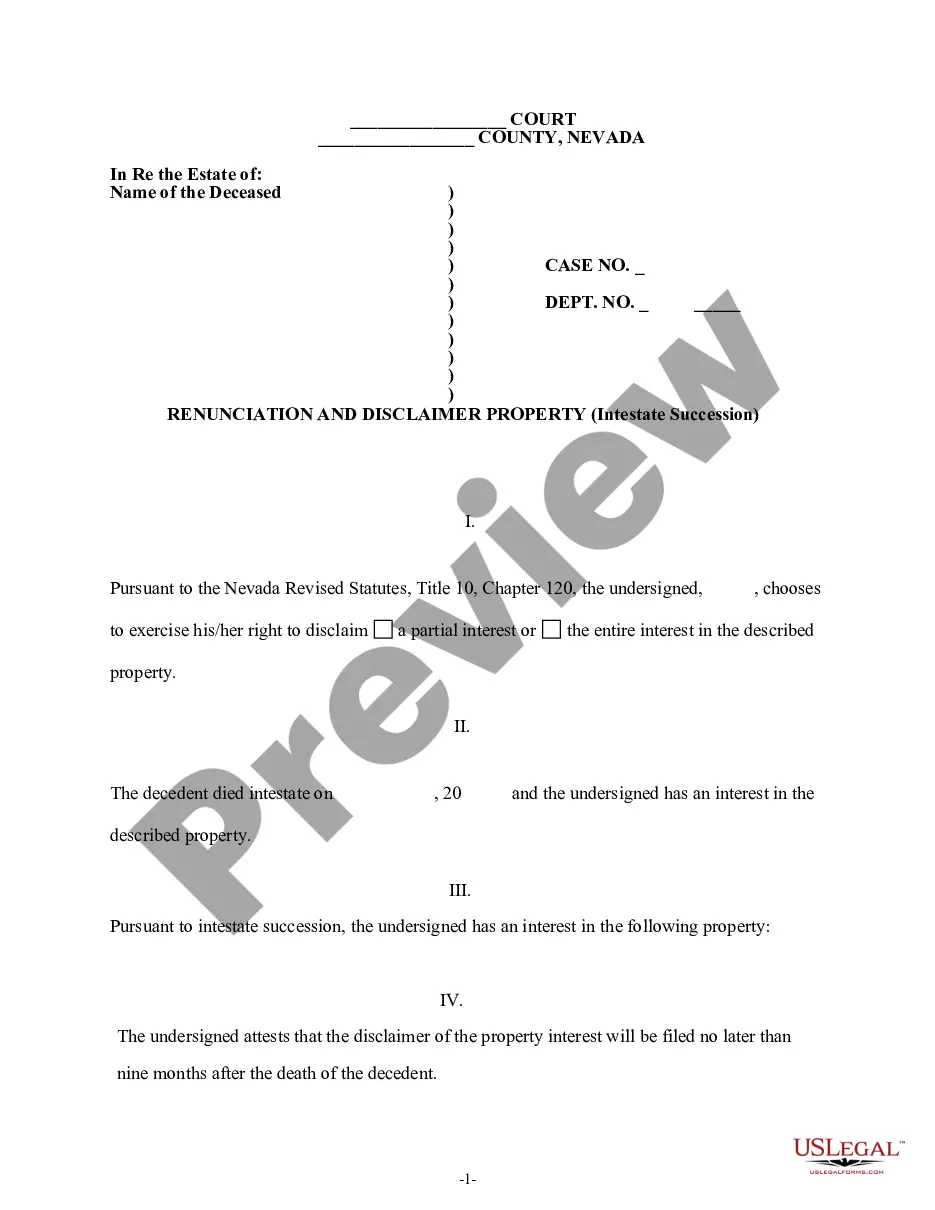
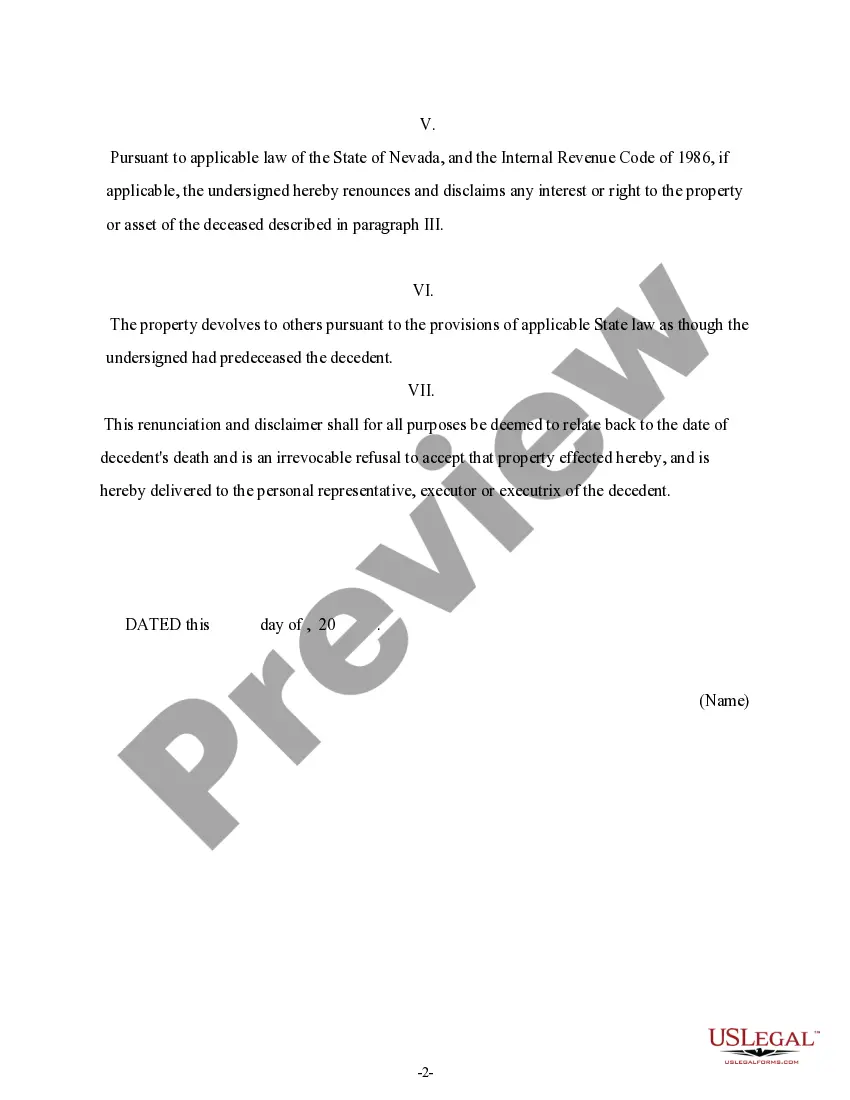
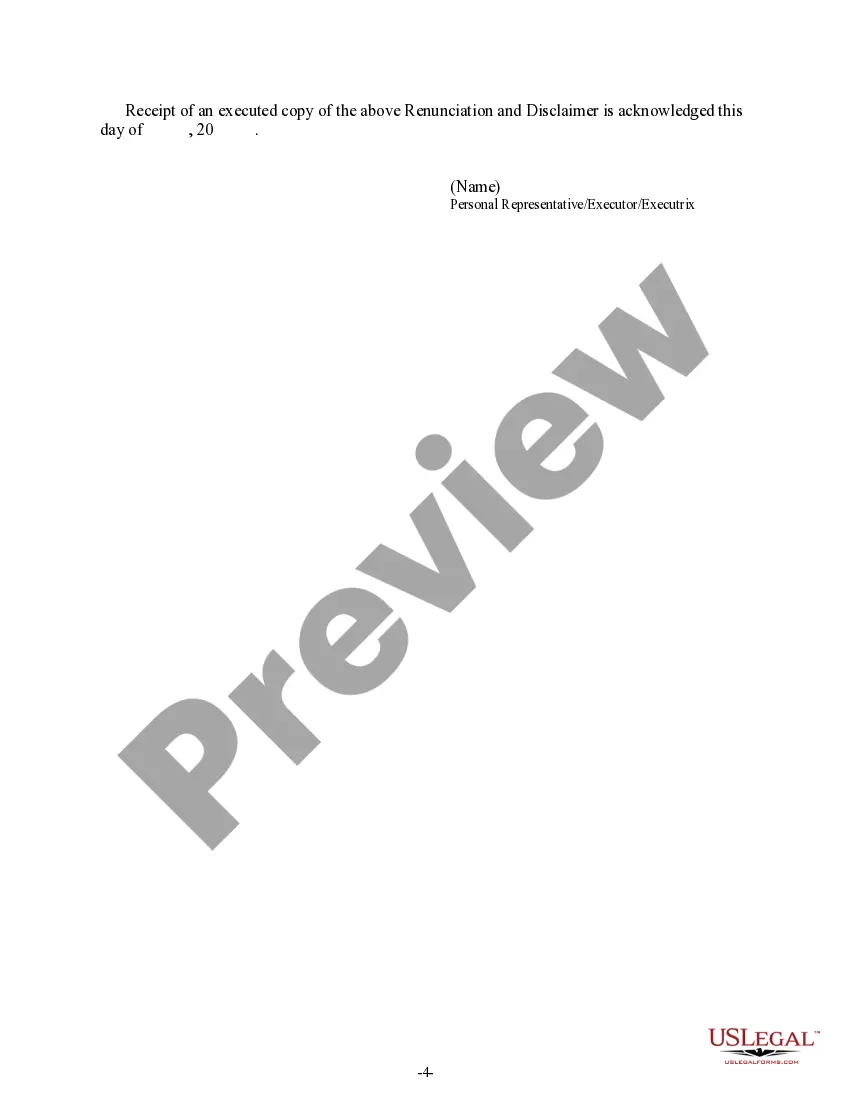
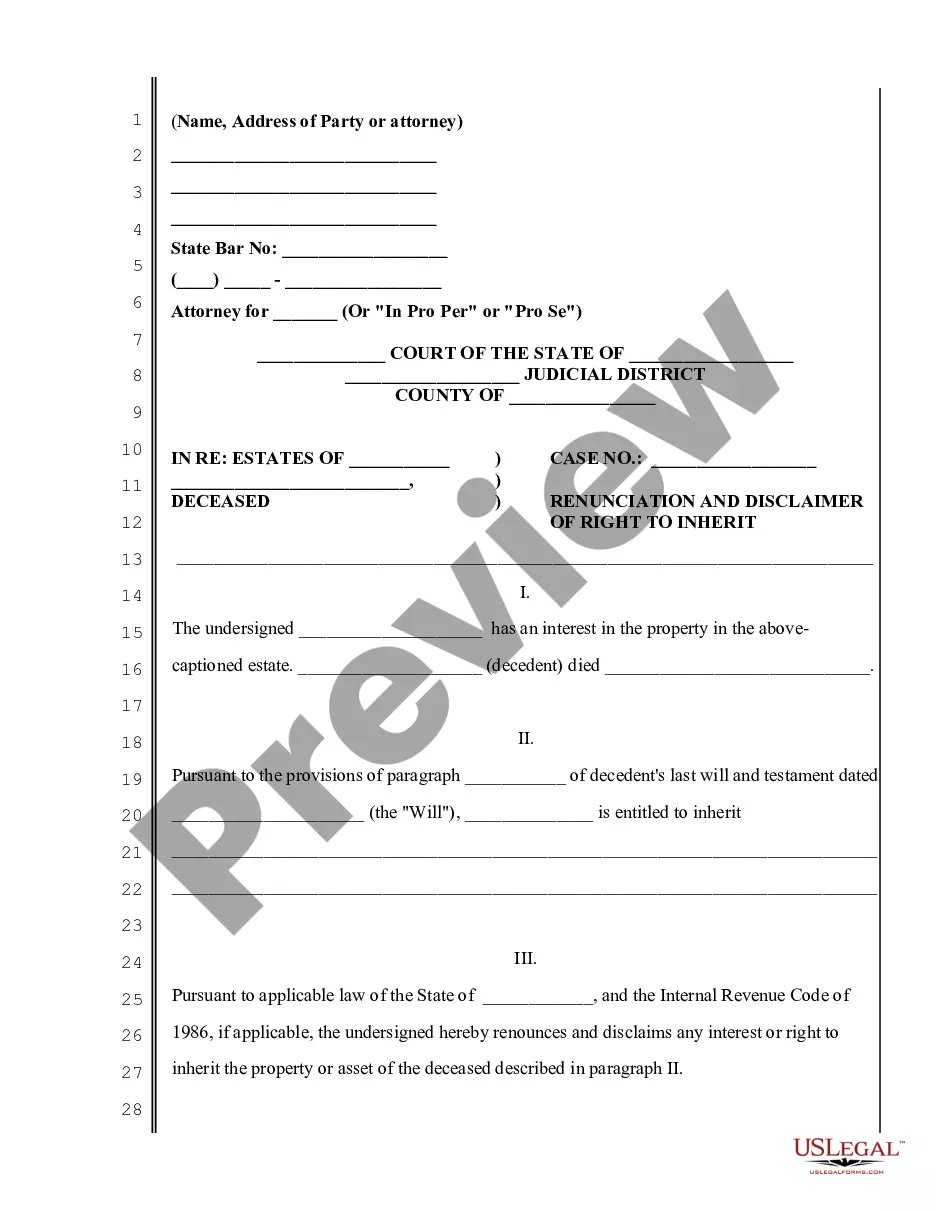
The Renunciation and Disclaimer of Property - Intestate Succession form allows a beneficiary to legally renounce their interest in property acquired through intestate succession, meaning the decedent died without a will. By using this form, the beneficiary effectively decides to forgo their rights to the property, resulting in the property passing to other heirs as if the beneficiary predeceased the decedent. This form is specific to Nevada law and includes necessary state-specific acknowledgments and a certificate for document delivery verification.
Form components explained
- Identification of the beneficiary renouncing their interest.
- Description of the property being disclaimed.
- Statement of renunciation in accordance with Nevada law.
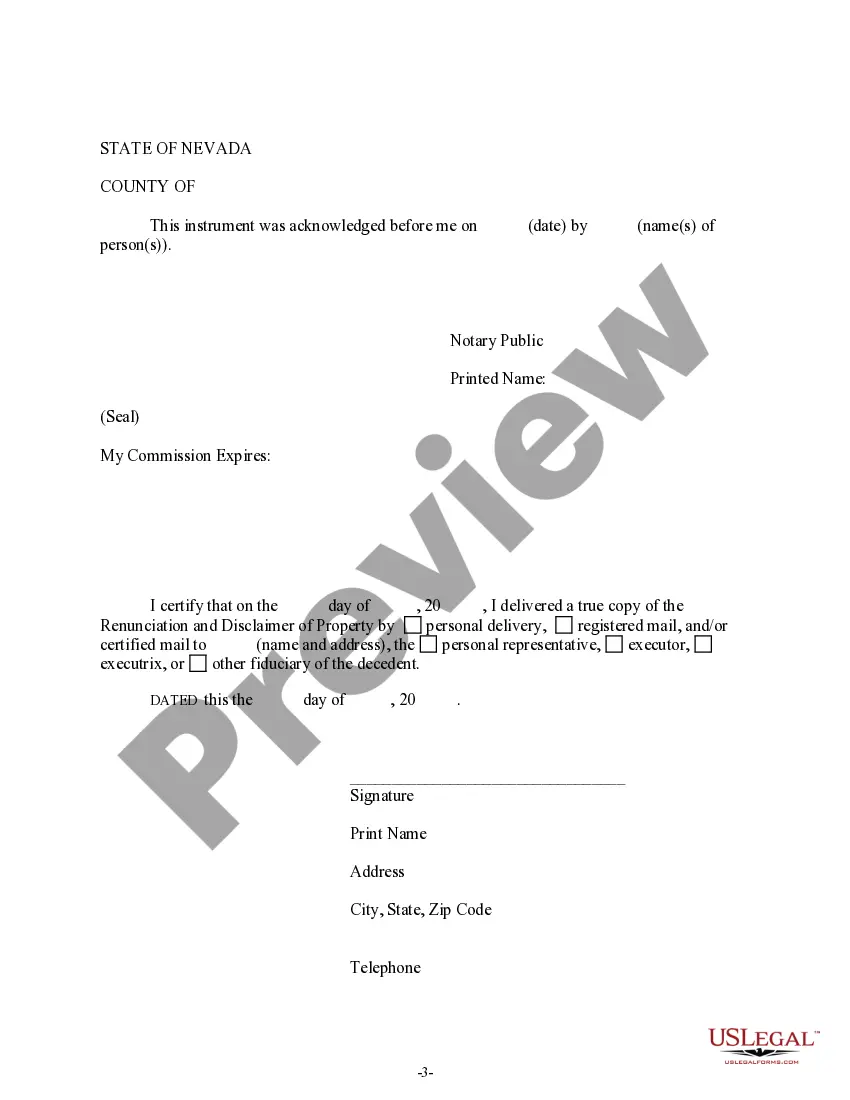
- Legal acknowledgment section for state requirements.
- Certificate for confirming the delivery of the document.

When this form is needed
This form is used when an individual inherits property from a decedent who did not leave a will, and the inheritor decides to refuse their claim to that property. Situations may include family disputes over estate distribution, personal financial considerations, or strategic reasons where accepting the inheritance may result in tax liabilities or unwanted obligations.
Intended users of this form
- Beneficiaries of an estate when they want to disclaim property interests.
- Individuals navigating intestate succession under Nevada law.
- Heirs looking to avoid complications or liabilities associated with inherited property.
Completing this form step by step
- Identify the beneficiary who is renouncing their interest.
- Clearly specify the property or properties being disclaimed.
- Include an explicit statement of renunciation according to state law.
- Complete the acknowledgment section as required by Nevada law.
- Sign and date the document, ensuring proper delivery confirmation.
Notarization guidance
To make this form legally binding, it must be notarized. Our online notarization service, powered by Notarize, lets you verify and sign documents remotely through an encrypted video session.
Get your form ready online
Our built-in tools help you complete, sign, share, and store your documents in one place.
Make edits, fill in missing information, and update formatting in US Legal Forms—just like you would in MS Word.
Download a copy, print it, send it by email, or mail it via USPS—whatever works best for your next step.
Sign and collect signatures with our SignNow integration. Send to multiple recipients, set reminders, and more. Go Premium to unlock E-Sign.
If this form requires notarization, complete it online through a secure video call—no need to meet a notary in person or wait for an appointment.
We protect your documents and personal data by following strict security and privacy standards.

Make edits, fill in missing information, and update formatting in US Legal Forms—just like you would in MS Word.

Download a copy, print it, send it by email, or mail it via USPS—whatever works best for your next step.

Sign and collect signatures with our SignNow integration. Send to multiple recipients, set reminders, and more. Go Premium to unlock E-Sign.

If this form requires notarization, complete it online through a secure video call—no need to meet a notary in person or wait for an appointment.

We protect your documents and personal data by following strict security and privacy standards.
Avoid these common issues
- Failing to correctly identify all properties being renounced.
- Not including necessary acknowledgments required by state law.
- Overlooking the need for proper signatures and witnesses.
Benefits of using this form online
- Convenient access to a professionally drafted legal document.
- Immediate download and flexibility to complete at your own pace.
- Peace of mind knowing the form adheres to state requirements.
Main things to remember
- The Renunciation and Disclaimer of Property - Intestate Succession allows a beneficiary to refuse an inheritance.
- Proper completion and delivery of this form can facilitate smoother estate management.
- This form must comply with Nevada laws regarding property disclaimers.
Looking for another form?
Form popularity
FAQ
Children - if there is no surviving married or civil partnerIf there is no surviving partner, the children of a person who has died without leaving a will inherit the whole estate. This applies however much the estate is worth. If there are two or more children, the estate will be divided equally between them.
Who Inherits When There's No Will? Intestate succession laws determine how to distribute assets among them when no will is in place. This varies between states. Generally, a spouse receives most of the assets and property, followed by children, parents, grandparents, and other blood relatives of the deceased.
How Is Next of Kin Determined? To determine next of kin in California, go down the list until someone exists in the category listed.For example, if decedent had no surviving spouse or registered domestic partner, but was survived by adult children, then the adult children would be next of kin.
In Nevada, you can make a living trust to avoid probate for virtually any asset you ownreal estate, bank accounts, vehicles, and so on. You need to create a trust document (it's similar to a will), naming someone to take over as trustee after your death (called a successor trustee).
Children - if there is no surviving married or civil partner If there is no surviving partner, the children of a person who has died without leaving a will inherit the whole estate. This applies however much the estate is worth. If there are two or more children, the estate will be divided equally between them.
If you die without a will, you are considered to have died "intestate." Typically, your spouse and children will serve as your next of kin. If you have no spouse or children, then your parents and siblings often qualify as next of kin, though this will differ depending on the state.
If you pass away without a last will, you are said to have died intestate. Under these circumstances, the probate court is required to distribute your assets under the intestate succession laws. In Nevada, your spouse would get everything if you have no children.
In Nevada, if the total amount of the deceased person's assets exceeds $20,000, or if real estate is involved, probate (or administration) will be required and there is normally no reason to delay starting the process.The petitioner will receive a court order directing the distribution of the estate property.
Inheritance. Inheritance automatically goes to your legal next of kin -- your spouse -- if you die, but your will can change this. You might opt to leave some things to your spouse and others to your children or parents.