New Mexico Deed of Release and Full Reconveyance - Corporate Trustee
About this form
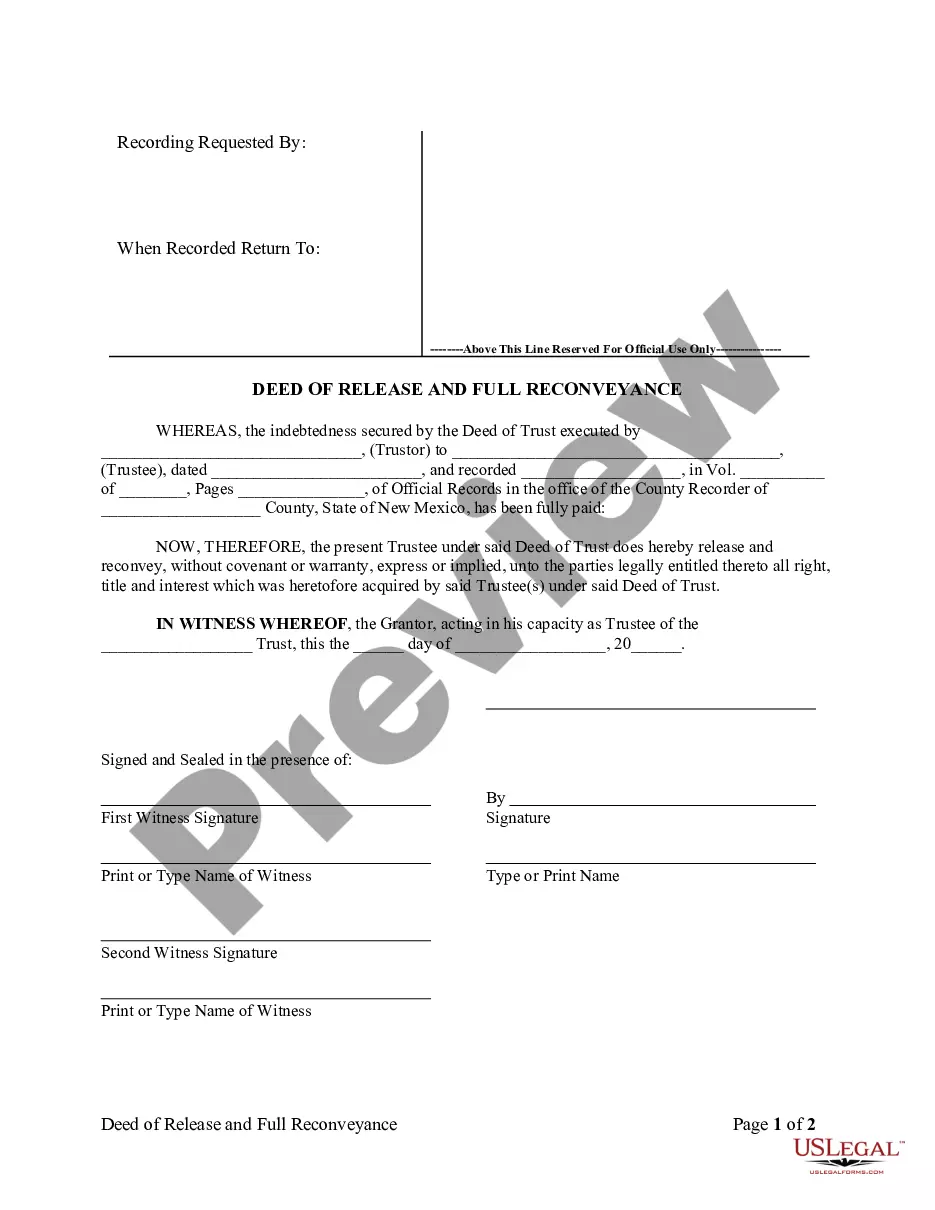
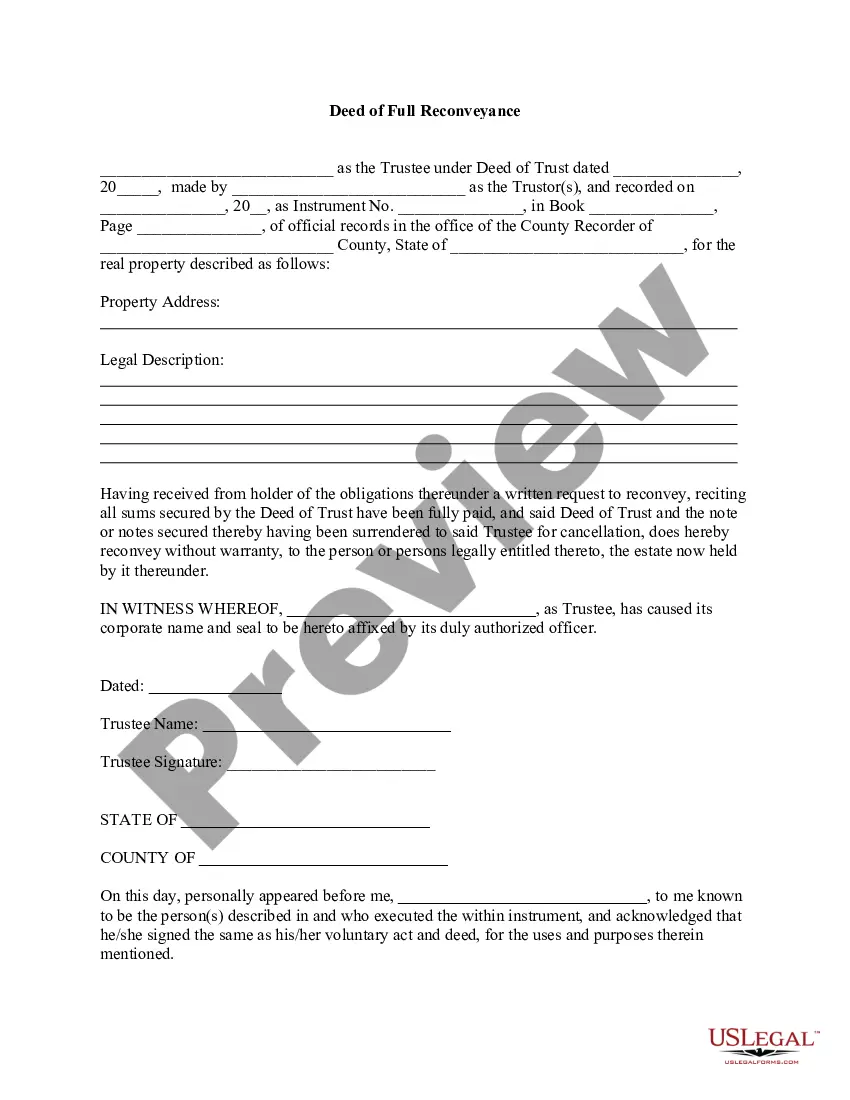
The Deed of Release and Full Reconveyance - Corporate Trustee is a legal document that officially releases a mortgage secured by a Deed of Trust. This form is specifically designed for corporate trustees in the state of New Mexico, ensuring that the property is free from the obligations of the mortgage once the indebtedness has been fully satisfied. Unlike other forms, this document serves to confirm that all debts related to the property have been paid, marking the conclusion of the financial obligation.
Form components explained
- Identification of the trustor and trustee involved in the initial Deed of Trust.
- Statement confirming that the indebtedness has been fully paid.
- Release of all rights, title, and interest held by the trustee under the original Deed of Trust.
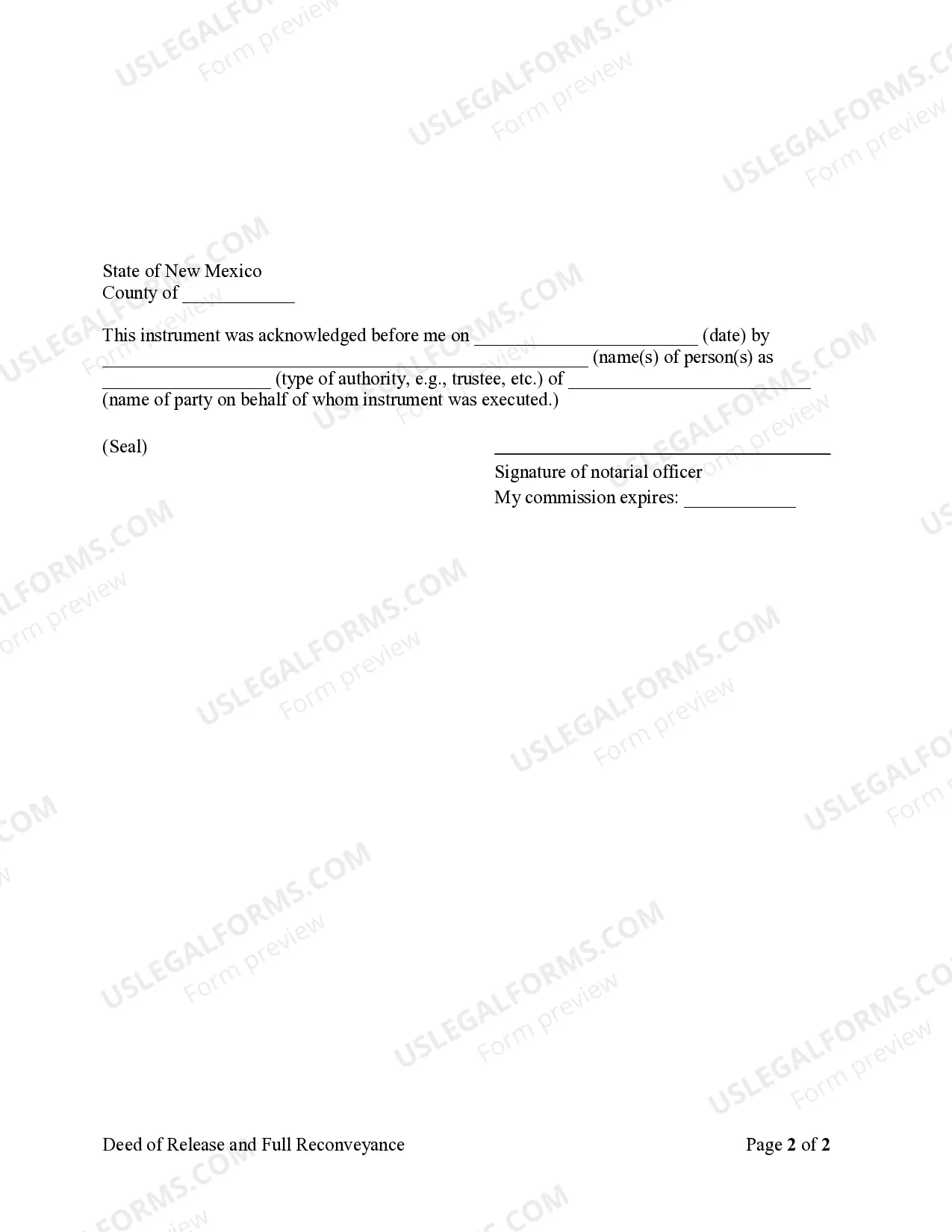
- Signature of the trustee, notarized to confirm authenticity.


Common use cases
This form should be used when a corporate lender has confirmed that a borrower has fully paid off their mortgage obligation. It is necessary to legally release the property from the mortgage lien, ensuring that the borrower has clear ownership of the property without any encumbrances. Common situations for using this form include the conclusion of a loan term or refinancing where no further payments are due.
Who can use this document
- Corporate lenders acting as trustees under a Deed of Trust.
- Trustors who have fully satisfied their mortgage obligations.
- Homeowners wishing to clear any legal claims against their property.
Instructions for completing this form
- Identify the parties involved by filling in the names of the trustor and the trustee.
- Specify the original Deed of Trust details, including the date and recording information.
- Clearly state that all indebtedness has been satisfied.
- Have the trustee sign the document in front of a notary public.
- Ensure that all relevant fields are completed accurately before submission.
Does this document require notarization?
Notarization is required for this form to take effect. Our online notarization service, powered by Notarize, lets you verify and sign documents remotely through an encrypted video session, available 24/7.
Get your form ready online
Our built-in tools help you complete, sign, share, and store your documents in one place.
Make edits, fill in missing information, and update formatting in US Legal Forms—just like you would in MS Word.
Download a copy, print it, send it by email, or mail it via USPS—whatever works best for your next step.
Sign and collect signatures with our SignNow integration. Send to multiple recipients, set reminders, and more. Go Premium to unlock E-Sign.
If this form requires notarization, complete it online through a secure video call—no need to meet a notary in person or wait for an appointment.
We protect your documents and personal data by following strict security and privacy standards.

Make edits, fill in missing information, and update formatting in US Legal Forms—just like you would in MS Word.

Download a copy, print it, send it by email, or mail it via USPS—whatever works best for your next step.

Sign and collect signatures with our SignNow integration. Send to multiple recipients, set reminders, and more. Go Premium to unlock E-Sign.

If this form requires notarization, complete it online through a secure video call—no need to meet a notary in person or wait for an appointment.

We protect your documents and personal data by following strict security and privacy standards.
Avoid these common issues
- Failing to include all necessary identification information for trustor and trustee.
- Not clearly stating that the indebtedness has been fully paid.
- Missing the notary signature, which is essential for legal validity.
Benefits of completing this form online
- Convenience of downloading and printing the form at your own pace.
- Easy editability to ensure all information is accurately reflected.
- Reliability through access to forms drafted by licensed attorneys.
Looking for another form?
Form popularity
FAQ
A mortgage holder issues a deed of reconveyance to indicate that the borrower has been released from the mortgage debt. The deed transfers the property title from the lender, also called the beneficiary, to the borrower. This document is most commonly used when a mortgage has been paid in full.
A Substitution of Trustee is a form filed when a successor trustee takes the place of a previous trustee. A successor is a person or entity who takes over and continues the role or position of another.
A mortgage holder issues a deed of reconveyance to indicate that the borrower has been released from the mortgage debt. The deed transfers the property title from the lender, also called the beneficiary, to the borrower. This document is most commonly used when a mortgage has been paid in full.
Trustee's deeds convey real estate out of a trust.This type of conveyance is named for the person using the form the trustee who stands in for the beneficiary of the trust and holds title to the property.
A document known as a substitution of trustee and full reconveyance identifies the person who has the authority to reconvey the property and remove the lien.Once the document is registered, it establishes the borrower as the sole owner of the property, which is now free and clear of the previous mortgage.
When a deed of trust/mortgage is paid in full, you can record a Full Reconveyance from the trustee stating publicly that the loan has been paid. The Full Reconveyance Form. is completed and signed by the trustee, whose signature must be notarized.
A document known as a substitution of trustee and full reconveyance identifies the person who has the authority to reconvey the property and remove the lien. Most importantly, a deed of full reconveyance, known as a satisfaction of mortgage in some states, transfers title back to the borrower.
A deed of release or release deed is a legal document that removes the claim of a person from an immovable property and transfers his/her share to the co-owner. The release deed procedure is executed in the sub-registrars office and both the parties are required to be present for signing it.
When a deed of trust/mortgage is paid in full, you can record a Full Reconveyance from the trustee stating publicly that the loan has been paid. The Full Reconveyance Form. is completed and signed by the trustee, whose signature must be notarized.