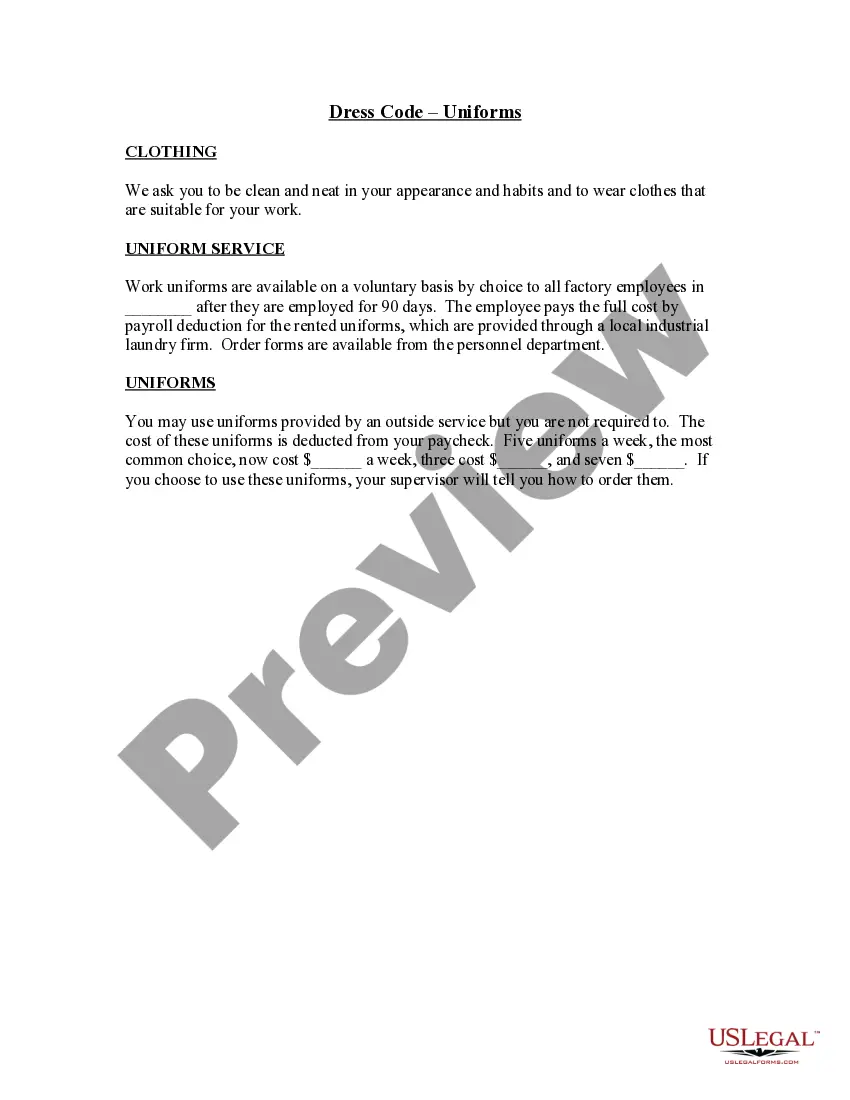
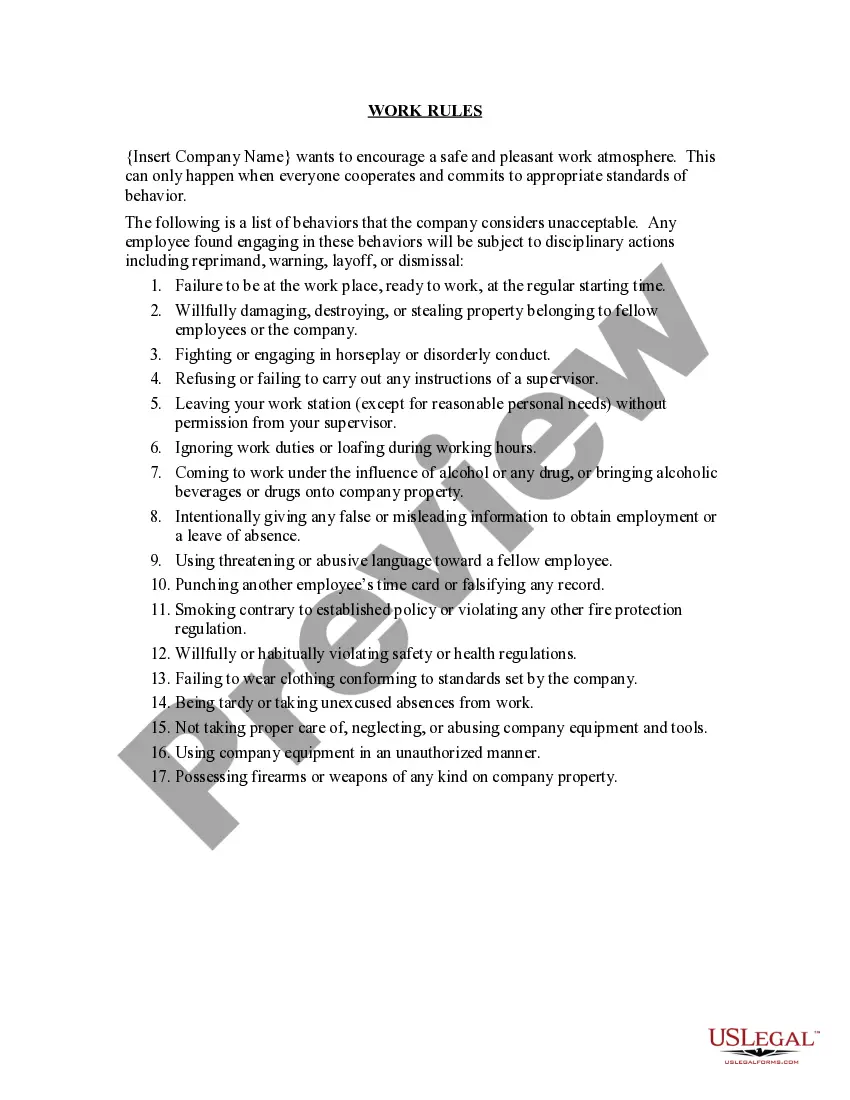
New Mexico Employee Dress Code Policy - General
Description
Get your form ready online
Our built-in tools help you complete, sign, share, and store your documents in one place.
Make edits, fill in missing information, and update formatting in US Legal Forms—just like you would in MS Word.
Download a copy, print it, send it by email, or mail it via USPS—whatever works best for your next step.
Sign and collect signatures with our SignNow integration. Send to multiple recipients, set reminders, and more. Go Premium to unlock E-Sign.
If this form requires notarization, complete it online through a secure video call—no need to meet a notary in person or wait for an appointment.
We protect your documents and personal data by following strict security and privacy standards.

Make edits, fill in missing information, and update formatting in US Legal Forms—just like you would in MS Word.

Download a copy, print it, send it by email, or mail it via USPS—whatever works best for your next step.

Sign and collect signatures with our SignNow integration. Send to multiple recipients, set reminders, and more. Go Premium to unlock E-Sign.

If this form requires notarization, complete it online through a secure video call—no need to meet a notary in person or wait for an appointment.

We protect your documents and personal data by following strict security and privacy standards.
Looking for another form?
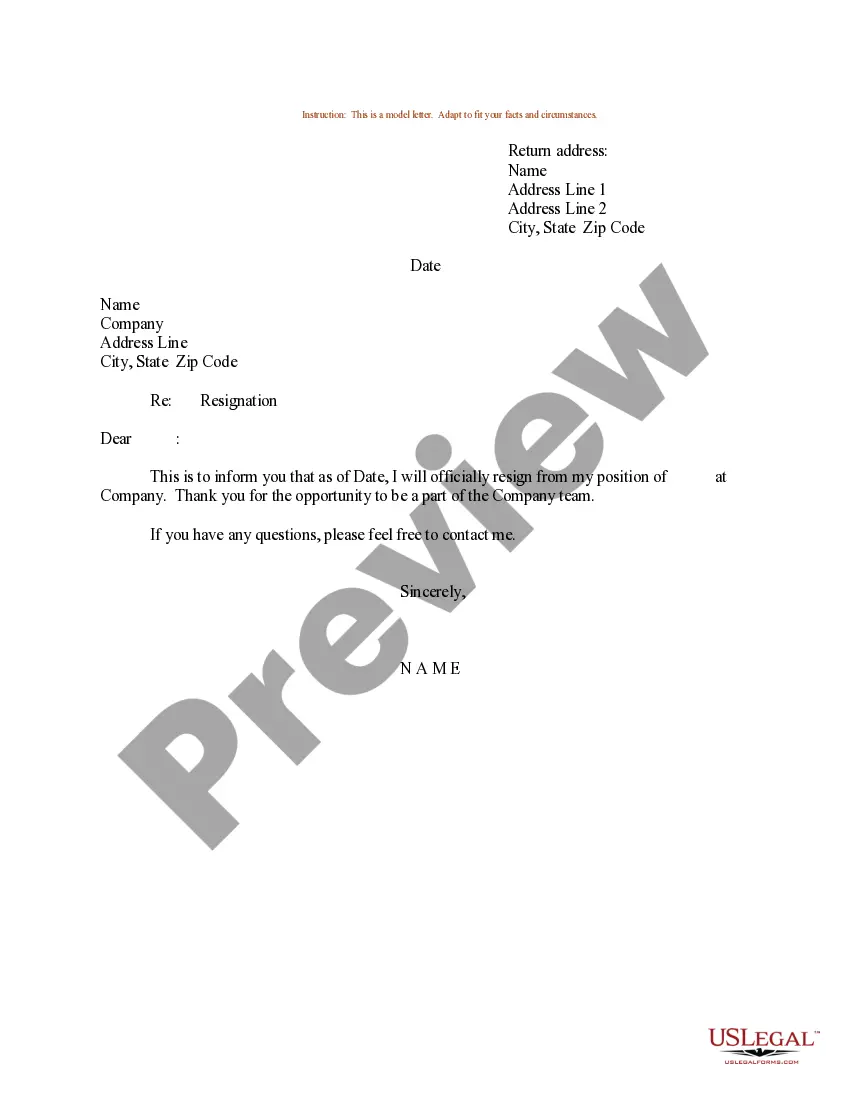


How to fill out Employee Dress Code Policy - General?
US Legal Forms - one of the largest collections of legal documents in the United States - offers a variety of legal form templates that you can download or create.
By using the website, you can access thousands of forms for business and personal purposes, categorized by types, states, or keywords.
You can find the latest versions of forms like the New Mexico Employee Dress Code Policy - General in just seconds.
If the form does not meet your requirements, use the Search field at the top of the page to find the one that does.
If you are satisfied with the form, confirm your choice by clicking the Buy now button. Then, choose the pricing plan you desire and provide your credentials to create an account.
- If you currently hold a monthly subscription, Log In and download the New Mexico Employee Dress Code Policy - General from your US Legal Forms library.
- The Download button will appear on every form you view.
- You can access all previously downloaded forms from the My documents section of your account.
- If you want to use US Legal Forms for the first time, here are simple steps to get started.
- Ensure you have selected the correct form for your city/county.
- Choose the button to review the form's content.
Form popularity
FAQ
An attire policy outlines acceptable clothing for workers in a professional setting. For example, a company might specify that business casual attire is appropriate, which includes dress pants, collared shirts, and closed-toe shoes. By defining attire clearly, employees understand expectations and can adhere to the New Mexico Employee Dress Code Policy - General. You can find detailed examples on uslegalforms for your needs.
Avoid wearing outfits which expose much of your body parts. Wear clothes which fit you best. Don't wear too tight or loose clothes. Understand the basic difference between a party wear and office attire.
Everyone is expected to be well-groomed and wear clean clothing, free of holes, tears, or other signs of wear. Clothing with offensive or inappropriate designs or stamps are not allowed. Clothing should not be too revealing. Clothing and grooming styles dictated by religion or ethnicity are exempt.
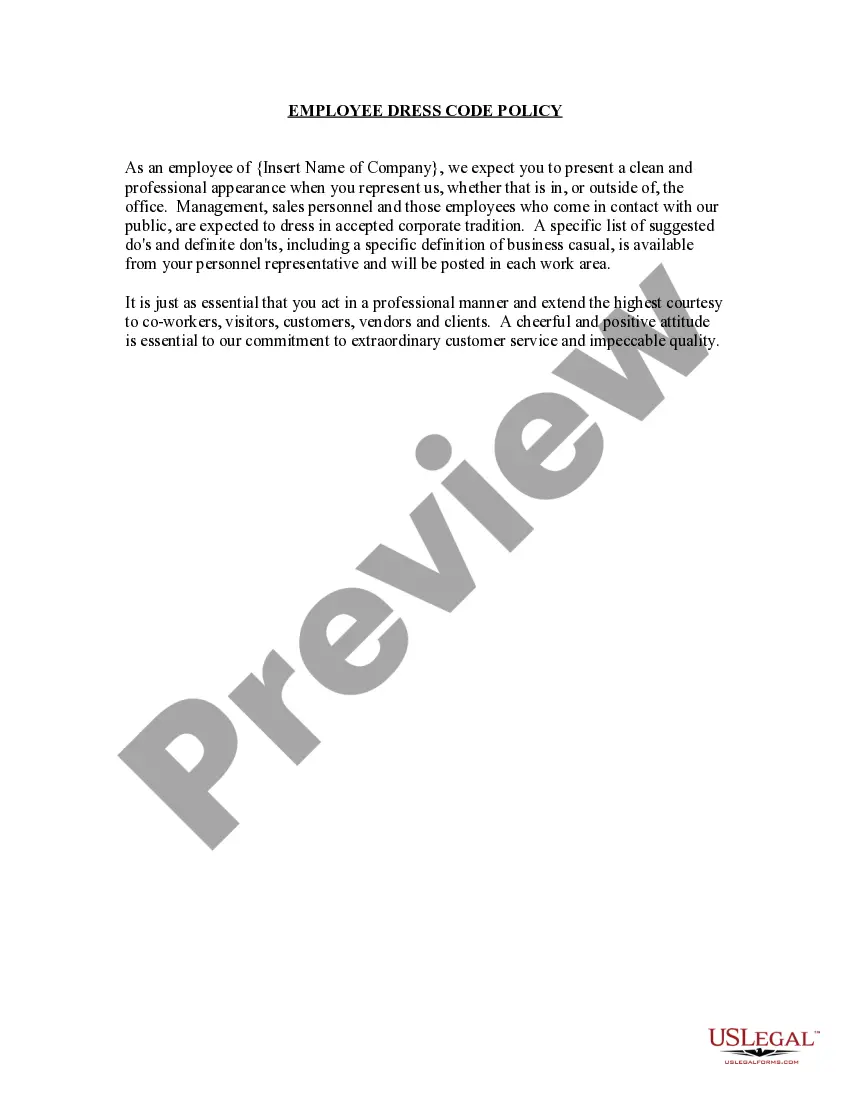
A dress code policy is a document, typically associated with the employee handbook, that specifies what is appropriate for employees to wear to work. Dress codes will vary from company to company, especially in different industries.
Definition of dress code : formally or socially imposed standards of dress.
Clothes should still be pressed, neat, and appropriate for the type of work you do. For men, you can expect casual pants and slacks with collared polos or crew-neck sweaters. Women have the freedom to wear nicely-fitted tops and blouses, slacks or skirts. Fun patterns and colors are acceptable with a casual dress code.
There are typically four types of corporate dress codes: business formal, business professional, business casual, and casual.
The Basics: The expectations of business professional are the most standardized no matter where you go, the expectations are generally the same: Charcoal or navy suits (pant suits or skirt suits) where the jacket matches the pants/skirt. Button down shirts (always tucked in for a clean look)
Dress codes are used to communicate to employees what the organization considers appropriate work attire. A dress code or appearance policy allows an employer to set expectations regarding the image it wants the company to convey. Dress codes can be formal or informal and might include the use of uniforms.
Dirty or wrinkled clothing. Tight-fitting or revealing clothing. Too casual, such as yoga pants, overalls, flip flops or shorts. T-shirts with inappropriate messages or offensive content.