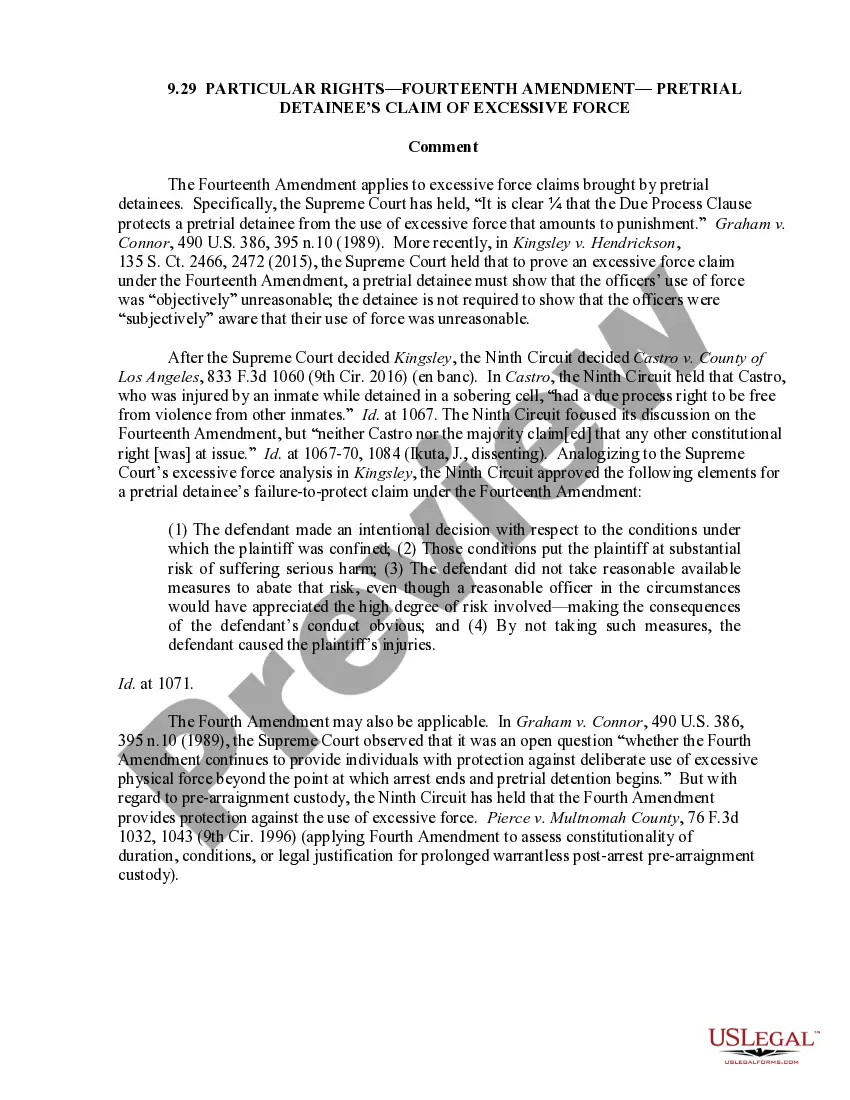
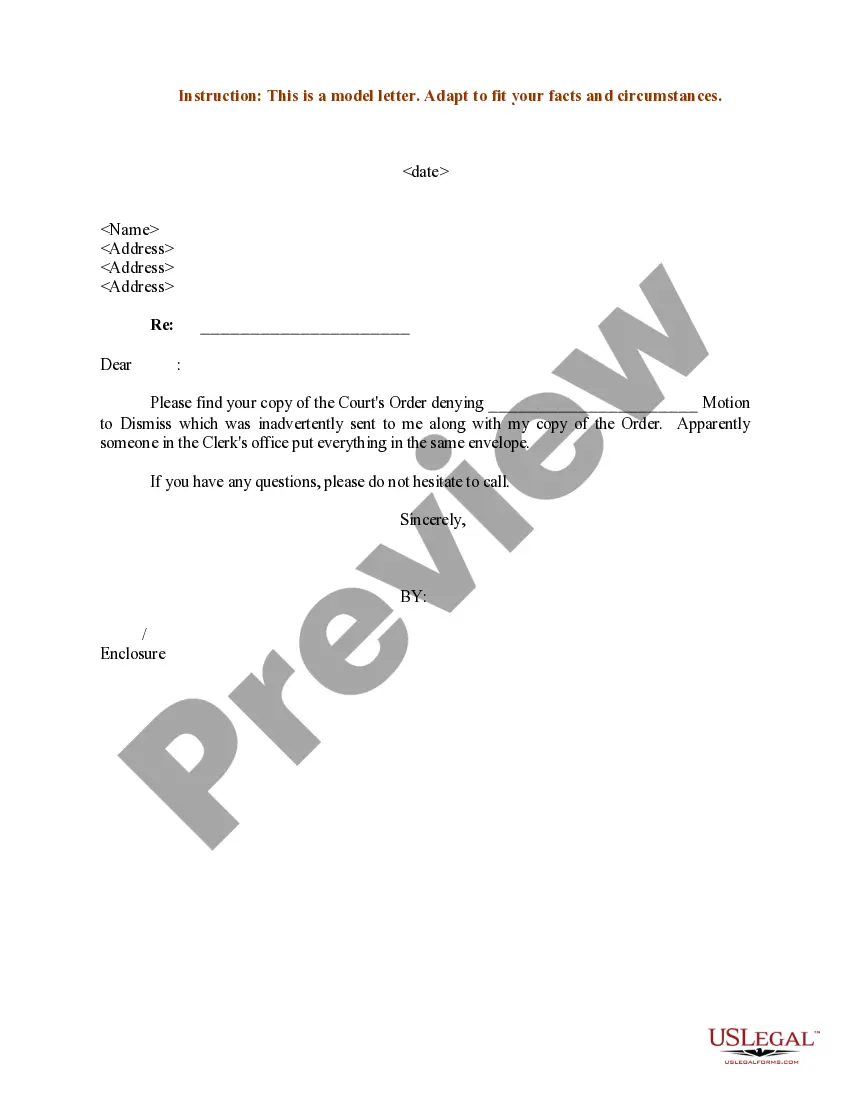
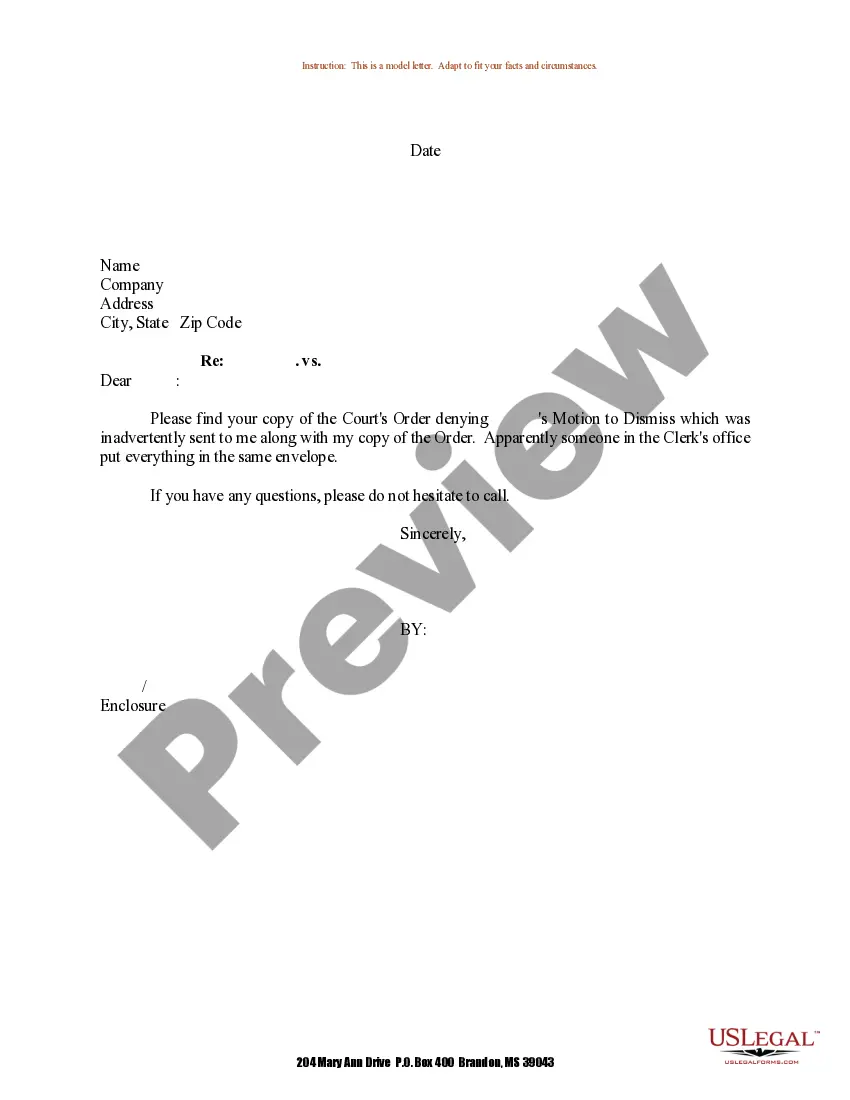
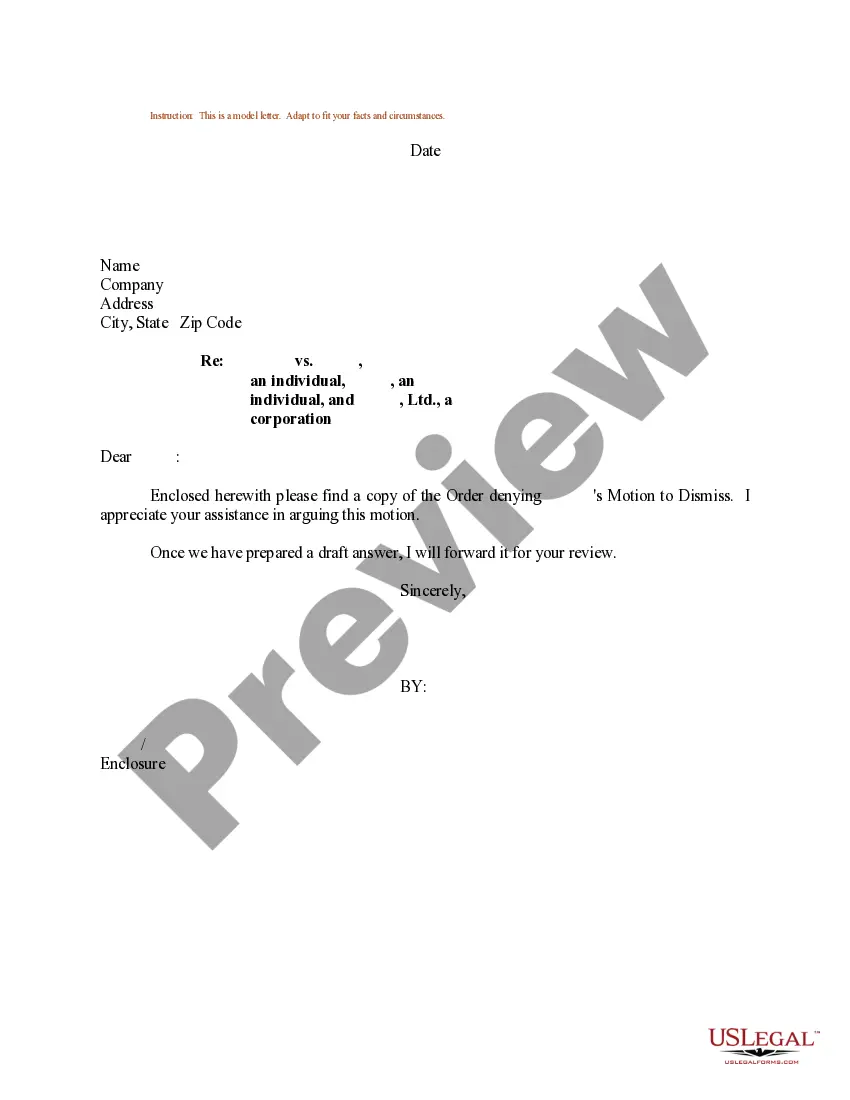
New Mexico Sample Letter for Order Denying Motion to Dismiss
Description
Get your form ready online
Our built-in tools help you complete, sign, share, and store your documents in one place.
Make edits, fill in missing information, and update formatting in US Legal Forms—just like you would in MS Word.
Download a copy, print it, send it by email, or mail it via USPS—whatever works best for your next step.
Sign and collect signatures with our SignNow integration. Send to multiple recipients, set reminders, and more. Go Premium to unlock E-Sign.
If this form requires notarization, complete it online through a secure video call—no need to meet a notary in person or wait for an appointment.
We protect your documents and personal data by following strict security and privacy standards.

Make edits, fill in missing information, and update formatting in US Legal Forms—just like you would in MS Word.

Download a copy, print it, send it by email, or mail it via USPS—whatever works best for your next step.

Sign and collect signatures with our SignNow integration. Send to multiple recipients, set reminders, and more. Go Premium to unlock E-Sign.

If this form requires notarization, complete it online through a secure video call—no need to meet a notary in person or wait for an appointment.

We protect your documents and personal data by following strict security and privacy standards.
Looking for another form?



How to fill out Sample Letter For Order Denying Motion To Dismiss?
If you wish to obtain, acquire, or create authentic document templates, utilize US Legal Forms, the largest collection of legal forms available online.
Take advantage of the site's easy and straightforward search to find the documents you require. Numerous templates for business and personal purposes are organized by categories and states, or keywords.
Use US Legal Forms to obtain the New Mexico Sample Letter for Order Denying Motion to Dismiss with just a few clicks.
Step 5. Complete the transaction. You can use your Visa, Mastercard, or PayPal account to finalize the transaction.
Step 6. Choose the format of the legal form and download it to your device. Step 7. Fill out, edit, and print or sign the New Mexico Sample Letter for Order Denying Motion to Dismiss. Every legal document template you acquire is yours permanently. You have access to every form you downloaded in your account. Click on the My documents section and choose a form to print or download again. Be proactive and obtain, and print the New Mexico Sample Letter for Order Denying Motion to Dismiss with US Legal Forms. There are numerous professional and state-specific forms available for your business or personal needs.
- If you are already a US Legal Forms user, Log In to your account and click the Acquire button to download the New Mexico Sample Letter for Order Denying Motion to Dismiss.
- You can also access forms you previously downloaded in the My documents section of your account.
- If you are using US Legal Forms for the first time, follow the instructions below.
- Step 1. Ensure you have selected the form for your relevant city/state.
- Step 2. Use the Review feature to examine the form's details. Be sure to read the information thoroughly.
- Step 3. If you are not satisfied with the form, use the Search box at the top of the screen to find alternative templates in the legal form category.
- Step 4. Once you have found the form you need, click the Buy now button. Select the pricing plan you prefer and enter your credentials to register for an account.
Form popularity
FAQ
Judge Murphy noted that under Rule 1-041(E)(1), a party can move to dismiss an action with prejudice if the claimant has failed to take any significant action within two years, but that the action shall not be dismissed if the party opposing the motion is in compliance with a Rule 1-016 NMRA scheduling order.
Rule 1-056 - Summary judgment A. For claimant. A party seeking to recover upon a claim, counterclaim or cross-claim or to obtain a declaratory judgment may move with or without supporting affidavits for a summary judgment in his favor upon all or any part thereof.
Dismissal for failure to prosecute. Any action pending for six (6) months from the date the complaint is filed, in which the plaintiff or defendant asserting a counterclaim has failed to take all available steps to bring the matter to trial, shall be dismissed without prejudice.
A judge may dismiss a case without prejudice in order to allow for errors in the case presented to be addressed before it is brought back to court. A judge will dismiss a case with prejudice if he or she finds reason why the case should not move forward and should be permanently closed.
Because the prosecutor filed the charge, they also have the discretion to dismiss it if they believe the facts and circumstances warrant it. Likewise, a judge can dismiss the case if they find no legal basis for the charge, if the defendant's rights have been violated, or if the state has failed to prove its case.
(1) Any party may move to dismiss the action, or any counterclaim, cross-claim or third-party claim with prejudice if the party asserting the claim has failed to take any significant action to bring such claim to trial or other final disposition within two (2) years from the filing of such action or claim.
Rule 1-012 - Defenses and objections; when and how presented; by pleading or motion; motion for judgment on the pleadings A. When presented. A defendant shall serve his answer within thirty (30) days after the service of the summons and complaint upon him.