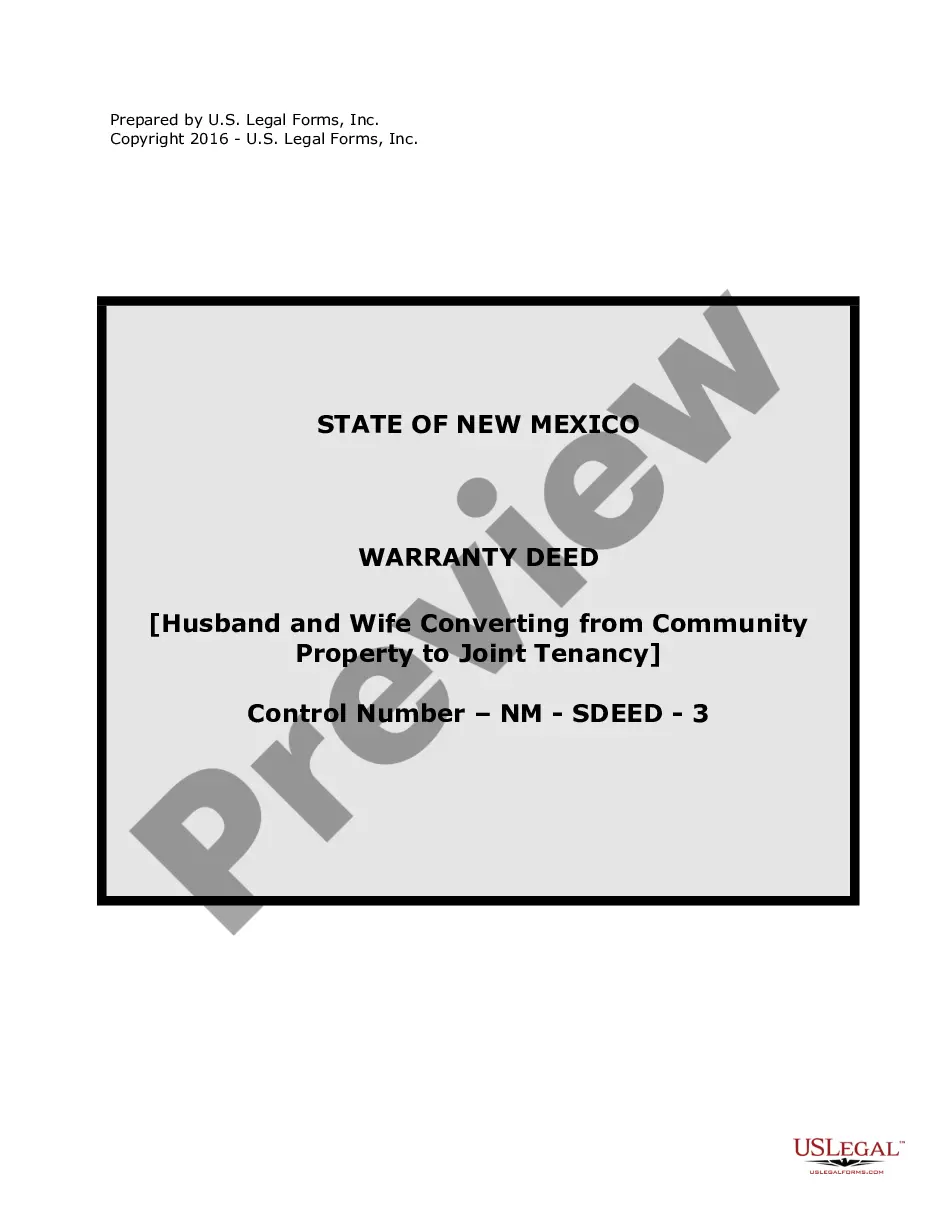
New Mexico Warranty Deed to convert Community Property to Joint Tenancy
What this document covers
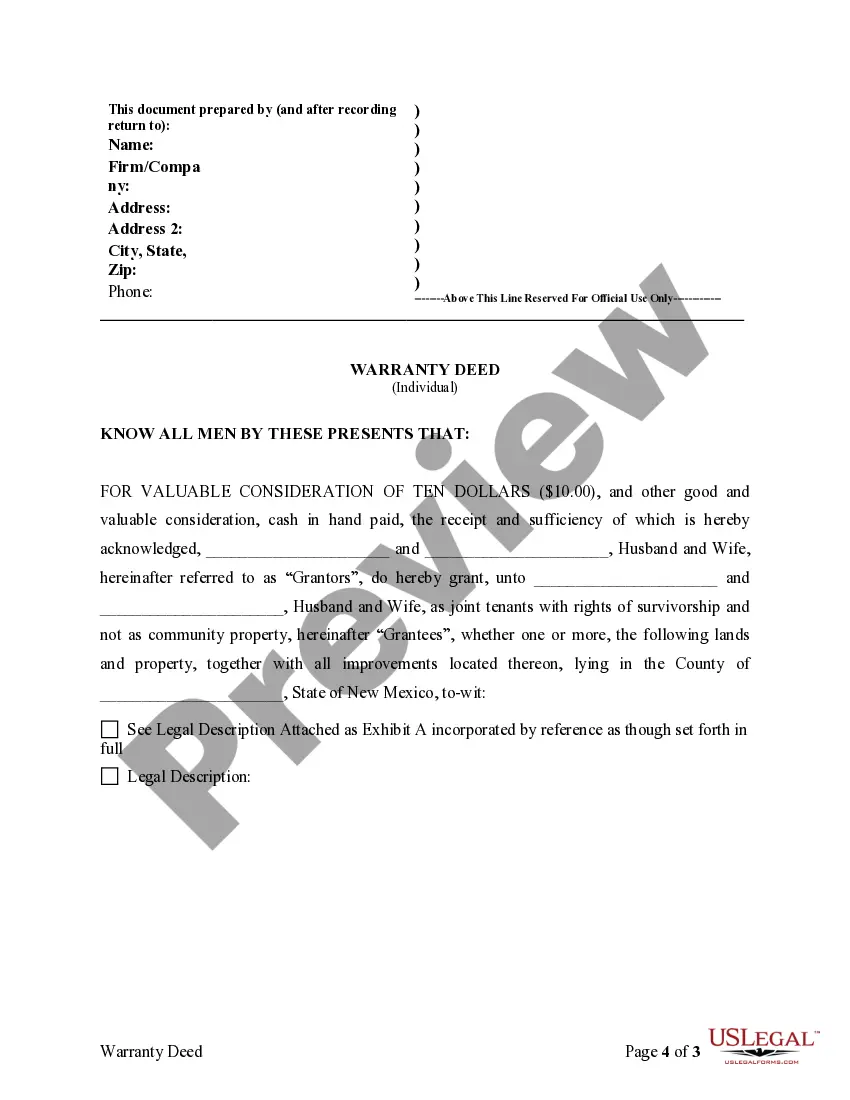
The Warranty Deed to convert Community Property to Joint Tenancy is a legal document that enables husband and wife to change their property ownership from community property to joint tenancy. This form ensures that both parties maintain equal rights to the property while providing for automatic transfer of the property to the surviving spouse upon the death of one co-owner, unlike community property which can be subject to different rules after death. This distinction makes the Warranty Deed crucial for couples who want to ensure seamless transfer of their shared property without going through probate.
Key parts of this document
- Identification of the grantors (husband and wife) and grantees.
- Description of the property being converted.
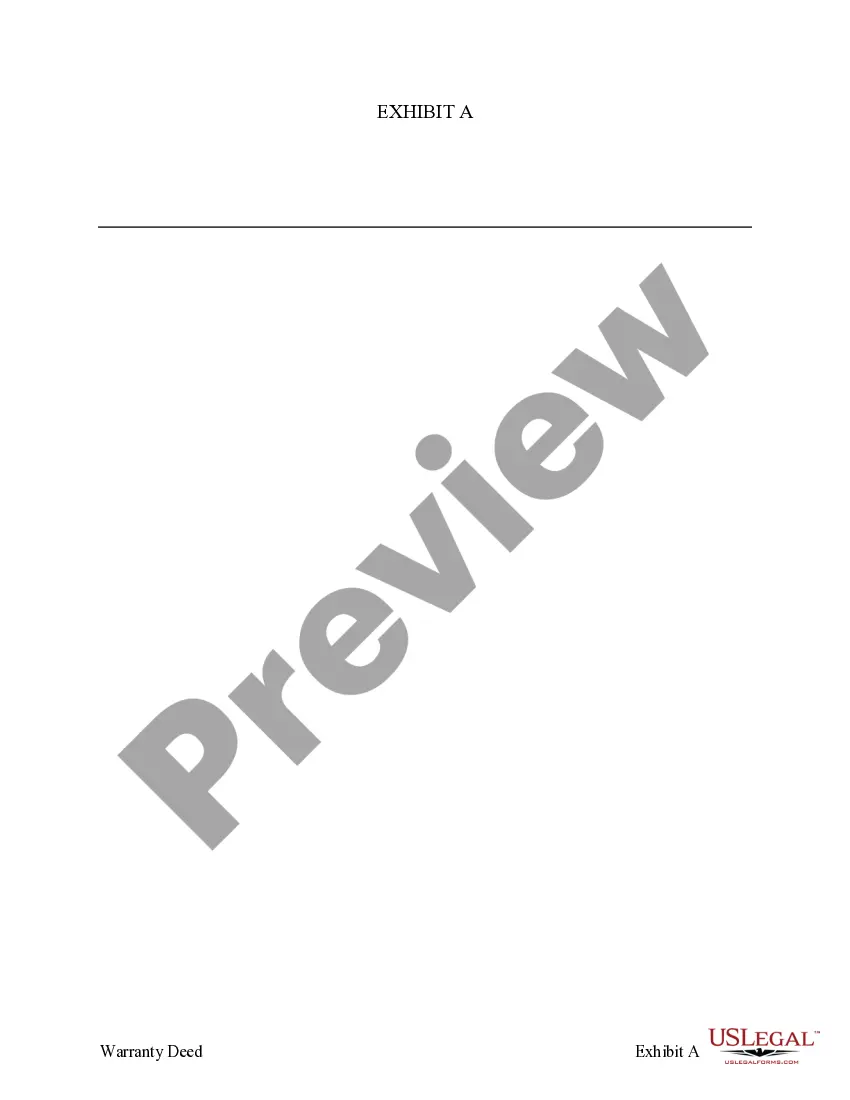
- Legal descriptions and necessary exhibits as attachments.
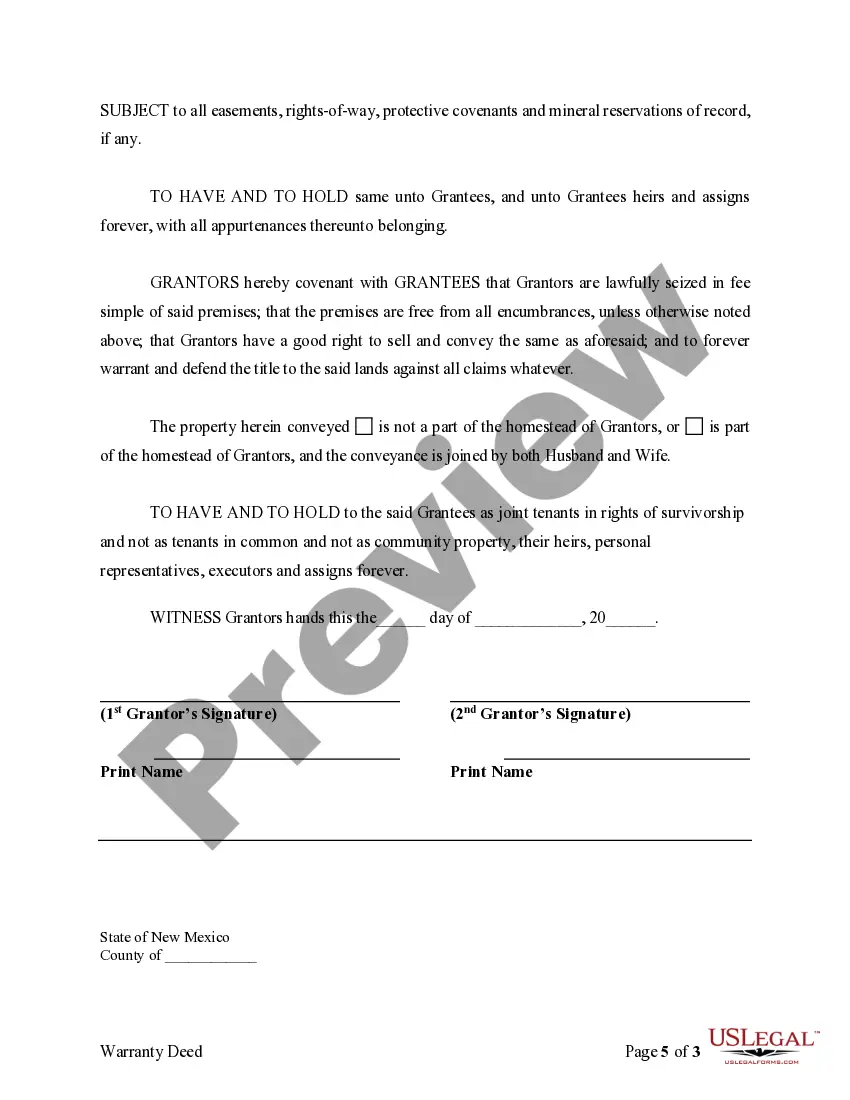
- Signatures of both grantors with date and witness statements.
- Indication of whether the property is part of the grantors' homestead.



Situations where this form applies
This form should be used when a married couple wishes to convert their jointly owned community property into joint tenancy. This scenario may arise during estate planning to ensure that upon the death of one spouse, the property automatically passes to the surviving spouse, avoiding probate complications. It is also applicable when couples seek to clarify their intentions regarding property ownership and survivorship rights.
Intended users of this form
- Married couples in New Mexico looking to update their property deed.
- Couples wanting to streamline the transfer of property through survivorship.
- Individuals preparing to make significant legal shifts in how their property is titled.
Steps to complete this form
- Identify and enter the names of both grantors and grantees at the beginning of the document.
- Provide a detailed legal description of the property being converted.
- Specify whether the property is part of the homestead of the grantors.
- Both grantors must sign the document with the correct date.
- Attach any necessary exhibits containing legal descriptions if required.
Does this document require notarization?
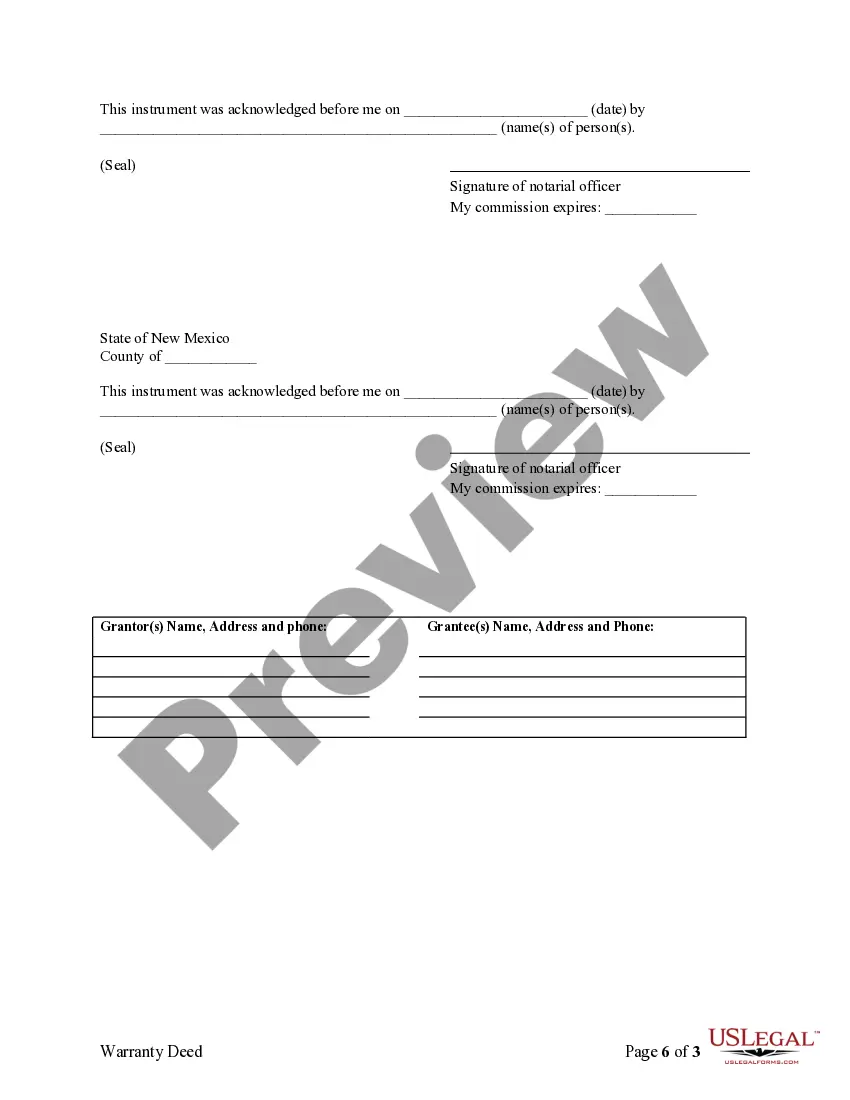
This form does not typically require notarization unless specified by local law. However, having a notary can provide additional legal validation and may be recommended for official use.
Get your form ready online
Our built-in tools help you complete, sign, share, and store your documents in one place.
Make edits, fill in missing information, and update formatting in US Legal Forms—just like you would in MS Word.
Download a copy, print it, send it by email, or mail it via USPS—whatever works best for your next step.
Sign and collect signatures with our SignNow integration. Send to multiple recipients, set reminders, and more. Go Premium to unlock E-Sign.
If this form requires notarization, complete it online through a secure video call—no need to meet a notary in person or wait for an appointment.
We protect your documents and personal data by following strict security and privacy standards.

Make edits, fill in missing information, and update formatting in US Legal Forms—just like you would in MS Word.

Download a copy, print it, send it by email, or mail it via USPS—whatever works best for your next step.

Sign and collect signatures with our SignNow integration. Send to multiple recipients, set reminders, and more. Go Premium to unlock E-Sign.

If this form requires notarization, complete it online through a secure video call—no need to meet a notary in person or wait for an appointment.

We protect your documents and personal data by following strict security and privacy standards.
Mistakes to watch out for
- Forgetting to sign the deed, which renders it invalid.
- Neglecting to provide an accurate legal description of the property.
- Failing to indicate the homestead status if applicable.
- Overlooking witness requirements as per state law.
Advantages of online completion
- Convenience of completing the form at your own pace online.
- Editability to customize to your specific situation before printing.
- Access to reliable templates drafted by licensed attorneys.
Looking for another form?
Form popularity
FAQ
Each party has a full ownership interest in the property. The property will pass instantly to the survivor upon the death of the other without probate. Conveyance by one party without the other breaks the joint tenancy. Seller warrants that he/she has good title and will warrant and defend title.
The term joint tenancy refers to a legal arrangement in which two or more people own a property together, each with equal rights and obligations. Joint tenancies can be created by married and non-married couples, friends, relatives, and business associates.
The dangers of joint tenancy include the following: Danger #1: Only delays probate. When either joint tenant dies, the survivor usually a spouse or child immediately becomes the owner of the entire property. But when the survivor dies, the property still must go through probate.
Joint tenancy is ideal for spousesJoint tenancy might look like an appealing shortcut in estate planning because it contains a right of survivorship, meaning assets avoid the probate process and surviving joint tenants assume immediate control. However, joint tenancy does have substantial risk associated with it.
What Is the Difference Between a Warranty Deed & a Survivorship Deed?A warranty deed is the most comprehensive and provides the most guarantees. Survivorship isn't so much a deed as a title. It's a way to co-own property where, upon the death of one owner, ownership automatically passes to the survivor.
Change from tenants in common to joint tenants You need the agreement of all the other joint owners to change from being tenants in common to joint tenants. A solicitor, conveyancer or legal executive can also make the application for you.
If you own property jointly with someone else, and this ownership includes the "right of survivorship," then the surviving owner automatically owns the property when the other owner dies.In New Mexico, each owner, called a joint tenant, must own an equal share.
If you are a joint tenant with your partner, you both have the right to carry on living in the property. However, either of you can give notice to the landlord to end the tenancy (unless it's a fixed-term tenancy).You might be able to negotiate with the landlord so that one of you can take out a new tenancy.
A Survivorship Deed transfers residential or commercial property from one property owner (the grantor) to another (the grantee) while allowing them to avoid going through probate when they (the grantor) passes away. The parties transferring property in a Survivorship Deed must have full ownership of the property.