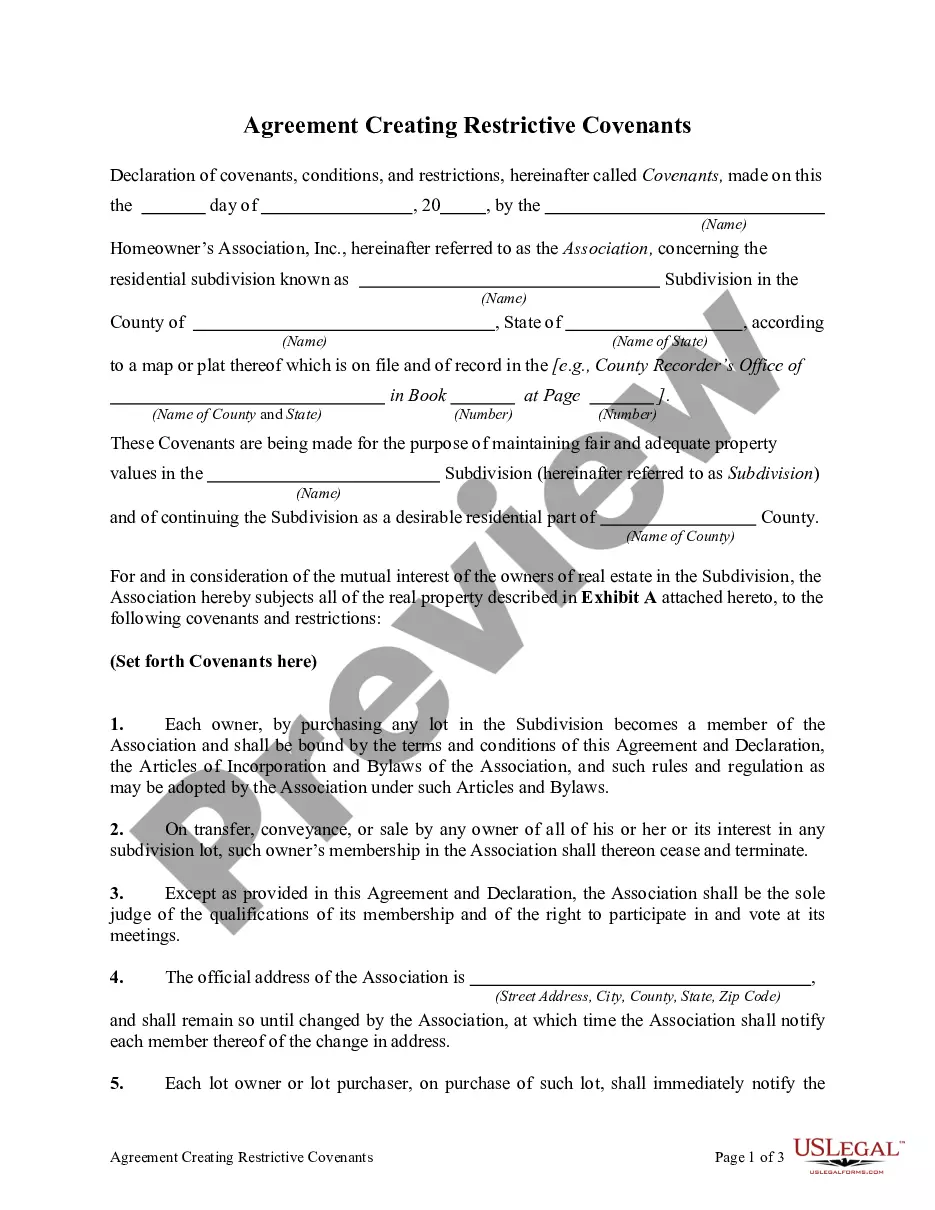
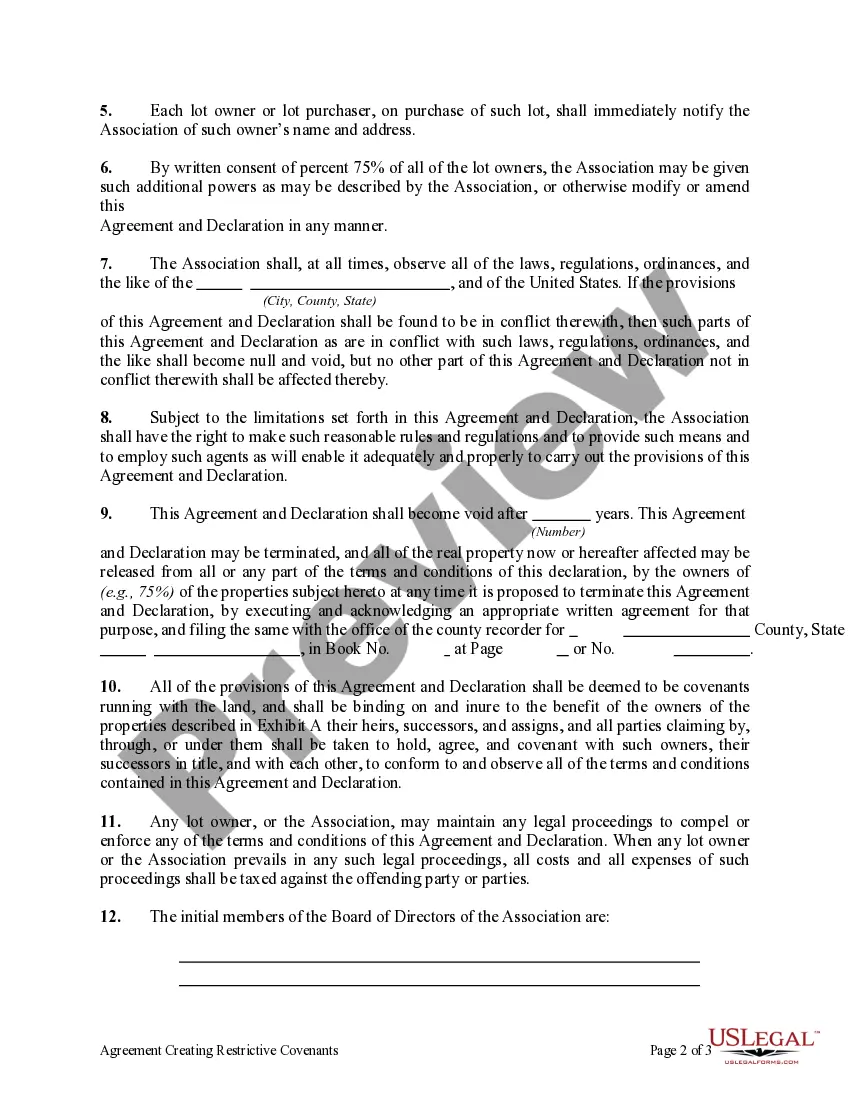
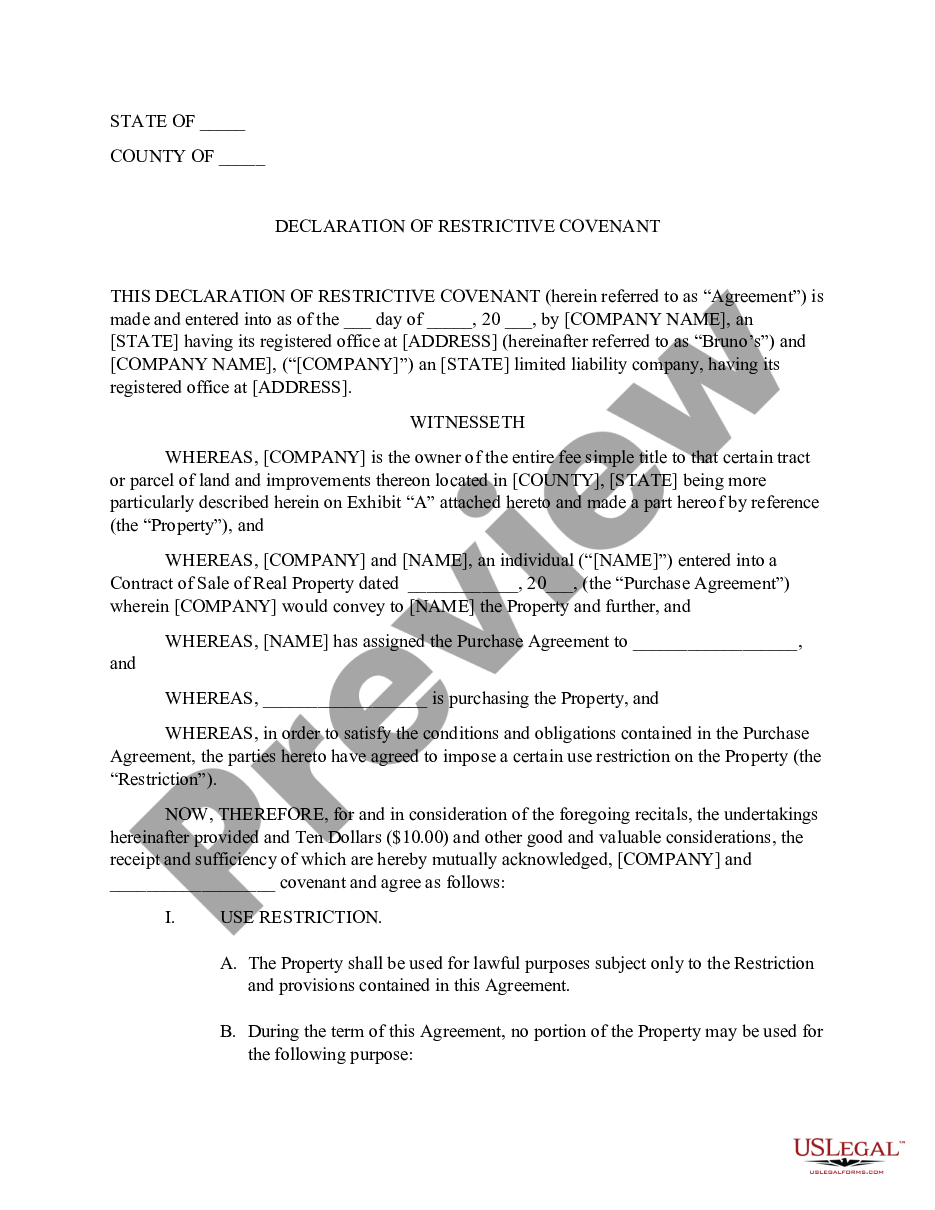
If you are planning on buying a home, condominium, townhouse, or other property, you must take note of whether any restrictive covenants will affect your ability to use your new residence.
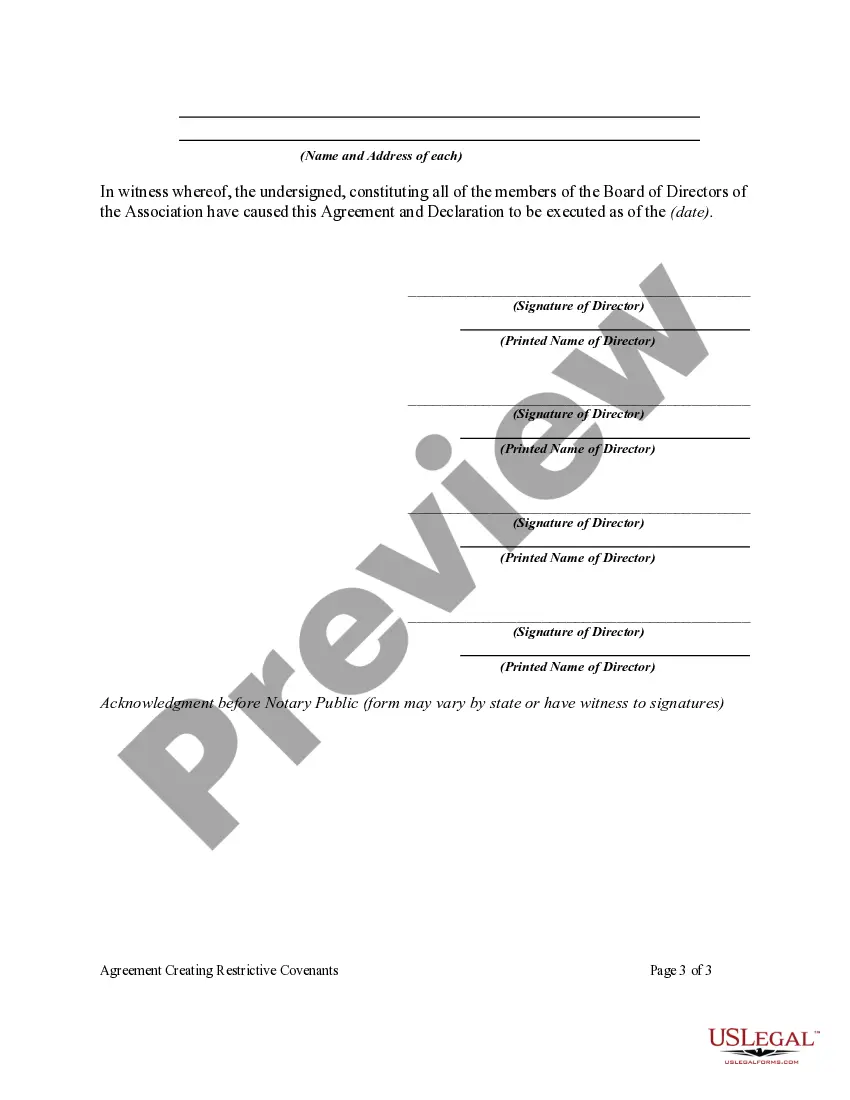
New Jersey Agreement Creating Restrictive Covenants
64 downloads
Description
Free preview

Get your form ready online
Our built-in tools help you complete, sign, share, and store your documents in one place.
Built-in online Word editor
Make edits, fill in missing information, and update formatting in US Legal Forms—just like you would in MS Word.
Export easily
Download a copy, print it, send it by email, or mail it via USPS—whatever works best for your next step.
E-sign your document
Sign and collect signatures with our SignNow integration. Send to multiple recipients, set reminders, and more. Go Premium to unlock E-Sign.
Notarize online 24/7
If this form requires notarization, complete it online through a secure video call—no need to meet a notary in person or wait for an appointment.
Store your document securely
We protect your documents and personal data by following strict security and privacy standards.

Make edits, fill in missing information, and update formatting in US Legal Forms—just like you would in MS Word.

Download a copy, print it, send it by email, or mail it via USPS—whatever works best for your next step.

Sign and collect signatures with our SignNow integration. Send to multiple recipients, set reminders, and more. Go Premium to unlock E-Sign.

If this form requires notarization, complete it online through a secure video call—no need to meet a notary in person or wait for an appointment.

We protect your documents and personal data by following strict security and privacy standards.
Looking for another form?


How to fill out Agreement Creating Restrictive Covenants?
You can spend hours online searching for the legal document template that meets the state and federal requirements you need. US Legal Forms provides thousands of legal forms that have been reviewed by professionals.
You can easily download or print the New Jersey Agreement Creating Restrictive Covenants from my services. If you have a US Legal Forms account, you can Log In and then click the Obtain button. After that, you can complete, modify, print, or sign the New Jersey Agreement Creating Restrictive Covenants.
Every legal document template you purchase is yours permanently. To obtain another copy of the acquired form, go to the My documents tab and click the corresponding button. If you are using the US Legal Forms website for the first time, follow the simple instructions below: First, ensure you have selected the correct document template for the county/town of your choice. Review the form summary to verify you have chosen the right form. If available, use the Preview button to look through the document template as well.
- If you need to find another version of your form, use the Search field to locate the template that meets your needs and requirements.
- Once you have found the template you need, click Buy now to continue.
- Choose the pricing plan you want, enter your details, and register for your account on US Legal Forms.
- Complete the transaction. You can use your credit card or PayPal account to pay for the legal form.
- Select the format of your document and download it to your device.
- Make any necessary adjustments to your document. You can complete, modify, and sign and print the New Jersey Agreement Creating Restrictive Covenants.
- Access and print thousands of document templates using the US Legal Forms site, which offers the largest selection of legal forms. Utilize professional and state-specific templates to address your business or personal needs.
Form popularity
FAQ
To become law, a bill must pass both Houses by a majority vote and be approved by the Governor. How a Bill Becomes Law presents the steps in the process. The Legislature can also propose amendments to the New Jersey Constitution.
Restrictive covenants may contain 4 different types of promises: (1) a promise not to compete with one's former employer; (2) a promise not to solicit or accept business from customers of the former employer; (3) a promise not to recruit or hire away employees of the former employer; and (4) the promise not to use or ...
The law prohibits ?unfair methods of competition in or affecting commerce.? It gives enforcement authority to the FTC. The agency issued a notice about the proposed rule on January 5, 2023, followed by publication in the Federal Register on January 19.
Restrictive covenants may be enforceable in New Jersey?but only if they are ?reasonable.? Courts in New Jersey will use a three-pronged test in order to determine whether or not a restrictive covenant is legally valid.
BILL A3715 TO REFORM RESTRICTIVE COVENANTS REFORM PASSES ASSEMBLY LABOR COMMITTEE. NEWARK, N.J. ? Bill A3715 successfully moved through the NJ Assembly Labor Committee with all Democrats voting in favor in a 6-3 party-line vote today.
BILL A3715 TO REFORM RESTRICTIVE COVENANTS REFORM PASSES ASSEMBLY LABOR COMMITTEE. NEWARK, N.J. ? Bill A3715 successfully moved through the NJ Assembly Labor Committee with all Democrats voting in favor in a 6-3 party-line vote today.
New Jersey Assembly Bill 3715 Limits certain provisions in restrictive covenants and limits enforceability of restrictive covenants. Establishes second degree crime for threatening to kill law enforcement officers.
The bill provides that, not later than 10 days after the termination of an employment relationship, the employer must notify the employee in writing of the employer's intent to enforce the agreement. If the employer fails to provide notice, the agreement is void.