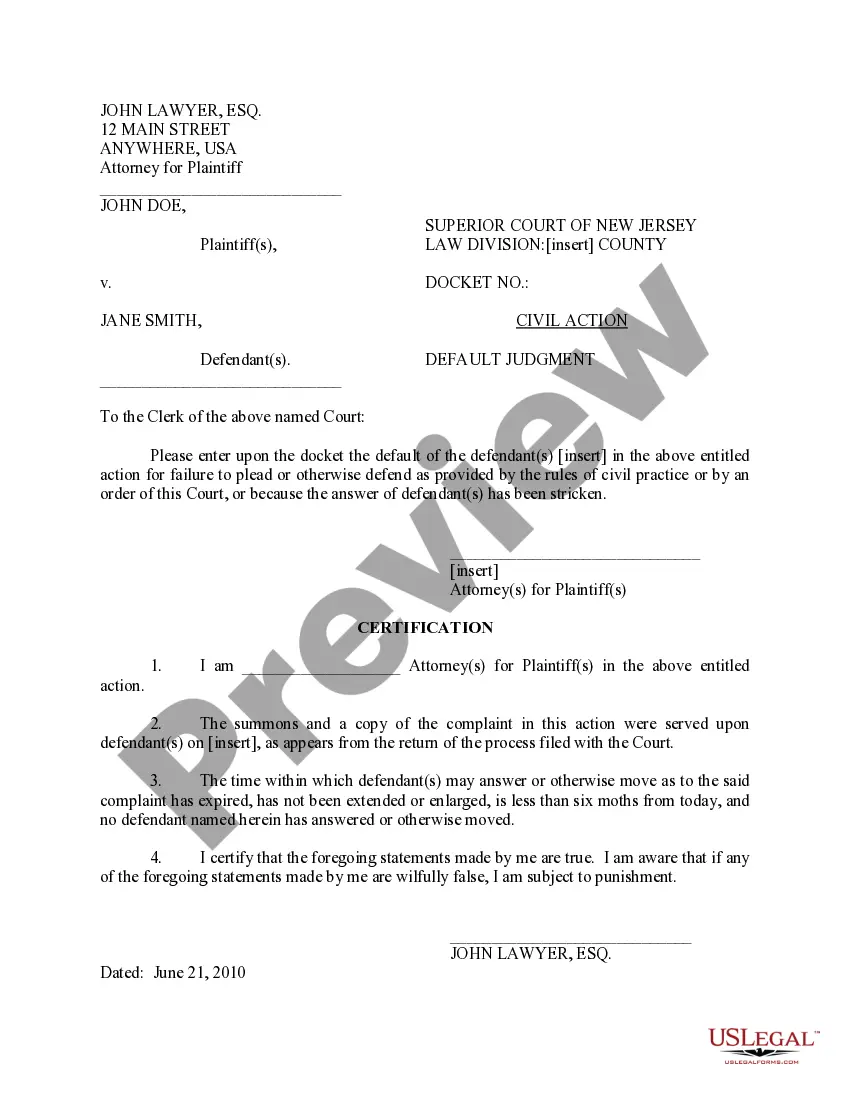
New Jersey Default Judgment and Certification
About this form
This Default Judgment and Certification form is used in civil proceedings within the state of New Jersey. It allows a plaintiff to request a default judgment against a defendant who has failed to respond to a complaint. This form is necessary when a defendant does not provide an answer or otherwise defend against the claims made in a lawsuit, differentiating it from other forms that may be used for various legal actions.
Main sections of this form
- Header section including case information and court details.
- Request to enter the default of the defendant(s) for failure to respond.
- Certification section with statements verifying service of process.
- Signature and date section for the attorney representing the plaintiff.
When to use this document
This form should be used when you have filed a civil lawsuit, and the defendant has not responded within the specified time period. It is typically employed when a plaintiff seeks a judgment without a trial, due to the defendant's lack of action. Common scenarios include debt collection cases, landlord-tenant disputes, or any situation where the defendant fails to contest the claims made against them.
Who should use this form
This form is intended for:
- Plaintiffs who have initiated a civil action in New Jersey.
- Attorneys representing plaintiffs in civil proceedings.
- Individuals or entities seeking a default judgment against a non-responsive defendant.
Steps to complete this form
- Identify the parties involved, including the names of the plaintiff(s) and defendant(s).
- Insert the court information, including the court name and docket number.
- Specify the date when the complaint was served to the defendant(s).
- Complete the certification section by confirming that the defendant(s) have failed to respond and that the statements are true.
- Sign and date the form at the bottom where indicated.
Does this form need to be notarized?
This form does not typically require notarization unless specified by local law. Always check with court requirements or a legal professional for confirmation.
Get your form ready online
Our built-in tools help you complete, sign, share, and store your documents in one place.
Make edits, fill in missing information, and update formatting in US Legal Forms—just like you would in MS Word.
Download a copy, print it, send it by email, or mail it via USPS—whatever works best for your next step.
Sign and collect signatures with our SignNow integration. Send to multiple recipients, set reminders, and more. Go Premium to unlock E-Sign.
If this form requires notarization, complete it online through a secure video call—no need to meet a notary in person or wait for an appointment.
We protect your documents and personal data by following strict security and privacy standards.

Make edits, fill in missing information, and update formatting in US Legal Forms—just like you would in MS Word.

Download a copy, print it, send it by email, or mail it via USPS—whatever works best for your next step.

Sign and collect signatures with our SignNow integration. Send to multiple recipients, set reminders, and more. Go Premium to unlock E-Sign.

If this form requires notarization, complete it online through a secure video call—no need to meet a notary in person or wait for an appointment.

We protect your documents and personal data by following strict security and privacy standards.
Mistakes to watch out for
- Failing to complete all required fields accurately.
- Not providing the correct court information or docket number.
- Missing the deadline to file the default judgment after the defendant's response period has expired.
- Neglecting to sign and date the form correctly.
Why use this form online
- Convenience of downloading and filling out the form at your own pace.
- Access to templates that are compliant with New Jersey legal standards.
- Editable fields allow you to customize the form as needed.
- Reliable templates drafted by licensed attorneys ensure compliance with state law.
Main things to remember
- The Default Judgment and Certification form is essential for plaintiffs seeking a default judgment in New Jersey.
- Completing the form accurately minimizes the risk of errors and ensures timely processing by the court.
- Understand the specific rules and procedures set forth by New Jersey law when utilizing this form.
Looking for another form?
Form popularity
FAQ
Typically, a court's rules governing enforcement of default judgments include procedures for wage garnishments, attachment of bank accounts and seizure of assets. The plaintiff can usually pursue more than one of these enforcement mechanisms simultaneously.
A very important fact you should keep in mind is that California courts do impose a timeline for seeking entry of a default judgment. Specifically, a request for entry of default must be filed within 10 days following a defendant's failure to timely file and serve a responsive pleading.
Generally, if a defendant fails to respond to a complaint you can get a default judgment after 45 days. However, the court system is very slow these days and it can take several months to get the court to issue the default judgment.
Step 1: Make Sure You've Met the Requirements for a Default. Step 2: Decide How You Wish to Proceed. Step 3: Complete the Necessary Forms. Step 4: Complete Your Declaration in Support of Default Judgment. Step 5: Calculate Prejudgment Interest, if Appropriate. Step 6: Copy and Assemble Your Documents.
If you file a motion to vacate a default or a default judgment, you must file an answer to the original complaint along with any cross claims or counterclaims you may wish to assert, and the motion must be accompanied by the appropriate fee. Make a check or money order payable to Treasurer, State of New Jersey.
The entry of default allows you to obtain a default judgment without proving your case to the court.Some courts will provide you with a form for this. Your Application or Request for Certificate of Default should also include an affidavit setting forth your opponent's default.
Default judgments happen when you don't respond to a lawsuit often from a debt collector and a judge resolves the case without hearing your side. In effect, you're found guilty because you never entered a defense. Default judgments are sometimes called automatic judgments because of how fast they can happen.
In most cases, however, default judgment can be obtained through an administrative process, simply by filing a request with the court, and even where an application is required it can in some circumstances be made without notice to the defendant.
In order to vacate a judgment in California, You must file a motion with the court asking the judge to vacate or set aside the judgment. Among other things, you must tell the judge why you did not respond to the lawsuit (this can be done by written declaration).