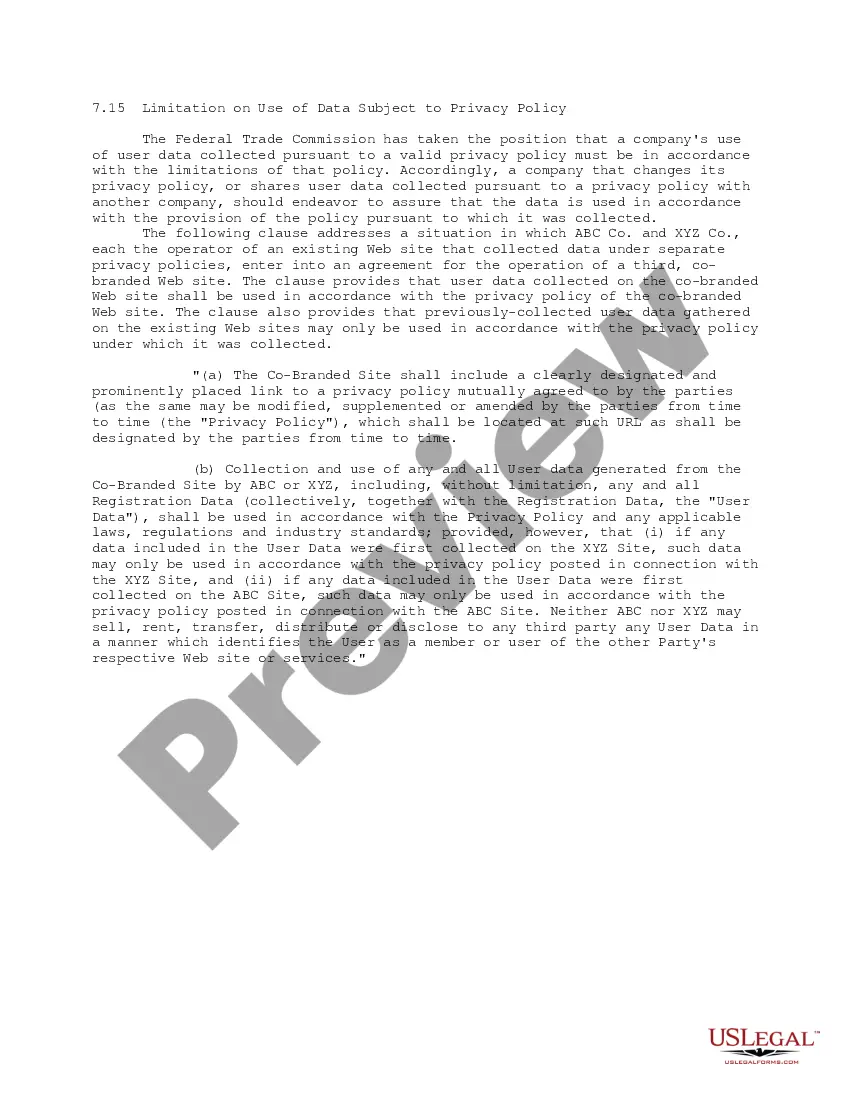
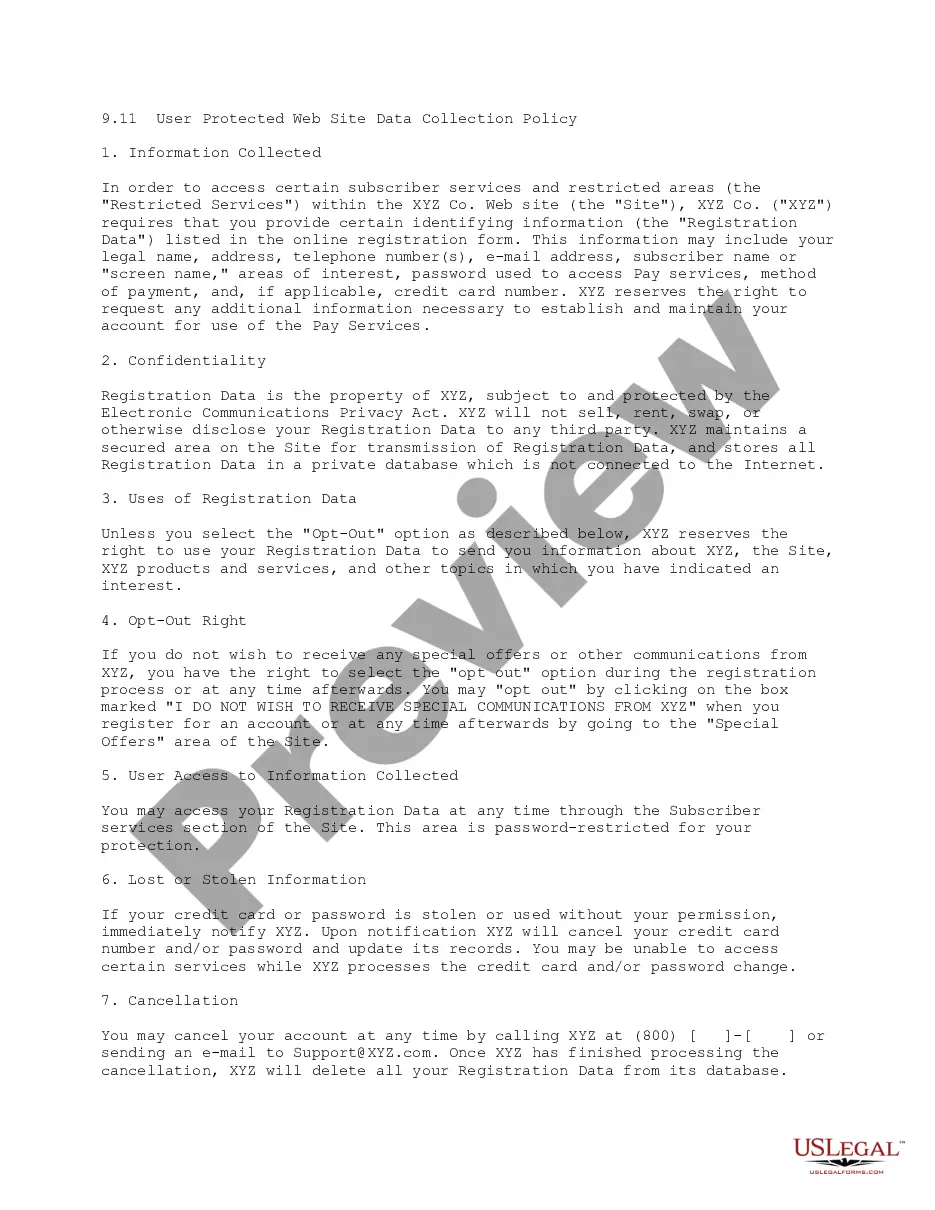
This form is a Limitation on Use of Data Subject to Privacy Policy that enables a company that changes its privacy policy, or shares user data collected pursuant to a privacy policy with another company, to endeavor to assure that the data is used in accordance with the provision of the privacy policy pursuant to which it was collected.
New Hampshire Limitation on Use of Data Subject to Privacy Policy
Category:
State:
Multi-State
Control #:
US-IP0715
Format:
Word;
PDF;
Rich Text
Instant download
Description



How to fill out Limitation On Use Of Data Subject To Privacy Policy?
Have you ever entered a location where you frequently need paperwork for either business or personal reasons? There is a multitude of legal document templates available online, but finding reliable versions can be challenging. US Legal Forms offers thousands of form templates, including the New Hampshire Limitation on Use of Data Subject to Privacy Policy, designed to meet both state and federal requirements.
If you are already acquainted with the US Legal Forms website and possess an account, simply Log In. After that, you can download the New Hampshire Limitation on Use of Data Subject to Privacy Policy template.
If you do not have an account and wish to start using US Legal Forms, follow these instructions: Obtain the form you need and ensure it corresponds to your specific city/region. Utilize the Preview button to review the document. Check the outline to confirm that you have selected the correct form. If the form isn’t what you are looking for, use the Search field to find the document that suits your needs and requirements. Once you find the correct form, click on Purchase now. Choose the pricing plan you want, complete the required information to create your account, and pay for your order using PayPal or Visa or Mastercard. Select a convenient file format and download your version.
- Find all the document templates you have acquired in the My documents section. You can obtain another copy of the New Hampshire Limitation on Use of Data Subject to Privacy Policy at any time, if needed. Simply click on the desired form to download or print the document template.
- Utilize US Legal Forms, one of the most comprehensive collections of legal forms, to save time and avoid errors. The service provides properly crafted legal document templates that can be used for a variety of purposes.
- Create your account on US Legal Forms and start making your life somewhat easier.
Form popularity
FAQ
Writing a data privacy policy involves several key steps to ensure compliance with the New Hampshire Limitation on Use of Data Subject to Privacy Policy. Start by identifying the types of personal data you collect, how you use that data, and who you share it with. Clearly outline users' rights regarding their data, including access and deletion options. Using platforms like uslegalforms can simplify this process, providing templates and guidance to create a comprehensive and compliant privacy policy.
The New Hampshire data privacy law establishes guidelines for the handling and protection of personal data. It emphasizes the New Hampshire Limitation on Use of Data Subject to Privacy Policy, ensuring that organizations use personal data responsibly. This law empowers individuals by giving them more control over their information and how it is used. To comply, businesses must implement clear privacy policies and practices that align with these regulations.
The constitutional right to privacy in New Hampshire is a fundamental principle that protects individuals from unwarranted government interference in their personal lives. This right is particularly important in the context of the New Hampshire Limitation on Use of Data Subject to Privacy Policy, which ensures that personal information is handled with care and respect. In essence, residents have the right to control their personal data and make informed decisions about its use. Understanding this right can empower you to protect your privacy effectively.
Legislation aimed at information brokers was introduced in 11 states. California, Nevada and Vermont had previously enacted laws, and Nevada in 2021 enacted legislation expanding its law, but no other bills passed.
Your personal data is incomplete, outdated, false, or unlawfully obtained. It is being used for purposes you did not authorize. The data is no longer necessary for the purposes for which they were collected.
Confidentiality of data and systems that use or generate personal data. Integrity of data and systems that use or generate personal data. Ability to restore data and systems that use or generate personal data after a physical or technical incident.
Four statesCalifornia, Colorado, Utah and Virginiahave enacted comprehensive consumer data privacy laws. The three laws have several provisions in common, such as the right to access and delete personal information and to opt-out of the sale of personal information, among others.
New data privacy laws are designed to protect personal data and put power back into the hands of the consumer. Chief among the new laws is the California Consumer Privacy Act (CCPA). Born from a consumer-driven ballot initiative to protect personal data privacy, CCPA will go into effect January 2020.
The Privacy Act of 1974, as amended to present (5 U.S.C. 552a), Protects records about individuals retrieved by personal identifiers such as a name, social security number, or other identifying number or symbol.
Republic Act No. 10173, otherwise known as the Data Privacy Act is a law that seeks to protect all forms of information, be it private, personal, or sensitive. It is meant to cover both natural and juridical persons involved in the processing of personal information.