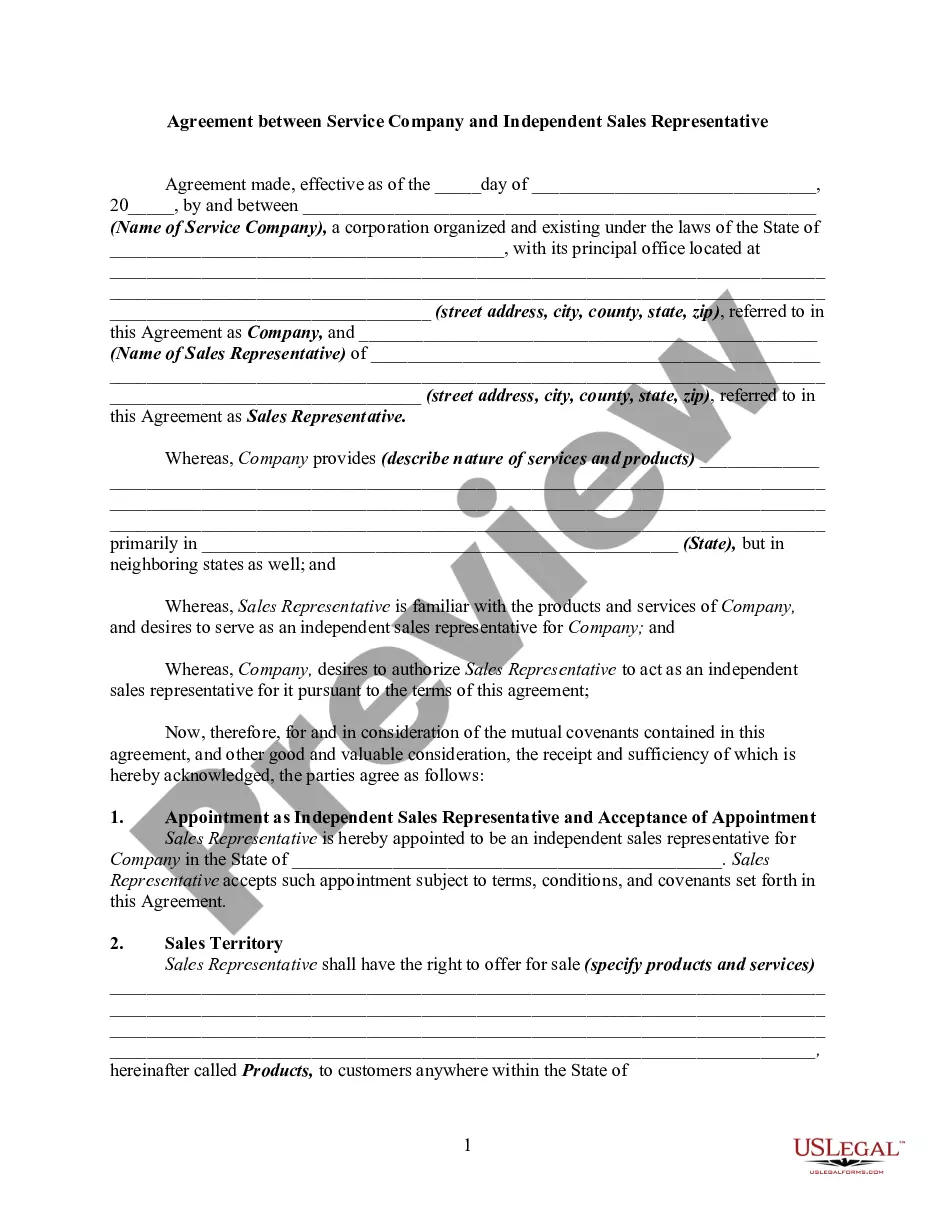
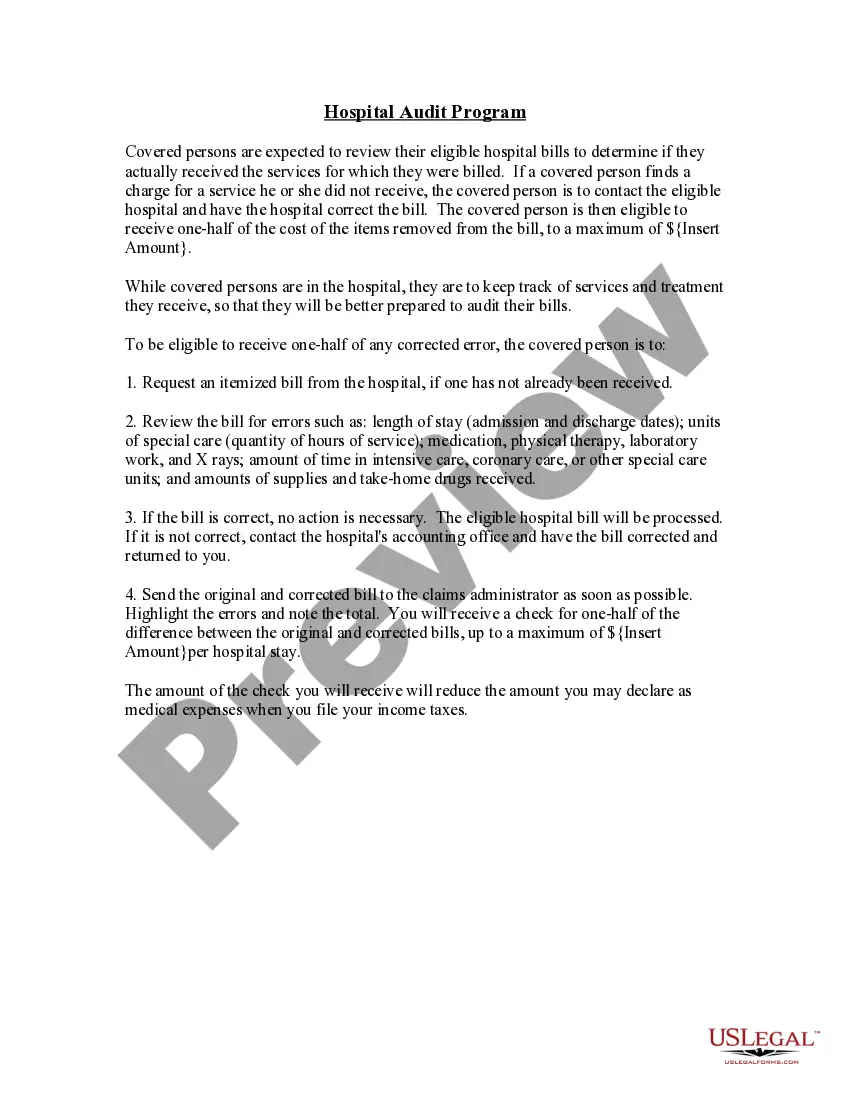
New Hampshire Hospital Audit Program
Description
Get your form ready online
Our built-in tools help you complete, sign, share, and store your documents in one place.
Make edits, fill in missing information, and update formatting in US Legal Forms—just like you would in MS Word.
Download a copy, print it, send it by email, or mail it via USPS—whatever works best for your next step.
Sign and collect signatures with our SignNow integration. Send to multiple recipients, set reminders, and more. Go Premium to unlock E-Sign.
If this form requires notarization, complete it online through a secure video call—no need to meet a notary in person or wait for an appointment.
We protect your documents and personal data by following strict security and privacy standards.

Make edits, fill in missing information, and update formatting in US Legal Forms—just like you would in MS Word.

Download a copy, print it, send it by email, or mail it via USPS—whatever works best for your next step.

Sign and collect signatures with our SignNow integration. Send to multiple recipients, set reminders, and more. Go Premium to unlock E-Sign.

If this form requires notarization, complete it online through a secure video call—no need to meet a notary in person or wait for an appointment.

We protect your documents and personal data by following strict security and privacy standards.
Looking for another form?
How to fill out Hospital Audit Program?
You have the ability to spend time online searching for the legal document template that meets the federal and state requirements you seek.
US Legal Forms provides thousands of legal forms that have been assessed by experts.
You can download or print the New Hampshire Hospital Audit Program from the platform.
If available, utilize the Preview option to review the document template as well.
- If you already possess a US Legal Forms account, you can sign in and select the Download option.
- Next, you can complete, modify, print, or sign the New Hampshire Hospital Audit Program.
- Each legal document template you obtain is yours forever.
- To acquire another copy of the downloaded form, visit the My documents section and click on the relevant option.
- If you are visiting the US Legal Forms website for the first time, follow the simple instructions below.
- First, ensure you have selected the appropriate document template for your preferred locale/city.
- Review the form description to confirm you have chosen the right form.
Form popularity
FAQ
Setting up an audit program involves several key steps. First, identify the objectives of the New Hampshire Hospital Audit Program and define the areas that require auditing. Next, develop a schedule and allocate resources, including staffing and tools, ensuring that your program aligns with regulatory requirements and improves overall hospital performance.
Internal audit conducts assurance audits through a five-phase process which includes selection, planning, conducting fieldwork, reporting results, and following up on corrective action plans.
Audit in healthcare is a process used by health professionals to assess, evaluate and improve care of patients in a systematic way. Audit measures current practice against a defined (desired) standard. It forms part of clinical governance, which aims to safeguard a high quality of clinical care for patients.
Audit in healthcare is a process used by health professionals to assess, evaluate and improve care of patients in a systematic way. Audit measures current practice against a defined (desired) standard. It forms part of clinical governance, which aims to safeguard a high quality of clinical care for patients.
Here are our top seven tips to prepare for a healthcare compliance audit.Examine your last risk assessment or prior audit results.Ensure you have an audit trail.Pull together the pieces of the audit's focus.Break down the audit scope into manageable pieces.More items...?
Audit ProcessStep 1: Planning. The auditor will review prior audits in your area and professional literature.Step 2: Notification.Step 3: Opening Meeting.Step 4: Fieldwork.Step 5: Report Drafting.Step 6: Management Response.Step 7: Closing Meeting.Step 8: Final Audit Report Distribution.More items...
CHOOSE A CLINICAL AUDIT TOPIC. Your topic should be chosen systematically.FORM A PROJECT TEAM.SET THE AIM, OBJECTIVES AND STANDARDS.ETHICS & ENGAGEMENT.SELECT AN AUDIT SAMPLE.PLAN AND CARRY OUT DATA COLLECTION.ANALYSE THE DATA.PRESENT THE FINDINGS.More items...
Preparing for an AuditPlanning for the audit. Planning is crucial, and additional time needs to be taken to adequately prepare for an audit.Keeping up with accounting standards.Assess organizational changes.Learn from the past.Develop a timeline and assign responsibilities.Organize data.
16 Steps for Conducting an Audit. By Leita Hart-Fanta, CPA.Receive vague audit assignment. Some auditors have it easier than others.Gather information about the audit subject.Determine audit criteria.Perform a risk assessment.Refine the objective.Choose the methodologies.Budget each methodology.
Random Audit A random audit is one of the most efficient and commonly used audit types, designed to get a glimpse of the medical organization and the way it functions.