New Hampshire Acknowledgment for Person Signing in Representative Capacity
Overview of this form
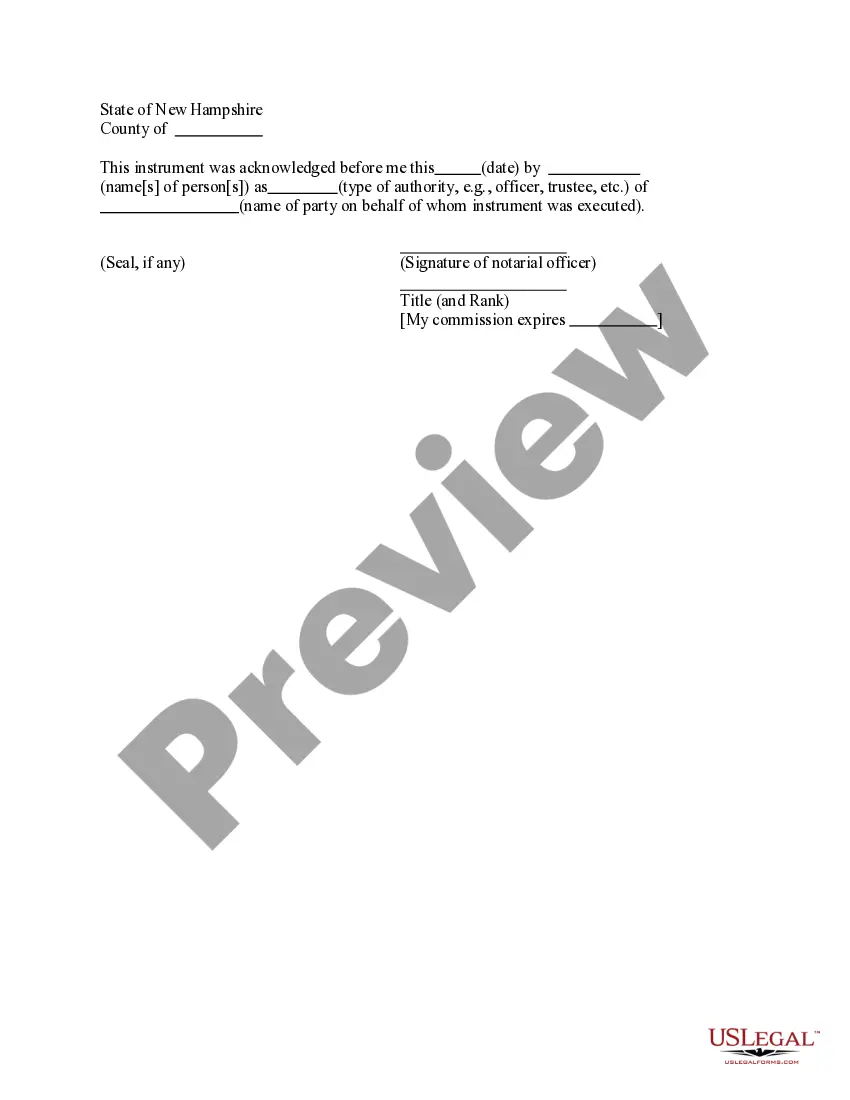
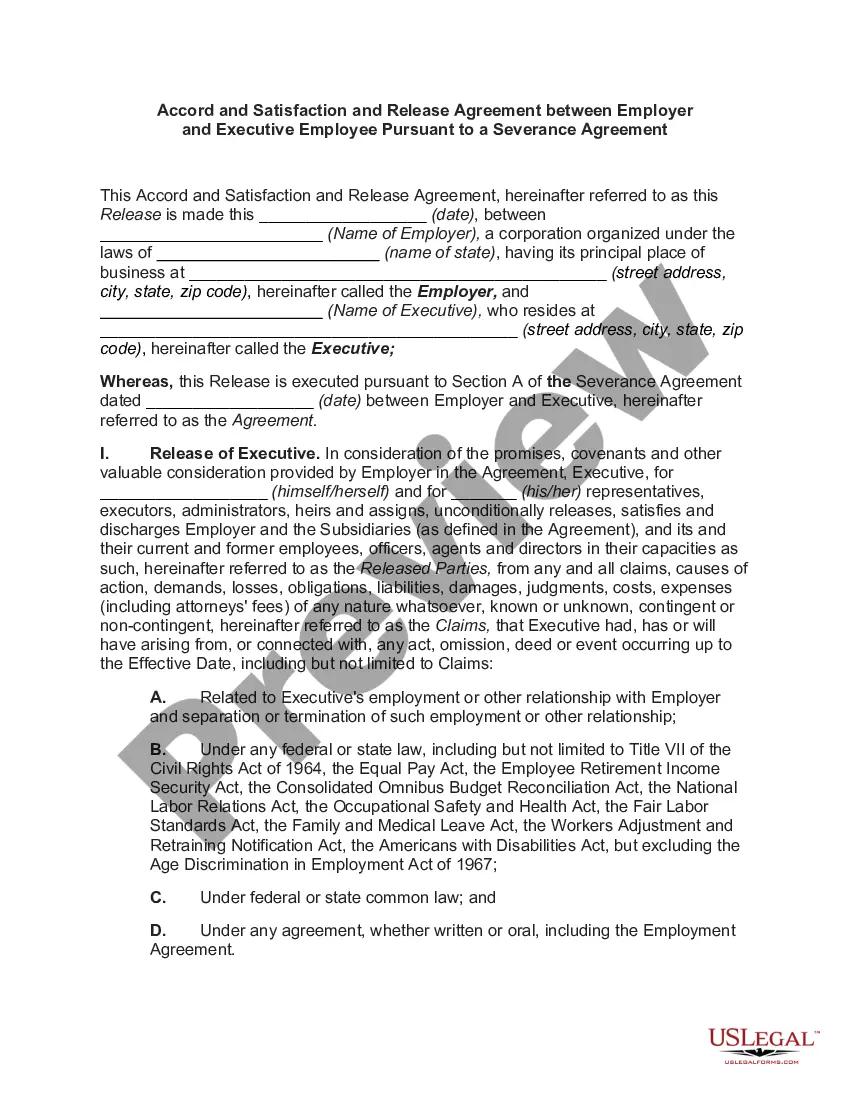
The Acknowledgment for Person Signing in Representative Capacity is a legal document used to verify that an individual is signing on behalf of another party less than their own authority. This form is essential in ensuring that the signatures on legal documents are valid and binding by confirming that the person signing has the necessary authority to do so. Unlike standard signature acknowledgment forms, this document specifically addresses those who act as representatives, affirming their capacity and authority in the matter.
Form components explained
- Date of acknowledgment
- Name of the individual signing
- Type of authority (such as officer or trustee)
- Name of the party being represented
- Signature of the notarial officer, if applicable
- Seal, if required

Situations where this form applies
This form should be used when an individual is signing a document on behalf of another entity, such as a corporation or trust. Typical scenarios include corporate resolutions, trust agreements, or any situation where the signer is not acting in their personal capacity. Using this acknowledgment helps prevent disputes regarding the authority of the signatory.
Who can use this document
This form is suitable for:
- Corporate officers signing documents on behalf of their company
- Trustees executing documents for a trust
- Attorneys-in-fact under a power of attorney
- Any representative acting on behalf of another party
How to prepare this document
- Identify the date when the acknowledgment is being made.
- Complete the name of the person signing on behalf of another party.
- Specify the type of authority under which the individual is signing.
- Enter the name of the party on whose behalf the document is being executed.
- Ensure to provide the signature of the notary if required.
- Obtain and add any necessary seals pertinent to the signing process.
Does this document require notarization?
To make this form legally binding, it must be notarized. Our online notarization service, powered by Notarize, lets you verify and sign documents remotely through an encrypted video session.
Get your form ready online
Our built-in tools help you complete, sign, share, and store your documents in one place.
Make edits, fill in missing information, and update formatting in US Legal Forms—just like you would in MS Word.
Download a copy, print it, send it by email, or mail it via USPS—whatever works best for your next step.
Sign and collect signatures with our SignNow integration. Send to multiple recipients, set reminders, and more. Go Premium to unlock E-Sign.
If this form requires notarization, complete it online through a secure video call—no need to meet a notary in person or wait for an appointment.
We protect your documents and personal data by following strict security and privacy standards.

Make edits, fill in missing information, and update formatting in US Legal Forms—just like you would in MS Word.

Download a copy, print it, send it by email, or mail it via USPS—whatever works best for your next step.

Sign and collect signatures with our SignNow integration. Send to multiple recipients, set reminders, and more. Go Premium to unlock E-Sign.

If this form requires notarization, complete it online through a secure video call—no need to meet a notary in person or wait for an appointment.

We protect your documents and personal data by following strict security and privacy standards.
Mistakes to watch out for
- Failing to specify the type of authority of the signer.
- Not including the required date of acknowledgment.
- Omitting the notary's signature where applicable.
- Using the form without confirming the authority of the signer.
Why complete this form online
- Convenient access to a legally vetted template, eliminating confusion.
- Editability allows users to customize the form as necessary.
- Reliable format ensures completeness and legal compliance.
Legal use & context
- This form is legally recognized across various jurisdictions.
- Failure to properly acknowledge representation may lead to disputes regarding the validity of the document.
- It ensures the accountability of the signer acting on behalf of another entity.
Key takeaways
- The form serves to validate the signing authority of a representative.
- It is important to complete the form accurately to avoid legal issues.
- Online notarization options can streamline the process for users.
Looking for another form?

Form popularity
FAQ
While notarizing for a parent is not prohibited, as suggested in Article II-B-5 of The Notary Public Code Of Professional Responsibility the NNA recommends that you not notarize for a parent, sibling or other family members related by heredity or marriage because the financial affairs of family members are often
A notary public who has a direct or indirect financial (or other beneficial) interest in a document may not notarize such a document. The better practice is not to notarize for a spouse or family member in order to preserve the integrity of the notarization and to prevent a challenge to the notarization.
For an acknowledgment, the signer must always: Be positively identified by the Notary. The Notary must always identify the signer for an acknowledgement; whether the signer personally knows the Notary, presents an ID document, or is identified by a credible witness depends on the circumstances.
Step 1: Require Personal Appearance. Step 2: Check Over The Document. Step 3: Carefully Identify The Signer. Step 4: Record Your Journal Entry. Step 5: Complete The Notarial Certificate. A Last Note: Never Give Advice.
An acknowledgment is a formal declaration before an authorized official such as a notary, by a person who has signed a document, that the document is his or her act. Acknowledgments are governed by the Uniform Acknowledgment Act. The person acknowledging the document must personally appear before the notary.
When you see (here insert the name and character of the officer) next to a blank as shown below, it means you should insert Your name, Notary Public in the blank.
For an acknowledgment, the signer must always: Be positively identified by the Notary. The Notary must always identify the signer for an acknowledgement; whether the signer personally knows the Notary, presents an ID document, or is identified by a credible witness depends on the circumstances.
They key difference is that for a signature witnessing, the signer must always sign the document in the Notary's presence.An acknowledgment, on the other hand, does not require the Notary to witness the signature in most states (one exception is Maryland).
As long as the signer is personally present before the notary and acknowledges the signature, then the notary can proceed with performing the notarial act.If the document has already been signed, the signer can sign his or her name again above or next to the first signature. You can then proceed with the notarization.