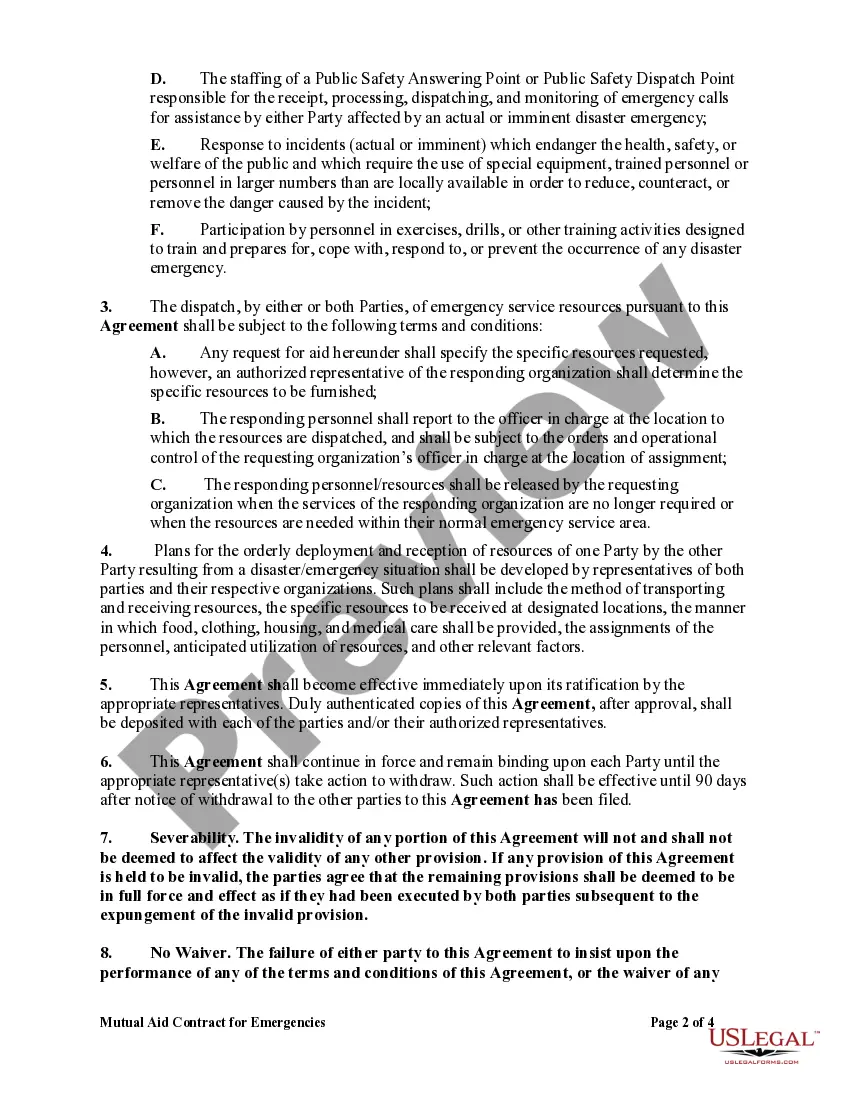
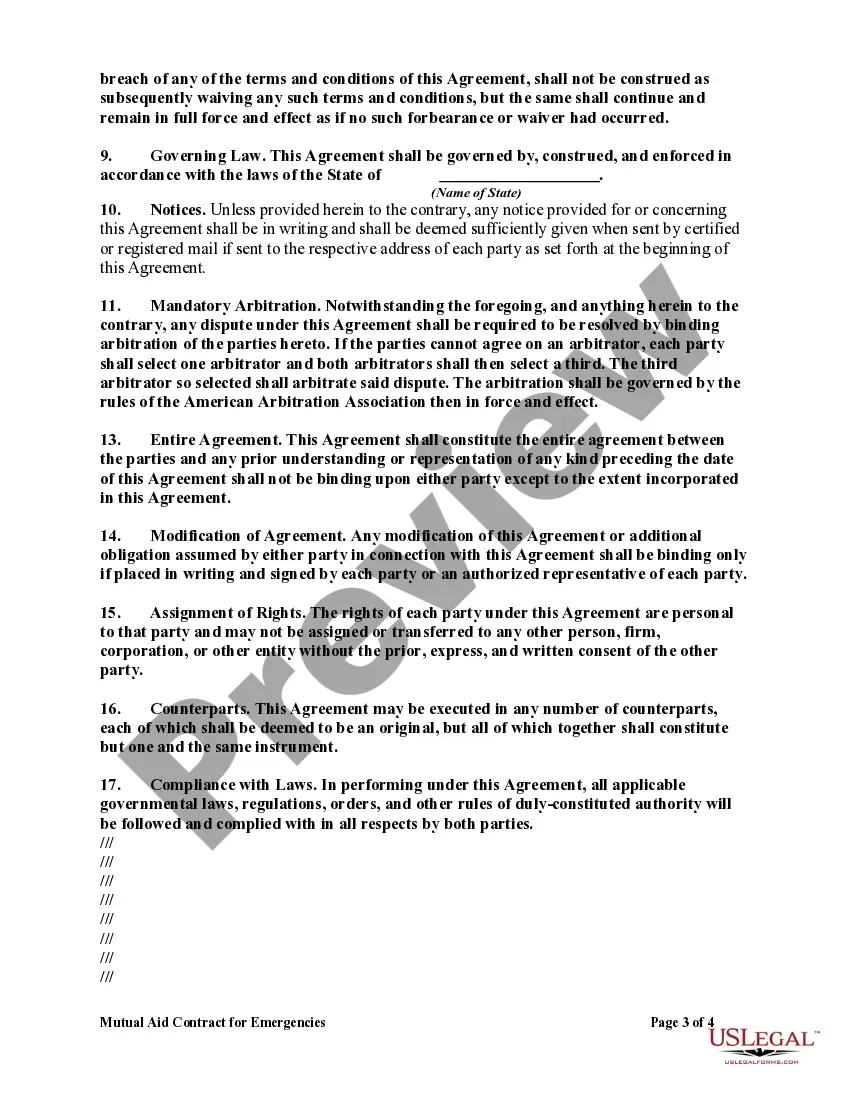
Nebraska Mutual Aid Contract for Emergencies
Description


Get your form ready online
Our built-in tools help you complete, sign, share, and store your documents in one place.
Make edits, fill in missing information, and update formatting in US Legal Forms—just like you would in MS Word.
Download a copy, print it, send it by email, or mail it via USPS—whatever works best for your next step.
Sign and collect signatures with our SignNow integration. Send to multiple recipients, set reminders, and more. Go Premium to unlock E-Sign.
If this form requires notarization, complete it online through a secure video call—no need to meet a notary in person or wait for an appointment.
We protect your documents and personal data by following strict security and privacy standards.

Make edits, fill in missing information, and update formatting in US Legal Forms—just like you would in MS Word.

Download a copy, print it, send it by email, or mail it via USPS—whatever works best for your next step.

Sign and collect signatures with our SignNow integration. Send to multiple recipients, set reminders, and more. Go Premium to unlock E-Sign.

If this form requires notarization, complete it online through a secure video call—no need to meet a notary in person or wait for an appointment.

We protect your documents and personal data by following strict security and privacy standards.
Looking for another form?

How to fill out Mutual Aid Contract For Emergencies?
US Legal Forms - one of the most prominent collections of legal documents in the United States - provides a vast array of legal paperwork categories that you can download or create.
Using the platform, you can access countless forms for business and personal purposes, organized by categories, suggestions, or keywords. You can find the latest versions of forms like the Nebraska Mutual Aid Contract for Emergencies in just a few minutes.
If you have a subscription, sign in and download the Nebraska Mutual Aid Contract for Emergencies from the US Legal Forms library. The Download button will be visible on every form you view. You can access all previously acquired forms in the My documents section of your account.
Complete the transaction. Use your credit card or PayPal account to finalize the purchase.
Choose the format and download the form to your device. Fill in, modify, print, and sign the downloaded Nebraska Mutual Aid Contract for Emergencies. All templates you have added to your account have no expiration date and are yours permanently. Therefore, to download or print another copy, simply go to the My documents section and click on the form you need. Access the Nebraska Mutual Aid Contract for Emergencies with US Legal Forms, the most comprehensive source of legal document themes. Utilize a wide selection of professional and state-specific templates that meet your business or personal requirements.
- Ensure you have chosen the correct form for your area/county.
- Click on the Review button to examine the content of the form.
- Check the description of the form to verify you have selected the correct one.
- If the form does not meet your requirements, utilize the Search feature at the top of the page to find an appropriate one.
- Once you are satisfied with the form, confirm your selection by clicking the Purchase now button.
- Then, choose your preferred pricing plan and provide your details to register for an account.
Form popularity
FAQ
ICS in FEMA stands for the Incident Command System, which is a key component of effective emergency management. It provides a structured approach for managing incidents, allowing agencies to work together more efficiently. The Nebraska Mutual Aid Contract for Emergencies integrates ICS principles to ensure that mutual aid is effectively coordinated across jurisdictions.
A mutual aid pact refers to a formal agreement between entities to assist one another during emergencies. This cooperation can include sharing personnel, equipment, and expertise, enhancing overall response efforts. The Nebraska Mutual Aid Contract for Emergencies exemplifies such pacts by fostering collaboration among agencies in crisis situations.
Three key features of a mutual aid agreement include clear definitions of resources, established communication protocols, and guidelines for accountability. These components ensure that all participating parties understand their roles and responsibilities. The Nebraska Mutual Aid Contract for Emergencies provides a comprehensive outline for these features, promoting effective collaboration.
A mutual aid agreement FEMA is a framework established for local and state governments to assist each other in emergencies. This agreement facilitates resource sharing and coordinated response efforts. The Nebraska Mutual Aid Contract for Emergencies aligns with FEMA guidelines, ensuring that agencies can work together seamlessly during disaster response.
The ICS mutual aid agreement is a formal understanding that outlines how agencies will assist one another during incidents. It establishes protocols for resource sharing, communication, and joint operations. By utilizing the Nebraska Mutual Aid Contract for Emergencies, agencies can create effective ICS mutual aid agreements that enhance collective response capabilities.
A best practice for updating your mutual aid agreement is to conduct regular reviews and revisions based on changing needs and experiences from past emergencies. Engaging with all stakeholders to gather feedback is essential for this process. The Nebraska Mutual Aid Contract for Emergencies encourages periodic assessments to ensure effectiveness and relevance.
The initial step in creating a mutual aid agreement involves identifying the parties who will participate in the agreement. This includes assessing the needs of each entity and defining the resources they can offer. The Nebraska Mutual Aid Contract for Emergencies simplifies this process by providing templates and guidance for establishing robust agreements.
The Incident Command System (ICS) provides a standardized approach to handling emergencies. It ensures effective coordination among various agencies, allowing them to work collaboratively during incidents. The Nebraska Mutual Aid Contract for Emergencies leverages this system to streamline mutual assistance, enhancing preparedness and response.
Automatic aid involves a pre-arranged response where resources are dispatched without a request during incidents. In contrast, mutual aid requires a formal request for assistance based on the Nebraska Mutual Aid Contract for Emergencies. Understanding these differences helps entities determine the appropriate action to take during an emergency.
Mutual aid agreements are typically established by state and local emergency management agencies. These agreements ensure cooperation and resource sharing among various jurisdictions during emergencies. The Nebraska Mutual Aid Contract for Emergencies serves as a framework that guides these agreements, promoting collaboration within the state.