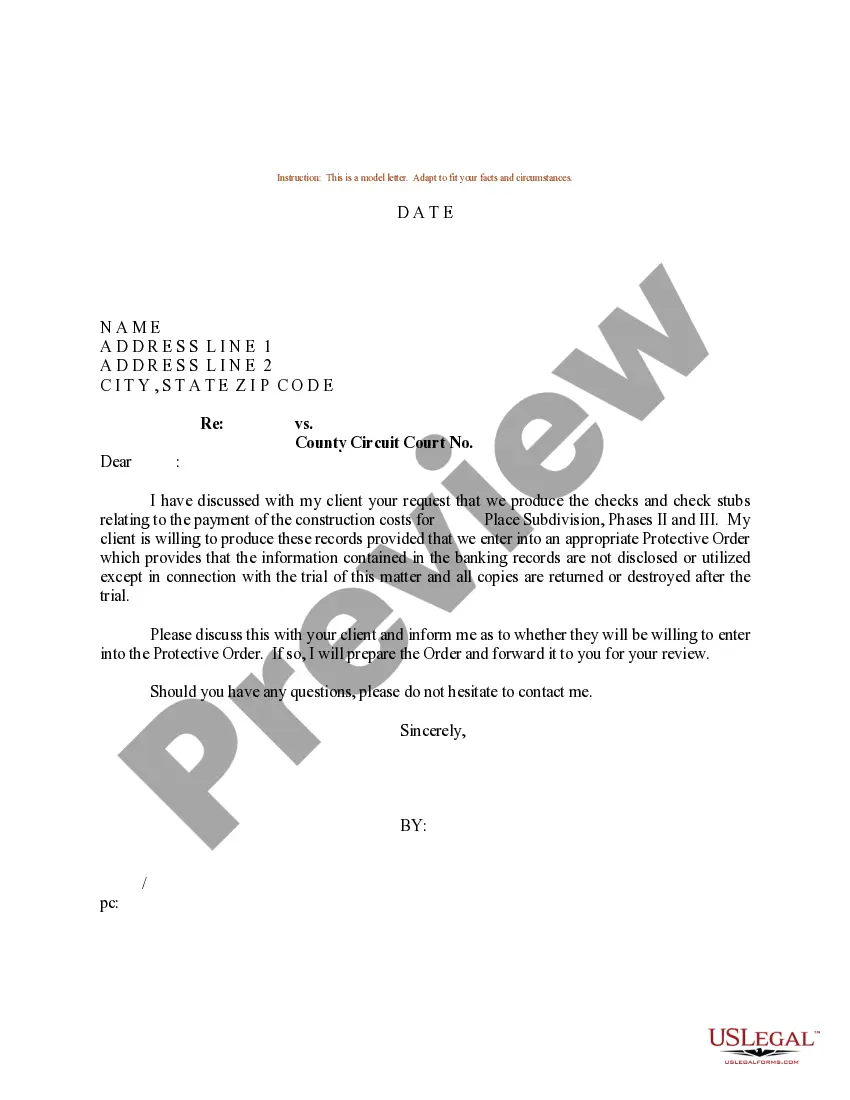
Letter from attorney to opposing counsel requesting documentation concerning homestead exemption for change of venue motion.
Nebraska Sample Letter for Change of Venue and Request for Homestead Exemption
Instant download
Description






How to fill out Sample Letter For Change Of Venue And Request For Homestead Exemption?
It is feasible to dedicate numerous hours online trying to locate the official document template that meets the state and federal standards you require.
US Legal Forms offers thousands of legal forms that are reviewed by experts.
You can easily download or print the Nebraska Sample Letter for Change of Venue and Request for Homestead Exemption from their services.
- If you already have a US Legal Forms account, you can Log In and click on the Acquire button.
- After that, you can complete, modify, print, or sign the Nebraska Sample Letter for Change of Venue and Request for Homestead Exemption.
- Every legal document template you buy is yours forever.
- To obtain another copy of the purchased form, go to the My documents tab and click on the relevant button.
- If you are using the US Legal Forms website for the first time, follow the simple instructions below.
- First, ensure that you have selected the correct document template for the area/region of your choice.
- Read the form description to make sure you have chosen the right form.
- If available, use the Review button to browse through the document template as well.
- If you want to find another version of the form, use the Lookup field to find the template that fits your needs and specifications.
- Once you have located the template you want, click Get now to proceed.
- Select the pricing plan you prefer, enter your details, and register for an account on US Legal Forms.
- Complete the transaction. You can use your credit card or PayPal account to purchase the legal form.
- Choose the format of the document and download it to your device.
- Make edits to the document if necessary.
- You can complete, modify, sign, and print the Nebraska Sample Letter for Change of Venue and Request for Homestead Exemption.
- Obtain and print thousands of document templates using the US Legal Forms website, which offers the largest selection of legal forms.
- Utilize professional and state-specific templates to address your business or personal needs.
Form popularity
FAQ
In Nebraska, the homestead exemption typically applies to residential properties, with a maximum acreage limit of one acre in urban areas or up to 160 acres in rural areas. This exemption aims to support homeowners by reducing their taxable property value. If you need assistance with the application process, consider using the Nebraska Sample Letter for Change of Venue and Request for Homestead Exemption as a helpful resource. For the most accurate information regarding your specific situation, always check with your local county assessor.
In Nebraska, seniors aged 65 or older may qualify for property tax relief programs, which can significantly reduce their tax burden. While seniors do not completely stop paying property taxes, these programs can provide substantial exemptions or credits. Utilizing the Nebraska Sample Letter for Change of Venue and Request for Homestead Exemption may help seniors navigate the application process for such benefits. It's advisable to consult your local tax authority for specific eligibility requirements and available options.
Transferring your homestead exemption in Nebraska involves notifying your local county assessor of your move and completing the necessary paperwork. You will need to provide documentation that proves your new residence is your primary home. Using the Nebraska Sample Letter for Change of Venue and Request for Homestead Exemption can assist you in clearly communicating your intentions and ensuring a smooth transfer. Check with your local assessor for additional details on the required forms and deadlines.
In Nebraska, the homestead exemption allows eligible homeowners to exempt a portion of their property's value from taxation. To qualify, homeowners must occupy the property as their primary residence and meet certain income and age criteria. The Nebraska Sample Letter for Change of Venue and Request for Homestead Exemption can help streamline the process of applying for or renewing this exemption. It’s essential to stay informed about the specific requirements each year to ensure you maintain your benefits.
Contact your county assessor for assistance. For more information contact your local county assessor's office, or see revenue.nebraska.gov/PAD, or call 888-475-5101.
A homestead not exceeding sixty thousand dollars in value shall consist of the dwelling house in which the claimant resides, its appurtenances, and the land on which the same is situated, not exceeding one hundred and sixty acres of land, to be selected by the owner, and not in any incorporated city or village, or, at ...
To qualify for a homestead exemption under this category, an individual must: ? Be 65 or older before January 1 of the application year; ? Own and occupy a homestead continuously from January 1 through August 15; and ? Have qualifying household income ? see Table I. Maximum Exempt Amount.
The form must be filed with the Sarpy County Assessor's Office between Feb. 2, 2023 and June 30, 2023. Find Form 458 here. The homestead exemption provides relief from property taxes by exempting all or a portion of the taxable value of the residence.
Homestead Exemption Categories There are no income limits and homestead value requirements for categories 4 and 5. The State of Nebraska reimburses counties and other governmental subdivisions for the reduction in tax revenue as a result of approved homestead exemptions.
Homestead Exemption ? Nebraska Homestead Exemption is a property tax relief program for qualifying homeowners, including veterans totally disabled by a service-connected accident or illness, qualified totally disabled veterans or their surviving spouse, and veterans whose home was substantially contributed to by the ...