Nebraska Order for Default Judgment
What is this form?
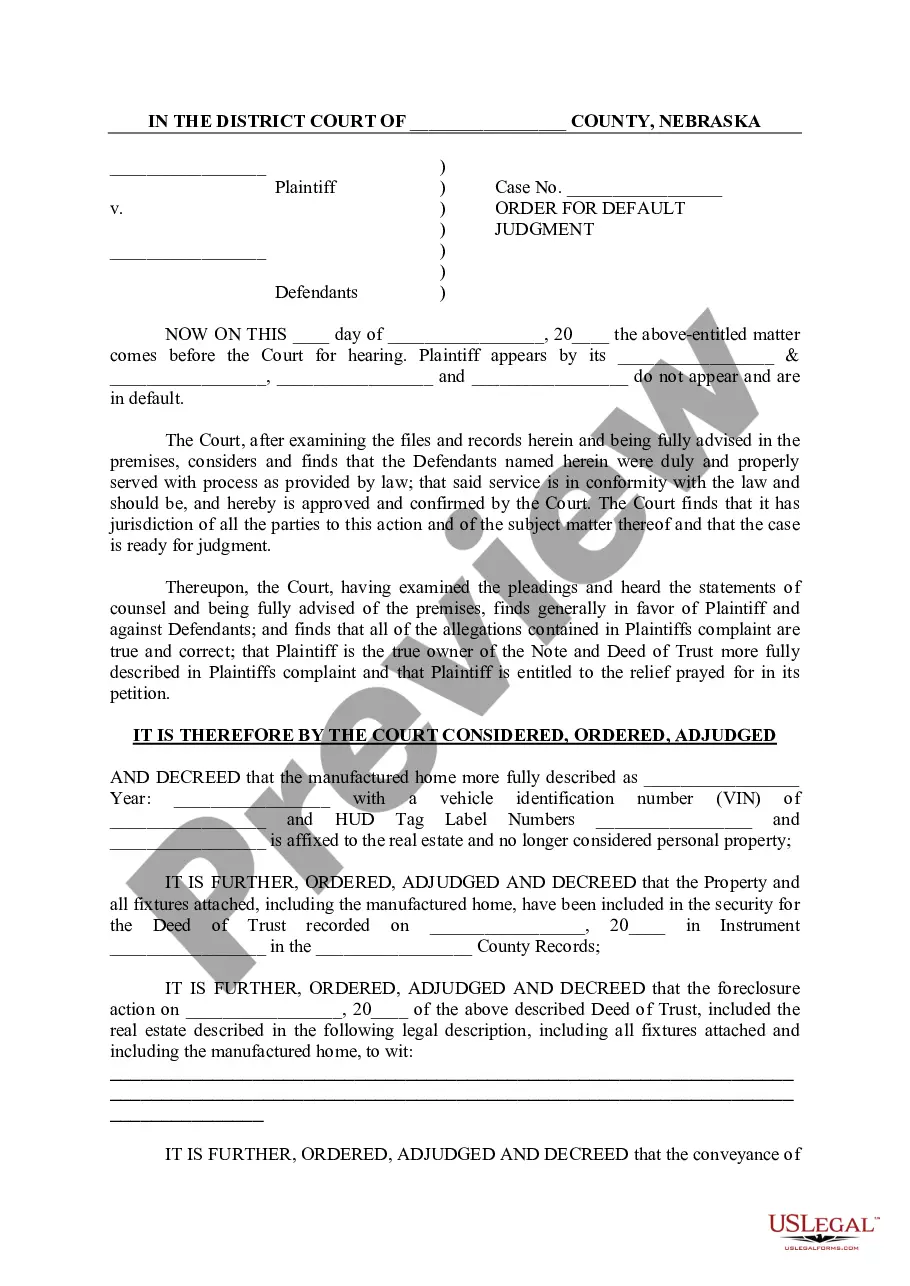
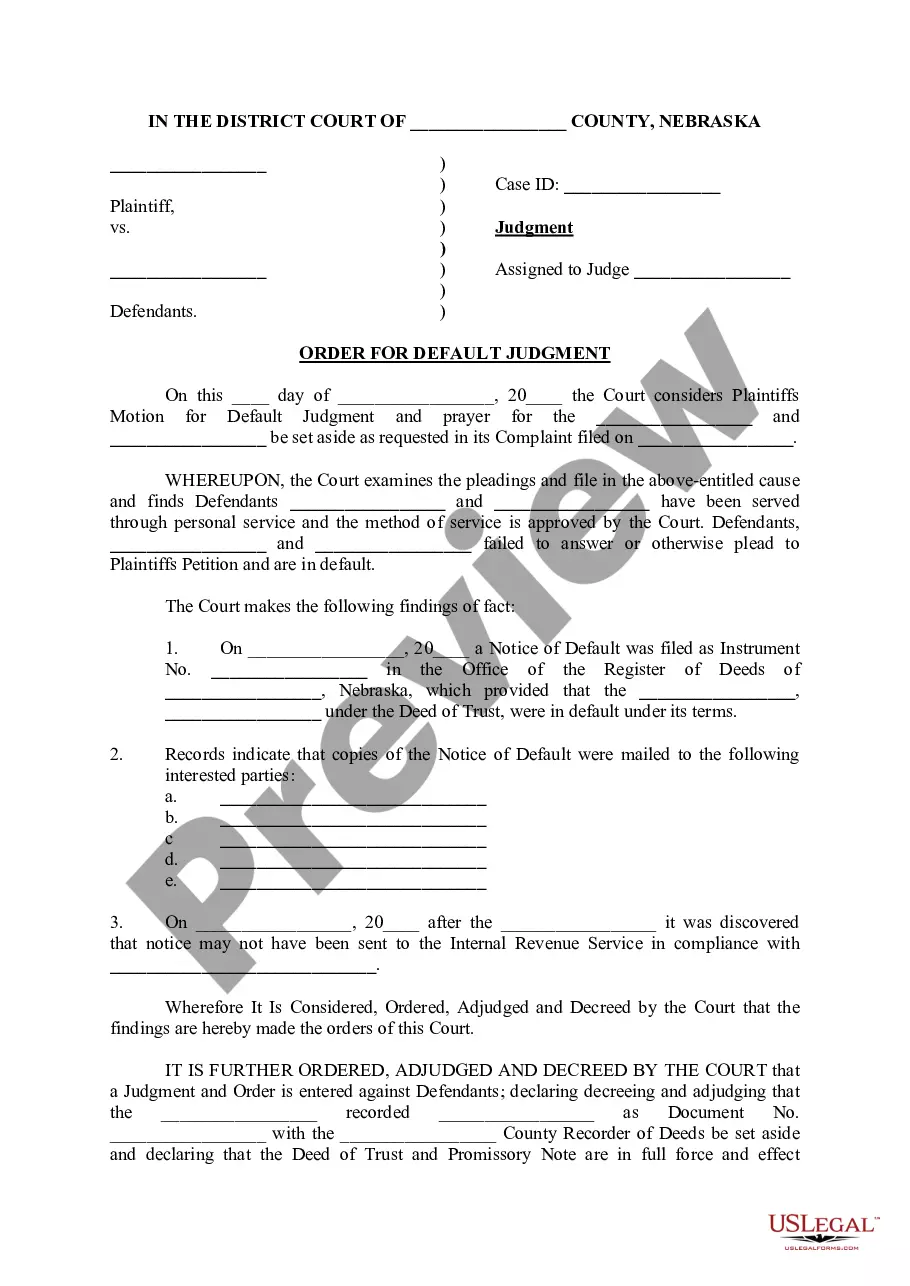
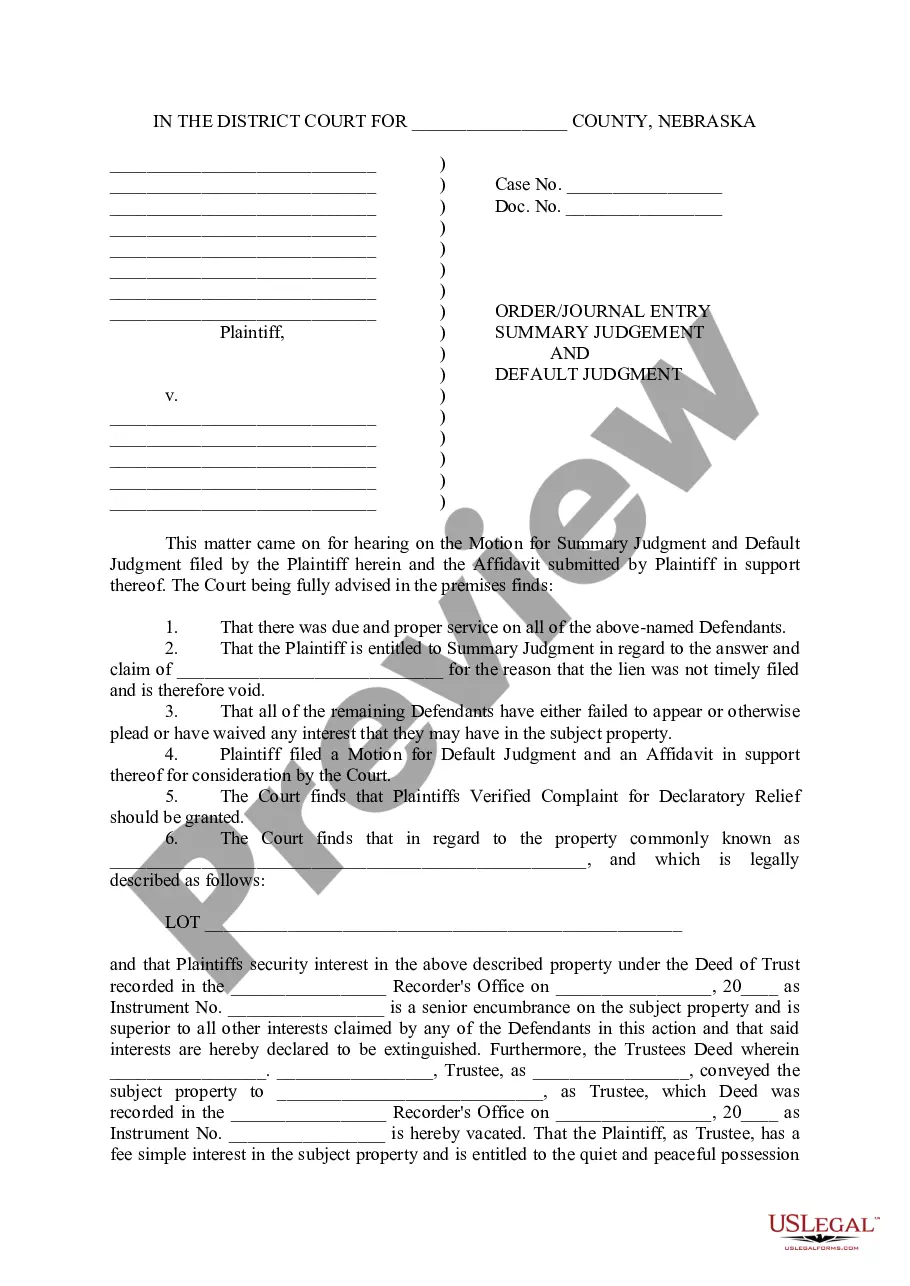
The Order for Default Judgment is a legal document issued by a court to formalize a judgment in a foreclosure case involving a manufactured home. This form is distinct as it confirms that the defendants have failed to respond or appear in court, resulting in a judgment in favor of the plaintiff. It serves as a legal determination that the property is now considered part of the real estate rather than personal property.
Key parts of this document
- Identifying information for the court, plaintiff, and defendants.
- Date of the hearing for the default judgment.
- Findings of the court regarding service of process and jurisdiction.
- Description of the manufactured home and its attachment to the property.
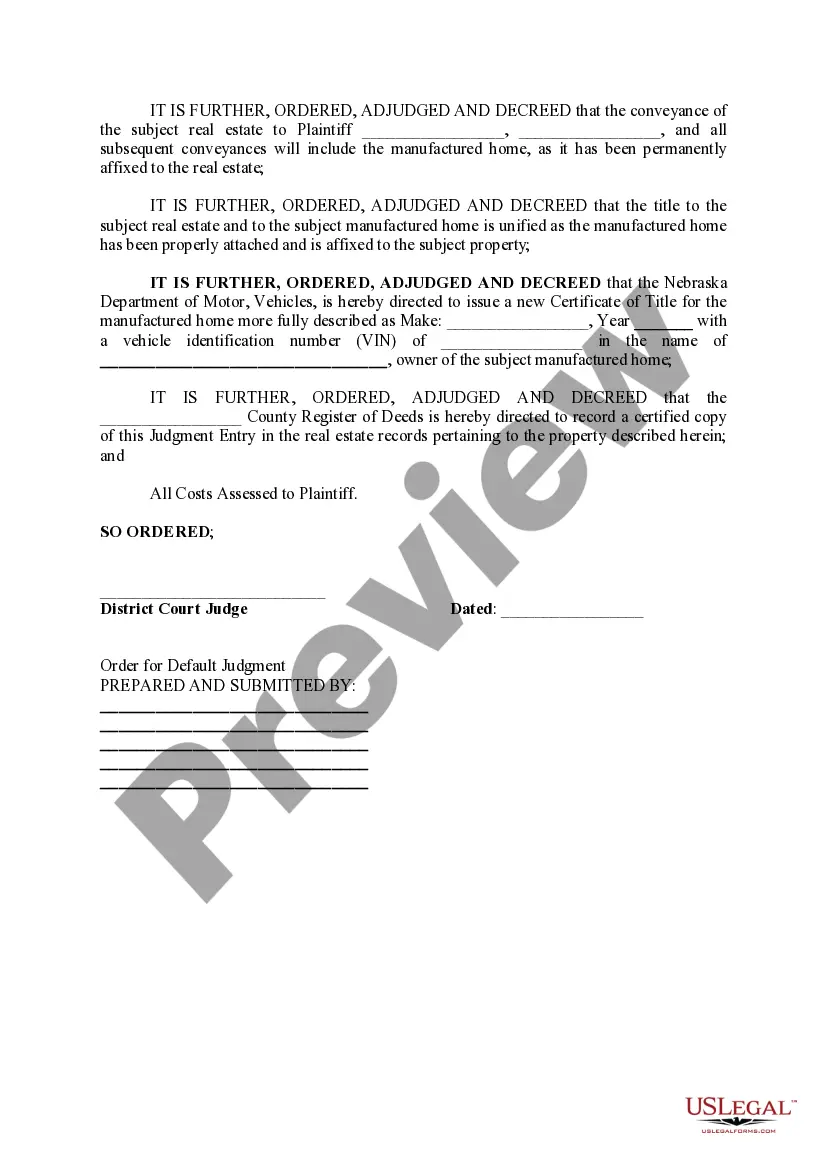
- Orders concerning the issuance of a new certificate of title for the manufactured home.
- Instructions for recording the judgment entry in real estate records.
When to use this form
This form is used when a plaintiff has filed a foreclosure action against a manufactured home and the defendants have failed to respond, resulting in a default. It is necessary to obtain a legal decision that allows the plaintiff to proceed with foreclosure and take possession of the property according to state law. This circumstance typically arises in cases where the homeowner has stopped making payments and has not attended court proceedings.
Intended users of this form
- Homeowners facing foreclosure who have not responded to a lawsuit.
- Plaintiffs (lenders or mortgage holders) seeking to secure a default judgment.
- Real estate attorneys representing clients in foreclosure actions.
Instructions for completing this form
- Identify and enter the court name, county, and case number at the top of the form.
- Specify the date of the hearing and the representation of the plaintiff.
- Provide a thorough description of the manufactured home, including its VIN and HUD tag numbers.
- Complete the orders regarding property classification and title issuance for the manufactured home.
- Have the judge sign and date the document to finalize the order.
Does this document require notarization?
This form does not typically require notarization unless specified by local law. Review court requirements or consult an attorney to ensure compliance with any specific rules applicable to your case.
Get your form ready online
Our built-in tools help you complete, sign, share, and store your documents in one place.
Make edits, fill in missing information, and update formatting in US Legal Forms—just like you would in MS Word.
Download a copy, print it, send it by email, or mail it via USPS—whatever works best for your next step.
Sign and collect signatures with our SignNow integration. Send to multiple recipients, set reminders, and more. Go Premium to unlock E-Sign.
If this form requires notarization, complete it online through a secure video call—no need to meet a notary in person or wait for an appointment.
We protect your documents and personal data by following strict security and privacy standards.

Make edits, fill in missing information, and update formatting in US Legal Forms—just like you would in MS Word.

Download a copy, print it, send it by email, or mail it via USPS—whatever works best for your next step.

Sign and collect signatures with our SignNow integration. Send to multiple recipients, set reminders, and more. Go Premium to unlock E-Sign.

If this form requires notarization, complete it online through a secure video call—no need to meet a notary in person or wait for an appointment.

We protect your documents and personal data by following strict security and privacy standards.
Common mistakes to avoid
- Failing to properly include all necessary information about the defendants.
- Not accurately describing the manufactured home and its affixation to the property.
- Omitting the signature of the judge, which renders the judgment invalid.
- Misunderstanding the timeline for filing the form after a defendant has defaulted.
Why complete this form online
- Convenient access to legal forms from anywhere with an internet connection.
- Easy to edit and customize based on your specific legal needs.
- Reliable templates drafted by licensed attorneys to ensure legal compliance.
- Fast download options to get the necessary forms quickly for your case.
Looking for another form?
Form popularity
FAQ
Default judgment is a binding judgment in favor of either party based on some failure to take action by the other party. Most often, it is a judgment in favor of a plaintiff when the defendant has not responded to a summons or has failed to appear before a court of law. The failure to take action is the default.
Default judgments happen when you don't respond to a lawsuit often from a debt collector and a judge resolves the case without hearing your side.Next up could be wage garnishment or a bank account levy, which allows a creditor to remove money from your bank accounts to repay the debt.
A default judgment means that the court has decided that you owe money. This a result of the person suing you in small claims court and you failed to appear at the hearing.
After you notify the defendant of the judgment, you can begin to enforce the judgment. Your judgment might be for money, repossession, eviction, foreclosure, or any number of things. In any case, your rights at this point would be the same as if you had gone to trial and won.
First, you can ask the court to set aside the default judgment and give you an opportunity to contest it. Next, you can settle the debt with the debt buyer for an amount less than what the default judgment is for. And finally you can eliminate the default judgment completely by filing for bankruptcy.