Nebraska Assignment of Lien - Individual
Overview of this form
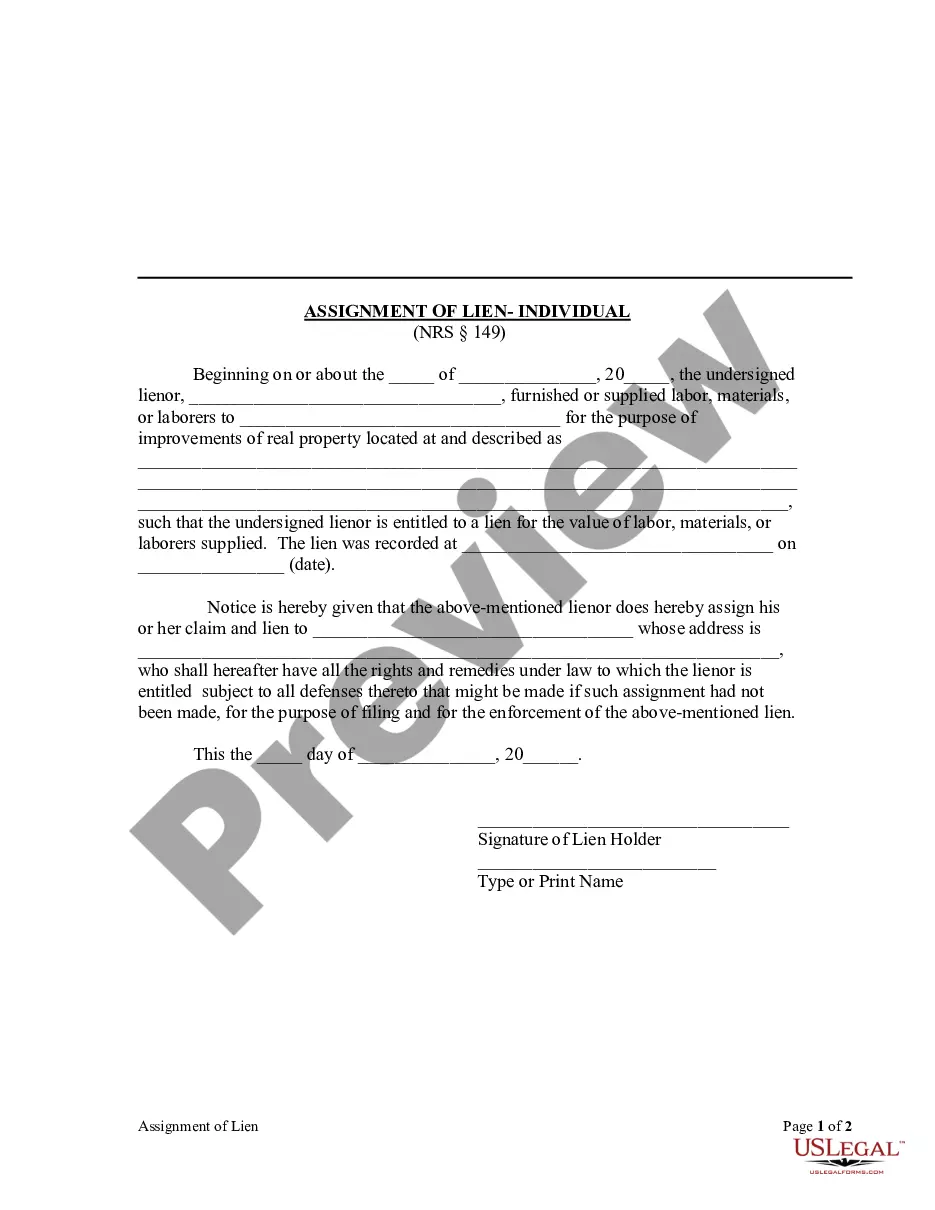
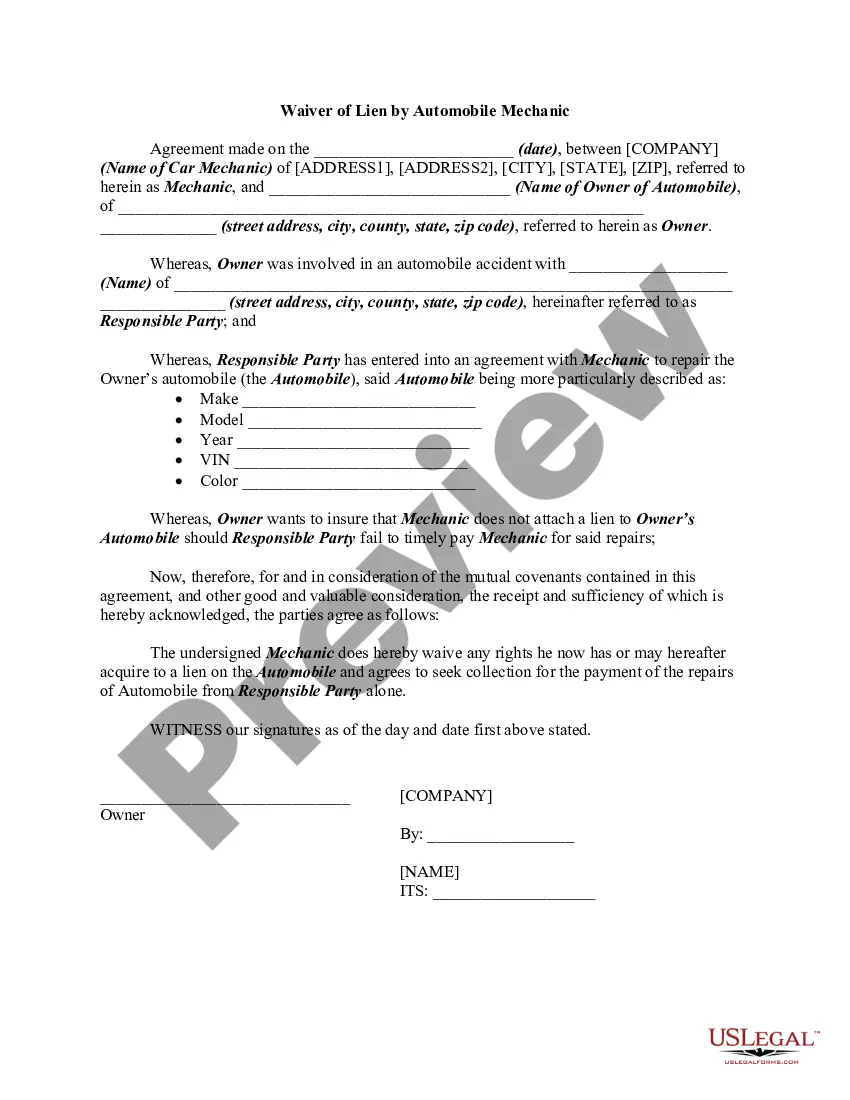
The Assignment of Lien - Individual is a legal document used by individuals who have provided labor, materials, or services for the improvement of real property. It serves to formally transfer the right to claim a lien from the original lienor to an assignee. This form allows the lienor to inform relevant parties that their claim has been assigned, ensuring that the assignee retains all legal rights associated with the lien. Unlike other lien-related forms, this document specifically caters to individual lienors rather than businesses or property owners.
Key parts of this document
- Identification of the lienor and the property involved.
- Details of the labor or materials supplied.
- Recording information of the original lien.
- Information of the assignee including name and address.
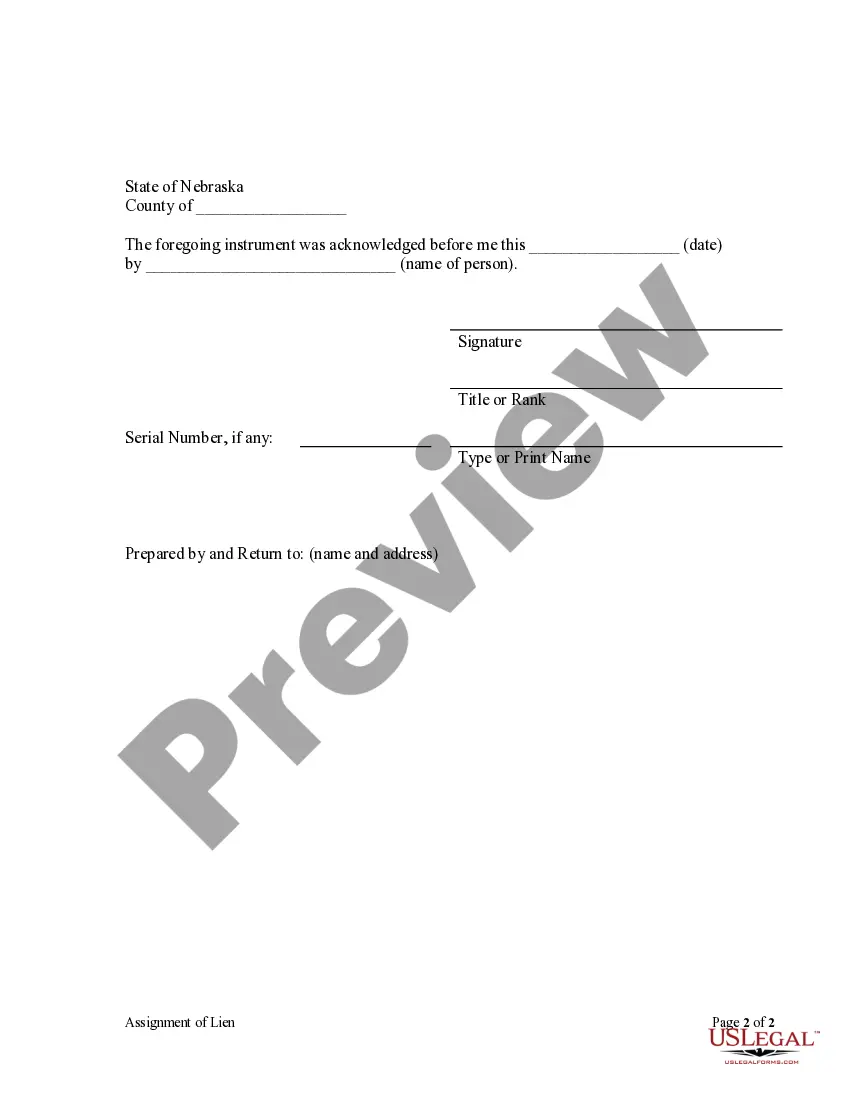
- Acknowledgment section for notarization.
When to use this document
You should use the Assignment of Lien - Individual when you have provided labor or materials for a property improvement project and wish to assign your lien rights to another party. This is particularly important if you want the assignee to take over the responsibilities of enforcing the lien or filing related claims. Common situations include subcontractors needing to transfer their claims to contractors or individuals selling their lien rights for financial reasons.
Who this form is for
- Individuals who provided labor, services, or materials for property enhancement.
- Liens holders looking to assign their claims to another party.
- Contractors or subcontractors involved in construction or remodeling projects.
- Anyone needing to formalize the assignment of their legal rights associated with a lien.
How to complete this form
- Identify the lienor by entering their name at the top of the form.
- Specify the property involved, including its location and description.
- Enter the details of the labor, materials, or services supplied.
- Fill in the date the original lien was recorded.
- Provide the name and address of the assignee.
- Sign and date the document in the designated section, and arrange for notarization if necessary.
Notarization guidance
Notarization is required for this form to take effect. Our online notarization service, powered by Notarize, lets you verify and sign documents remotely through an encrypted video session, available 24/7.
Get your form ready online
Our built-in tools help you complete, sign, share, and store your documents in one place.
Make edits, fill in missing information, and update formatting in US Legal Forms—just like you would in MS Word.
Download a copy, print it, send it by email, or mail it via USPS—whatever works best for your next step.
Sign and collect signatures with our SignNow integration. Send to multiple recipients, set reminders, and more. Go Premium to unlock E-Sign.
If this form requires notarization, complete it online through a secure video call—no need to meet a notary in person or wait for an appointment.
We protect your documents and personal data by following strict security and privacy standards.

Make edits, fill in missing information, and update formatting in US Legal Forms—just like you would in MS Word.

Download a copy, print it, send it by email, or mail it via USPS—whatever works best for your next step.

Sign and collect signatures with our SignNow integration. Send to multiple recipients, set reminders, and more. Go Premium to unlock E-Sign.

If this form requires notarization, complete it online through a secure video call—no need to meet a notary in person or wait for an appointment.

We protect your documents and personal data by following strict security and privacy standards.
Typical mistakes to avoid
- Failing to include complete property descriptions.
- Not providing accurate dates or information about the original lien.
- Neglecting to have the form notarized when required.
- Incorrectly identifying the assignee or lienor.
Benefits of completing this form online
- Convenient access to legally compliant templates without visiting a lawyer.
- Easy editing capabilities to customize the form for specific needs.
- Fast download and preparation for immediate use.
- Reliable updates ensure the form meets current legal standards.
Quick recap
- The Assignment of Lien - Individual allows you to assign your lien rights to another party.
- This form is essential for individuals involved in property improvements who seek to transfer their claims.
- Notarization is required for legal validity.
- Ensure all information provided is accurate and complete to avoid legal issues.
Looking for another form?


Form popularity
FAQ
There, a construction lien on a commercial project must be filed with a county clerk within 90 days of the last day services or materials were provided. Filing a construction lien on residential projects requires filing a Notice of Unpaid Balance and Right to File Lien within 90 days of the last day of service.
A contractor's lien (often known as a mechanic's lien, or a construction lien) is a claim made by contractors or subcontractors who have performed work on a property, and have not yet been paid.After all, contractors would rather work out a deal than go through the hassle of filing a lien against your property.
Who you are. The services or materials you provided. The last date you provided the services or materials. How much payment should be. The date on which you will file a lien if you do not receive payment. How the debtor should pay.
To establish a valid lien, the contractor typically must comply with a number of statutory requirements: the builder must give the homeowner a preliminary lien notice within a specified number of days of beginning work or delivering materials.
Discharge or release of lien. In Nebraska, liens can be discharged at any time by the contractor who asserted the lien by filing a release with the Register of Deeds.
Step 1: Prepare the lien form. Fill out the information on the lien form. Step 2: Record your lien. Step 3: Serve a copy of the mechanics lien.
If you're claiming a lien on real property, it must be filed in the recorder's office of the county where the property is located. Expect to pay a filing fee between $25 and $50 depending on the location where you file.
A mechanics lien may be recorded only after the contractor stops furnishing labor, services, equipment or materials to the project. (Civil Code §3116). For the purposes of recording a lien, it does not matter if the contractor voluntarily stopped, or was prevented by a third party from completing the work.
Even though these states may permit project participants to secure lien rights and claim a mechanics lien even without a written contract, it is generally best practice to have a signed written contract for work provided.