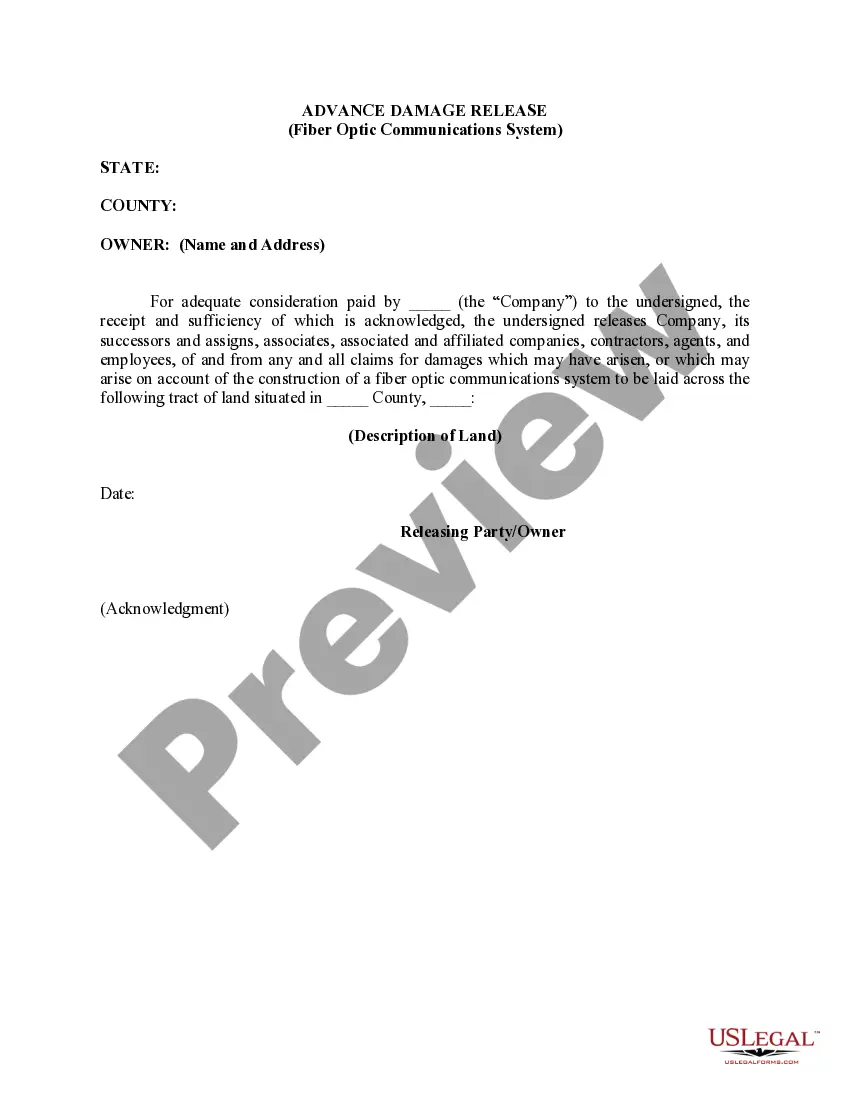
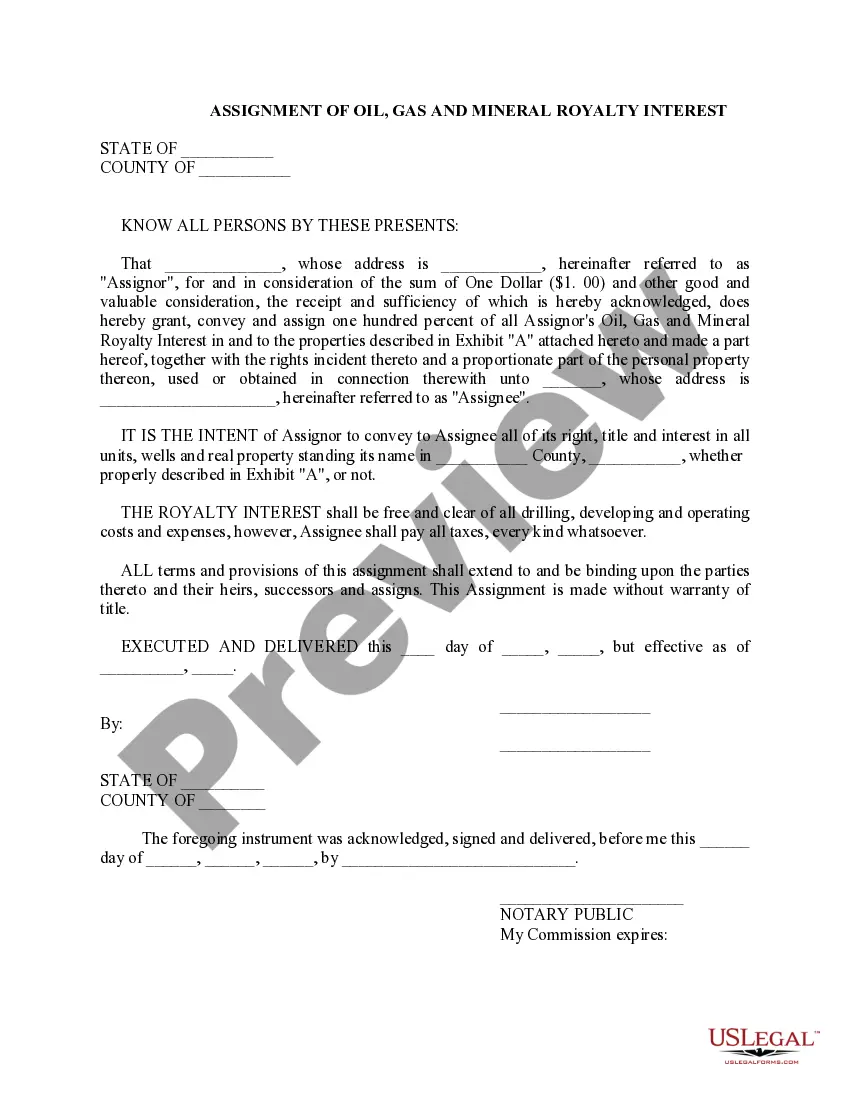
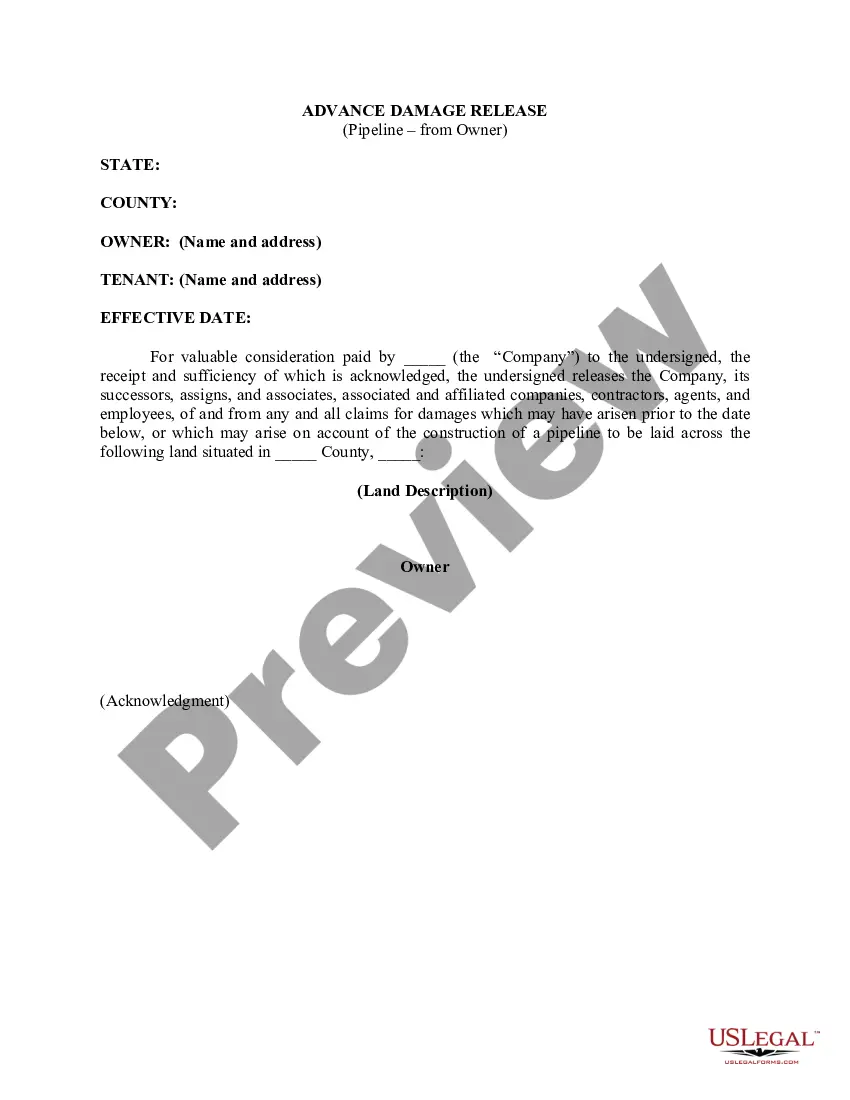
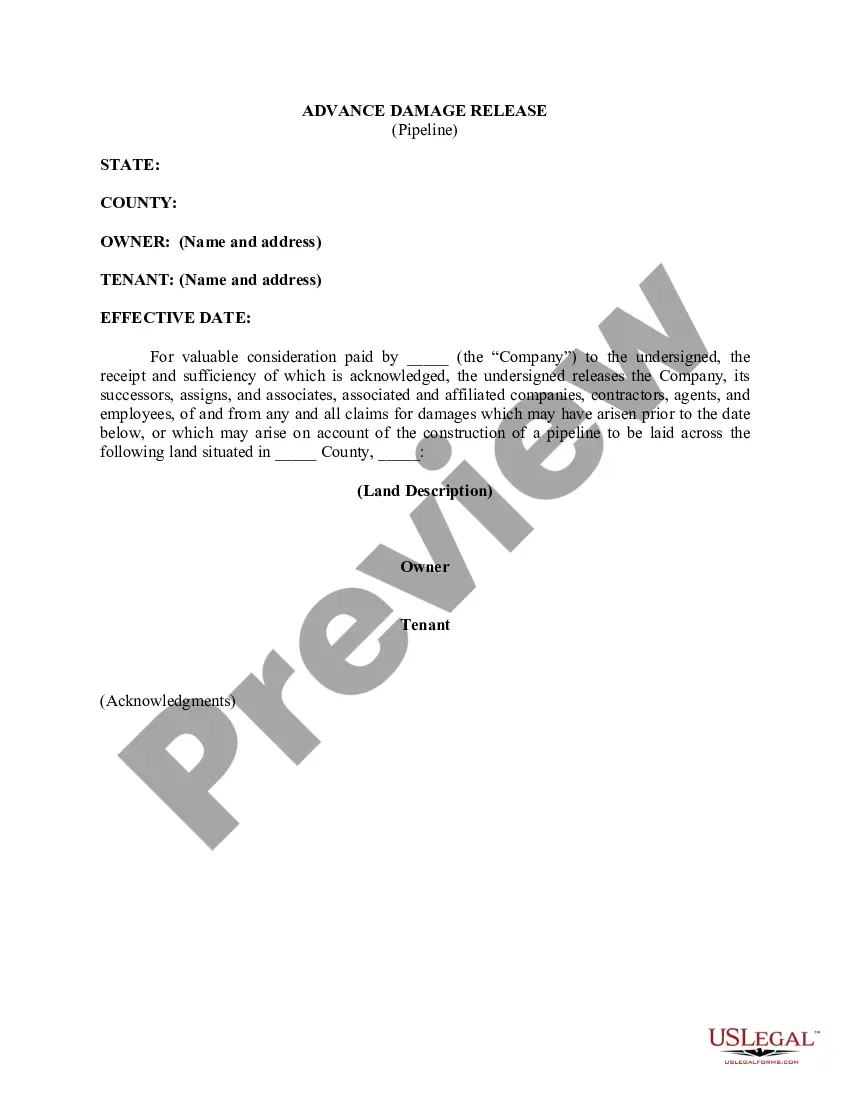
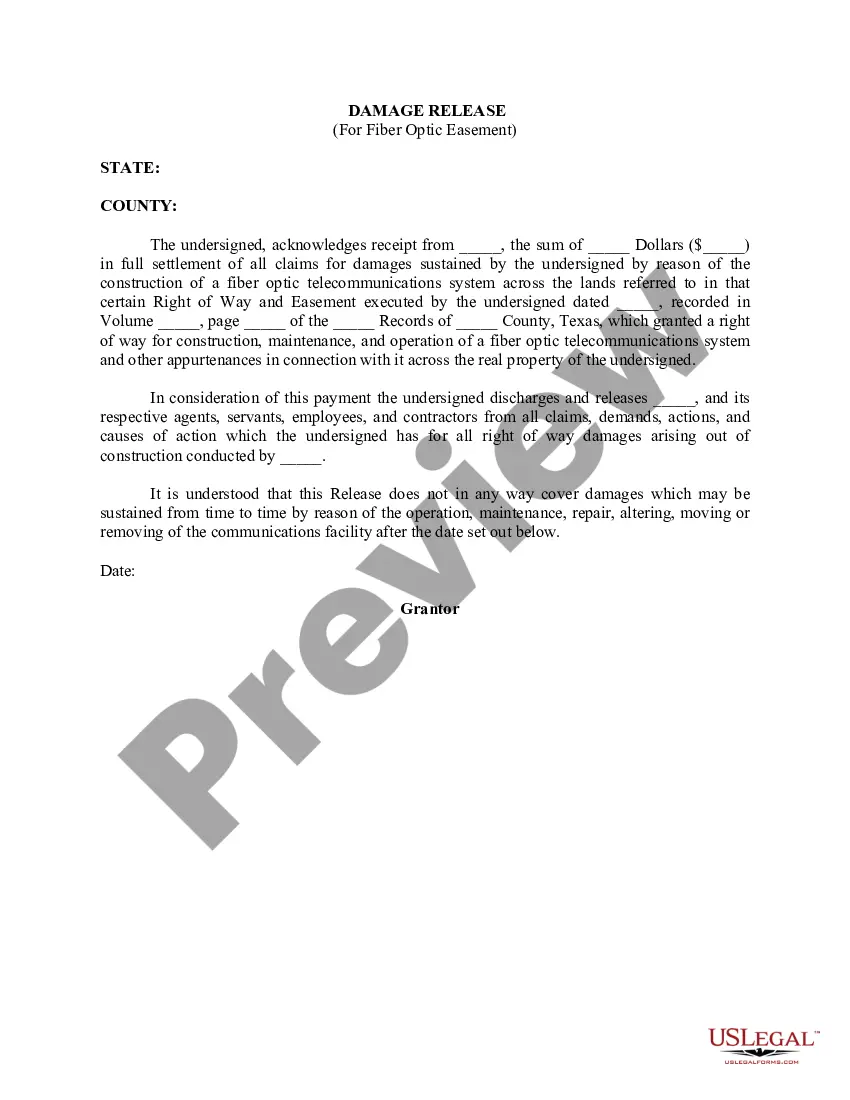
North Dakota Advance Damage Release (Fiber Optic Communications System)
Description
Get your form ready online
Our built-in tools help you complete, sign, share, and store your documents in one place.
Make edits, fill in missing information, and update formatting in US Legal Forms—just like you would in MS Word.
Download a copy, print it, send it by email, or mail it via USPS—whatever works best for your next step.
Sign and collect signatures with our SignNow integration. Send to multiple recipients, set reminders, and more. Go Premium to unlock E-Sign.
If this form requires notarization, complete it online through a secure video call—no need to meet a notary in person or wait for an appointment.
We protect your documents and personal data by following strict security and privacy standards.

Make edits, fill in missing information, and update formatting in US Legal Forms—just like you would in MS Word.

Download a copy, print it, send it by email, or mail it via USPS—whatever works best for your next step.

Sign and collect signatures with our SignNow integration. Send to multiple recipients, set reminders, and more. Go Premium to unlock E-Sign.

If this form requires notarization, complete it online through a secure video call—no need to meet a notary in person or wait for an appointment.

We protect your documents and personal data by following strict security and privacy standards.
Looking for another form?






How to fill out Advance Damage Release (Fiber Optic Communications System)?
You are able to commit several hours on the Internet looking for the legal file template that suits the state and federal demands you need. US Legal Forms gives thousands of legal forms that happen to be analyzed by pros. You can easily download or print the North Dakota Advance Damage Release (Fiber Optic Communications System) from our service.
If you have a US Legal Forms bank account, you may log in and click on the Obtain button. Following that, you may full, edit, print, or sign the North Dakota Advance Damage Release (Fiber Optic Communications System). Each legal file template you get is your own permanently. To obtain yet another duplicate associated with a obtained develop, check out the My Forms tab and click on the related button.
If you use the US Legal Forms web site the very first time, adhere to the basic guidelines below:
- Very first, be sure that you have selected the correct file template for the area/town of your liking. Browse the develop outline to ensure you have chosen the proper develop. If available, take advantage of the Preview button to look through the file template as well.
- In order to locate yet another model from the develop, take advantage of the Research discipline to get the template that meets your needs and demands.
- When you have located the template you desire, simply click Acquire now to continue.
- Choose the rates prepare you desire, key in your references, and register for an account on US Legal Forms.
- Total the deal. You should use your credit card or PayPal bank account to cover the legal develop.
- Choose the file format from the file and download it in your product.
- Make alterations in your file if necessary. You are able to full, edit and sign and print North Dakota Advance Damage Release (Fiber Optic Communications System).
Obtain and print thousands of file templates using the US Legal Forms site, that offers the most important assortment of legal forms. Use expert and state-certain templates to tackle your business or specific requirements.
Form popularity
FAQ
At any cable ends where splicing or termination is required, an extra 30-60 feet (10-20 meters) of cable should be left for splicing.
The most commonly used connectors today are ST, SC, FC, MT-RJ, & LC connectors while Plastic FOC, Opti-Jack, LX-5, Volition, MU, and E2000 are less used options. Finally, MPO / MTP connectors are fiber connectors that have become widely used in today's data centers.
The termination process involves cleaving the fiber and attaching the connector with a built-in mechanical splice or using a fusion splicing machine. It is faster than the adhesive/polish connectors when done by an experienced tech.
A typical fiber optic communication system consists of an optical transmitter, optical fiber, and an optical receiver. The optical transmitter converts the information-carrying electronic signal to an optical signal, which are then sent through a long length of optical fiber.
With the help of optical fiber, ONT connects to the Terminal Point (TP). A Terminal Point is a wall-mounted box where the optical fiber terminates in your home or office. The builder installs the TP during the building construction phase. The ONT connects to your router through a LAN or Ethernet cable.
A typical fiber termination kit should include elements for mechanical or splice-on connectors. A mechanical connector kit includes a fiber cleaver, fiber stripper, scissors, cleaning fluid and lint-free wipes. A visual fault finder is also recommended, but not required.
There are two types of fiber terminations: connector and splicing.
There are generally two ways how we terminate fiber optic cables, using connectors or splicing.