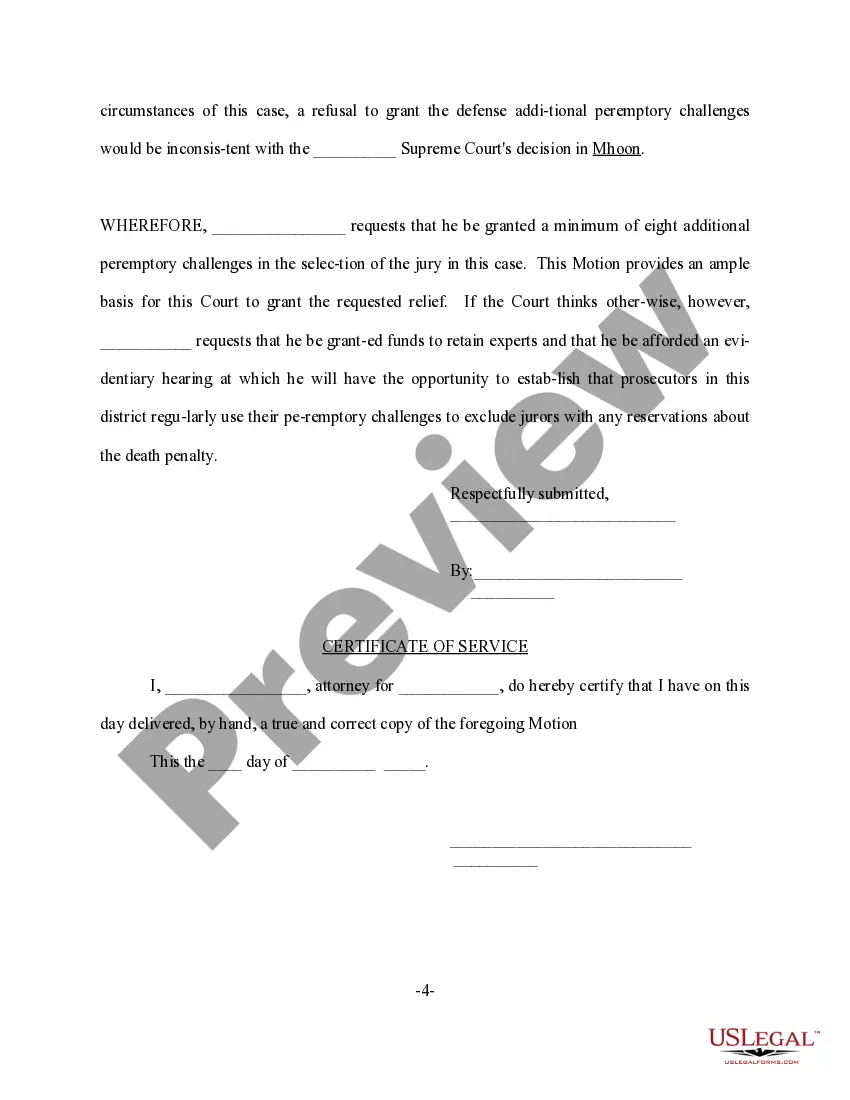
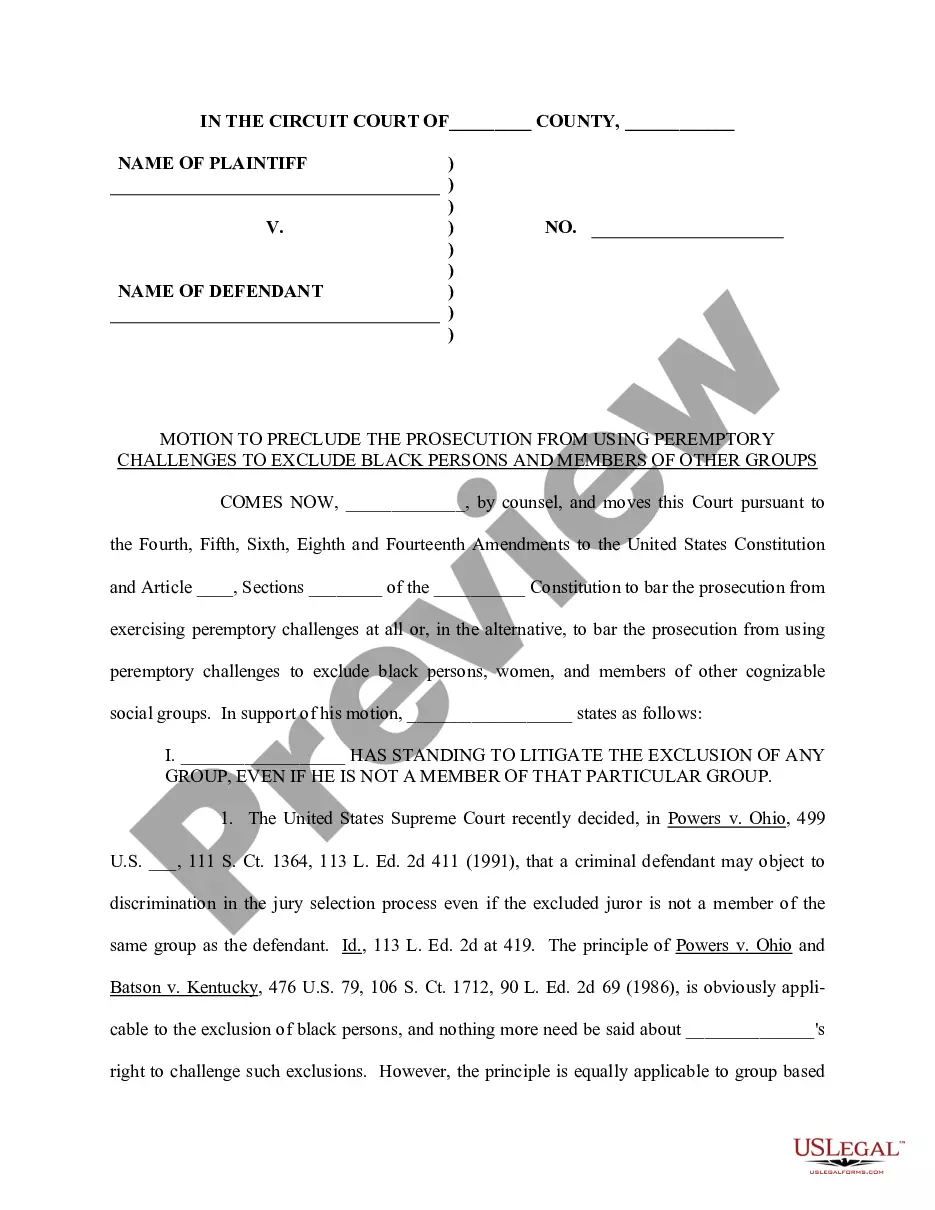
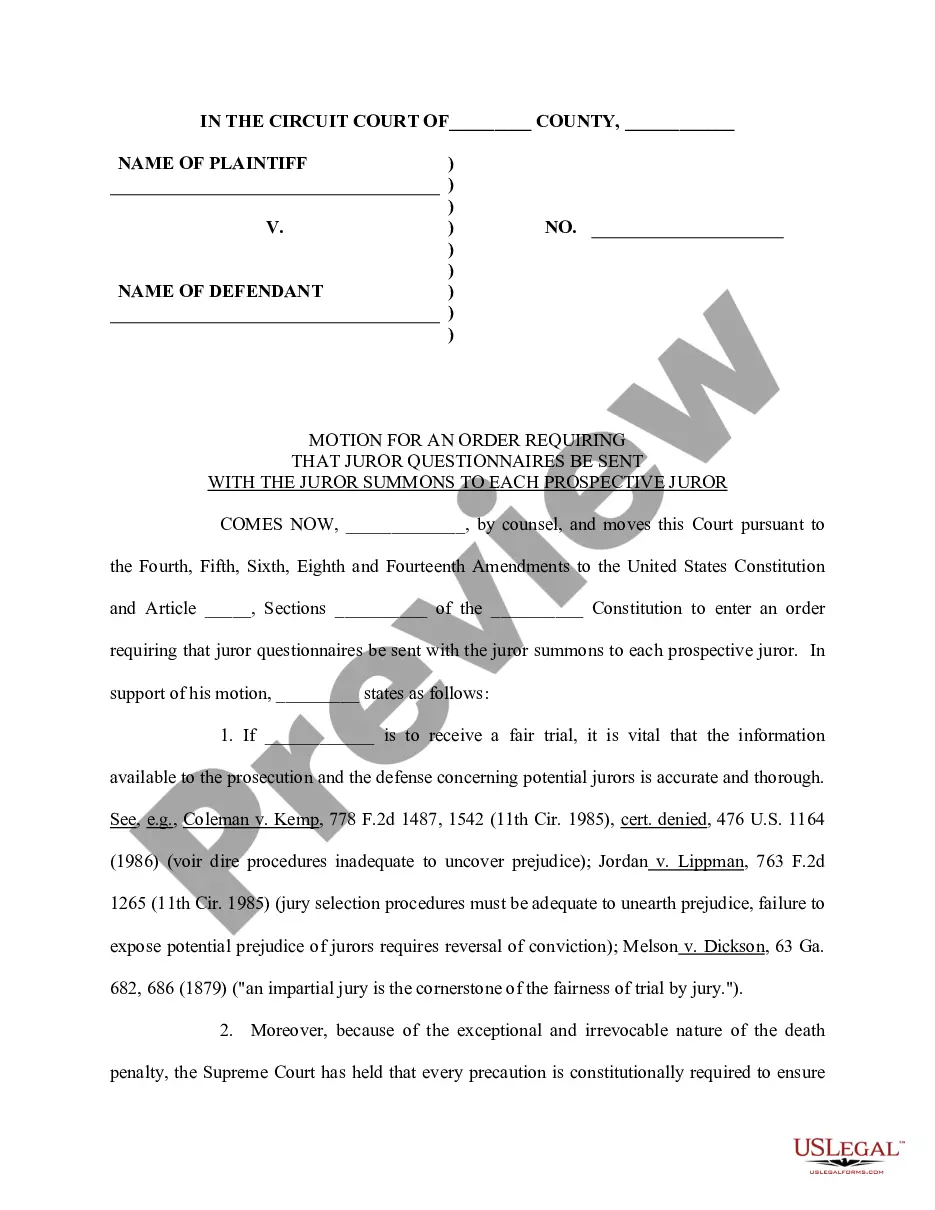
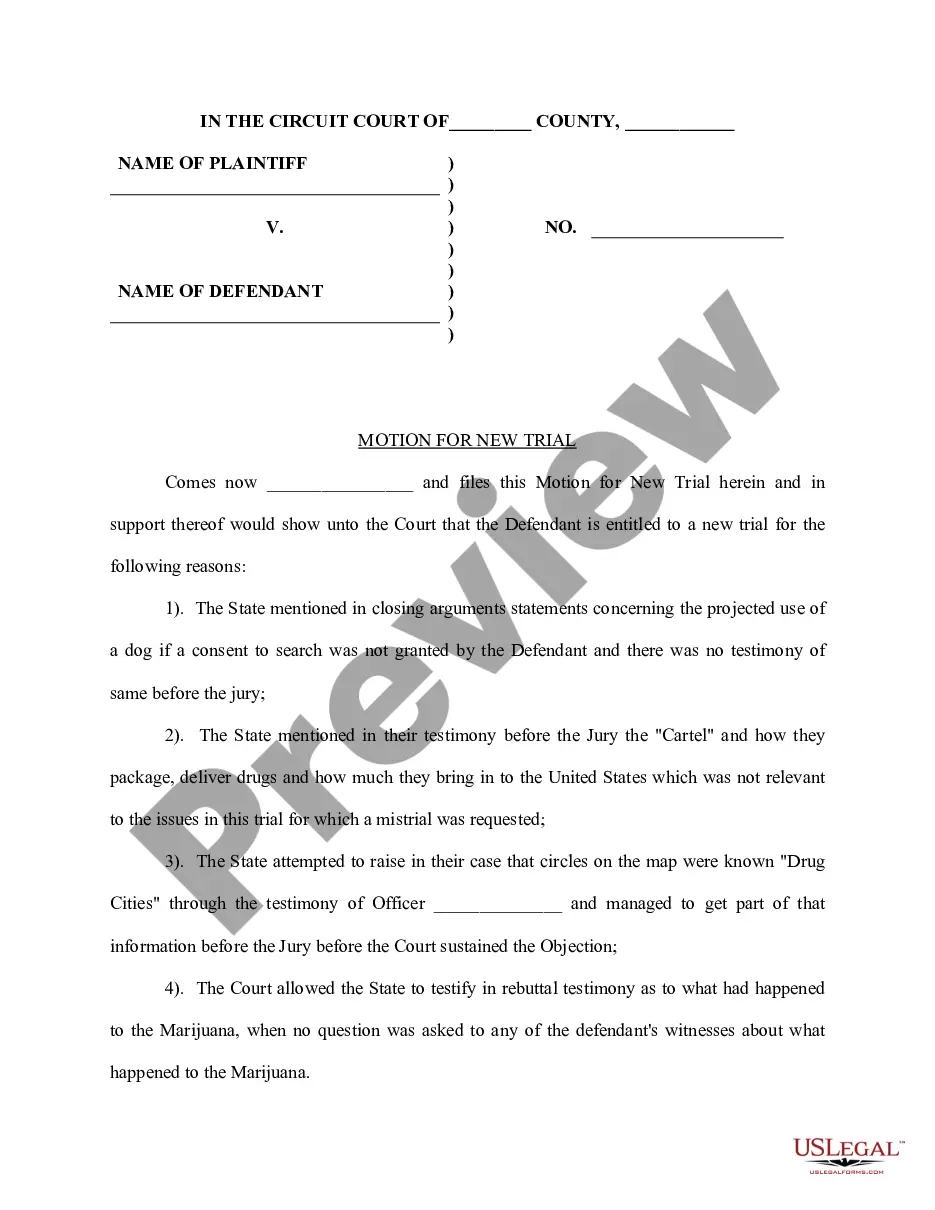
North Dakota Motion for Additional Peremptory Challenges
Description
Get your form ready online
Our built-in tools help you complete, sign, share, and store your documents in one place.
Make edits, fill in missing information, and update formatting in US Legal Forms—just like you would in MS Word.
Download a copy, print it, send it by email, or mail it via USPS—whatever works best for your next step.
Sign and collect signatures with our SignNow integration. Send to multiple recipients, set reminders, and more. Go Premium to unlock E-Sign.
If this form requires notarization, complete it online through a secure video call—no need to meet a notary in person or wait for an appointment.
We protect your documents and personal data by following strict security and privacy standards.

Make edits, fill in missing information, and update formatting in US Legal Forms—just like you would in MS Word.

Download a copy, print it, send it by email, or mail it via USPS—whatever works best for your next step.

Sign and collect signatures with our SignNow integration. Send to multiple recipients, set reminders, and more. Go Premium to unlock E-Sign.

If this form requires notarization, complete it online through a secure video call—no need to meet a notary in person or wait for an appointment.

We protect your documents and personal data by following strict security and privacy standards.
Looking for another form?





How to fill out Motion For Additional Peremptory Challenges?
US Legal Forms - one of the most extensive collections of legal documents in the US - offers a selection of legal form templates that you can download or print. By using the website, you can find thousands of forms for business and personal purposes, organized by categories, states, or keywords. You can locate the most recent versions of forms such as the North Dakota Motion for Additional Peremptory Challenges in just a few minutes.
If you hold a subscription, sign in and obtain the North Dakota Motion for Additional Peremptory Challenges from the US Legal Forms library. The Download option will appear on every form you view. You can access all previously downloaded forms from the My documents section of your account.
To use US Legal Forms for the first time, here are simple steps to help you get started: Ensure you have selected the correct form for your city/region. Choose the Review option to check the content of the form. Review the form description to make certain you have selected the appropriate form. If the form does not meet your requirements, use the Search field at the top of the screen to find one that does. If you are satisfied with the form, confirm your selection by clicking the Buy now button. Then, choose the payment plan you prefer and provide your details to register for an account. Process the payment. Use a credit card or PayPal account to complete the transaction. Select the format and download the form to your device. Edit. Fill out, modify, print, and sign the downloaded North Dakota Motion for Additional Peremptory Challenges. Each template you add to your account has no expiration date and is yours indefinitely. Therefore, if you wish to download or print another copy, simply go to the My documents section and click on the form you need.
US Legal Forms is an invaluable resource for anyone seeking legal documentation.
Explore the extensive catalog to find the forms that best suit your needs.
- Access the North Dakota Motion for Additional Peremptory Challenges with US Legal Forms, the most extensive library of legal document templates.
- Utilize thousands of professional and state-specific templates that meet your business or personal needs and requirements.
- Easily navigate through categories and keywords to find the right form.
- Enjoy unlimited access to your downloaded forms without expiration.
- Process your transactions securely using credit or PayPal.
- Edit and print your forms as necessary.
Form popularity
FAQ
?Equal justice under law requires a criminal trial free of racial discrimination in the jury selection process.? 19 Invidious discrimination in the use of peremptory challenges on the basis of race or gender offends the Equal Protection Clause with respect to both the defendant and the juror, harms the community ...
While the reason that Parliament abolished peremptory challenges was because they could be used to build less diverse juries, as in the Stanley trial, the judicial stand aside power is insufficient for ensuring jury diversity as it fails to address implicit biases.
When selecting a jury, both parties may remove potential jurors using an unlimited number of challenges for cause (e.g., stated reasons such as bias) and a limited number of peremptory challenges (i.e., do not need to state a reason).
Provided a party is aware of a cause, he may challenge any prospective juror on that basis. In many cases, however, parties will not have that information. Consequently, in addition to challenges for cause (which are numerically unlimited) each party may exercise four peremptory challenges.
Jump to essay-9The Supreme Court stated: This Court has long recognized that peremptory challenges are not of federal constitutional dimension.
The best-known problem with peremptory challenges ? a lawyer's dismissal of a prospective juror without a stated cause ? may be that too often there actually is a cause, and it's an improper one.
The author proffers that if jury service is one of the most important civic duties, the process should be free of racial discrimination. Abolishing the use of peremptory challenges is one way to begin to eradicate racial discrimination in the jury selection process.