A written agreement regarding child custody and support entered into by unmarried parents at time of their breakup is generally enforceable unless the parties abandon the agreement, or the agreement is unconscionable.
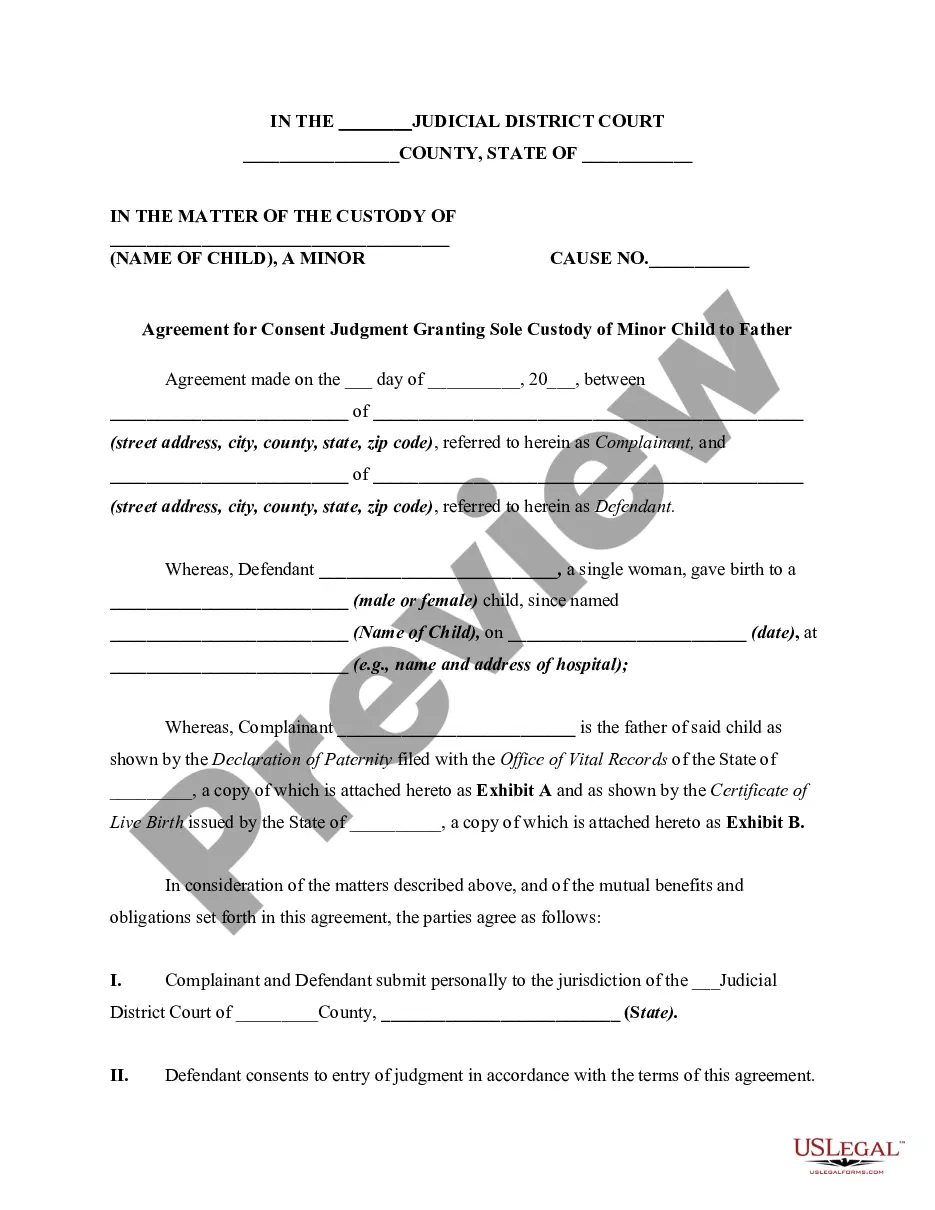
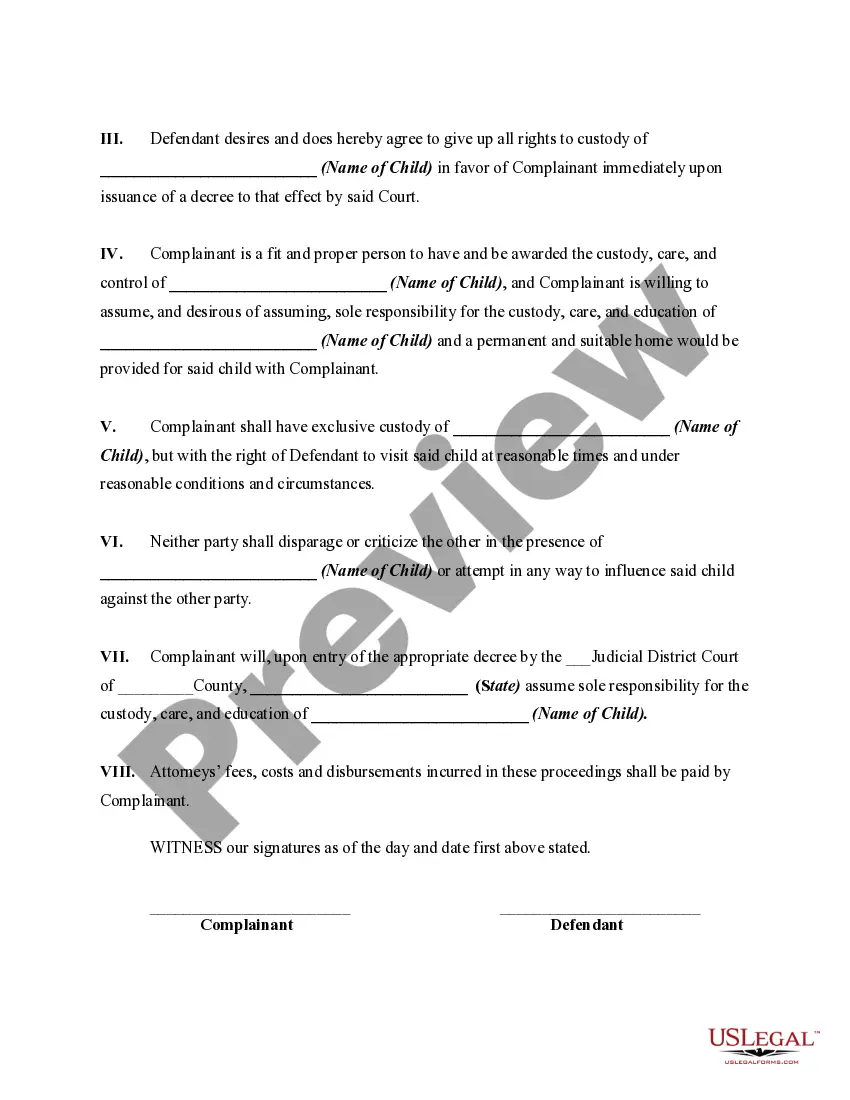
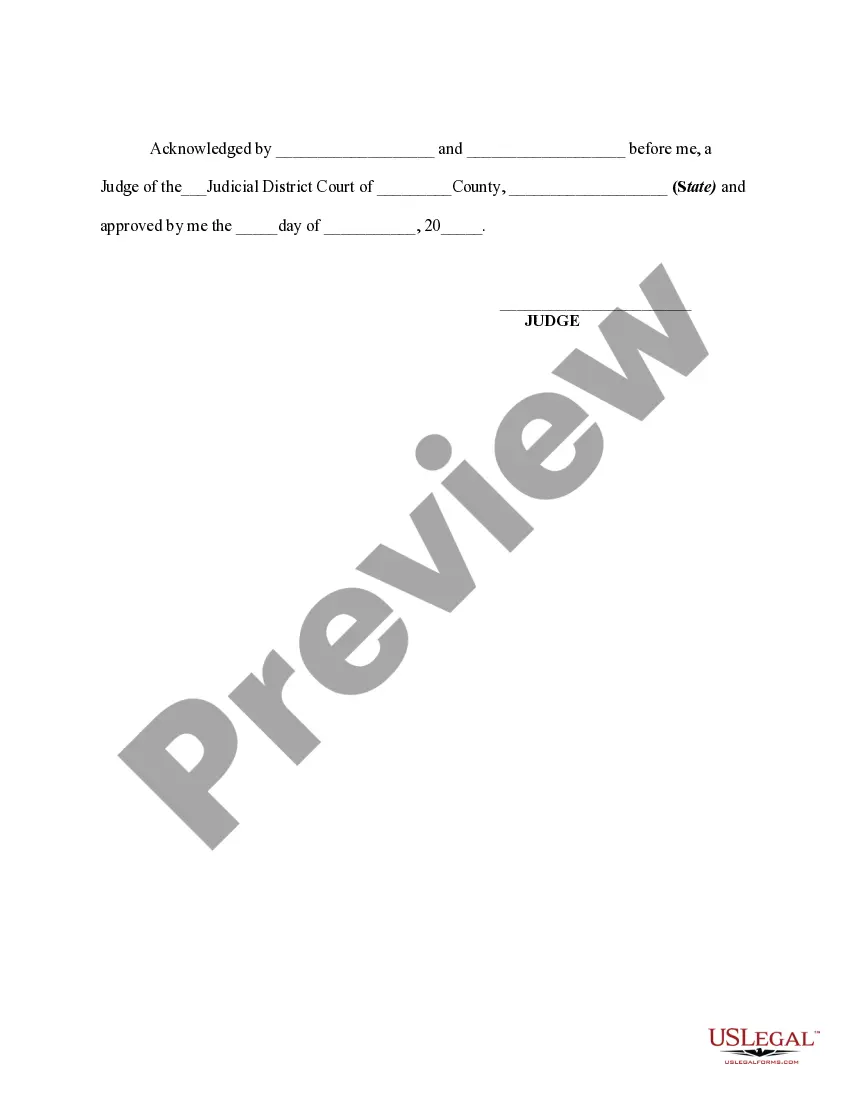
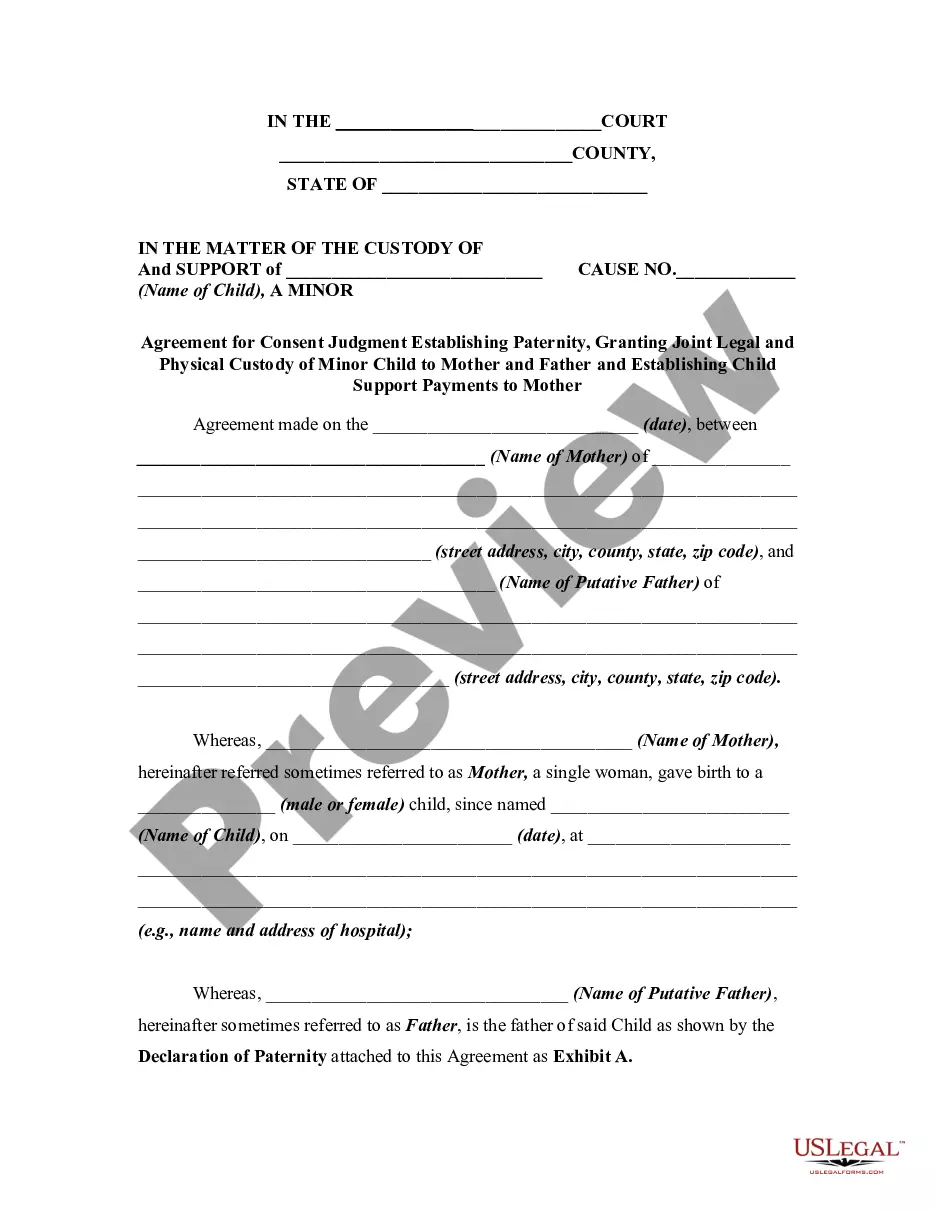
The following form is a sample of an agreement for a consent judgment granting sole custody of a minor child to the father.
North Dakota Agreement for Consent Judgment Granting Sole Custody of Minor Child to Father
State:
Multi-State
Control #:
US-00774BG
Format:
Word;
Rich Text
Instant download
Description
Free preview
Get your form ready online
Our built-in tools help you complete, sign, share, and store your documents in one place.
Built-in online Word editor
Make edits, fill in missing information, and update formatting in US Legal Forms—just like you would in MS Word.
Export easily
Download a copy, print it, send it by email, or mail it via USPS—whatever works best for your next step.
E-sign your document
Sign and collect signatures with our SignNow integration. Send to multiple recipients, set reminders, and more. Go Premium to unlock E-Sign.
Notarize online 24/7
If this form requires notarization, complete it online through a secure video call—no need to meet a notary in person or wait for an appointment.
Store your document securely
We protect your documents and personal data by following strict security and privacy standards.

Make edits, fill in missing information, and update formatting in US Legal Forms—just like you would in MS Word.

Download a copy, print it, send it by email, or mail it via USPS—whatever works best for your next step.

Sign and collect signatures with our SignNow integration. Send to multiple recipients, set reminders, and more. Go Premium to unlock E-Sign.

If this form requires notarization, complete it online through a secure video call—no need to meet a notary in person or wait for an appointment.

We protect your documents and personal data by following strict security and privacy standards.
Looking for another form?
How to fill out Agreement For Consent Judgment Granting Sole Custody Of Minor Child To Father?
Have you ever found yourself in a situation where you require documents for both business or particular purposes almost every time.
There are numerous authentic file templates available online, but finding reliable ones isn’t straightforward.
US Legal Forms offers an extensive array of form templates, including the North Dakota Agreement for Consent Judgment Granting Sole Custody of Minor Child to Father, which are crafted to comply with federal and state regulations.
Leverage US Legal Forms, one of the most comprehensive collections of legitimate forms, to save time and avoid mistakes.
The service provides professionally crafted legal document templates that you can utilize for various purposes. Create an account on US Legal Forms and begin simplifying your life.
- If you are already familiar with the US Legal Forms website and possess an account, simply Log In.
- Then, you can download the North Dakota Agreement for Consent Judgment Granting Sole Custody of Minor Child to Father template.
- If you don't have an account and wish to start using US Legal Forms, follow these steps.
- Obtain the form you need and ensure it corresponds to the correct city/state.
- Utilize the Preview button to review the document.
- Examine the description to confirm you have selected the appropriate form.
- If the form isn’t what you are looking for, use the Search section to find the form that meets your needs.
- Once you find the correct form, click Get now.
- Choose the pricing plan you prefer, enter the required information to create your account, and process your order using PayPal or Visa or Mastercard.
- Select a convenient file format and download your copy.
- Access all the file templates you have purchased in the My documents list. You can obtain another copy of the North Dakota Agreement for Consent Judgment Granting Sole Custody of Minor Child to Father at any time if needed. Click on the desired form to download or print the document template.
Form popularity
FAQ
North Dakota law allows for ?reasonable visitation? with a child for grandparents.
In the context of parental unfitness, the court would consider the physical and mental health of the parents, their ability to provide a stable and safe home environment, whether there was abuse or domestic violence in the home, and whether there was drug or alcohol abuse, among other things.
The North Dakota Department of Human Services says they recommend a child must be at least 9 years old before he or she is left alone. North Dakota says ages 0-8 must not be left alone under any circumstances.
Father's Rights to Child Custody and Visitation This means decisions regarding the child's residency as well as a visitation schedule by the non-custodial parents are all made with the child's best interests and wellbeing in mind.
When a child is born and the parents are not married, either parent may file a case to establish parentage. This means that parents are asking the court to make a ruling as to who the parents are, and who is legally responsible for that child.
In North Dakota, legal custody is known as in the statutes as "decision-making responsibility." The parents' custody order may specify the decision-making responsibility each parent has, but decision-making responsibility does not include decisions about child support. That is a separate determination.
There are no hard-and-fast rules as to the age at which a child is considered mature enough to testify as to a preference regarding residential responsibility. A court might find a ten year old in one case mature enough to express a preference, but find otherwise regarding a thirteen year old in another case.