North Dakota Tax Free Exchange Package
About this form package
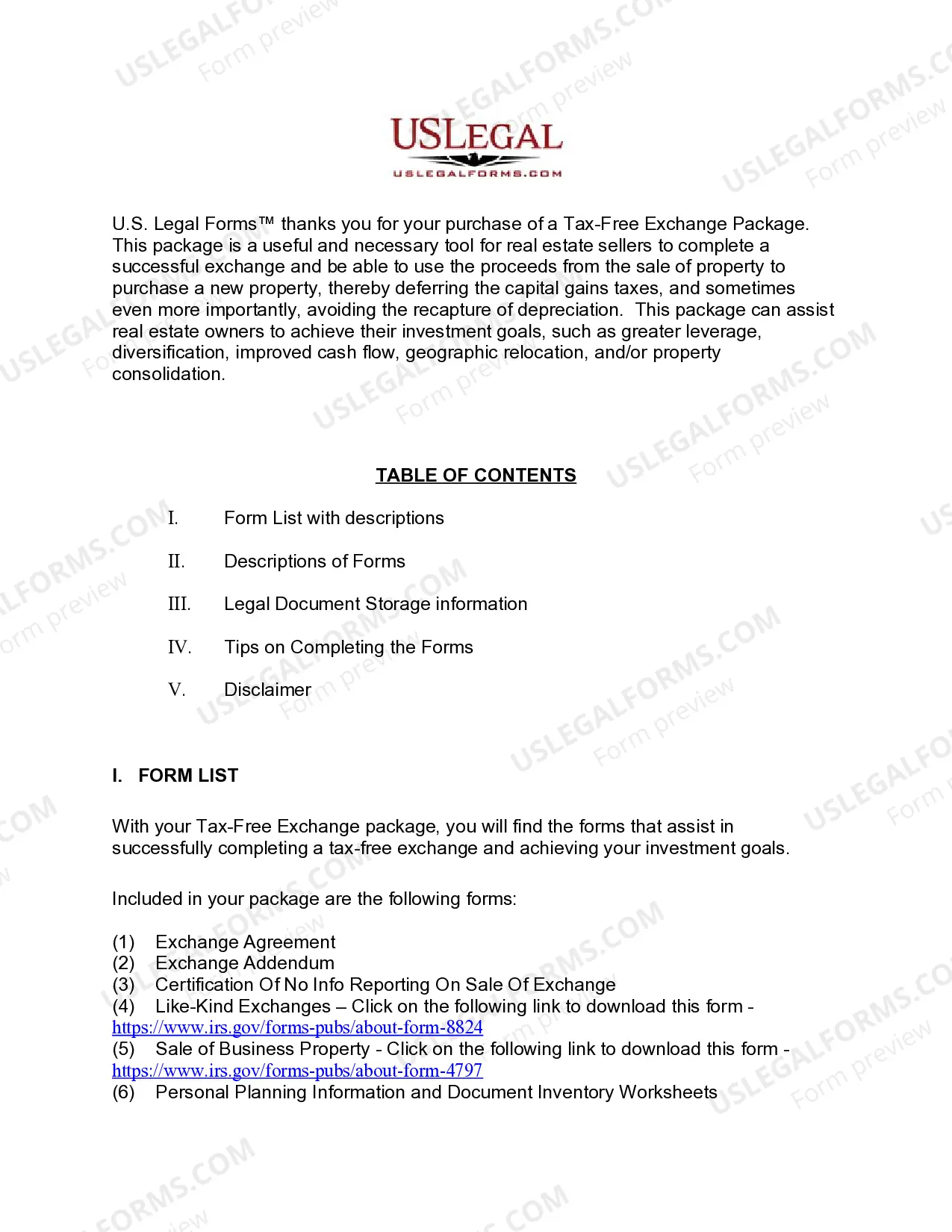
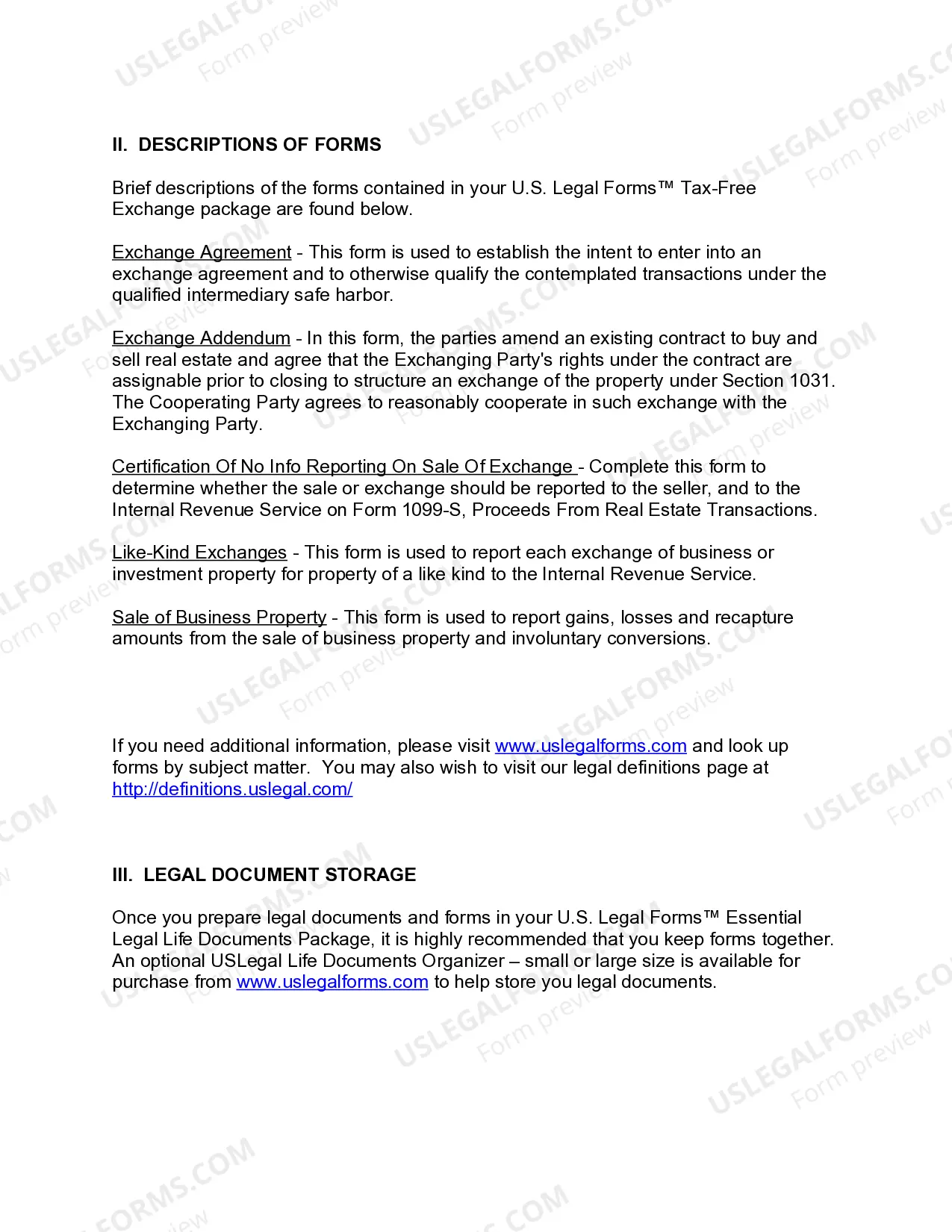
The North Dakota Tax Free Exchange Package contains essential forms to facilitate a tax-free exchange of like-kind property. This package is specifically designed to help property owners navigate the complexities of Section 1031 exchanges, which allow for the deferral of capital gains taxes when exchanging investment properties. Unlike other legal document packages, this one is tailored to meet North Dakota's specific regulations, ensuring compliance and protecting your investment interests.
Forms included in this package
When to use this document
This form package should be used when you intend to exchange investment properties and want to avoid immediate capital gains taxes. Scenarios include:
- Trading one rental property for another.
- Exchanging a commercial property for a different commercial property.
- Engaging in a complex property swap involving multiple parties.
Intended users of this form package
- Real estate investors looking to defer capital gains taxes.
- Property owners involved in a like-kind exchange.
- Individuals seeking professional guidance on real estate transactions.
Instructions for completing these forms
- Review the included forms.
- Gather necessary information about the properties involved in the exchange.
- Fill out the Exchange Agreement to establish intent and qualifications.
- Complete the Certification of No Info Reporting to determine reporting obligations.
- Sign and date all required documents in the presence of witnesses if needed.
Do forms in this package need to be notarized?
Some included forms must be notarized to ensure validity. US Legal Forms provides secure online notarization powered by Notarize, allowing you to complete the process through a verified video call anytime.
Get your form ready online
Our built-in tools help you complete, sign, share, and store your documents in one place.
Make edits, fill in missing information, and update formatting in US Legal Forms—just like you would in MS Word.
Download a copy, print it, send it by email, or mail it via USPS—whatever works best for your next step.
Sign and collect signatures with our SignNow integration. Send to multiple recipients, set reminders, and more. Go Premium to unlock E-Sign.
If this form requires notarization, complete it online through a secure video call—no need to meet a notary in person or wait for an appointment.
We protect your documents and personal data by following strict security and privacy standards.

Make edits, fill in missing information, and update formatting in US Legal Forms—just like you would in MS Word.

Download a copy, print it, send it by email, or mail it via USPS—whatever works best for your next step.

Sign and collect signatures with our SignNow integration. Send to multiple recipients, set reminders, and more. Go Premium to unlock E-Sign.

If this form requires notarization, complete it online through a secure video call—no need to meet a notary in person or wait for an appointment.

We protect your documents and personal data by following strict security and privacy standards.
Mistakes to watch out for
- Failing to properly complete the Exchange Agreement.
- Not adhering to the required timelines for identifying replacement properties.
- Neglecting to review the reporting obligations with the IRS.
Why complete this package online
- Convenient access to all necessary forms in one package.
- Editability allows you to fill out forms accurately and efficiently.
- Reliable guidance based on current legal standards and best practices.
Looking for another form?
Form popularity
FAQ
Five U.S. states (New Hampshire, Oregon, Montana, Alaska and Delaware) do not impose any general, statewide sales tax on goods or services. Of the 45 states remaining, four (Hawaii, South Dakota, New Mexico and West Virginia) tax services by default, with exceptions only for services specifically exempted in the law.
North Dakota does not require businesses to collect sales tax on the sale of digital goods or services.
In general, clothing, groceries, medicines and medical devices and industrial equipment are sales tax exempt in many states (but don't assume they'll be exempt in all states. Every state is different when it comes to sales tax!)
I . Sales to Residents of Montana: Residents of the state of Montana are exempt from North Dakota sales tax on purchases made in this state provided the following conditions are met:The property purchased must be removed from the state of North Dakota for use exclusively outside this state.
The statewide tax rate is 7.25%. In most areas of California, local jurisdictions have added district taxes that increase the tax owed by a seller. Those district tax rates range from 0.10% to 1.00%. Some areas may have more than one district tax in effect.
In the state of North Dakota, many services are considered to be taxable. For example, transportation services, repair services, hospital and nursing home services, and furnishing services are considered to be taxable, and thus you would most likely have to pay sales tax on the service.
In the state of North Dakota, many services are considered to be taxable. For example, transportation services, repair services, hospital and nursing home services, and furnishing services are considered to be taxable, and thus you would most likely have to pay sales tax on the service.
California law restricts the application of sales or use tax to transfers or consumption of tangible personal property or physical property other than real estate. Unlike many other states, California does not tax services unless they are an integral part of a taxable transfer of property.