West Virginia Revised Anatomical Gift Act Donation
What this document covers
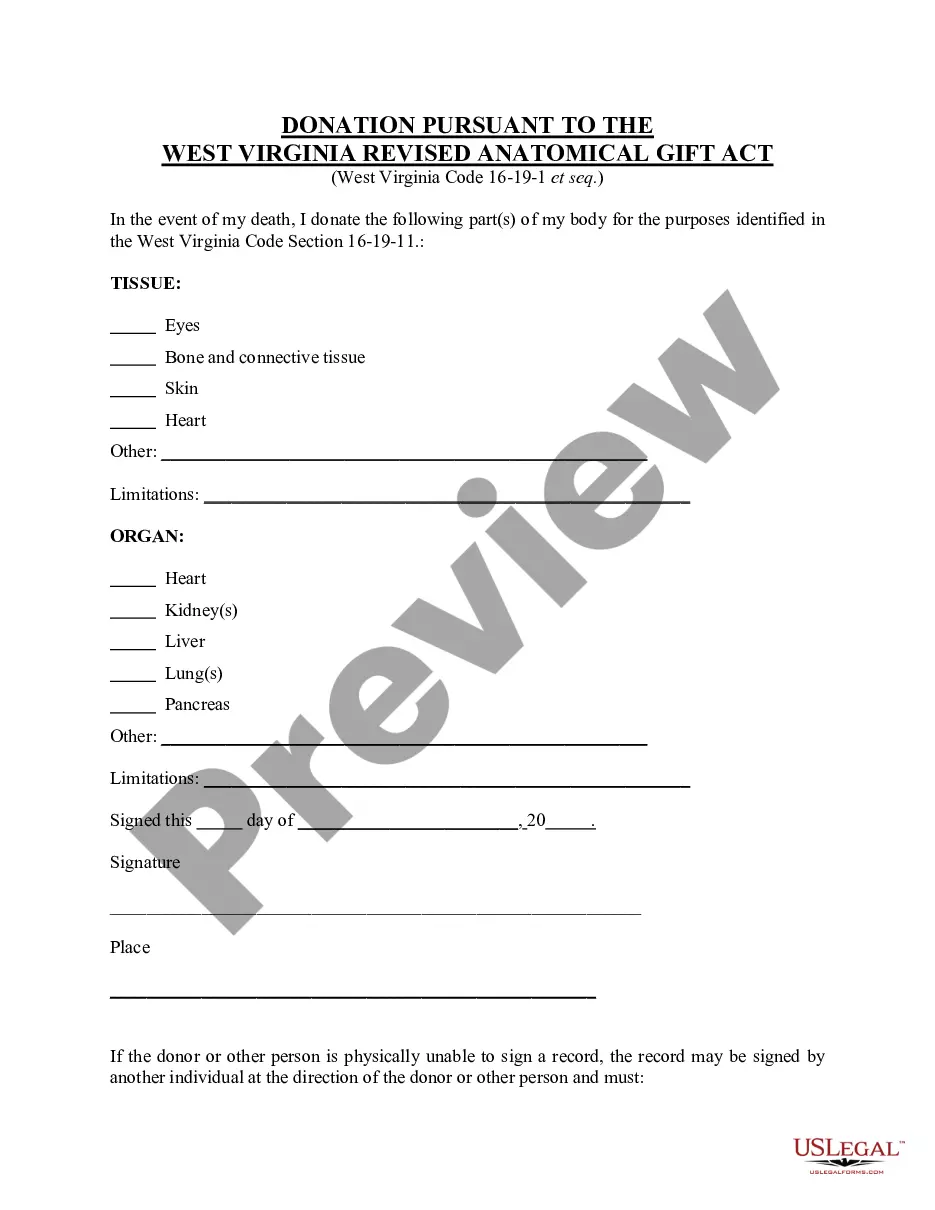
The Revised Anatomical Gift Act Donation form allows individuals to specify the body parts and organs they wish to donate upon their death. Unlike other donation forms, this document is governed by state-specific laws, ensuring that it meets local requirements for anatomical gifts. It provides a legal framework for individuals to make a clear declaration regarding their preferences for donation, which can ease the decision-making process for families during a difficult time.
Main sections of this form
- Donor's declaration of specific body parts or organs for donation.
- Signature section for the donor, including options for assistance if the donor is physically unable to sign.
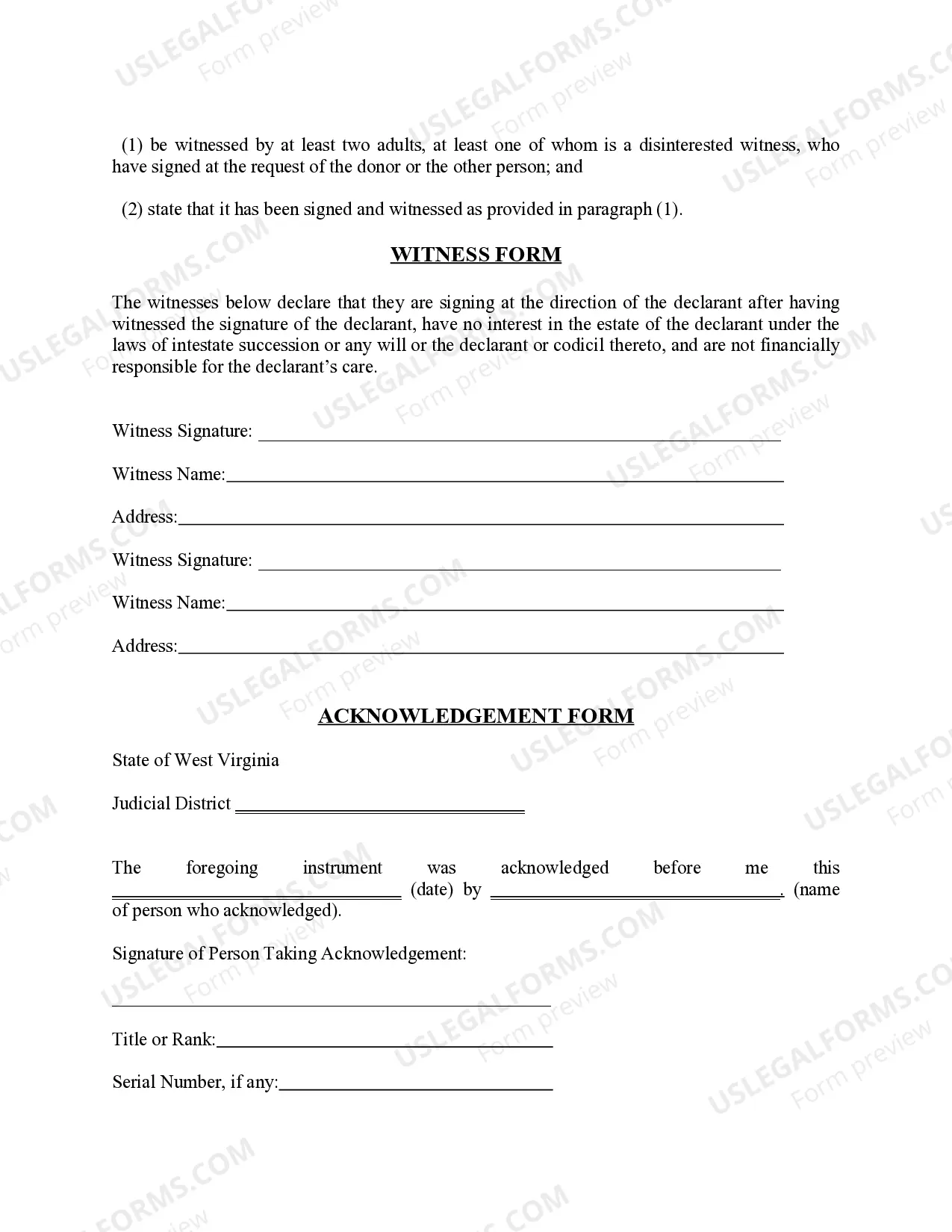
- Witness signature requirements, including the need for at least two adults, one of whom must be disinterested.
- Notarization clause to ensure the document's validity.
- Reference to applicable state statutes governing anatomical gifts.
When to use this document
This form is essential when an individual wants to make a legally recognized donation of their body parts or organs after their death. It should be completed well in advance of any medical situations that may arise. Situations where this form is often needed include planning for organ donation, participating in medical research, or favoring specific medical treatments that may require anatomical gifts.
Who can use this document
Individuals who meet the following criteria should consider using this form:
- Individuals who are at least eighteen years old.
- Anyone wishing to make an anatomical gift for transplantation or research purposes.
- Persons looking to clarify their donation preferences to alleviate future family decisions.
How to prepare this document
- Identify yourself as the donor and provide all necessary personal details.
- Clearly state the specific body parts or organs you wish to donate.
- Sign the document, ensuring that you understand its terms.
- Arrange for at least two adults to witness your signature, ensuring one is disinterested.
- Have the document notarized to confirm its authenticity, if required.
Notarization guidance
In most cases, this form does not require notarization. However, some jurisdictions or signing circumstances might. US Legal Forms offers online notarization powered by Notarize, accessible 24/7 for a quick, remote process.
Get your form ready online
Our built-in tools help you complete, sign, share, and store your documents in one place.
Make edits, fill in missing information, and update formatting in US Legal Forms—just like you would in MS Word.
Download a copy, print it, send it by email, or mail it via USPS—whatever works best for your next step.
Sign and collect signatures with our SignNow integration. Send to multiple recipients, set reminders, and more. Go Premium to unlock E-Sign.
If this form requires notarization, complete it online through a secure video call—no need to meet a notary in person or wait for an appointment.
We protect your documents and personal data by following strict security and privacy standards.

Make edits, fill in missing information, and update formatting in US Legal Forms—just like you would in MS Word.

Download a copy, print it, send it by email, or mail it via USPS—whatever works best for your next step.

Sign and collect signatures with our SignNow integration. Send to multiple recipients, set reminders, and more. Go Premium to unlock E-Sign.

If this form requires notarization, complete it online through a secure video call—no need to meet a notary in person or wait for an appointment.

We protect your documents and personal data by following strict security and privacy standards.
Common mistakes to avoid
- Failing to sign the form correctly or forgetting to specify which body parts to donate.
- Not having the required witnesses present during the signing.
- Neglecting to get the document notarized where necessary.
Benefits of completing this form online
- Convenience of filling out the form from home, at any time.
- Ability to edit and customize the form to match personal preferences before finalizing.
- Reliability assured through attorney-reviewed templates that comply with state laws.
Quick recap
- The Revised Anatomical Gift Act Donation form is essential for documenting one's intent to donate organs or tissues upon death.
- The form requires proper witnessing and notarization for legal validity.
- Using this form ensures your wishes regarding anatomical gifts are respected and clear.
Looking for another form?

Form popularity
FAQ
The Uniform Anatomical Gift Act (UAGA) has been revised in 2006 to permit the use of life support systems at or near death for the purpose of maximizing procurement opportunities of organs medically suitable for transplantation.
That was a major first step. The Uniform Anatomical Gift Act was subsequently adopted by all 50 states and the District of Columbia.