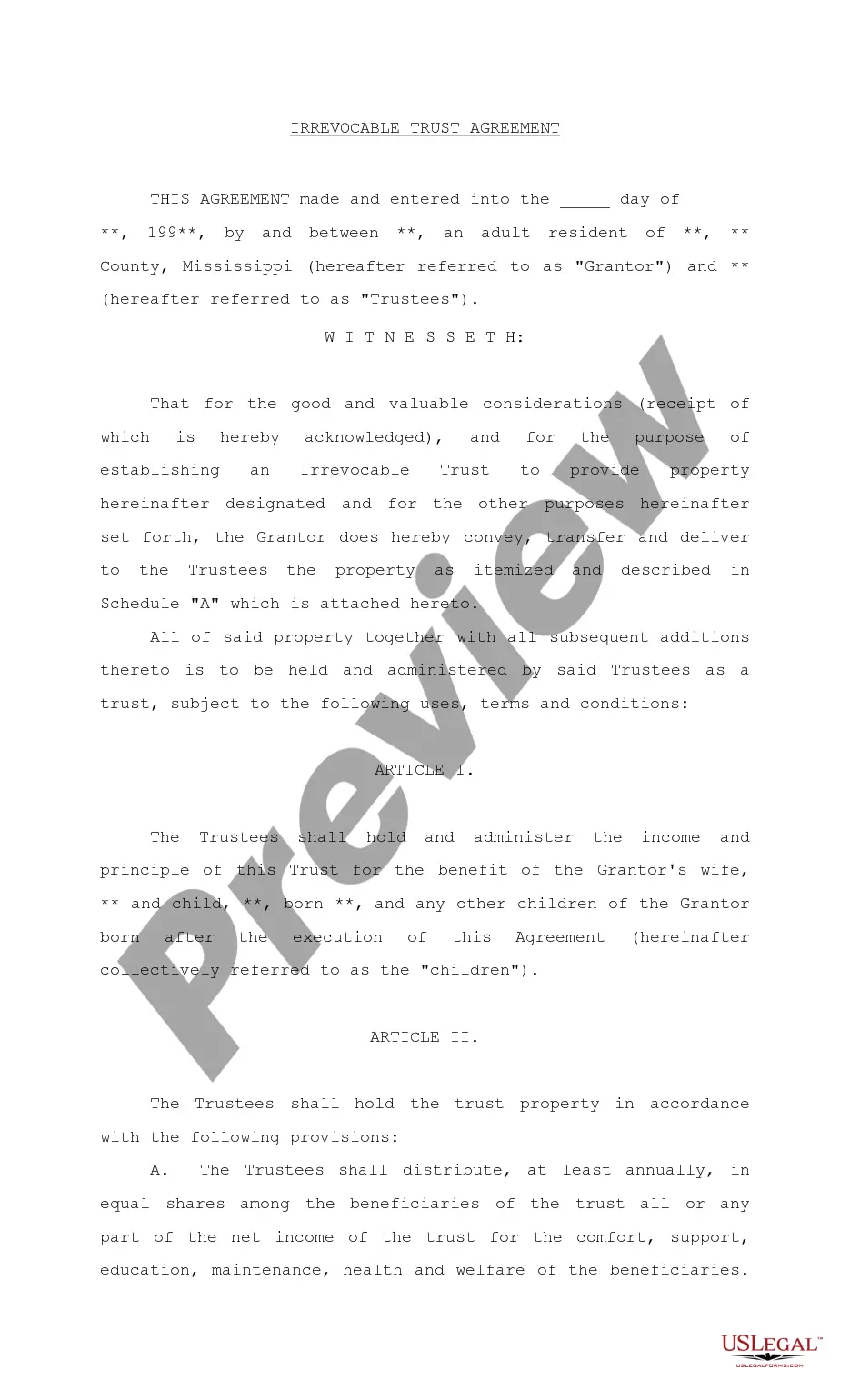
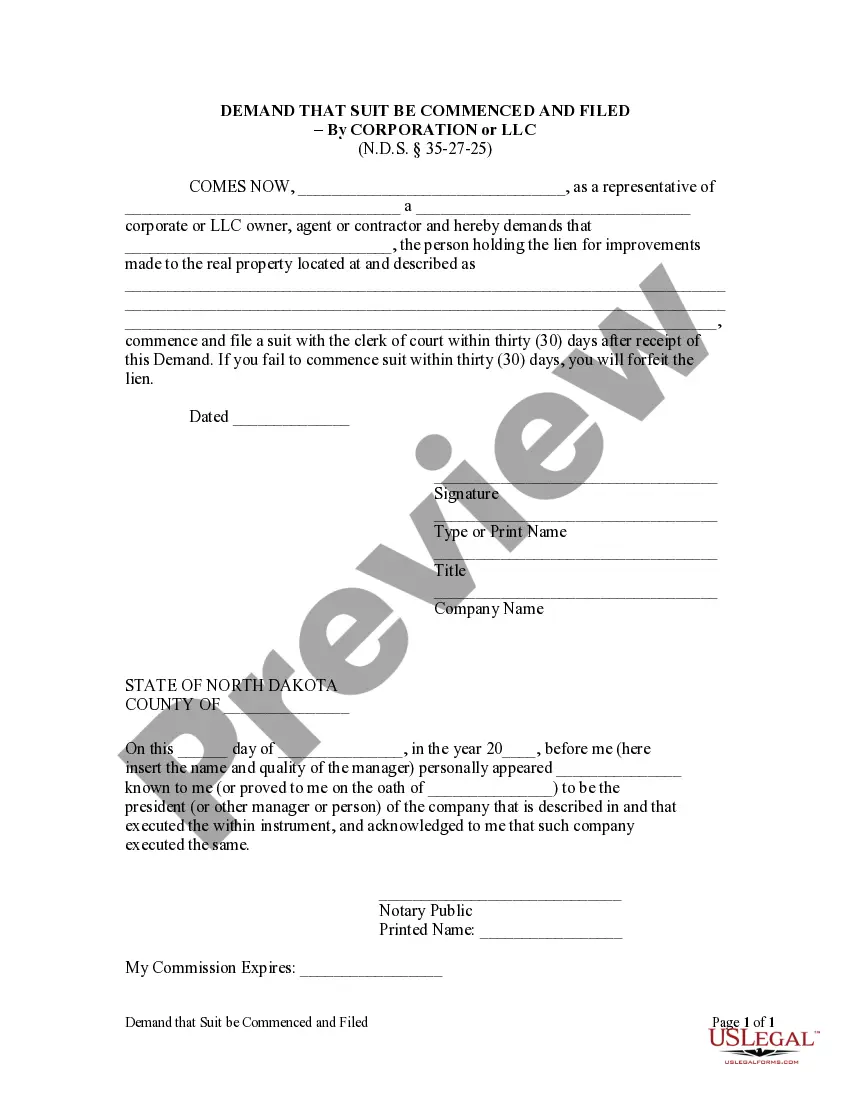
North Dakota Demand that Suit be Commenced and Filed - Corporation
Understanding this form
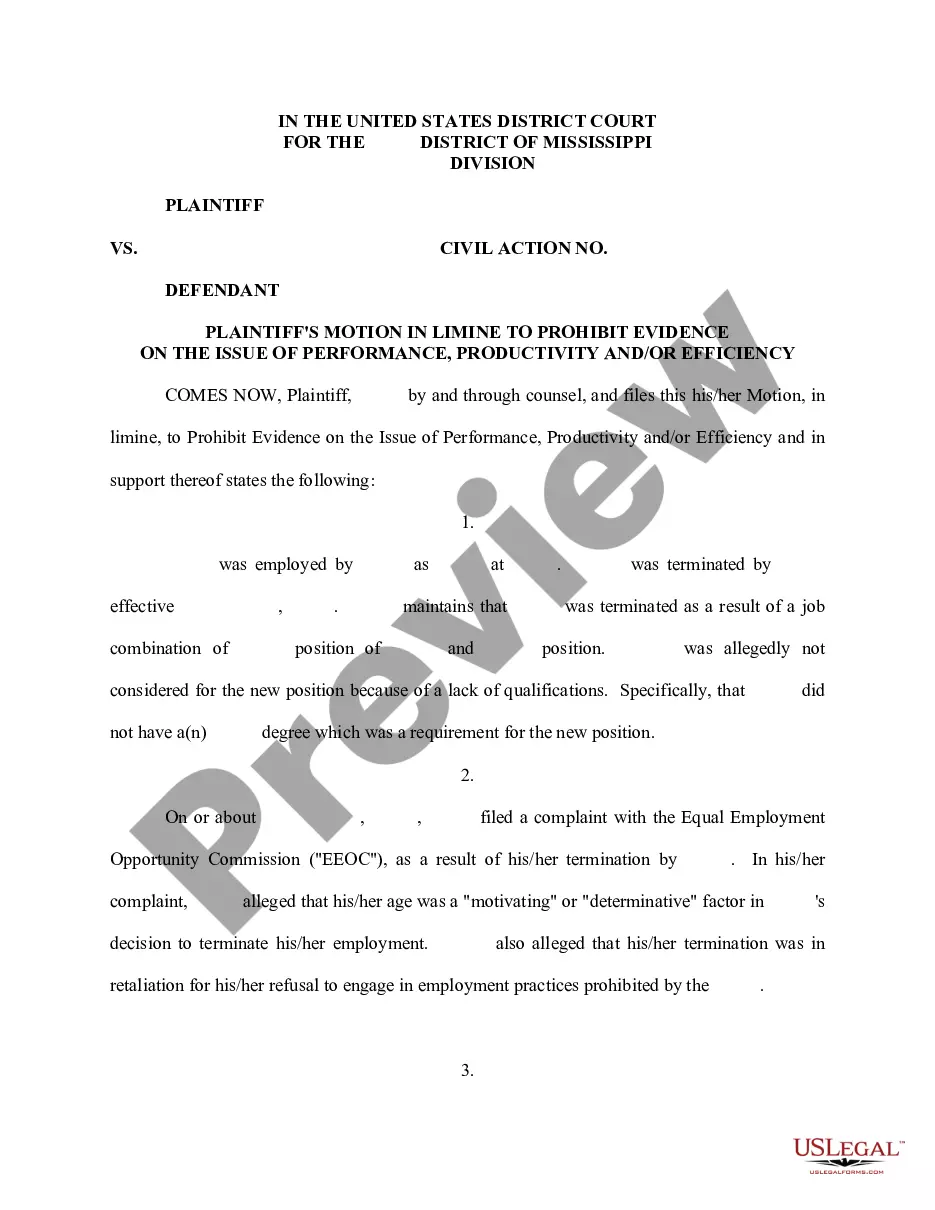
The Demand that Suit be Commenced and Filed form is a legal document used by corporate owners, agents, or contractors. Its purpose is to formally demand that a lienholder initiate a lawsuit within thirty days regarding improvements made to a specific property. This form helps protect the rights of the corporate entity and ensures that the lienholder does not forfeit their lien if they fail to act within the stipulated time frame.
Form components explained
- Corporate or LLC representative's name and title
- Specific property details where improvements were made
- Name of the lienholder
- 30-day period for commencing the lawsuit
- Signature of the corporate representative
- Required notary acknowledgment
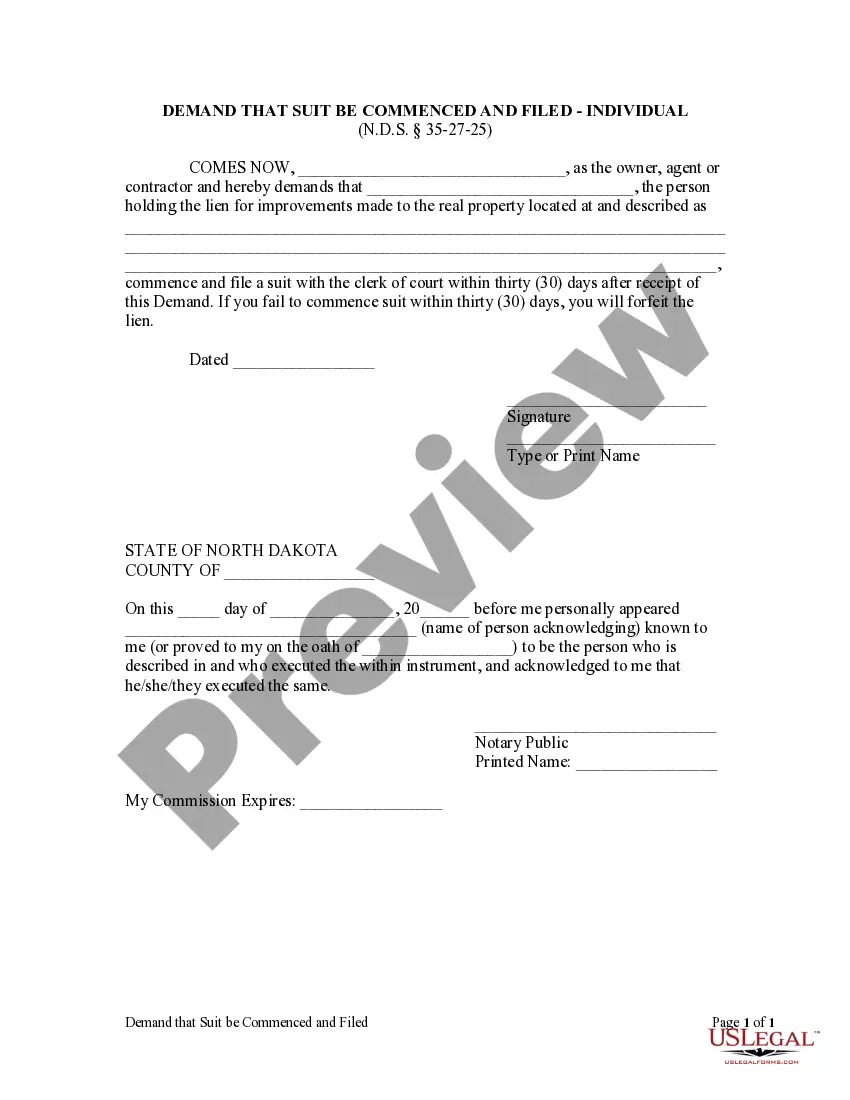
When to use this form
This form is typically used when a corporate entity has made improvements to real property and a lien has been placed by a contractor or subcontractor. If the corporate owner believes that the lienholder has not acted within the legal timeframe to enforce their lien rights, they can issue this demand to compel action and potentially safeguard their interests in the property.
Who should use this form
This form is intended for:
- Corporate owners or LLC representatives
- Agents of corporations dealing with real property improvements
- Contractors who need to enforce lien rights
Steps to complete this form
- Identify the corporate representative and enter their name and title.
- Specify the lienholder's name and the property details associated with the lien.
- Clearly state the demand for the lienholder to commence suit within thirty days.
- Include the date of the demand and the representative's signature.
- Complete the notary section to legally acknowledge the signatures.
Notarization guidance
Yes, this form must be notarized to be legally valid. US Legal Forms offers an integrated online notarization service that is available 24/7. This ensures secure video calls and provides legal equivalence, allowing you to complete the notarization process without having to travel.
Get your form ready online
Our built-in tools help you complete, sign, share, and store your documents in one place.
Make edits, fill in missing information, and update formatting in US Legal Forms—just like you would in MS Word.
Download a copy, print it, send it by email, or mail it via USPS—whatever works best for your next step.
Sign and collect signatures with our SignNow integration. Send to multiple recipients, set reminders, and more. Go Premium to unlock E-Sign.
If this form requires notarization, complete it online through a secure video call—no need to meet a notary in person or wait for an appointment.
We protect your documents and personal data by following strict security and privacy standards.

Make edits, fill in missing information, and update formatting in US Legal Forms—just like you would in MS Word.

Download a copy, print it, send it by email, or mail it via USPS—whatever works best for your next step.

Sign and collect signatures with our SignNow integration. Send to multiple recipients, set reminders, and more. Go Premium to unlock E-Sign.

If this form requires notarization, complete it online through a secure video call—no need to meet a notary in person or wait for an appointment.

We protect your documents and personal data by following strict security and privacy standards.
Common mistakes to avoid
- Failing to include all relevant property details.
- Not signing the form before the notary.
- Missing the thirty-day deadline before taking further action.
- Not providing the correct legal name of the corporate entity.
Benefits of completing this form online
- Easy access: Download and complete the form immediately.
- Editability: Customize the form to suit your specific needs before printing.
- Reliability: Ensure your form is drafted according to current legal standards by licensed attorneys.
Main things to remember
- This form demands a lienholder to commence legal action within thirty days.
- It is essential for protecting the interests of corporate entities regarding real property liens.
- Notarization is a necessary step to ensure the form's legality.
- Using this form can simplify legal processes related to property improvements and liens.
Looking for another form?


Form popularity
FAQ
In an LLC, individuals with an ownership share are called members. In a corporation, they are called shareholders. One of the advantages an LLC has over a corporation is that in many states, a creditor cannot collect a member's dividends, whereas in a corporation dividends can be collected from shareholders.
Profits subject to social security and medicare taxes. In some circumstances, owners of an LLC may end up paying more taxes than owners of a corporation. Salaries and profits of an LLC are subject to self-employment taxes, currently equal to a combined 15.3%.
Businesses that have or expect to have employees should incorporate before hiring them.If you run your business as a sole proprietorship, you as an individual are liable and your personal assets are at risk. However, if you have incorporated, the corporation or LLC is the employer and takes on this liability risk.
The advantages of incorporating a small business include: No.In a properly structured and managed corporation or LLC, owners should have limited liability for business debts and obligations. Corporations generally have more corporate formalities than an LLC that must be observed to obtain personal asset protection.
Both types of entities have the significant legal advantage of helping to protect assets from creditors and providing an extra layer of protection against legal liability. In general, the creation and management of an LLC are much easier and more flexible than that of a corporation.
Corporations offer more flexibility when it comes to their excess profits. Whereas all income in an LLC flows through to the members, an S corporation is allowed to pass income and losses to its shareholders, who report taxes on an individual tax return at ordinary levels.
Forming an LLC or a corporation will allow you to take advantage of limited personal liability for business obligations. LLCs are favored by small, owner-managed businesses that want flexibility without a lot of corporate formality. Corporations are a good choice for a business that plans to seek outside investment.
Because distributions are taxed at both the corporate and the shareholder level, C corporations and their shareholders often end up paying more in taxes than S corporations or LLCs.
You'll need your LLC's name, the name and address of its registered agent, and other basic information, like how it will be managed or the names of the LLC owners. You'll have to pay a filing fee when you submit the articles. In most states, the fees are modest - typically around $100.