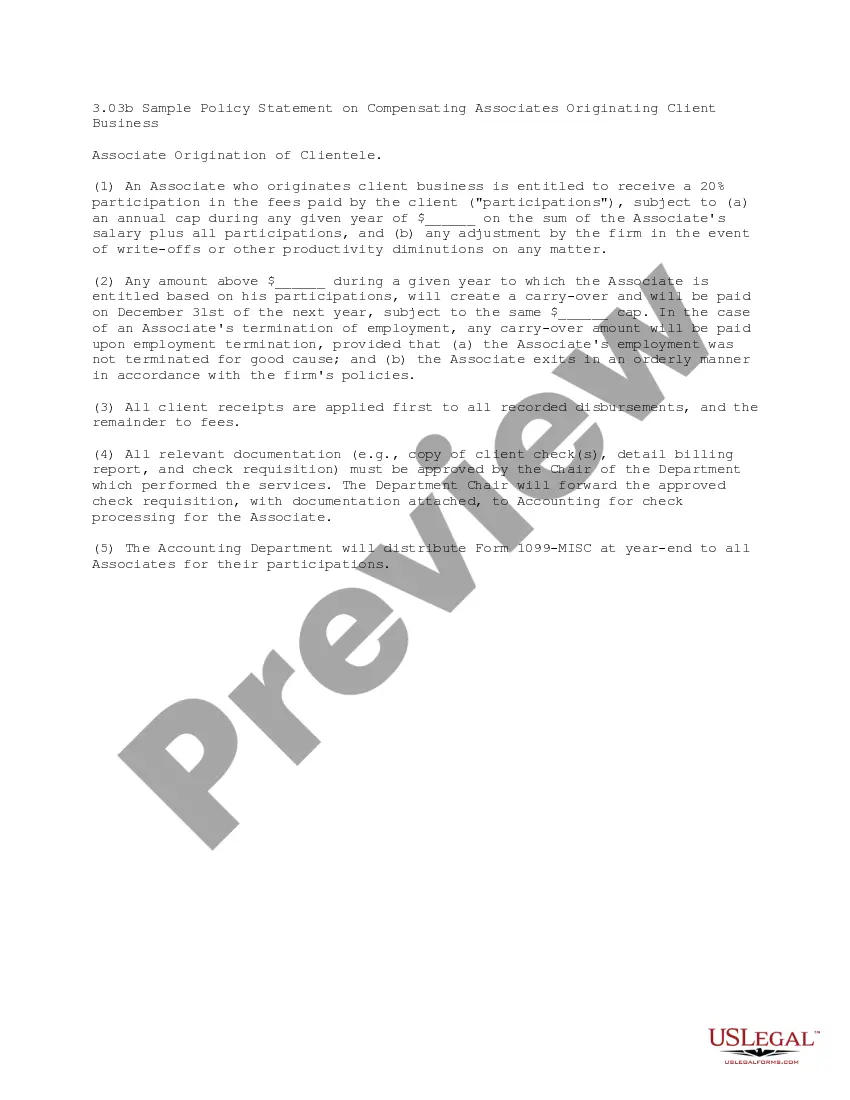
This document is a policy statement that defines the way an associate will be compensated for originating client business for the firm. It provides the percentage of fees paid to the associate, along with a "cap" amount in any given year. It also addresses carry-over amounts to the next calendar year and the issue of the associate leaving the firm.
North Carolina Policy Statement on Compensating Associates Originating Client Business
Category:
State:
Multi-State
Control #:
US-L0303B
Format:
Word;
PDF;
Rich Text
Instant download
Description






How to fill out Policy Statement On Compensating Associates Originating Client Business?
Finding the appropriate legal document template can be challenging. It goes without saying, there are numerous formats accessible online, but how can you locate the legal document you need? Take advantage of the US Legal Forms website. This service offers thousands of templates, including the North Carolina Policy Statement on Compensating Associates Originating Client Business, which you can utilize for both business and personal purposes. All templates are vetted by experts and comply with state and federal regulations.
If you are already registered, Log In to your account and click the Obtain button to download the North Carolina Policy Statement on Compensating Associates Originating Client Business. Use your account to browse through the legal documents you have previously acquired. Navigate to the My documents section of your account and obtain another copy of the document you need.
If you are a new user of US Legal Forms, here are simple instructions for you to follow: First, ensure you have selected the correct form for your city/region. You can preview the form using the Review option and read the form details to confirm it is the right one for you. If the form does not meet your needs, utilize the Search area to find the correct form. Once you are certain that the form is suitable, click on the Acquire now button to obtain the form. Choose the pricing plan you prefer and enter the required information. Create your account and complete your purchase using your PayPal account or credit card. Select the file format and download the legal document template to your device. Fill out, modify, print, and sign the obtained North Carolina Policy Statement on Compensating Associates Originating Client Business.
Take advantage of this extensive resource to simplify your legal document needs.
- US Legal Forms is the largest collection of legal documents where you can find various file formats.
- Utilize the service to download professionally crafted paperwork that adhere to state regulations.
- The templates are designed to meet both personal and business requirements.
- Ensure compliance with legal standards by using vetted forms.
- Access your previous downloads easily through your account.
- Follow the step-by-step instructions for a smooth experience.
Form popularity
FAQ
Rule 1.8 outlines the professional responsibilities of lawyers regarding specific client transactions, including business transactions and conflicts of interest. This rule ensures that lawyers do not exploit their clients' trust and that any agreements are fair and reasonable. The North Carolina Policy Statement on Compensating Associates Originating Client Business reflects the importance of adhering to these responsibilities. By understanding Rule 1.8, attorneys can foster transparent relationships with their clients and uphold ethical standards in their practice.
An example of a conflict of interest for a divorce lawyer arises when the attorney represents both spouses in the divorce proceedings. This situation can lead to divided loyalties and may hinder the lawyer's ability to advocate effectively for each party's interests. The North Carolina Policy Statement on Compensating Associates Originating Client Business emphasizes the need for clear boundaries in such cases to protect client rights. Identifying and addressing conflicts promptly is essential for maintaining ethical legal practices.
The common interest privilege in North Carolina allows parties with shared legal interests to communicate without fear that their discussions will be disclosed in court. This privilege promotes collaboration among clients and their attorneys while protecting sensitive information. The North Carolina Policy Statement on Compensating Associates Originating Client Business recognizes the importance of this privilege in facilitating effective legal representation. Understanding this privilege can be advantageous for clients navigating complex legal matters.
In legal ethics, Rule 1.7 prohibits attorneys from representing clients when there is a significant risk that the representation may be materially limited by the lawyer's responsibilities to another client, a former client, or a third person. This rule is fundamental in ensuring that lawyers act in the best interests of their clients without being influenced by conflicting obligations. The North Carolina Policy Statement on Compensating Associates Originating Client Business underscores the importance of adhering to ethical standards. By following these guidelines, lawyers can maintain trust and integrity in their practice.
Rule 1.7 in the Massachusetts rules of professional conduct similarly addresses conflicts of interest, stating that a lawyer must not represent a client if there is a concurrent conflict of interest. This rule aims to protect clients' interests by ensuring that attorneys do not favor one client over another. The North Carolina Policy Statement on Compensating Associates Originating Client Business aligns with these principles, providing guidance on ethical practices for lawyers. Legal professionals must be aware of these rules to uphold the standards of their field.
Rule 1.7 B specifically focuses on the situations where a lawyer cannot represent a client if their interests conflict with another client’s interests. This rule prioritizes the duty of loyalty and requires attorneys to avoid situations that could compromise their representation. Additionally, the North Carolina Policy Statement on Compensating Associates Originating Client Business highlights how compliance with such rules is crucial for maintaining professional integrity. Adhering to this rule protects both clients and the legal profession.
The rules of 1.7 B address conflicts of interest in legal practice, particularly regarding representation of clients with differing interests. These rules are essential in ensuring that attorneys maintain loyalty and confidentiality to their clients. The North Carolina Policy Statement on Compensating Associates Originating Client Business emphasizes the importance of these rules in guiding ethical practices. Understanding these rules helps lawyers navigate potential conflicts effectively.
Nonapportionable income in North Carolina refers to income that does not need to be divided among different states for taxation purposes. This type of income is typically earned from sources that are exclusive to North Carolina. Understanding nonapportionable income is crucial for compliance with the North Carolina Policy Statement on Compensating Associates Originating Client Business, as it can impact your overall tax strategy.
Mail NC D-403 to the address provided on the form for the North Carolina Department of Revenue. Ensure that all required information is complete to avoid processing delays. If you are considering how the North Carolina Policy Statement on Compensating Associates Originating Client Business affects your tax obligations, our resources can help clarify your responsibilities.
NC Form D-403 is a tax form used for reporting specific types of income in North Carolina. It is essential for businesses and individuals who need to report income that is not easily categorized. Understanding the relevance of the North Carolina Policy Statement on Compensating Associates Originating Client Business can help you fill out this form accurately.