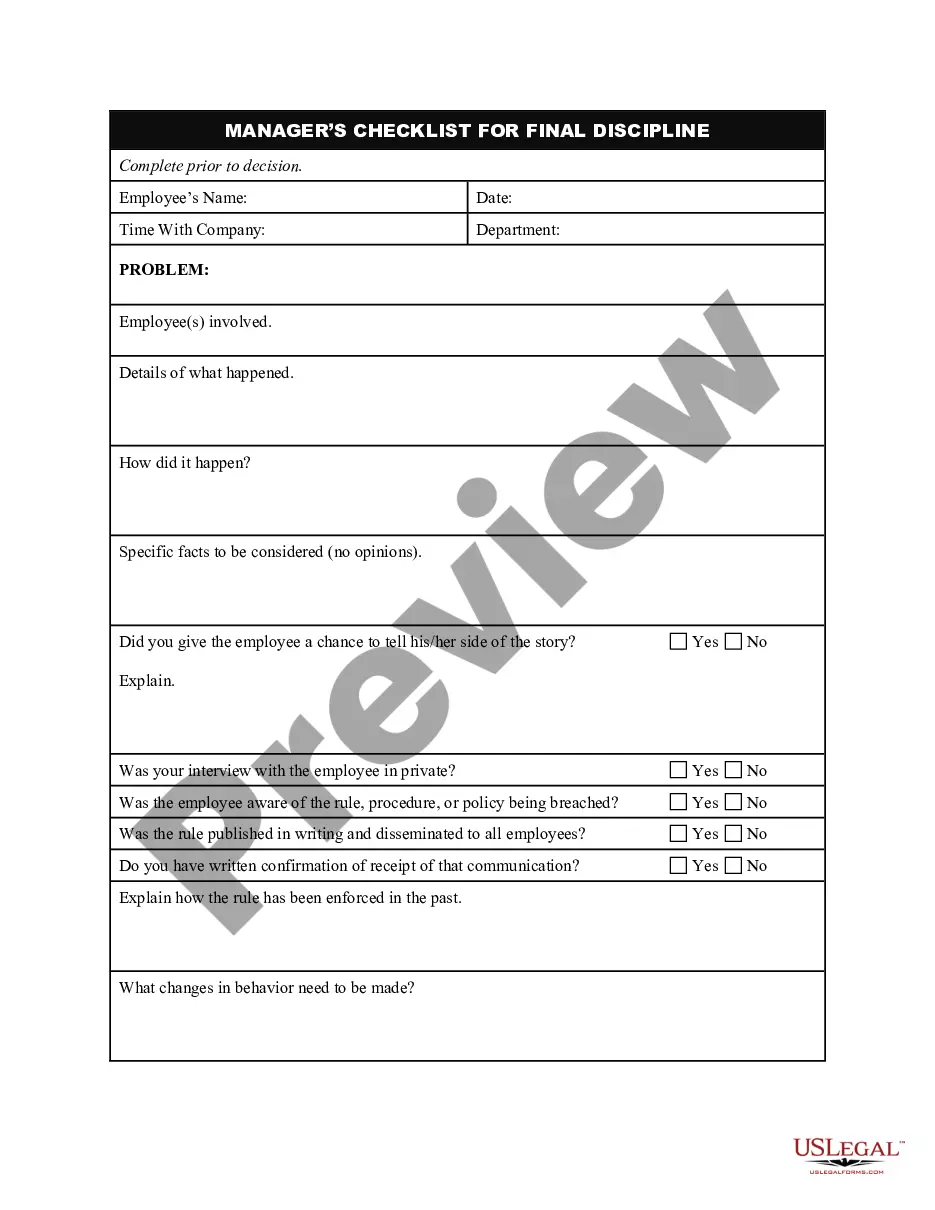
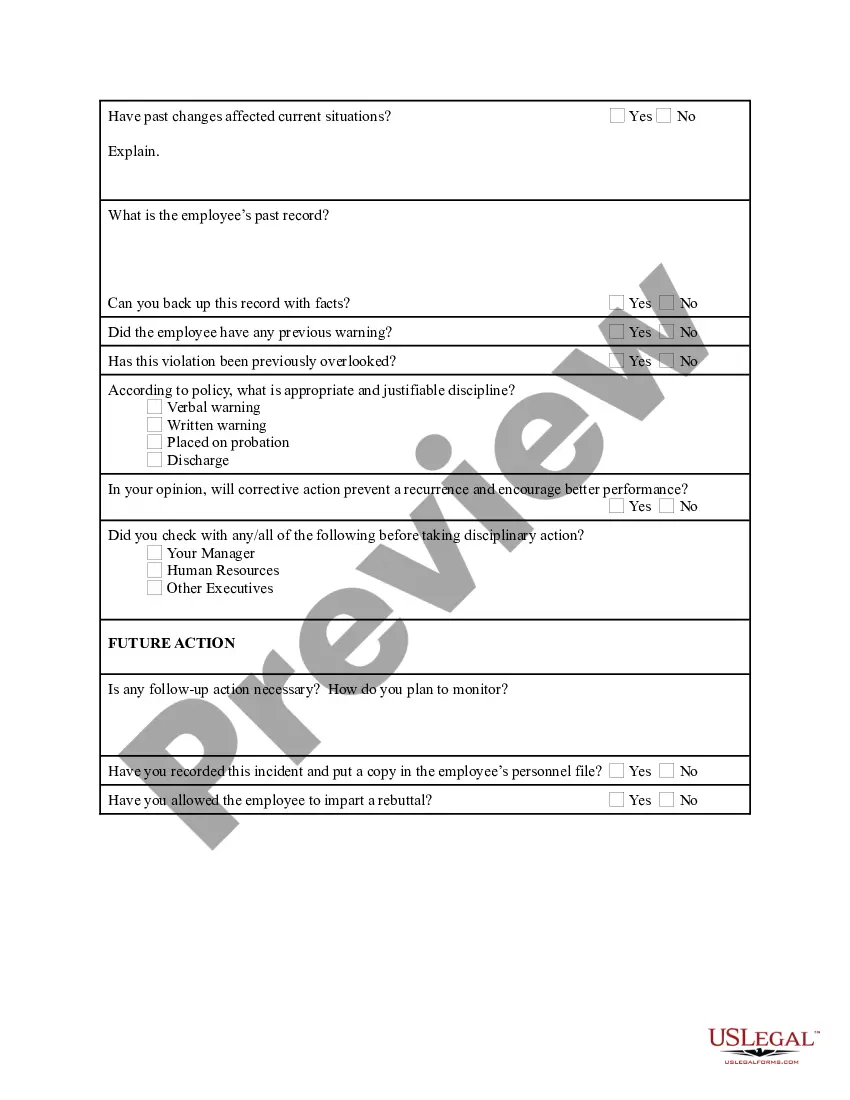
North Carolina Manager's Checklist for Final Discipline
Description
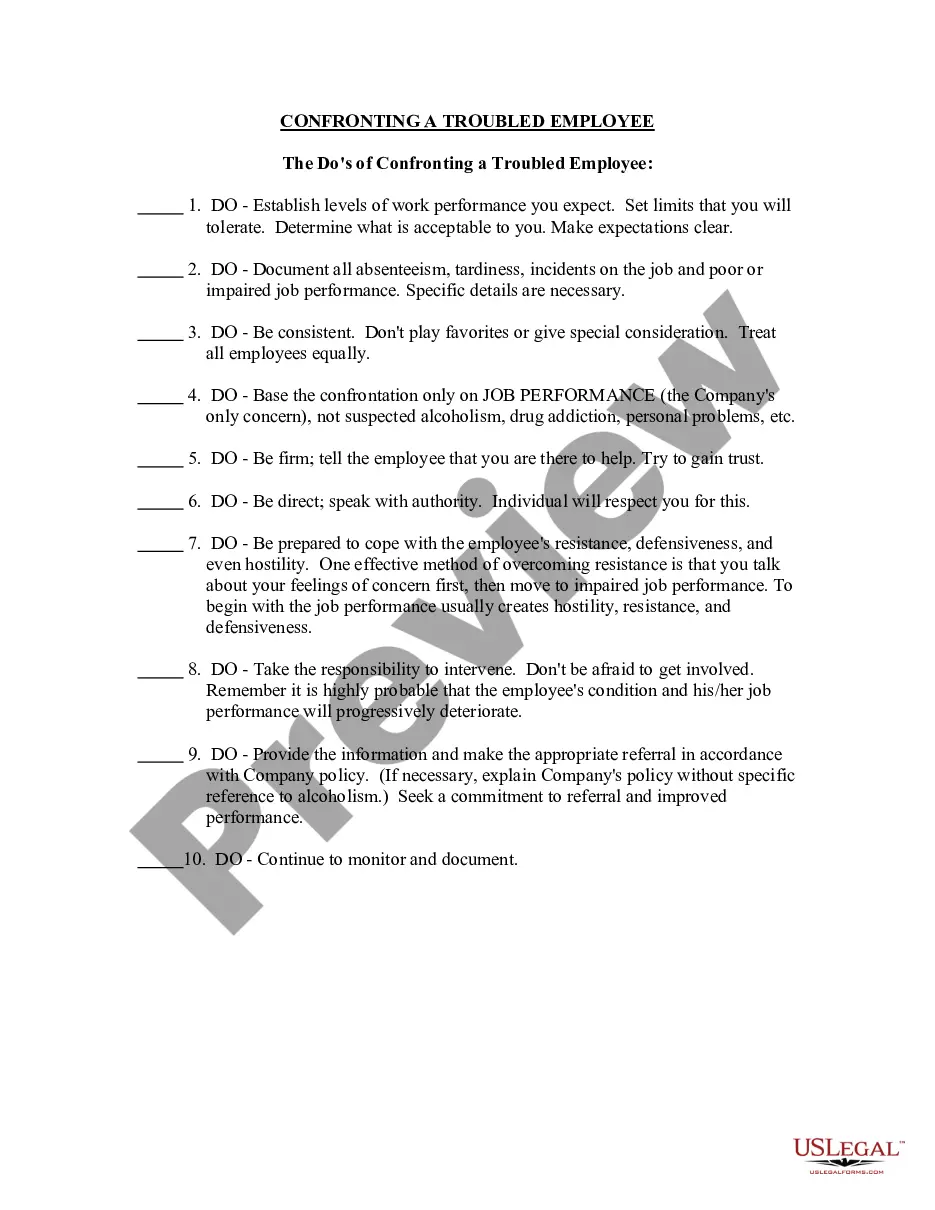
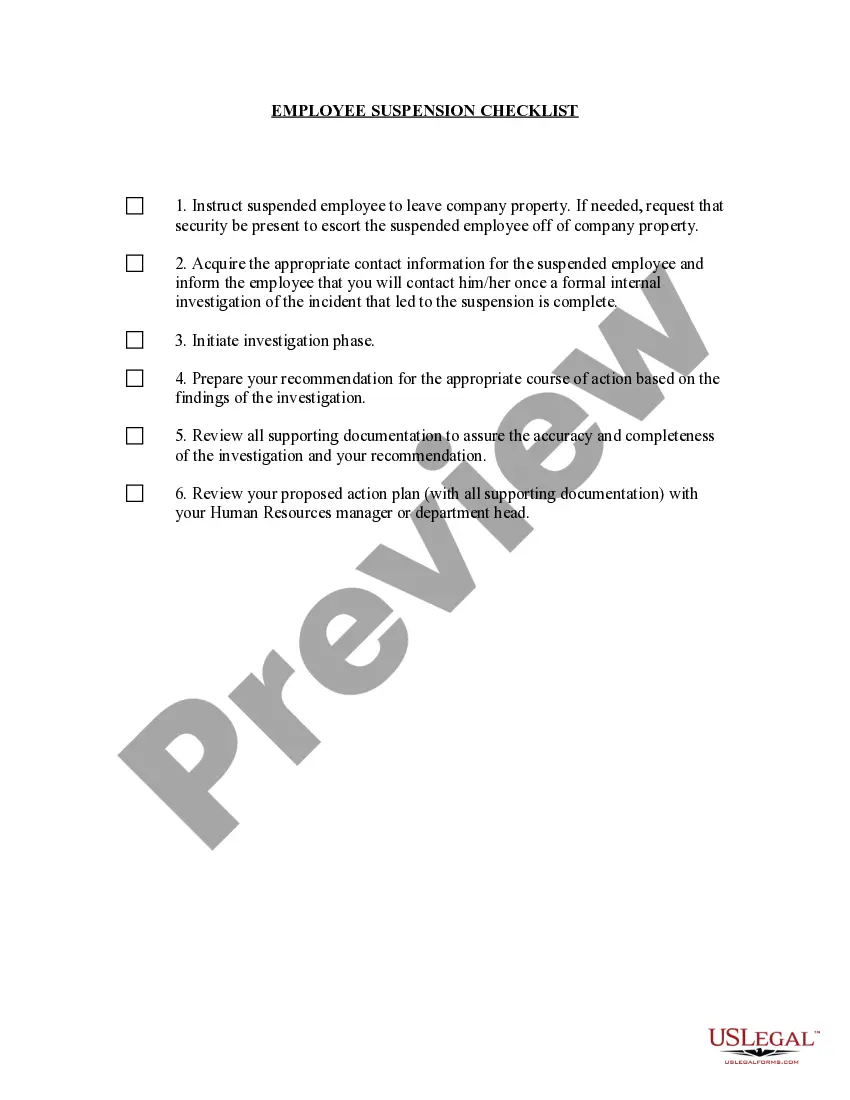
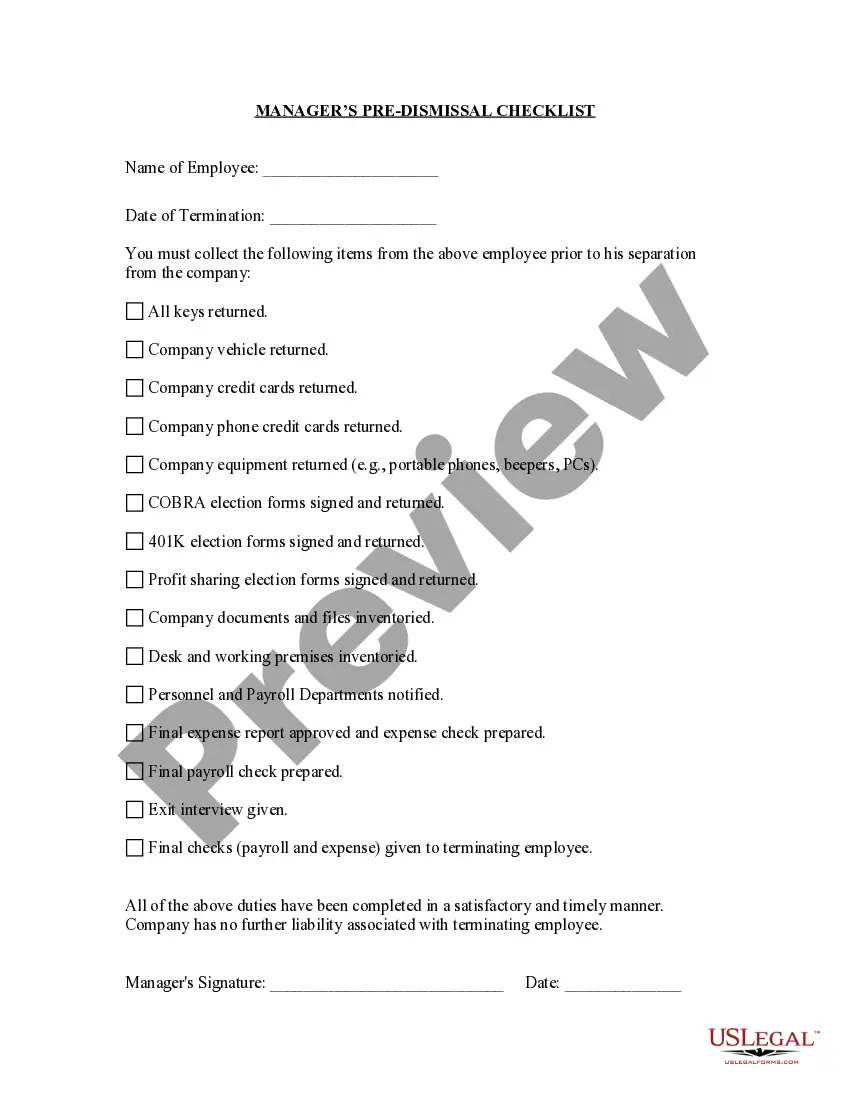
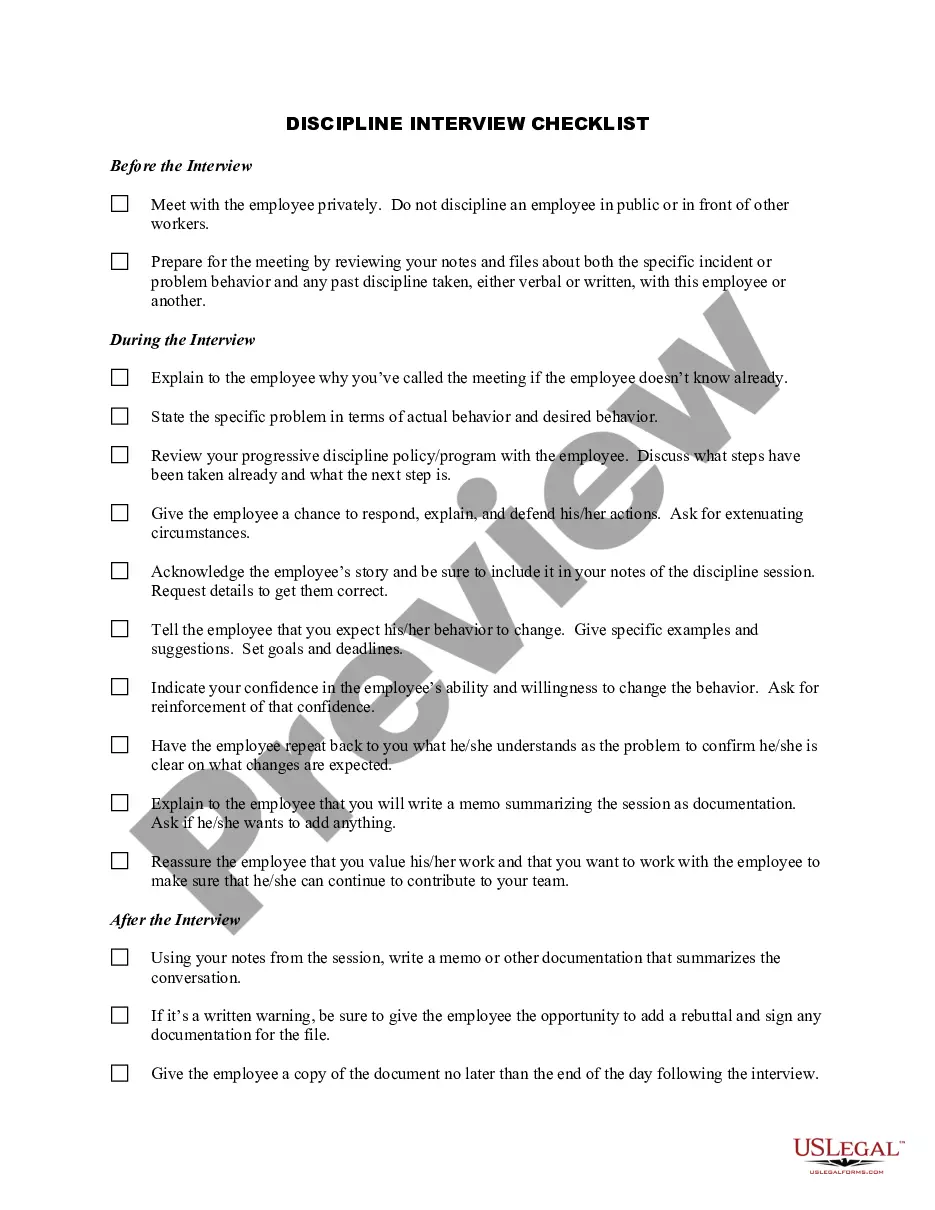
Get your form ready online
Our built-in tools help you complete, sign, share, and store your documents in one place.
Make edits, fill in missing information, and update formatting in US Legal Forms—just like you would in MS Word.
Download a copy, print it, send it by email, or mail it via USPS—whatever works best for your next step.
Sign and collect signatures with our SignNow integration. Send to multiple recipients, set reminders, and more. Go Premium to unlock E-Sign.
If this form requires notarization, complete it online through a secure video call—no need to meet a notary in person or wait for an appointment.
We protect your documents and personal data by following strict security and privacy standards.
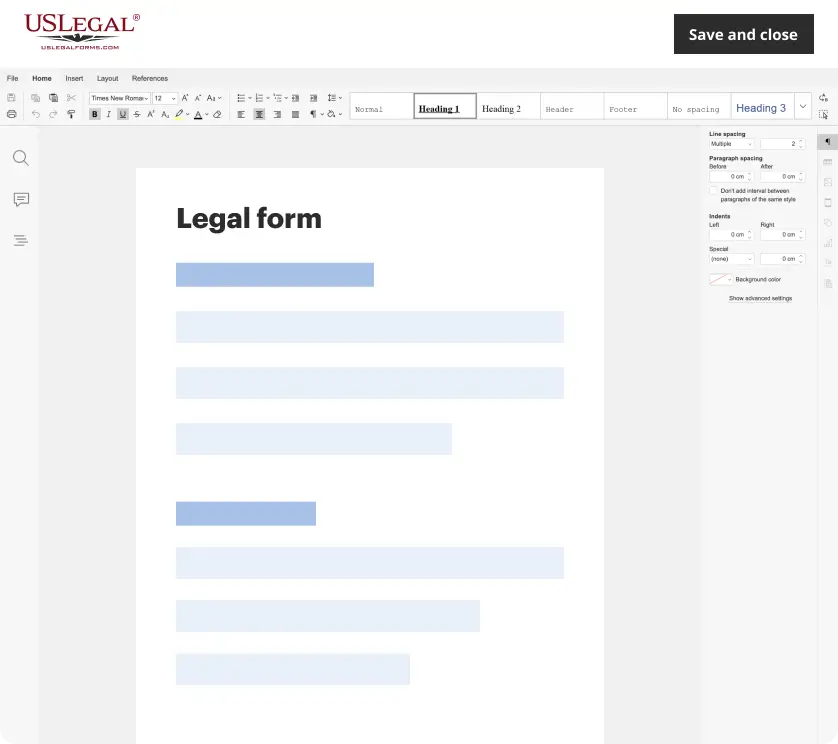
Make edits, fill in missing information, and update formatting in US Legal Forms—just like you would in MS Word.
Download a copy, print it, send it by email, or mail it via USPS—whatever works best for your next step.
Sign and collect signatures with our SignNow integration. Send to multiple recipients, set reminders, and more. Go Premium to unlock E-Sign.
If this form requires notarization, complete it online through a secure video call—no need to meet a notary in person or wait for an appointment.
We protect your documents and personal data by following strict security and privacy standards.
Looking for another form?





How to fill out Manager's Checklist For Final Discipline?
Selecting the appropriate legal document format can be quite challenging.
Clearly, there are numerous templates accessible online, but how will you acquire the legal form you require.
Utilize the US Legal Forms website. The service offers thousands of templates, including the North Carolina Manager's Checklist for Final Discipline, which can be utilized for business and personal purposes.
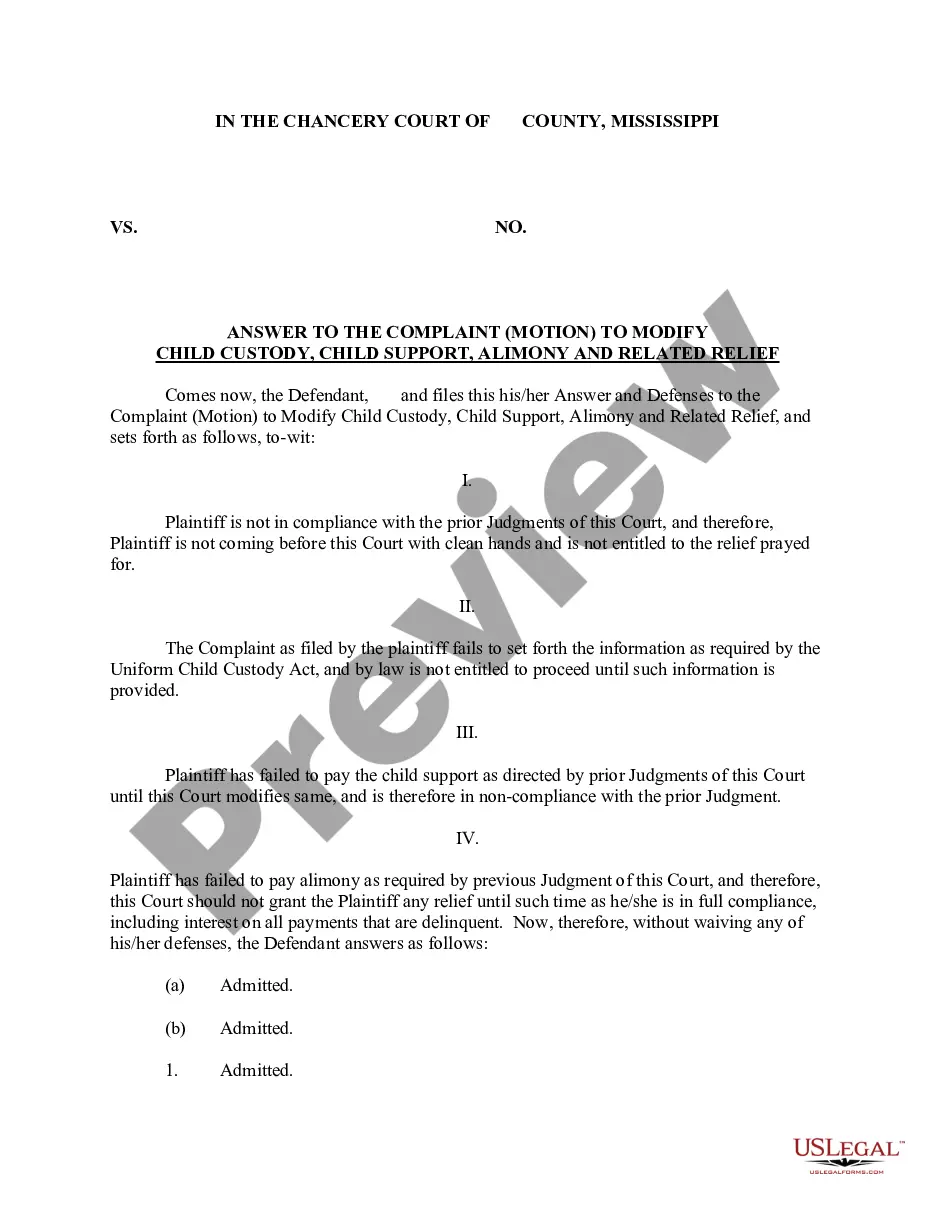
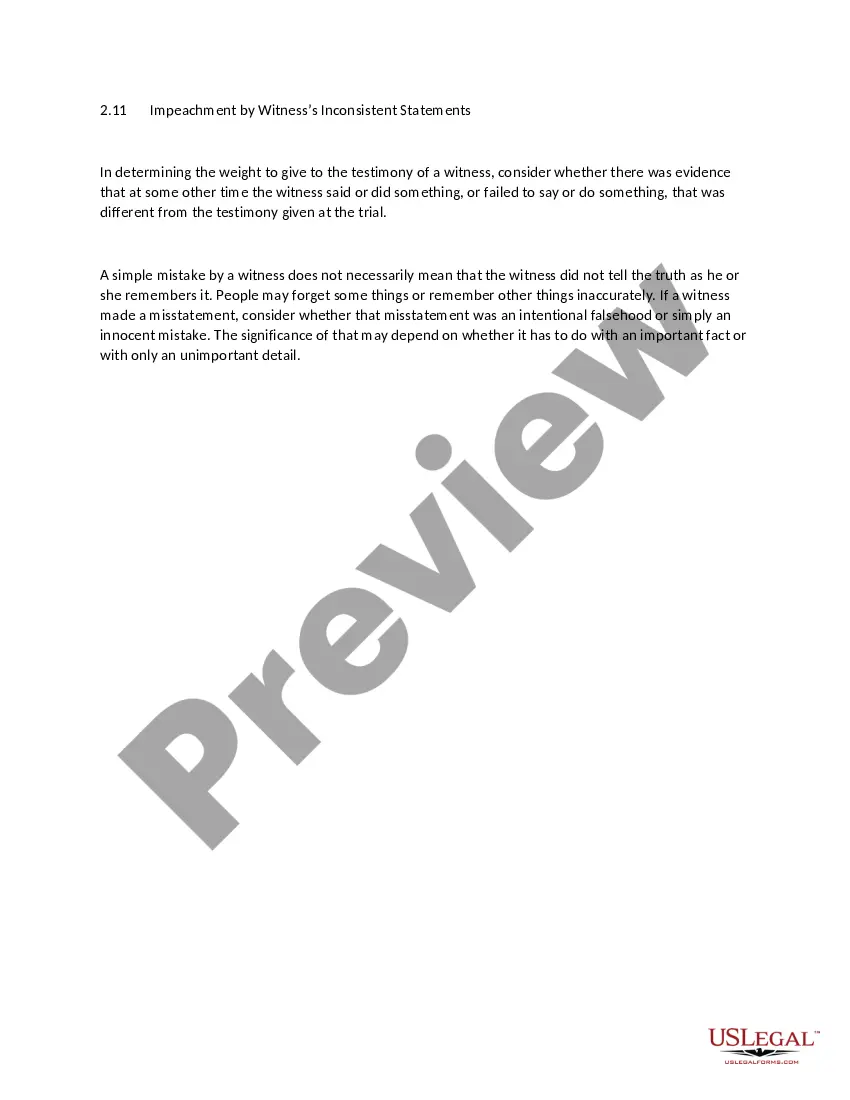
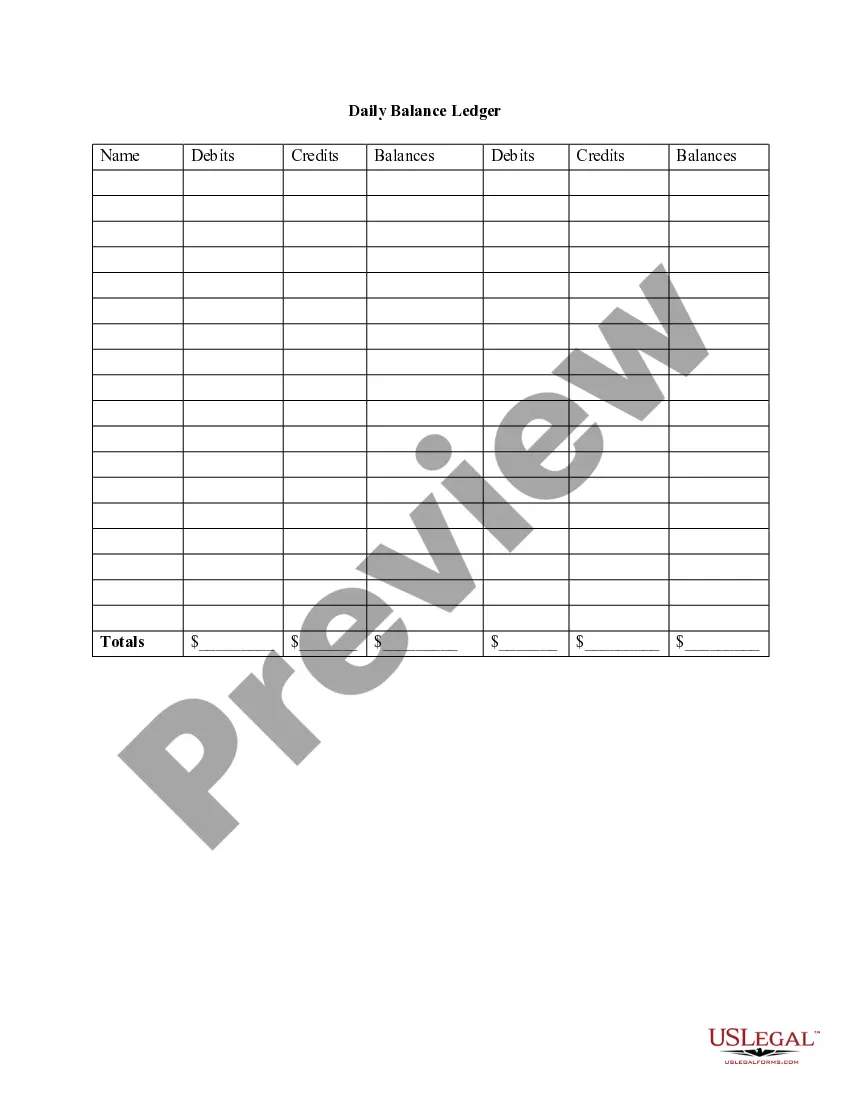
You can review the form using the Preview button and examine the form's outline to confirm it is suitable for your needs.
- All of the documents are reviewed by experts and meet federal and state regulations.
- If you are already registered, Log In to your account and click the Download button to get the North Carolina Manager's Checklist for Final Discipline.
- Use your account to browse through the legal forms you have previously purchased.
- Go to the My documents tab of your account and retrieve another copy of the document you need.
- If you are a new user of US Legal Forms, here are simple instructions for you to follow.
- First, ensure you have selected the correct form for your city/county.
Form popularity
FAQ
Your organization, specifically the Human Resources (HR) department and involved managers, should have a discipline process in place to address performance and behavioral issues and use these steps to discipline an employee.
When it's decided there was no misconduct or performance issue, the employer should end the disciplinary procedure. To make sure there is no bad feeling, the employer should talk privately with the employee and any other staff who knew the disciplinary procedure was happening.
Here are some general guidelines and best practices:Keep it private. Hold the discipline meeting in a private location, away from co-workers.Have a witness.Be straightforward.Remain calm.Be respectful.Explain impact to the company.Work with the employee to find a solution.State the consequences.More items...?
12 Tips for Handling Employee Terminations and Disciplinary...Confirm the information.Check the policy.Review past practices.Remove emotion from the decision-making process.Arrange for a witness.Have a plan.Prepare documents in advance.Meet in person if possible.More items...?
Using the following steps for disciplinary action can make it easy for you to meet this ideal.Step 1: Oral Reprimand.Step 2: Written Warning.Step 3: Final Documentation.Step 4: Suspension with Probation.Step 5: Termination.
Using the following steps for disciplinary action can make it easy for you to meet this ideal.Step 1: Oral Reprimand.Step 2: Written Warning.Step 3: Final Documentation.Step 4: Suspension with Probation.Step 5: Termination.
The 4-Step Progressive Discipline TemplateStep 1: Verbal Warning. In this step, the supervisor informs the employee of the concerns and listens to any information the employee provides.Step 2: Written Warning.Step 3: Suspension.Step 4: Termination.
There are five steps that can be taken in the progressive discipline process:Coaching Note (AKA Verbal Warning)Written Warning.Final Warning.Decision Day/Suspension.Separation.
Disciplinary stepsA meeting to discuss the issue. A disciplinary decision. A chance to appeal this decision.