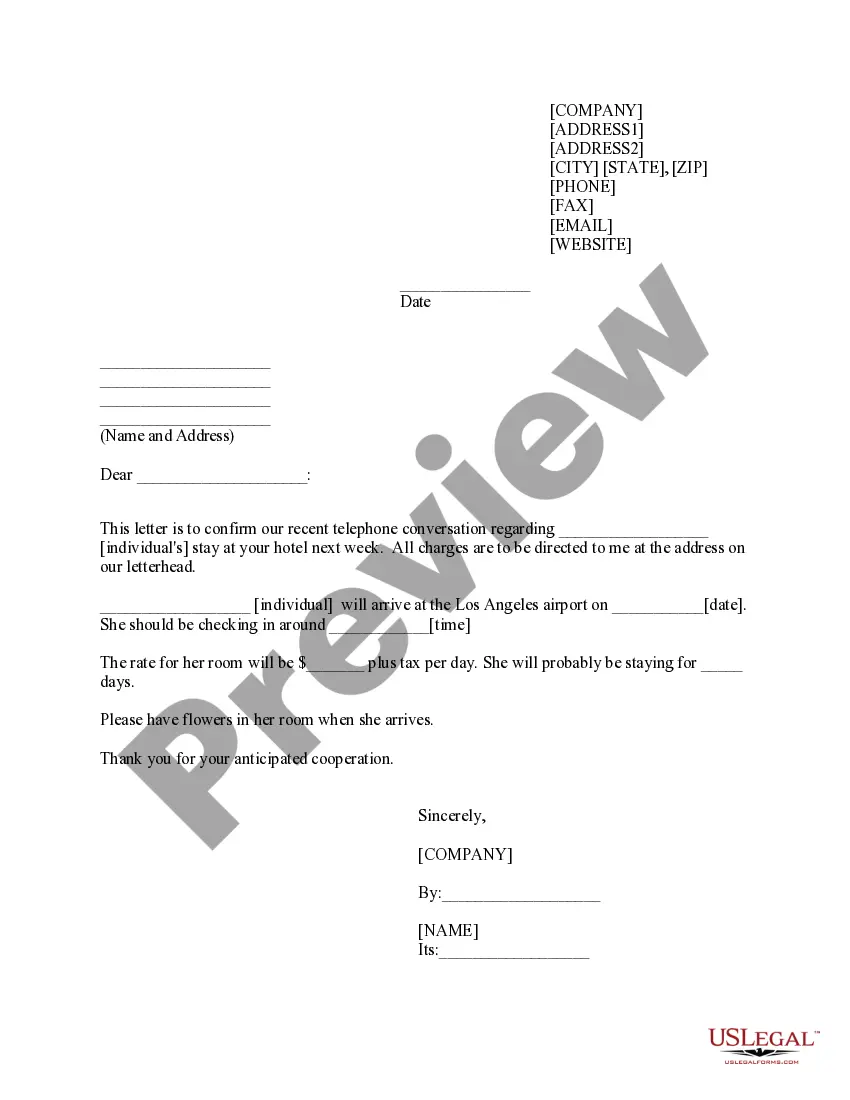
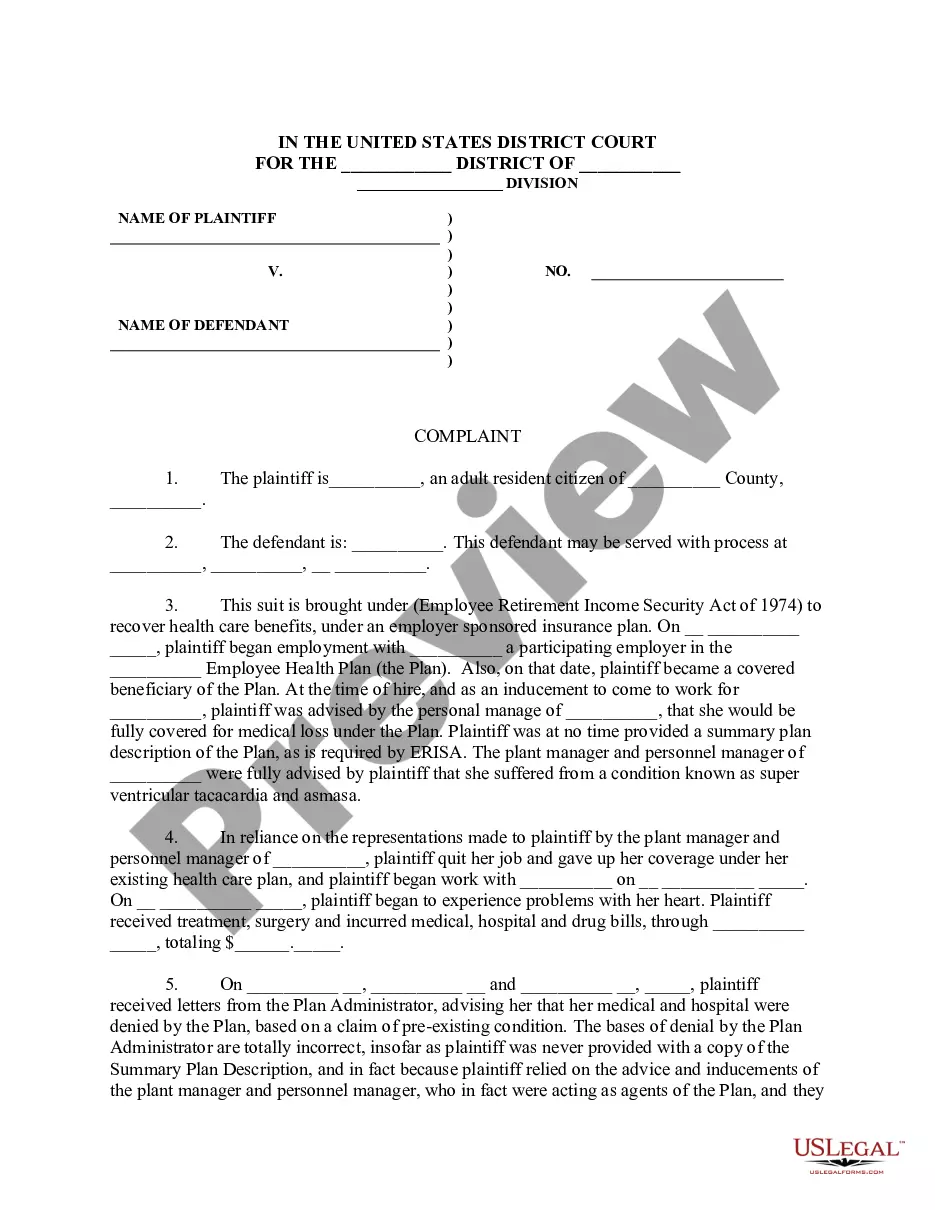
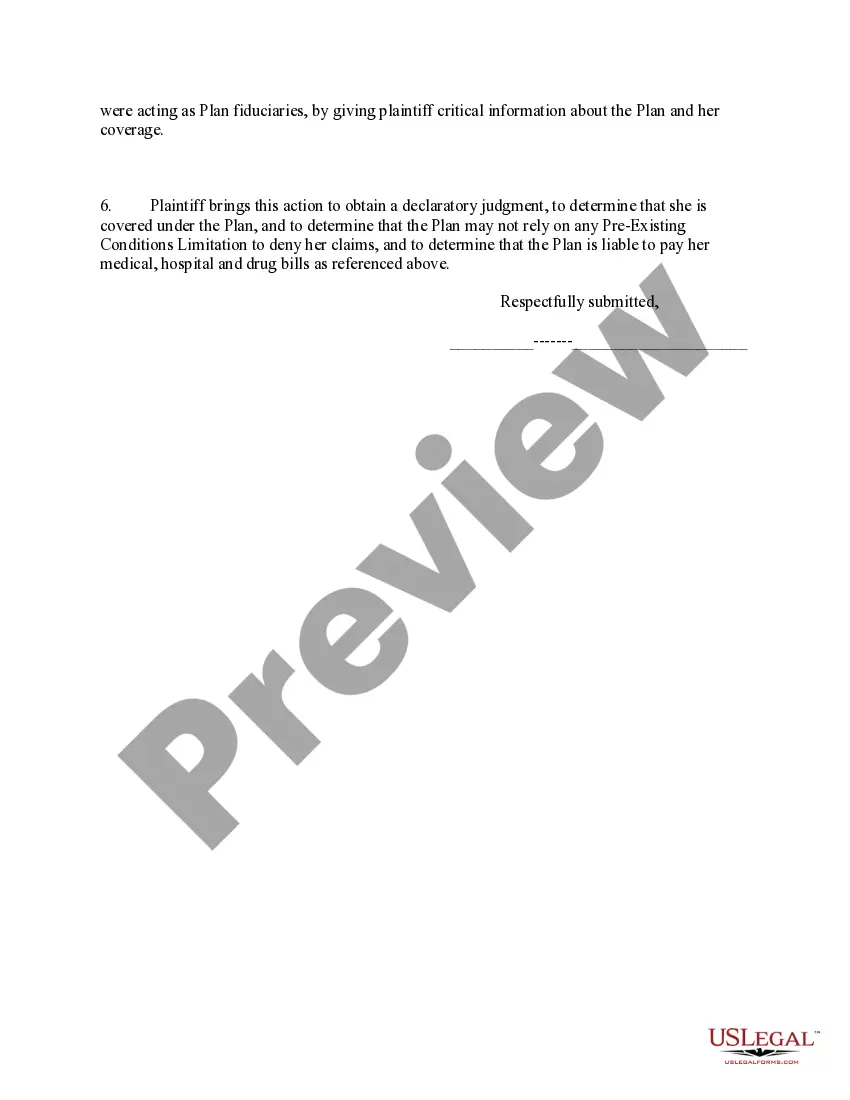
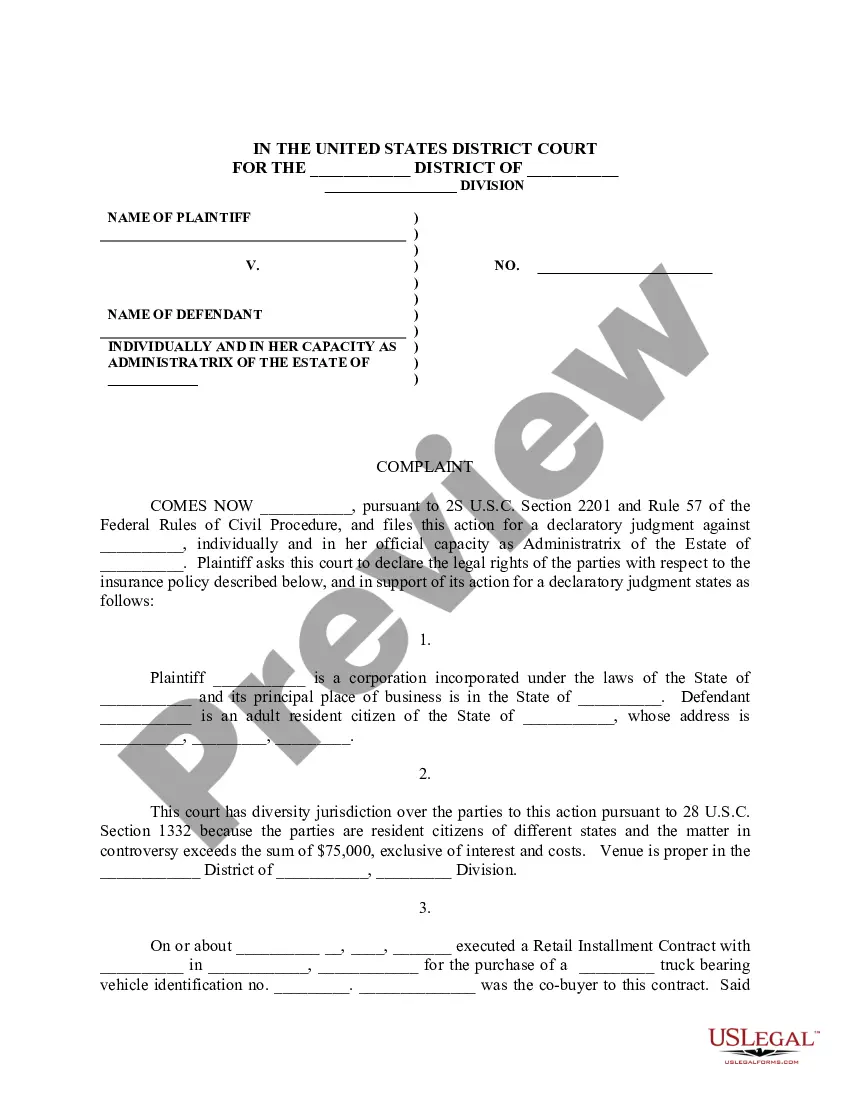
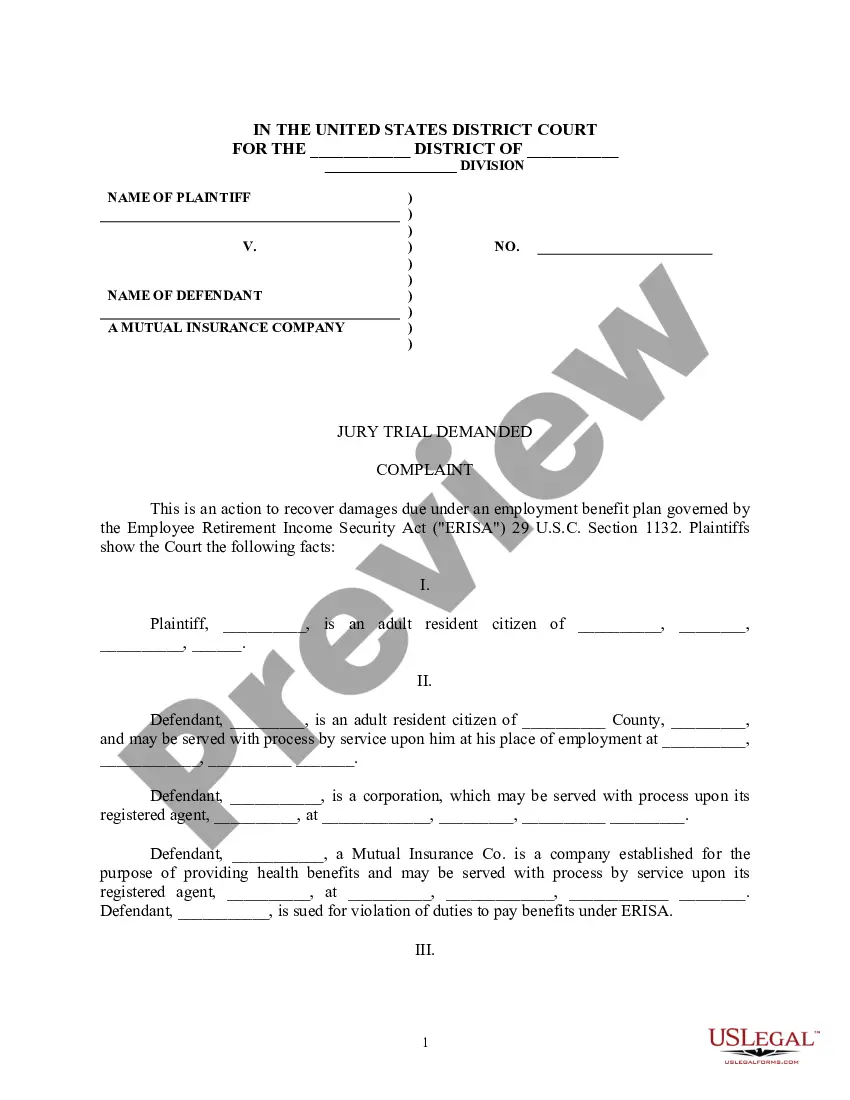
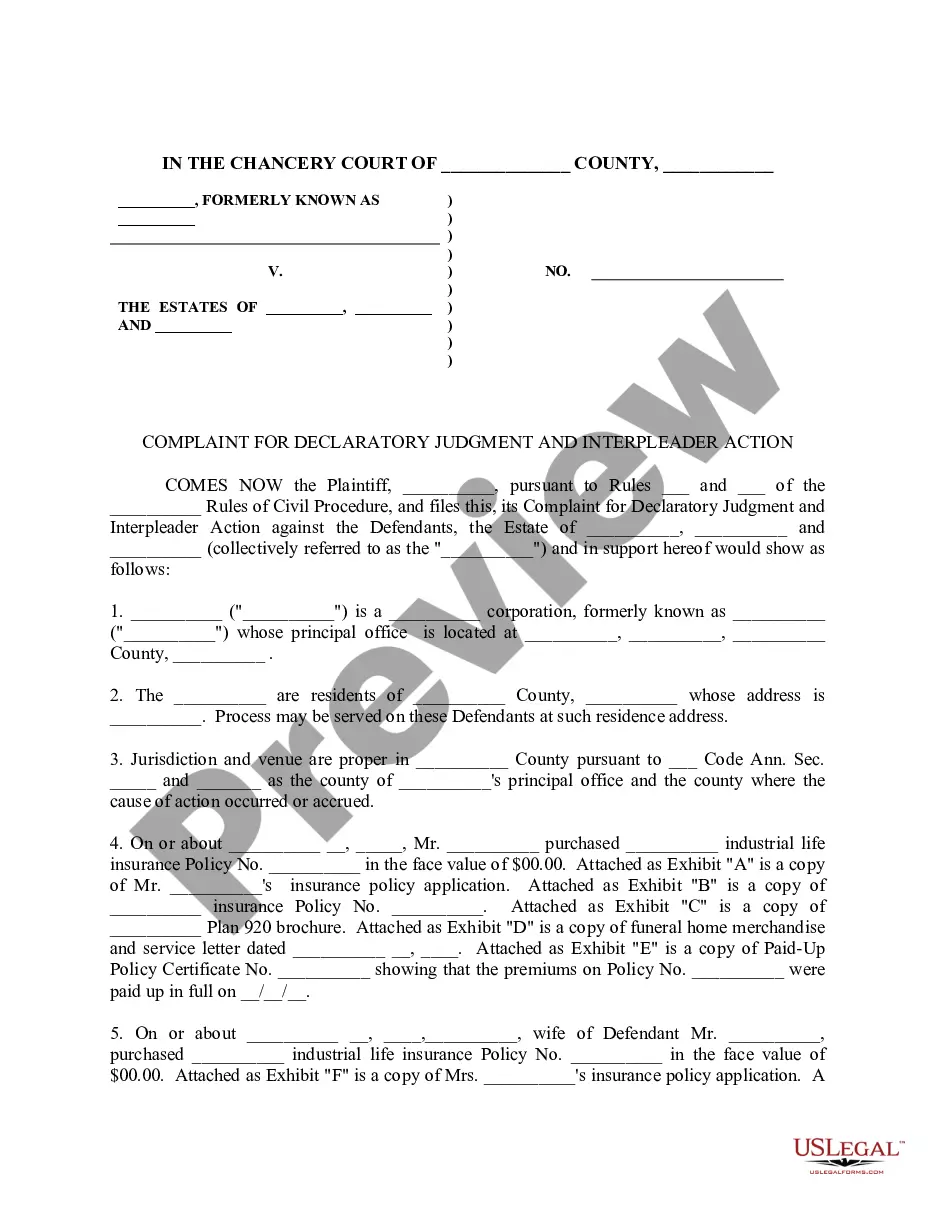
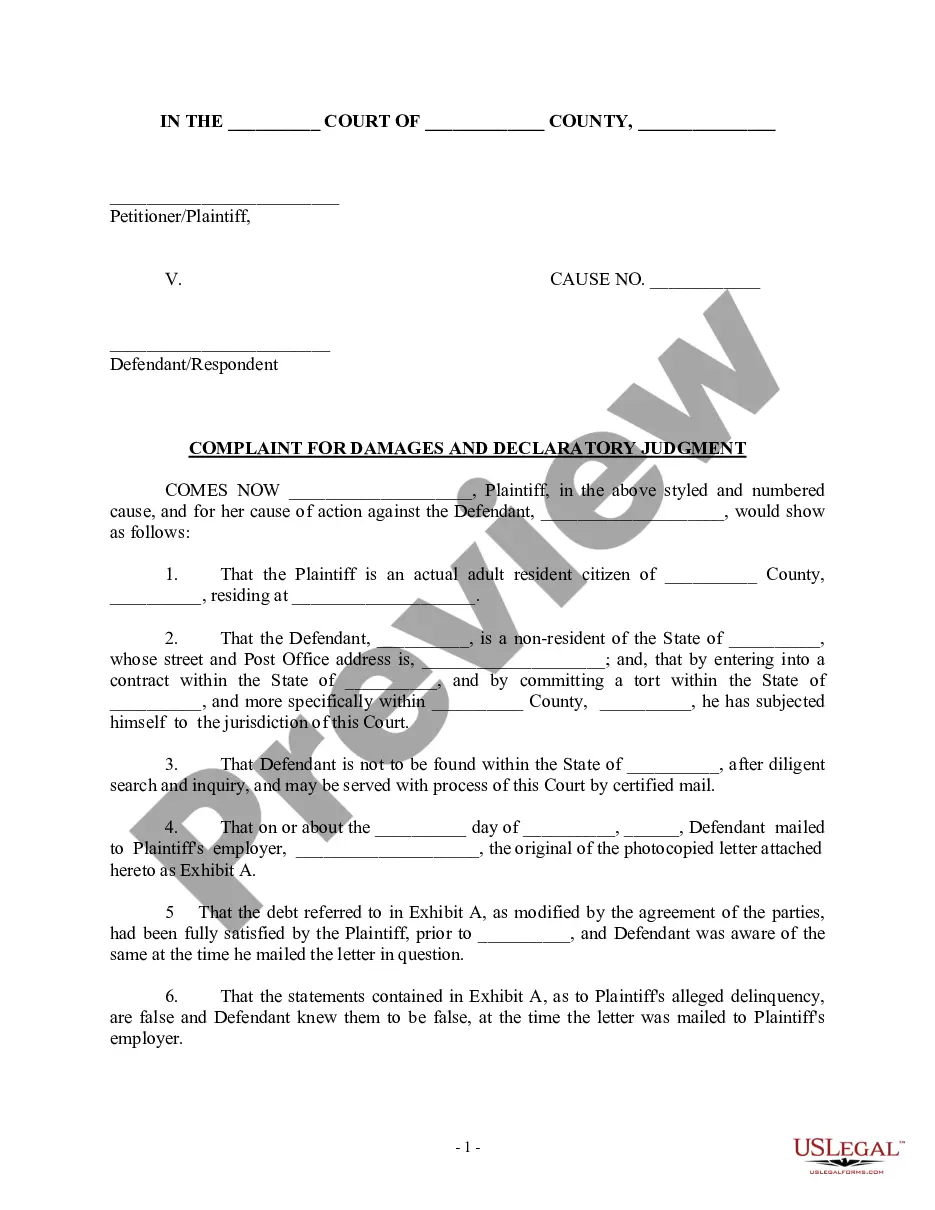
This form is a Complaint For Declaratory Judgment To Determine ERISA Coverage. Adapt to your specific circumstances. Don't reinvent the wheel, save time and money.
Montana Complaint For Declaratory Judgment To Determine ERISA Coverage
Instant download
Description
Free preview
Get your form ready online
Our built-in tools help you complete, sign, share, and store your documents in one place.
Built-in online Word editor
Make edits, fill in missing information, and update formatting in US Legal Forms—just like you would in MS Word.
Export easily
Download a copy, print it, send it by email, or mail it via USPS—whatever works best for your next step.
E-sign your document
Sign and collect signatures with our SignNow integration. Send to multiple recipients, set reminders, and more. Go Premium to unlock E-Sign.
Notarize online 24/7
If this form requires notarization, complete it online through a secure video call—no need to meet a notary in person or wait for an appointment.
Store your document securely
We protect your documents and personal data by following strict security and privacy standards.

Make edits, fill in missing information, and update formatting in US Legal Forms—just like you would in MS Word.

Download a copy, print it, send it by email, or mail it via USPS—whatever works best for your next step.

Sign and collect signatures with our SignNow integration. Send to multiple recipients, set reminders, and more. Go Premium to unlock E-Sign.

If this form requires notarization, complete it online through a secure video call—no need to meet a notary in person or wait for an appointment.

We protect your documents and personal data by following strict security and privacy standards.
Looking for another form?

How to fill out Complaint For Declaratory Judgment To Determine ERISA Coverage?
Have you found yourself in a circumstance where you need documents for business or specific objectives nearly every day.
There are numerous legal document templates accessible online, but finding ones you can rely on isn't straightforward.
US Legal Forms offers a wide range of form templates, including the Montana Complaint For Declaratory Judgment To Determine ERISA Coverage, designed to fulfill state and federal requirements.
Once you find the appropriate form, simply click Buy now.
Select the payment method you prefer, enter the necessary information to create your account, and complete your order using your PayPal or credit card.
- If you are already familiar with the US Legal Forms website and possess an account, simply Log In.
- After that, you can download the Montana Complaint For Declaratory Judgment To Determine ERISA Coverage template.
- If you don't have an account and wish to start using US Legal Forms, follow these steps.
- Find the form you need and ensure it is for your correct area/county.
- Use the Review button to examine the form.
- Check the description to confirm that you have selected the correct form.
- If the form isn't what you're looking for, utilize the Lookup section to find the form that meets your needs.
Form popularity
FAQ
To prove an insurance company acted in bad faith, you must show that the insurer denied your claim without a valid reason or failed to investigate your claim thoroughly. Gathering evidence such as communication records, policy documents, and witness statements can support your case. If you file a Montana Complaint For Declaratory Judgment To Determine ERISA Coverage, it may strengthen your argument by clarifying your rights under the plan. Utilizing the resources on US Legal Forms can help you draft an effective complaint.
Yes, Montana recognizes third-party bad faith claims against insurance companies. This means that if an insurer fails to act in good faith when handling a third-party claim, you may have legal grounds to pursue a case against them. Understanding this concept is crucial, especially if you consider filing a Montana Complaint For Declaratory Judgment To Determine ERISA Coverage. For further guidance, platforms like USLegalForms can help you navigate the legal process.
You can file a complaint against an insurance company in Montana by visiting the Montana insurance commissioner's website and completing the complaint form. Ensure that you provide all necessary details, including your contact information and a description of your issue. If your case involves ERISA coverage, you might want to explore a Montana Complaint For Declaratory Judgment To Determine ERISA Coverage. Resources like USLegalForms can assist you in preparing your documentation.
To report a health insurance company in Montana, you should gather all relevant information, including your policy details and any communication you've had with the insurer. You can file a complaint with the Montana insurance commissioner through their official website or by mail. If you need further assistance or guidance, consider using USLegalForms to craft a Montana Complaint For Declaratory Judgment To Determine ERISA Coverage, which can help clarify your situation.
The Montana insurance commissioner cannot provide legal advice, represent you in court, enforce your insurance policy, or negotiate settlements on your behalf. These limitations mean that while the commissioner can oversee insurance practices and regulations, you must take personal initiative for legal actions, such as filing a Montana Complaint For Declaratory Judgment To Determine ERISA Coverage. Understanding these boundaries helps you navigate your options effectively.
A declaratory judgment is a special type of lawsuit that allows you to seek a court order explaining the legal rights and duties of the parties to the suit. The court's order is as final and enforceable like any other legal judgment.
What Is a Declaratory Judgment Action? In the event of a legal controversy, both parties generally want to avoid any legal uncertainty and insecurity that could arise out of a dispute. A common way of eliminating this uncertainty is with a declaratory judgment action, also called a declaration.
Examples: a party to a contract may seek the legal interpretation of a contract to determine the parties' rights, or a corporation may ask a court to decide whether a new tax is truly applicable to that business before it pays it.
For example, a policyholder believes that their denied claim is unjust. As a result, they inform the insurer that they are considering a lawsuit to recover losses. The insurer seeks a declaratory judgment to clarify its rights and obligations with hopes of preventing the lawsuit.
"The essential requirements of a declaratory judgment action are: (1) a plaintiff with a legal tangible interest; (2) a defendant having an opposing interest; and (3) an actual controversy between the parties concerning such interests.