Montana Acknowledgment for Representative Capacities
Overview of this form
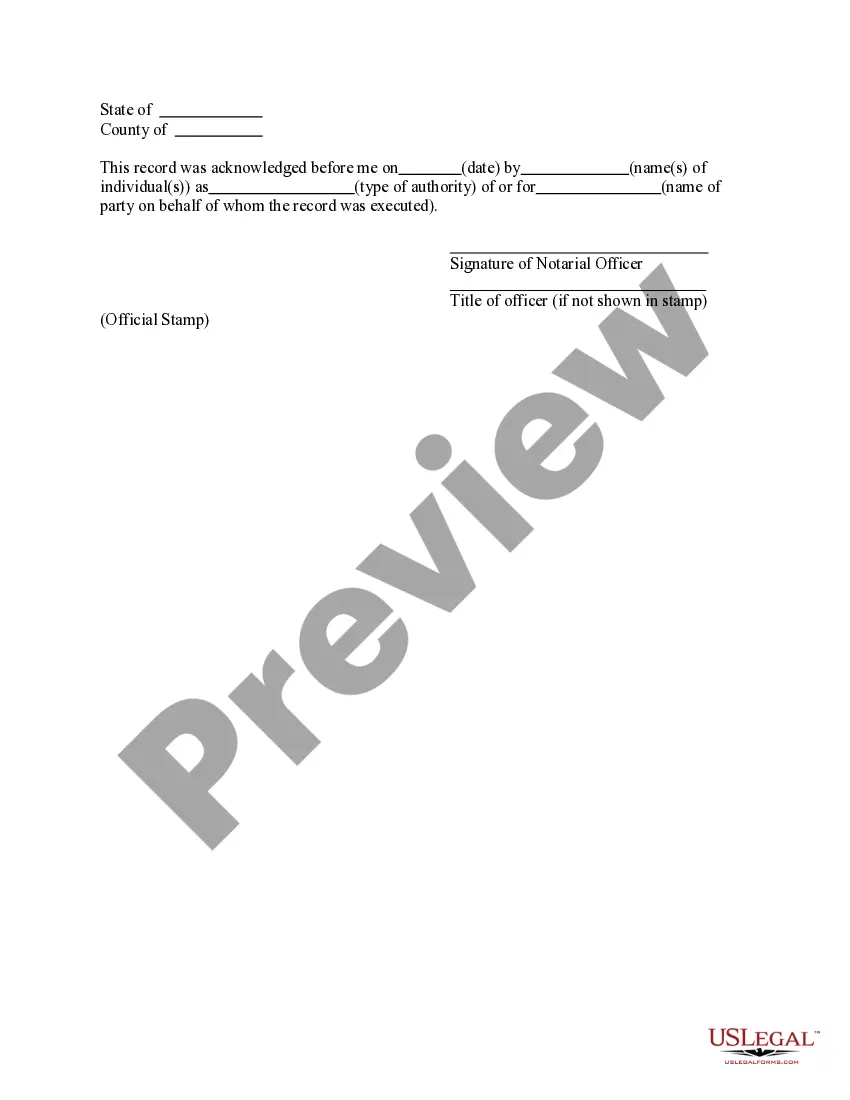
The Acknowledgment for Representative Capacities is a legal document that serves to confirm the authority of individuals to act on behalf of another party. This form is particularly important when a representative is executing documents that require formal acknowledgment. It ensures that all parties involved are aware of the representative's authority and the nature of their role, differentiating it from other acknowledgment forms which may not specify the capacity in which the representative is acting.
What’s included in this form
- Date of acknowledgment
- Name(s) of the individual(s) acknowledging their representative capacity
- Type of authority being recognized
- Name of the party on behalf of whom the actions are executed
- Signature of notarial officer
- Official stamp (if applicable)
Common use cases
This form is used in situations where a representative is acting on behalf of an individual or organization. Examples include scenarios involving guardianship, legal representation in property transactions, or when an official is required to acknowledge decisions made on behalf of another party. It may also be necessary when executing documents that require verification of authority, such as contracts or legal filings.
Who this form is for
- Individuals acting as legal representatives
- Guardians or conservators
- Officers of corporations or organizations
- Anyone needing to document their authority to act on another's behalf
Completing this form step by step
- Identify the parties involved and specify the date of acknowledgment.
- Provide the names of the individuals acknowledging their representative capacities.
- Clearly define the type of authority being recognized (e.g., attorney-in-fact, guardian).
- Name the party on whose behalf the acknowledgment is being executed.
- Obtain the signature of a notarial officer, if required, along with their official stamp.
Notarization requirements for this form
Notarization is required for this form to take effect. Our online notarization service, powered by Notarize, lets you verify and sign documents remotely through an encrypted video session, available 24/7.
Get your form ready online
Our built-in tools help you complete, sign, share, and store your documents in one place.
Make edits, fill in missing information, and update formatting in US Legal Forms—just like you would in MS Word.
Download a copy, print it, send it by email, or mail it via USPS—whatever works best for your next step.
Sign and collect signatures with our SignNow integration. Send to multiple recipients, set reminders, and more. Go Premium to unlock E-Sign.
If this form requires notarization, complete it online through a secure video call—no need to meet a notary in person or wait for an appointment.
We protect your documents and personal data by following strict security and privacy standards.

Make edits, fill in missing information, and update formatting in US Legal Forms—just like you would in MS Word.

Download a copy, print it, send it by email, or mail it via USPS—whatever works best for your next step.

Sign and collect signatures with our SignNow integration. Send to multiple recipients, set reminders, and more. Go Premium to unlock E-Sign.

If this form requires notarization, complete it online through a secure video call—no need to meet a notary in person or wait for an appointment.

We protect your documents and personal data by following strict security and privacy standards.
Typical mistakes to avoid
- Failing to specify the full names and roles of all parties involved.
- Omitting the type of authority granted to the representative.
- Not including the date of acknowledgment.
- Forgetting to secure the signature of a notarial officer when required.
Why complete this form online
- Convenient access to downloadable forms that can be filled out at your own pace.
- Editability allows for easy adjustments and corrections before finalizing.
- Reliable templates drafted by licensed attorneys ensure you meet legal standards.
- Instant availability means you can obtain the necessary documents without delay.
Looking for another form?

Form popularity
FAQ
As long as the signer is personally present before the notary and acknowledges the signature, then the notary can proceed with performing the notarial act.If the document has already been signed, the signer can sign his or her name again above or next to the first signature. You can then proceed with the notarization.
Step 1: Require Personal Appearance. Step 2: Check Over The Document. Step 3: Carefully Identify The Signer. Step 4: Record Your Journal Entry. Step 5: Complete The Notarial Certificate. A Last Note: Never Give Advice.
The purpose of an acknowledgment is for a signer, whose identity has been verified, to declare to a Notary or notarial officer that he or she has willingly signed a document.The signer may either sign the document before appearing before you, or in your presence.
All Montana notaries are required to have an ink stamp that creates a rectangular impression approximately 1" by 2 ½" in size, that contains, within a plain, narrow border, a seal (as described below) and the additional statutorily mandated information: the notary's printed name; the title, "Notary Public for the State
A notary public shall provide and keep an official seal, which shall clearly show, when embossed, stamped, impressed or affixed to a document, the name of the notary, the State Seal, the words "Notary Public," and the name of the county wherein the bond and oath of office are filed, and the date the notary public's
"Screen Shot" is the most common definition for SS on Snapchat, WhatsApp, Facebook, Twitter, and Instagram. SS. Definition: Screen Shot.
The SS stands for the Latin term scilicet which means "in particular" or "namely" and simply indicates where the venue information on a certificate is located. You do not have mark anything or fill in any additional information on the SS designation itself.
One of the main ways that a notary prevents fraud in written transactions is to require that the document signer personally appear before the notary at the time of the notarization. In fact, the law prohibits a notary from notarizing a signature if the signer is not present.
A notary public who has a direct or indirect financial (or other beneficial) interest in a document may not notarize such a document. The better practice is not to notarize for a spouse or family member in order to preserve the integrity of the notarization and to prevent a challenge to the notarization.