Mississippi Complaint for Divorce including children and child support
About this form
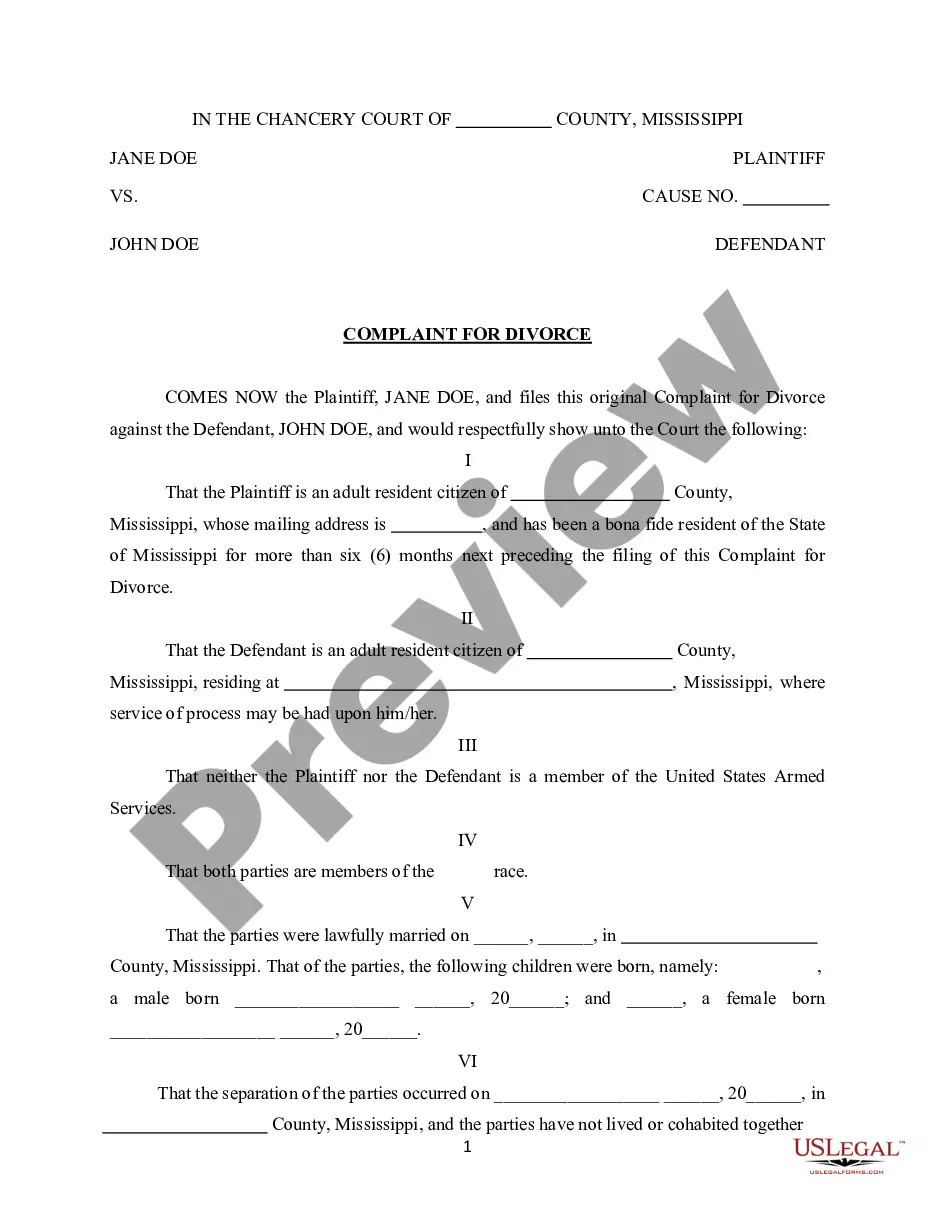
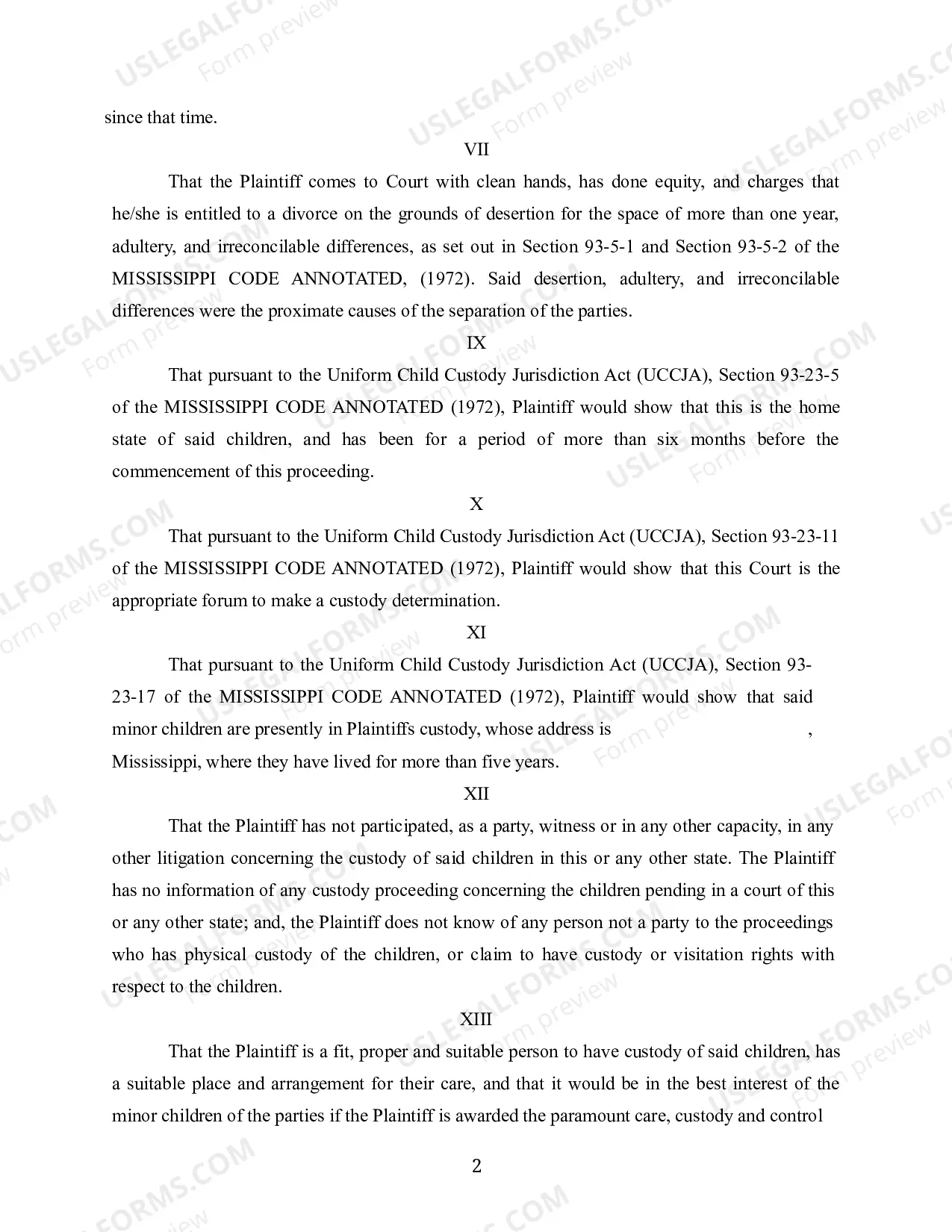
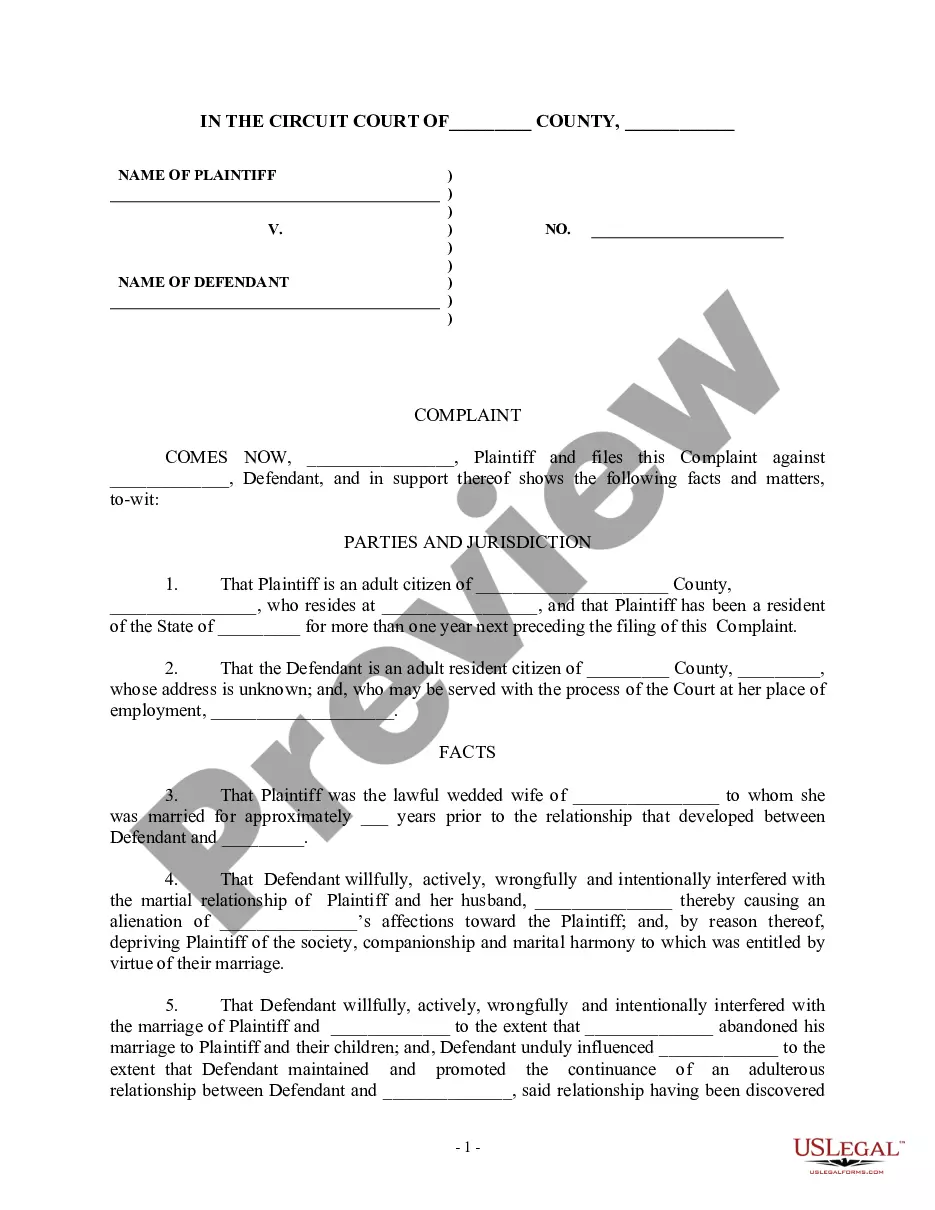
This Complaint for Divorce is a legal document used to initiate divorce proceedings in Mississippi, specifically when children and child support issues are involved. This form identifies the parties involved, states the grounds for divorce, and outlines the custody and support arrangements for any minor children. It is tailored to be customizable, allowing you to address your specific situation effectively.
Key parts of this document
- Identification of Plaintiff and Defendant
- Grounds for divorce, including desertion, adultery, and irreconcilable differences
- Details regarding minor children, including custody arrangements
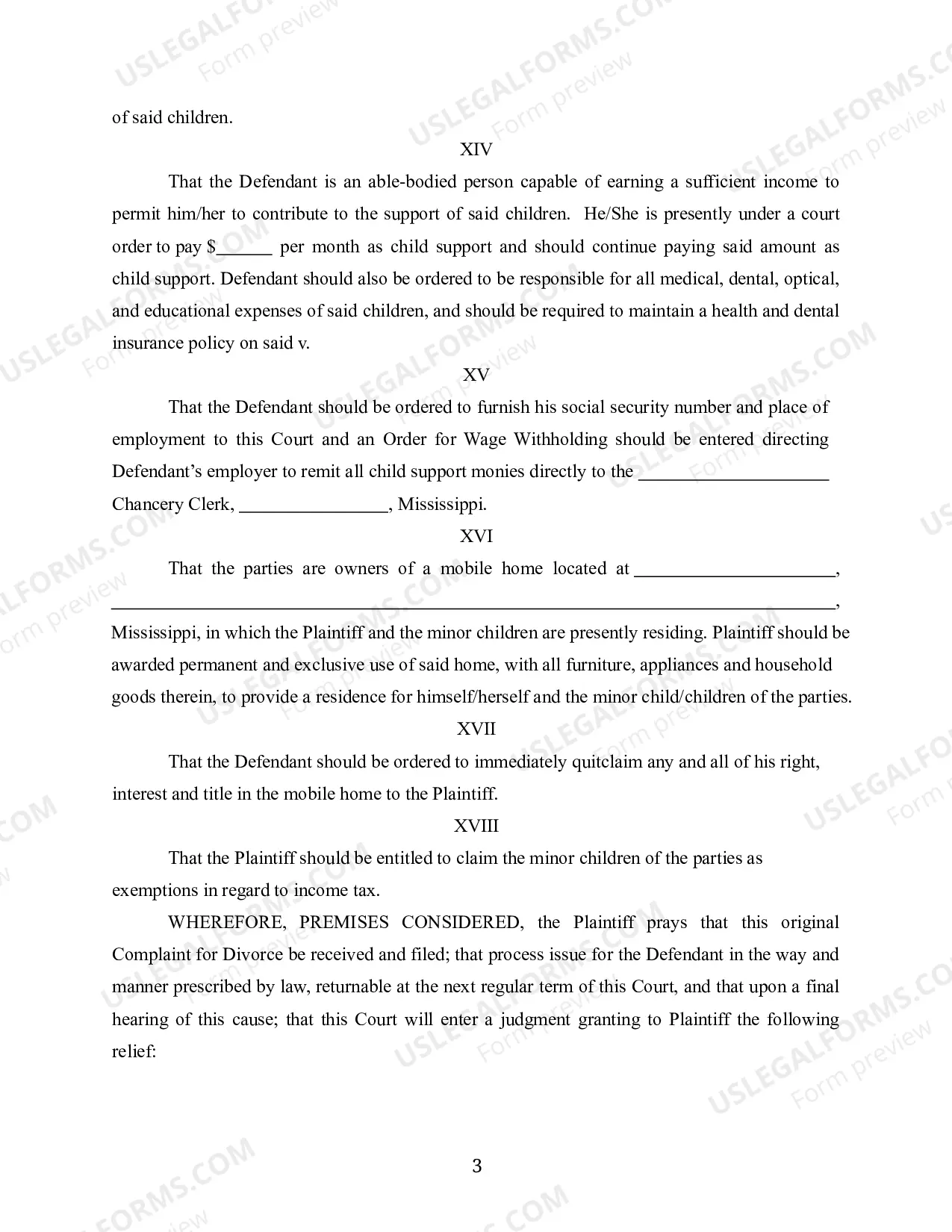
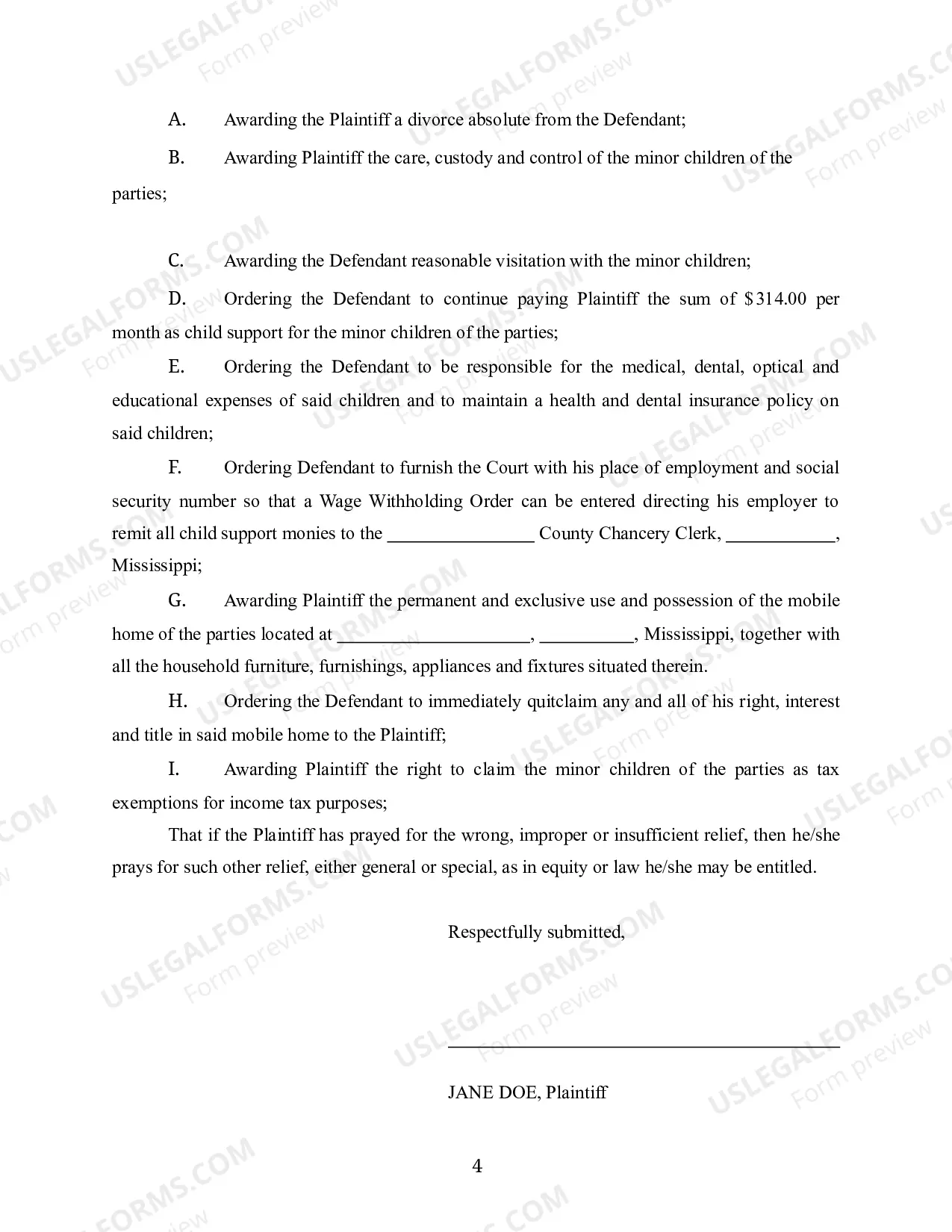
- Financial obligations, such as child support and additional expenses
- Property division, including details on shared assets like mobile homes
- Request for court orders related to visitation and financial support


Situations where this form applies
This Complaint for Divorce should be used when one spouse wishes to file for divorce, particularly when minor children are involved and there are issues of child custody and support to be addressed. It is essential to use this form when seeking a legally binding resolution to these matters in Mississippi.
Who this form is for
- Individuals seeking a divorce in Mississippi when children are involved
- Parents needing to establish custody and child support arrangements
- Spouses who need to clarify property division in a divorce
Steps to complete this form
- Identify the Plaintiff and Defendant by entering their names and addresses.
- Specify the grounds for divorce, including the reasons that apply to your situation.
- Provide details about any minor children, including their names and birth dates.
- Outline child support requirements and any obligations for medical and educational expenses.
- Describe any shared property, including requests for title transfers or exclusive use.
Does this document require notarization?
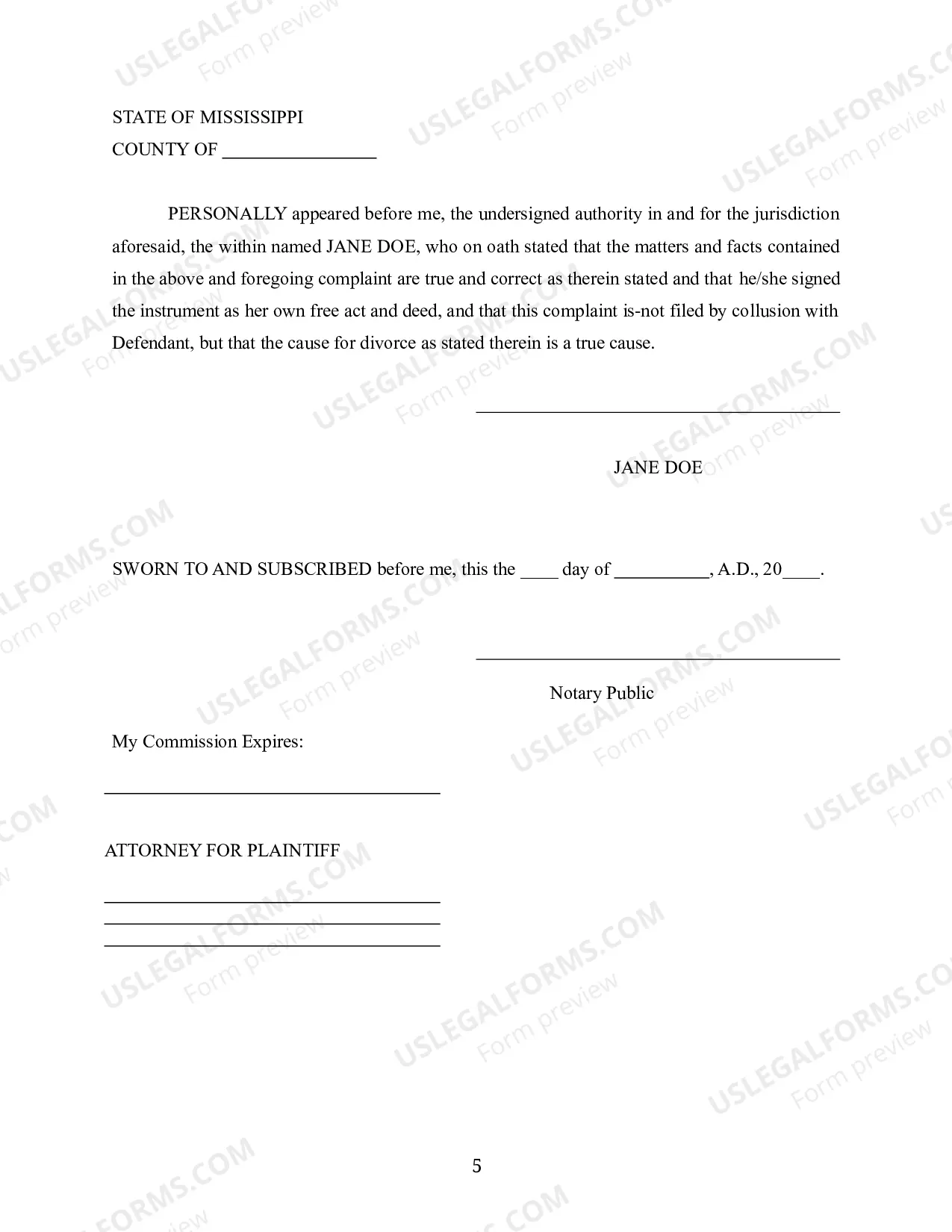
This form does not typically require notarization unless specified by local law. However, itâs important to ensure all signatures are properly executed to validate the document.
Get your form ready online
Our built-in tools help you complete, sign, share, and store your documents in one place.
Make edits, fill in missing information, and update formatting in US Legal Forms—just like you would in MS Word.
Download a copy, print it, send it by email, or mail it via USPS—whatever works best for your next step.
Sign and collect signatures with our SignNow integration. Send to multiple recipients, set reminders, and more. Go Premium to unlock E-Sign.
If this form requires notarization, complete it online through a secure video call—no need to meet a notary in person or wait for an appointment.
We protect your documents and personal data by following strict security and privacy standards.

Make edits, fill in missing information, and update formatting in US Legal Forms—just like you would in MS Word.

Download a copy, print it, send it by email, or mail it via USPS—whatever works best for your next step.

Sign and collect signatures with our SignNow integration. Send to multiple recipients, set reminders, and more. Go Premium to unlock E-Sign.

If this form requires notarization, complete it online through a secure video call—no need to meet a notary in person or wait for an appointment.

We protect your documents and personal data by following strict security and privacy standards.
Mistakes to watch out for
- Failing to accurately identify all children and their birth details.
- Omitting relevant grounds for divorce or incorrectly quoting the law.
- Not providing complete financial details related to child support.
- Overlooking the need for a signature or proper notarization.
Advantages of online completion
- Convenient access from anywhere to complete and download the form.
- Editable fields allow you to customize your document for your specific situation.
- Reliable templates crafted by licensed attorneys ensure legal compliance.
Looking for another form?
Form popularity
FAQ
If your spouse contests the divorce, then you may have a series of court appearances to sort the issues out. Also, if a certain period of time passes and your spouse does not sign the papers or file any papers of his/her own, you may be able to proceed with the divorce as an uncontested divorce anyway.
Section 43-19-101 of the MS. Ann. Code of 1972 spells out the child support guidelines. Even in joint physical custody situations, someone is ordered to pay child support most of the time.
If your spouse contests the divorce, then you may have a series of court appearances to sort the issues out. Also, if a certain period of time passes and your spouse does not sign the papers or file any papers of his/her own, you may be able to proceed with the divorce as an uncontested divorce anyway.
Spouse's Default In most states, when a spouse refuses to respond to a divorce complaint, the other spouse can file for a default judgment. However, Mississippi laws do not allow this. If a spouse fails to respond by ignoring the process, then you must go to trial, even if the spouse still refuses to participate.
Marital Property and Division of Assets Since 1994, Mississippi has been an equitable distribution state. This means that marital property is divided fairly and equitably, but not always in a 50/50 split. Chancery courts must first decide which assets are marital and which are separate.
A married couple's shared assets must be divided ?equitably? in a Mississippi divorce. However, the assets are not usually divided in a 50/50 split. Instead, the courts will fairly divide the assets while accounting for each spouse's needs, their standard of living before the divorce, and other factors.
This concept equally applies to divorce judgments, including alimony, property settlement, and child support provisions/judgments included in, or attached to, a final judgment of divorce. In Mississippi, the statute of limitations to enforce a divorce judgment is seven years.
To file for divorce in Mississippi, you must be a resident of the state for at least six months. An irreconcilable differences divorce requires a 60-day waiting period, assuming the spouses resolve all issues within that time and the court has approved the property settlement agreement.
To file for divorce in Mississippi, you must be a resident of the state for at least six months. An irreconcilable differences divorce requires a 60-day waiting period, assuming the spouses resolve all issues within that time and the court has approved the property settlement agreement.