Mississippi Settlement Statement and Receipt
Overview of this form
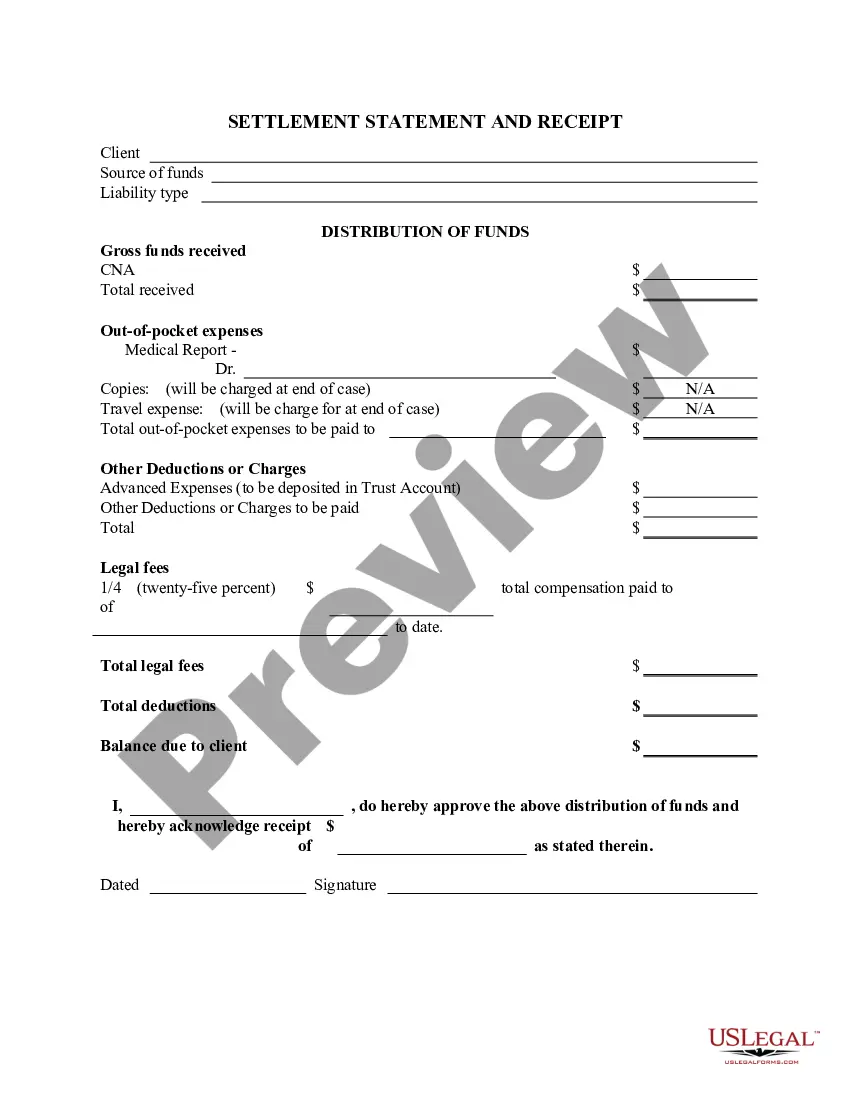
The Settlement Statement and Receipt is a legal document used in Mississippi to finalize the details of a settlement between two parties. This form outlines the agreed-upon settlement amount and serves as an acknowledgment that both parties have received the compensation as specified, differentiating it from other forms that may not include such detailed financial breakdowns.
What’s included in this form
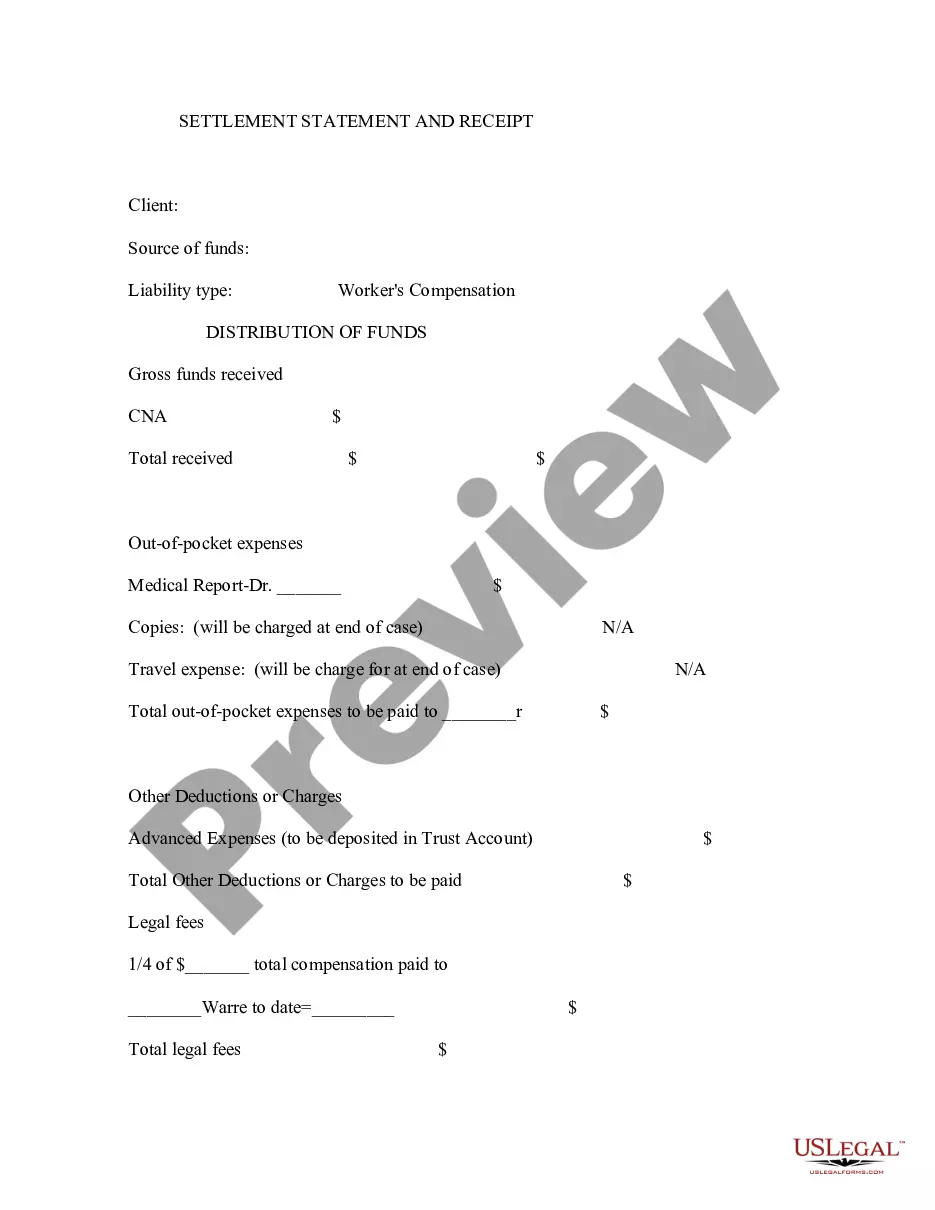
- Client details and source of funds
- Liability type, specifically Workers Compensation
- Distribution of funds section, listing gross funds and deductions
- Out-of-pocket expenses, including medical and travel costs
- Legal fees calculation
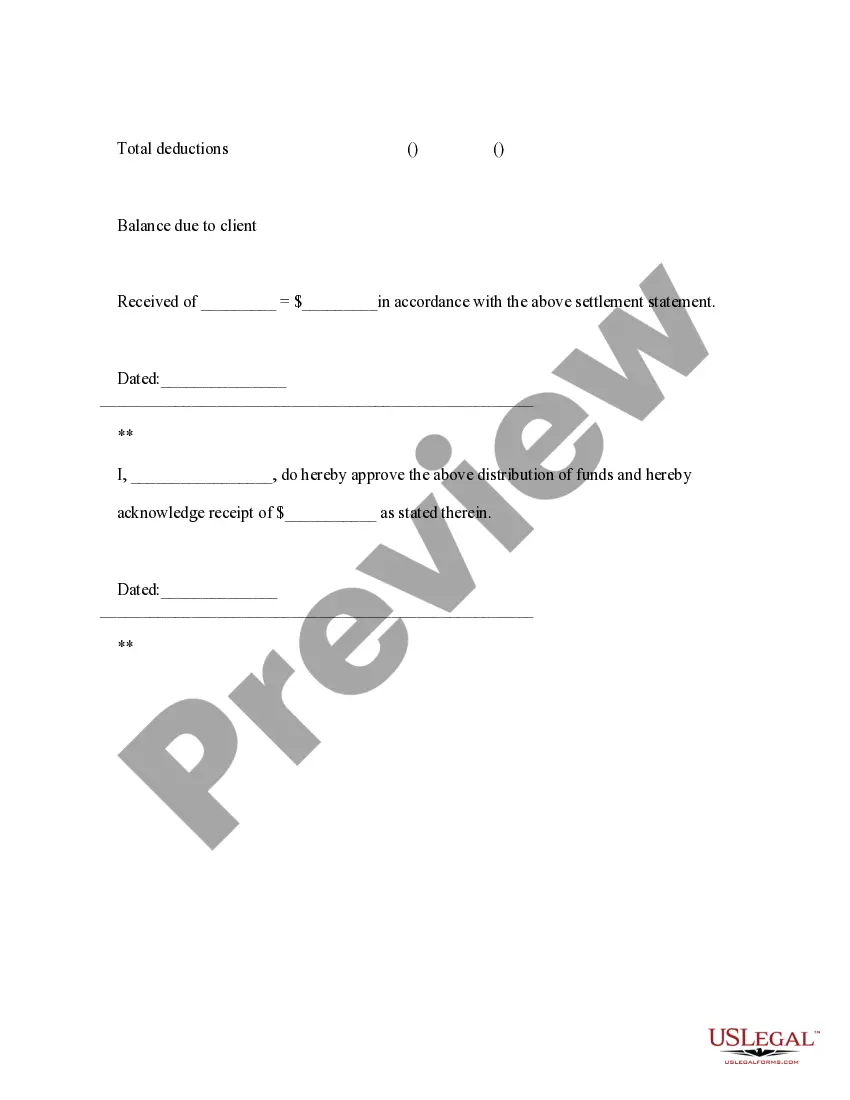
- Signature lines for acknowledgment and approval of the settlement

Common use cases
This form is typically used when two parties reach a settlement agreement after a legal dispute, particularly in cases involving workers' compensation claims. It is needed to clearly outline the financial details related to the settlement, ensuring both parties are informed of the distributions, expenses, and final amounts received.
Intended users of this form
- Individuals and businesses involved in a workers' compensation case
- Legal representatives managing settlement agreements
- Parties who have reached a settlement and need formal documentation
Instructions for completing this form
- Identify the parties involved and enter their names in the designated fields.
- Specify the source of funds and the type of liability, ensuring all details align with the settlement agreement.
- List the gross funds received and itemize any out-of-pocket expenses and other deductions, including legal fees.
- Calculate the total deductions and the balance due to the client.
- Obtain signatures from both parties to acknowledge receipt and approval of the terms stated in the form.
Notarization guidance
In most cases, this form does not require notarization. However, some jurisdictions or signing circumstances might. US Legal Forms offers online notarization powered by Notarize, accessible 24/7 for a quick, remote process.
Get your form ready online
Our built-in tools help you complete, sign, share, and store your documents in one place.
Make edits, fill in missing information, and update formatting in US Legal Forms—just like you would in MS Word.
Download a copy, print it, send it by email, or mail it via USPS—whatever works best for your next step.
Sign and collect signatures with our SignNow integration. Send to multiple recipients, set reminders, and more. Go Premium to unlock E-Sign.
If this form requires notarization, complete it online through a secure video call—no need to meet a notary in person or wait for an appointment.
We protect your documents and personal data by following strict security and privacy standards.

Make edits, fill in missing information, and update formatting in US Legal Forms—just like you would in MS Word.

Download a copy, print it, send it by email, or mail it via USPS—whatever works best for your next step.

Sign and collect signatures with our SignNow integration. Send to multiple recipients, set reminders, and more. Go Premium to unlock E-Sign.

If this form requires notarization, complete it online through a secure video call—no need to meet a notary in person or wait for an appointment.

We protect your documents and personal data by following strict security and privacy standards.
Mistakes to watch out for
- Failing to accurately calculate out-of-pocket expenses and legal fees.
- Omitting required signatures, which may invalidate the document.
- Not entering the correct date of agreement or payment, leading to potential disputes.
Benefits of using this form online
- Access to a reliable, attorney-drafted template that meets legal standards.
- Ease of completion with editable fields for personalized information.
- Immediate availability for download, allowing for timely settlements.
Looking for another form?
Form popularity
FAQ
As of October 3, 2015, the Closing Disclosure form replaced the HUD-1 form for most real estate transactions. However, if you applied for a mortgage on or before October 3, 2015, you received a HUD-1.
In mortgage lending, there are two main types of settlement statements a borrower may encounter: closing disclosures and HUD-1 settlement statements. A mortgage closing disclosure is a type of standard settlement statement that is formulated and regulated for the mortgage lending market.
In your case, you should start by contacting the settlement agent for the purchase of the home. Depending on how long they retain their records, they should be able to supply you with a copy of your settlement documents.
Completing Part B of HUD-1Fill in the property location and the name and address for the borrower, seller and lender. The settlement agent, date and location also are needed. Fill in the appropriate lines in sections J and K, which are summaries of the borrower's and seller's transactions, respectively.
A HUD-1 or HUD-1A Settlement Statement is prepared by a creditor or, more typically, by the settlement agent who conducts the closing on the creditor's behalf.
The HUD-1 form is used in purchase transactions, and it includes lines for both borrower charges/fees and seller charges/fees.The HUD-1A is an option, instead of using the HUD-1, for loan transactions that do not include a seller (refinance). The HUD-1 is three pages, while the HUD-1A is only two pages.
Federal regulations require that unless its use is specifically exempted, either the HUD-1 or the HUD-1A, as appropriate, must be used for all mortgage transactions that are subject to the Real Estate Settlement Procedures Act.
The HUD-1 Settlement Statement is a standard government real estate form that was once used by settlement agents, also called closing agents, to itemize all charges imposed upon a borrower and seller for a real estate transaction. The statement is no longer used, with one exceptionreverse mortgages.