Mississippi Jury Instruction - Breach of Duty Instruction
Understanding this form
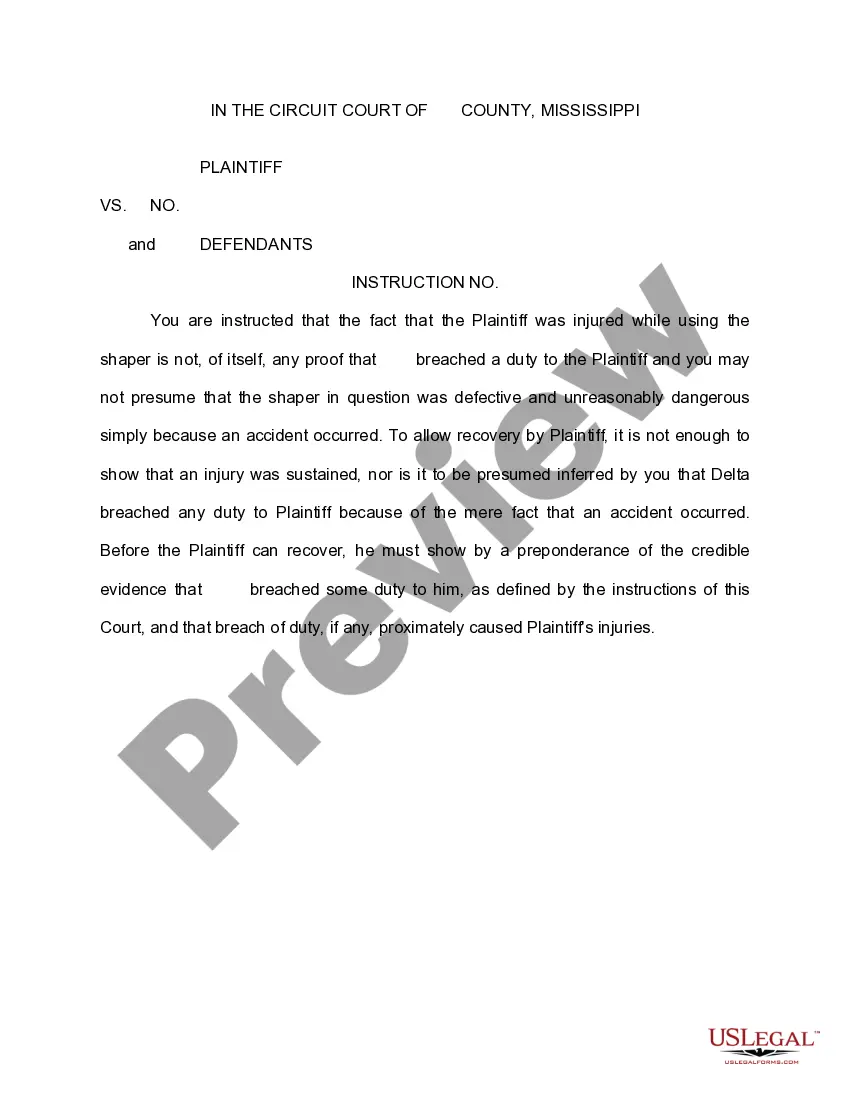
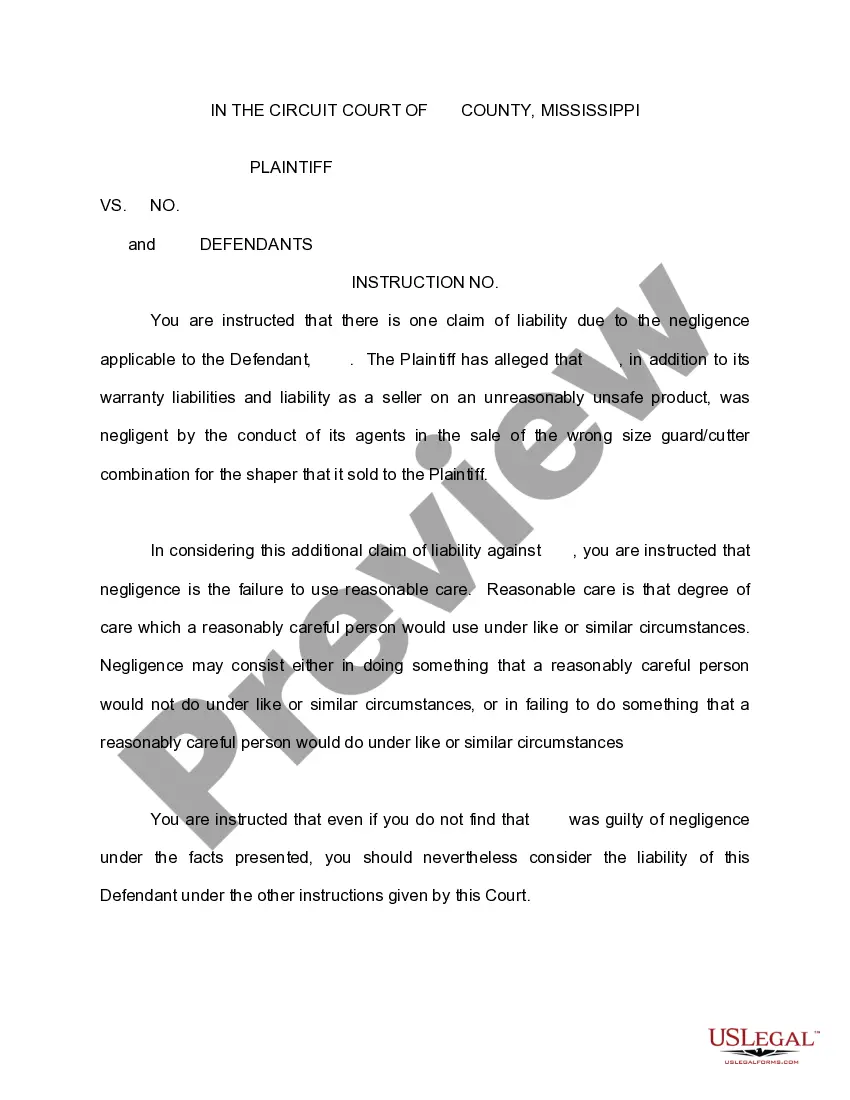
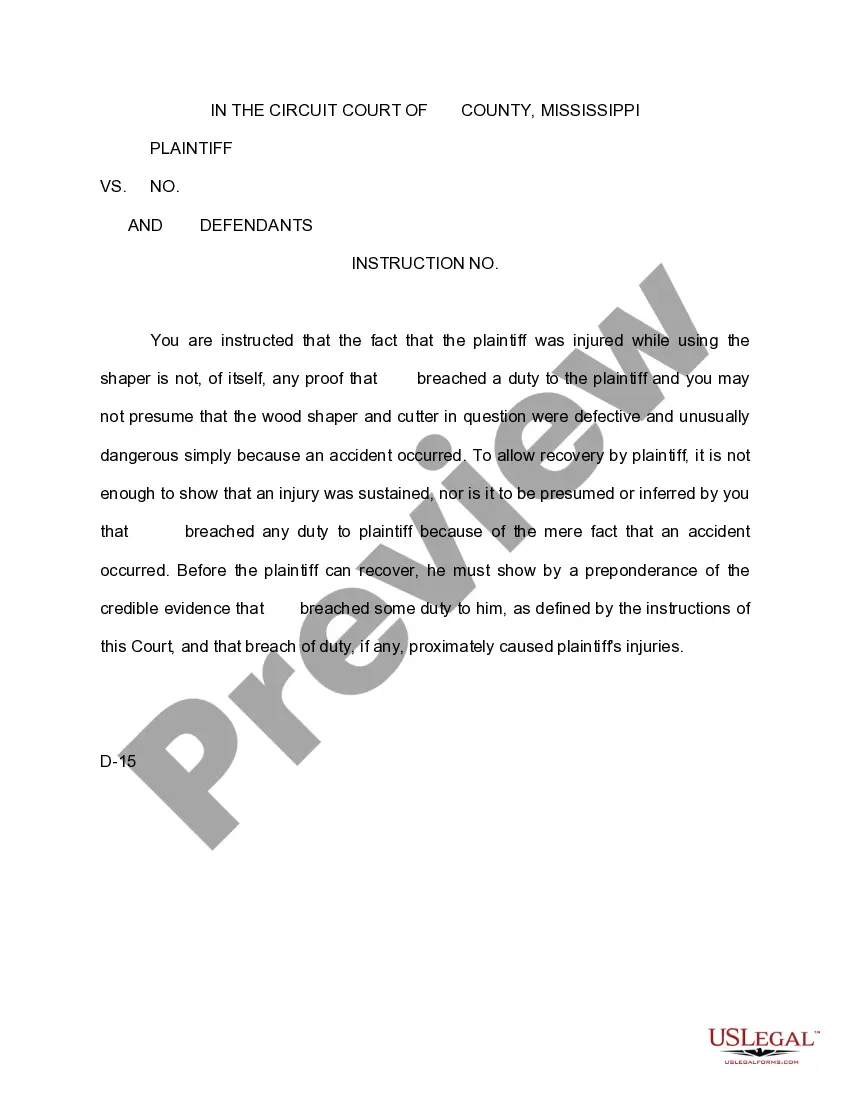
The Jury Instruction - Breach of Duty Instruction provides guidance for jury members in Mississippi regarding how to assess whether a plaintiff has proven a breach of duty resulting in injury. This jury instruction clarifies that simply sustaining an injury does not imply that a defendant failed in their duty and outlines the necessity for the plaintiff to present convincing evidence of a breach. This form differs from other jury instructions by specifically addressing the standards of proof applicable in breach of duty cases.
Main sections of this form
- Instruction to jury on the definition of breach of duty.
- Clarification that an injury alone does not prove breach.
- Requirement for the plaintiff to show evidence of duty breach.
- Details on the necessity for proving causation between breach of duty and injuries.
- Reference to the court's specific definitions and instructions.
When to use this document
This form is used during trials in Mississippi when a jury must determine if a defendant breached a duty owed to the plaintiff, resulting in injury. It is applicable in personal injury cases where the plaintiff may have been injured by a product or situation, and the jury needs clear instructions on evaluating evidence regarding breach of duty.
Intended users of this form
- Judges providing jury instructions in breach of duty cases.
- Attorneys preparing for trial in Mississippi regarding similar claims.
- Legal professionals seeking clarity on jury guidelines for personal injury litigation.
- Parties involved in litigation who need to understand how juries are instructed in these cases.
Steps to complete this form
- Identify the title and parties involved in the case.
- Review and verify compliance with current Mississippi case law.
- Specify the injury circumstances and outline the defendant's duty.
- Detail the jury's responsibilities and the standard of proof required for breach.
- Include the judge's specific definitions and instructions for clarity in deliberation.
Does this document require notarization?
In most cases, this form does not require notarization. However, some jurisdictions or signing circumstances might. US Legal Forms offers online notarization powered by Notarize, accessible 24/7 for a quick, remote process.
Get your form ready online
Our built-in tools help you complete, sign, share, and store your documents in one place.
Make edits, fill in missing information, and update formatting in US Legal Forms—just like you would in MS Word.
Download a copy, print it, send it by email, or mail it via USPS—whatever works best for your next step.
Sign and collect signatures with our SignNow integration. Send to multiple recipients, set reminders, and more. Go Premium to unlock E-Sign.
If this form requires notarization, complete it online through a secure video call—no need to meet a notary in person or wait for an appointment.
We protect your documents and personal data by following strict security and privacy standards.

Make edits, fill in missing information, and update formatting in US Legal Forms—just like you would in MS Word.

Download a copy, print it, send it by email, or mail it via USPS—whatever works best for your next step.

Sign and collect signatures with our SignNow integration. Send to multiple recipients, set reminders, and more. Go Premium to unlock E-Sign.

If this form requires notarization, complete it online through a secure video call—no need to meet a notary in person or wait for an appointment.

We protect your documents and personal data by following strict security and privacy standards.
Mistakes to watch out for
- Assuming that injury alone constitutes a breach of duty.
- Failing to provide adequate definitions for jury instructions.
- Not tailoring the instruction to the specifics of the case.
- Overlooking recent changes in case law affecting jury instructions.
Why use this form online
- Convenient access to legally drafted jury instructions at any time.
- Editable form to tailor the language for specific cases.
- Reliable templates drafted by licensed attorneys for accuracy.
- Quick download for immediate use in legal proceedings.
Looking for another form?
Form popularity
FAQ
The right to trial by jury in a criminal case resides in both Article III, Section 2 of the federal Constitution (The Trial of all Crimes, except in Cases of Impeachment, shall be by Jury) and the Sixth Amendment (In all criminal prosecutions, the accused shall enjoy the right to a speedy and public trial, by an
The judge reads the instructions to the jury. This is commonly referred to as the judge's charge to the jury. In giving the instructions, the judge will state the issues in the case and define any terms or words that may not be familiar to the jurors.
During trial, the prosecutor uses witnesses and evidence to prove to the jury that the defendant committed the crime(s). The defendant, represented by an attorney, also tells his side of the story using witnesses and evidence.
Who is eligible for jury service? Groups of 15 ordinary women and men are selected at random to uphold justice in their local community. It is a civic duty they are obliged to perform. Potential jurors must be at least 18 years old and they should be listed on the electoral roll.
Jury instructions are given to the jury by the judge, who usually reads them aloud to the jury. The judge issues a judge's charge to inform the jury how to act in deciding a case.
On the average, jurors serve approximately 1-3 days during a one month term of service. The Judge will adjourn the jury each evening and will instruct you on what time you must return the following morning. You must check in with the Jury Department each morning.
One may be excused from jury duty if their presence is required at home or if there is an emergency or personal illness. If you are 65 years of age or older and wish to be exempt from service, a juror's affidavit of excuse should be signed and mailed to the Circuit Clerk's office.
The criminal statute of limitations requires prosecutors to file criminal charges against a suspect within two years for misdemeanors and within five years for certain felonies, but there is no time limit in Mississippi for charges of murder, kidnapping, rape, burglary, robbery, larceny, and several other serious
If the juror fails to show good cause for noncompliance with the summons, the juror may be held in civil contempt of court and may be fined not more than Five Hundred Dollars ($ 500.00) or imprisoned not more than three (3) days, or both.