Mississippi Jury Instruction - Age of Plaintiff - Age Discrimination
Overview of this form
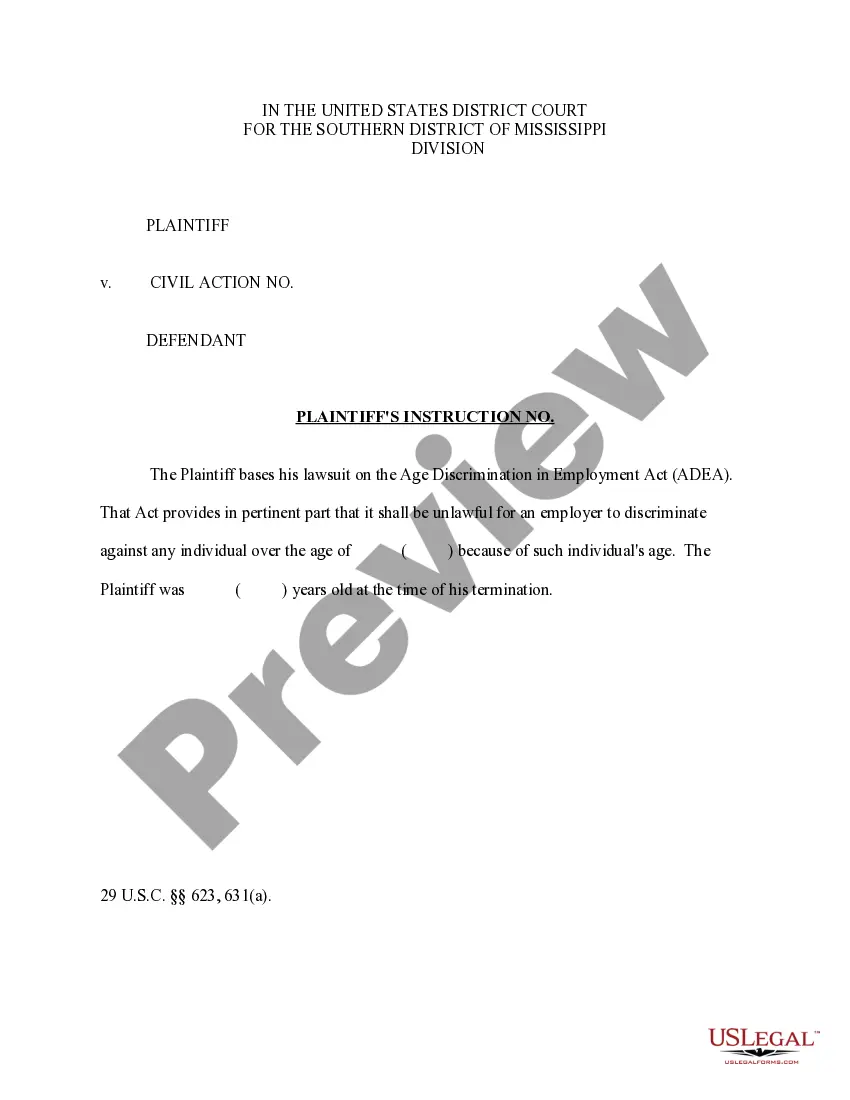
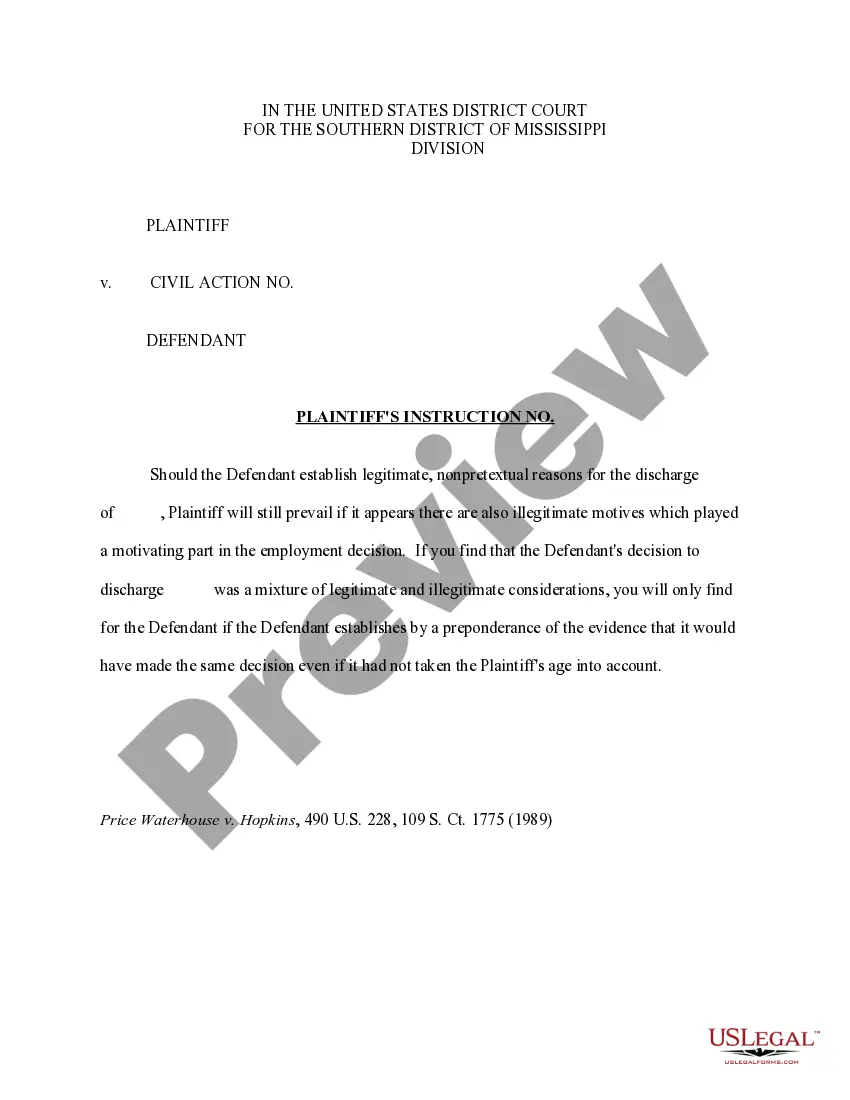
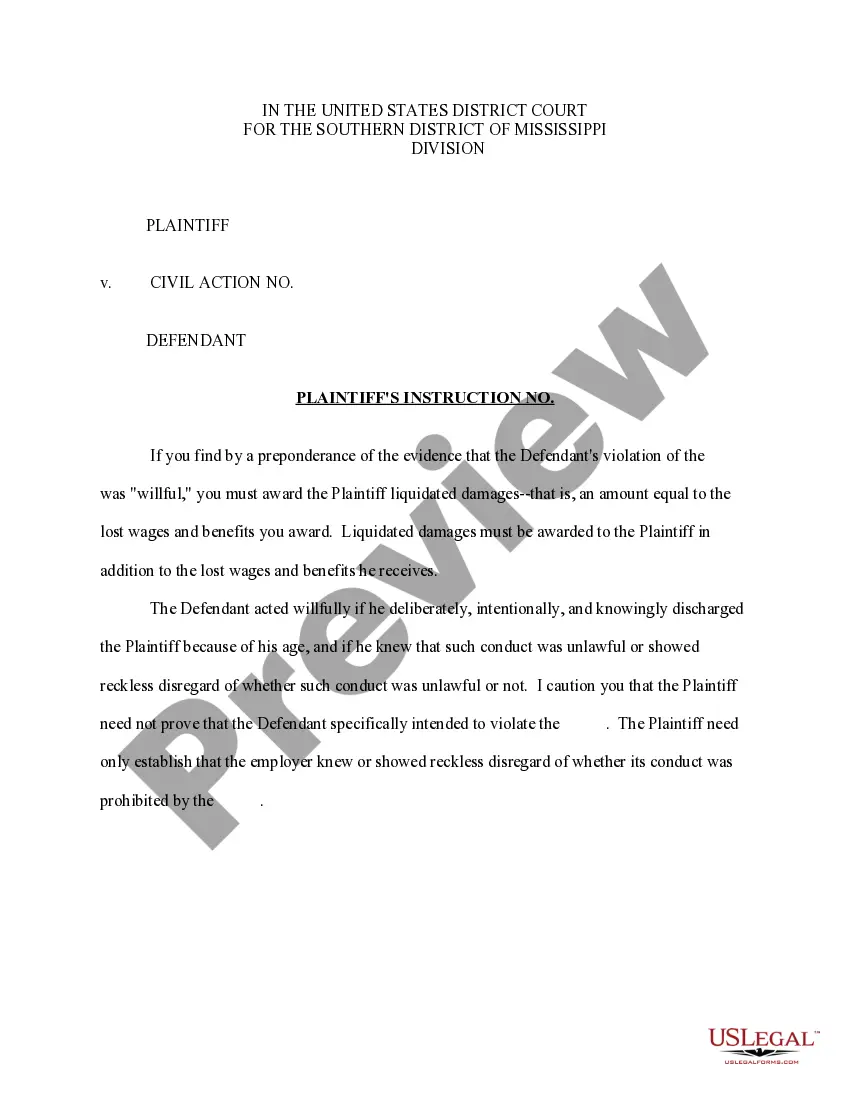
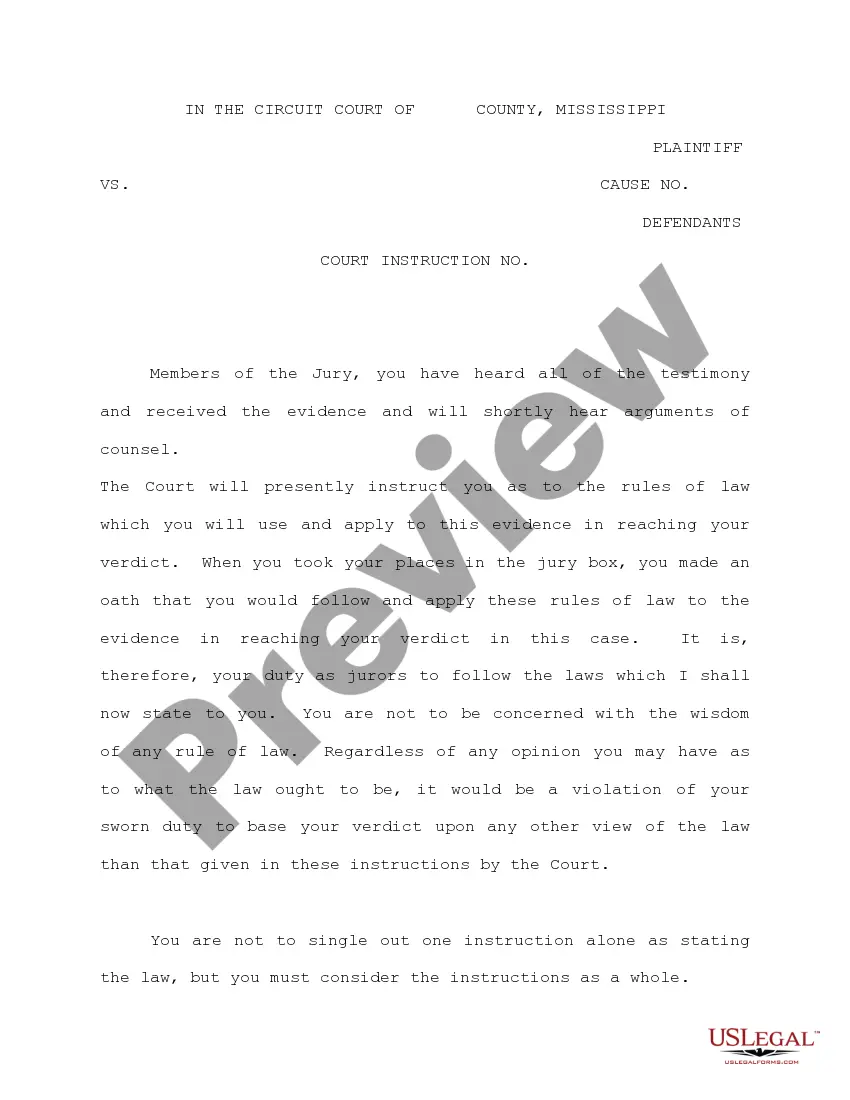
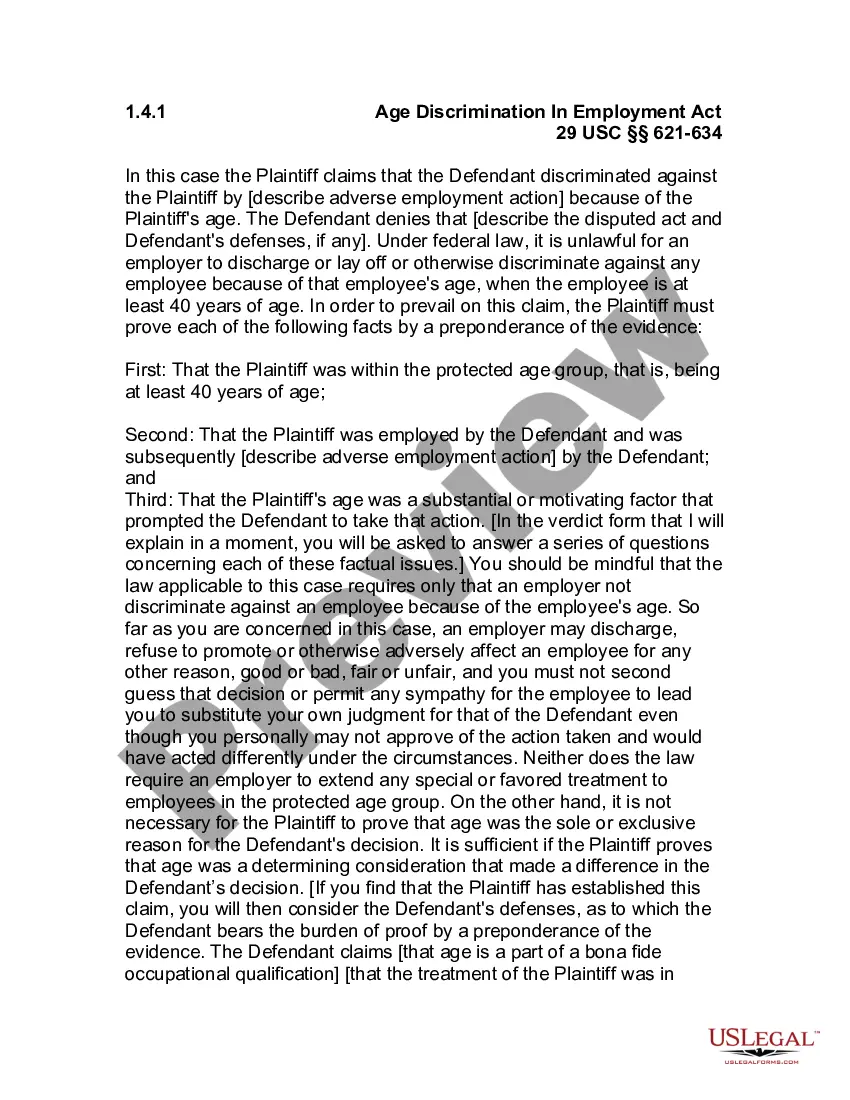
This form is a sample jury instruction related to age discrimination cases, specifically regarding the age of the plaintiff. It is designed to guide juries in understanding the legal context of age discrimination within the state of Mississippi. Unlike general jury instructions, this form focuses specifically on age-related issues, ensuring that jurors have a clear framework for their deliberations. Please note that this sample form should be reviewed for compliance with current case law as it may not reflect the latest legal standards.
Main sections of this form
- Defines the criteria for age discrimination cases.
- Addresses the age-related considerations juries must evaluate.
- Instructs juries on how to assess the relevance of the plaintiff's age in the context of discrimination claims.
- Offers guidance on relevant legal standards and definitions applicable to age discrimination.
When to use this form
This jury instruction form should be used in cases involving age discrimination claims in Mississippi. It is particularly applicable when the plaintiff's age is a focal point of the dispute, such as in employment cases where an individual claims they were treated unfairly due to their age. Utilizing this form can help ensure that jurors understand their responsibilities regarding age discrimination laws.
Who needs this form
- Attorneys representing plaintiffs in age discrimination cases.
- Defense attorneys involved in age-related legal disputes.
- Judges or court officials requiring a reference for jury instructions in relevant cases.
- Legal educators or students studying jury instructions in discrimination law.
Steps to complete this form
- Review the legal context of the case to understand the relevance of age discrimination.
- Customize any specific sections that may require additional case details.
- Ensure that the language used complies with Mississippi law and current legal standards.
- Submit the completed instruction to the court for approval before presenting it to the jury.
- Examine the final instruction for clarity and legal accuracy before use during jury deliberations.
Notarization guidance
This form does not typically require notarization to be legally valid. However, some jurisdictions or document types may still require it. US Legal Forms provides secure online notarization powered by Notarize, available 24/7 for added convenience.
Get your form ready online
Our built-in tools help you complete, sign, share, and store your documents in one place.
Make edits, fill in missing information, and update formatting in US Legal Forms—just like you would in MS Word.
Download a copy, print it, send it by email, or mail it via USPS—whatever works best for your next step.
Sign and collect signatures with our SignNow integration. Send to multiple recipients, set reminders, and more. Go Premium to unlock E-Sign.
If this form requires notarization, complete it online through a secure video call—no need to meet a notary in person or wait for an appointment.
We protect your documents and personal data by following strict security and privacy standards.

Make edits, fill in missing information, and update formatting in US Legal Forms—just like you would in MS Word.

Download a copy, print it, send it by email, or mail it via USPS—whatever works best for your next step.

Sign and collect signatures with our SignNow integration. Send to multiple recipients, set reminders, and more. Go Premium to unlock E-Sign.

If this form requires notarization, complete it online through a secure video call—no need to meet a notary in person or wait for an appointment.

We protect your documents and personal data by following strict security and privacy standards.
Common mistakes to avoid
- Failing to update the instruction based on recent changes in case law.
- Using vague language that may confuse jurors regarding age discrimination definitions.
- Omitting critical legal standards relevant to age considerations in the case.
Benefits of completing this form online
- Convenient access to tailored jury instruction samples at any time.
- Easy to download and print for immediate use in legal proceedings.
- Editable formats allow customization based on specific case details.
- Reliable content drafted by licensed attorneys ensures legal soundness.
Legal use & context
- This form is intended to provide a structured framework for jury deliberations in age discrimination cases.
- Using established jury instructions helps ensure fair and informed jury evaluations.
- Jurors must understand their duties regarding age discrimination claims to uphold legal standards.
Looking for another form?



Form popularity
FAQ
This happens when someone treats you worse than another person in a similar situation because of your age. For example: your employer refuses to allow you to do a training course because she thinks you are 'too old', but allows younger colleagues to do the training.
This act specifically prohibits age-based discrimination against employees who are at least 40 years of age.The core of Title VII was to prohibit discrimination in employment based on race, color, sex, national origin, or religion.
EDITOR'S NOTE: The following is the text of the Age Discrimination in Employment Act of 1967 (Pub. L. 90-202) (ADEA), as amended, as it appears in volume 29 of the United States Code, beginning at section 621. The ADEA prohibits employment discrimination against persons 40 years of age or older.
Johnson in 1967. Congress created the legislation in an effort to promote the employment of older persons based on their ability rather than age and to prohibit arbitrary age discrimination in employment.
The Age Discrimination in Employment Act (ADEA) prohibits employment discrimination on the basis of age. While the original 1967 law covered workers aged 40 to 65, subsequent amendments first raised and then eliminated the upper age limit, ending mandatory retirement for nearly all workers.
In 1967, the bill was signed into law by President Lyndon B. Johnson. The ADEA prevents age discrimination and provides equal employment opportunity under conditions that were not explicitly covered in Title VII of the Civil Rights Act of 1964.
In the example above, the recent college graduate wouldn't be suffering from age discrimination because neither federal nor California state law protects workers under the age of 40 from age discrimination. Under the law, the protected class for age is people aged 40 and older.
In 1967, Congress enacted the federal Age Discrimination in Employment Act (ADEA) to prohibit age discrimination in the workplace and promote the employment of older workers.
Age discrimination involves treating an applicant or employee less favorably because of his or her age. The Age Discrimination in Employment Act (ADEA) forbids age discrimination against people who are age 40 or older.