Mississippi Joint Motion
About this form
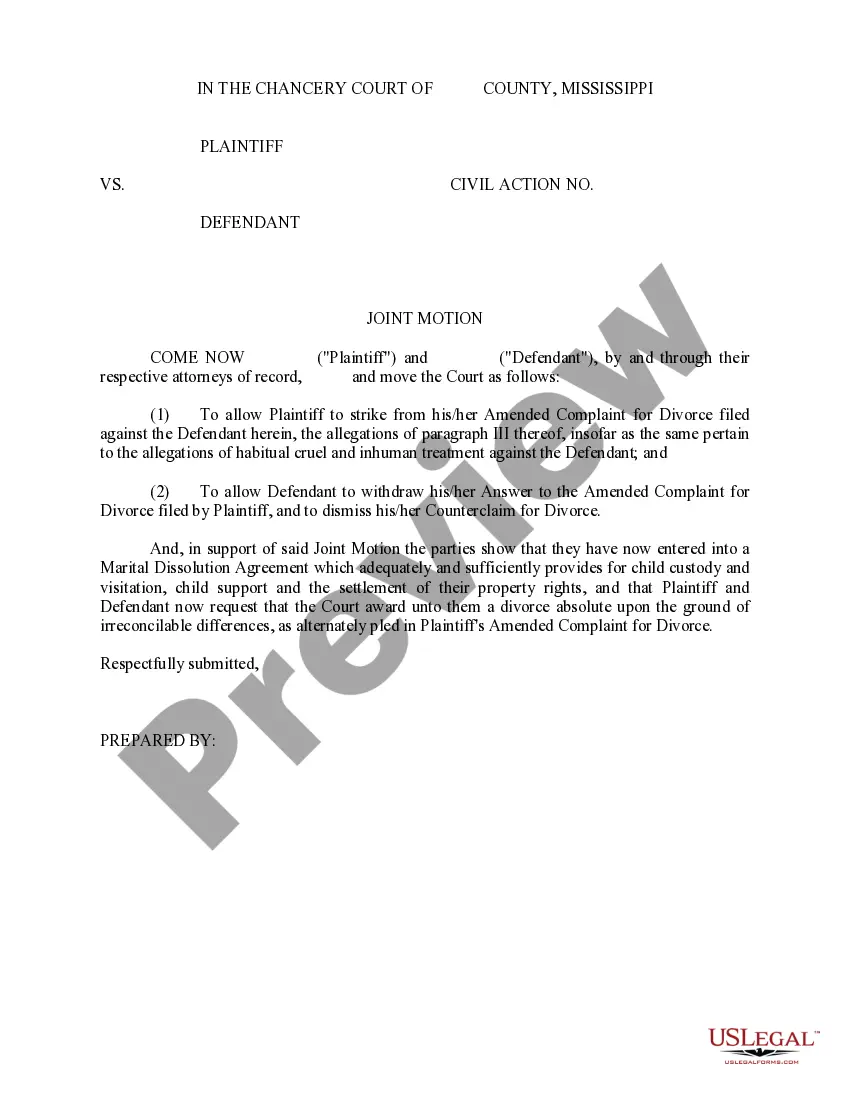
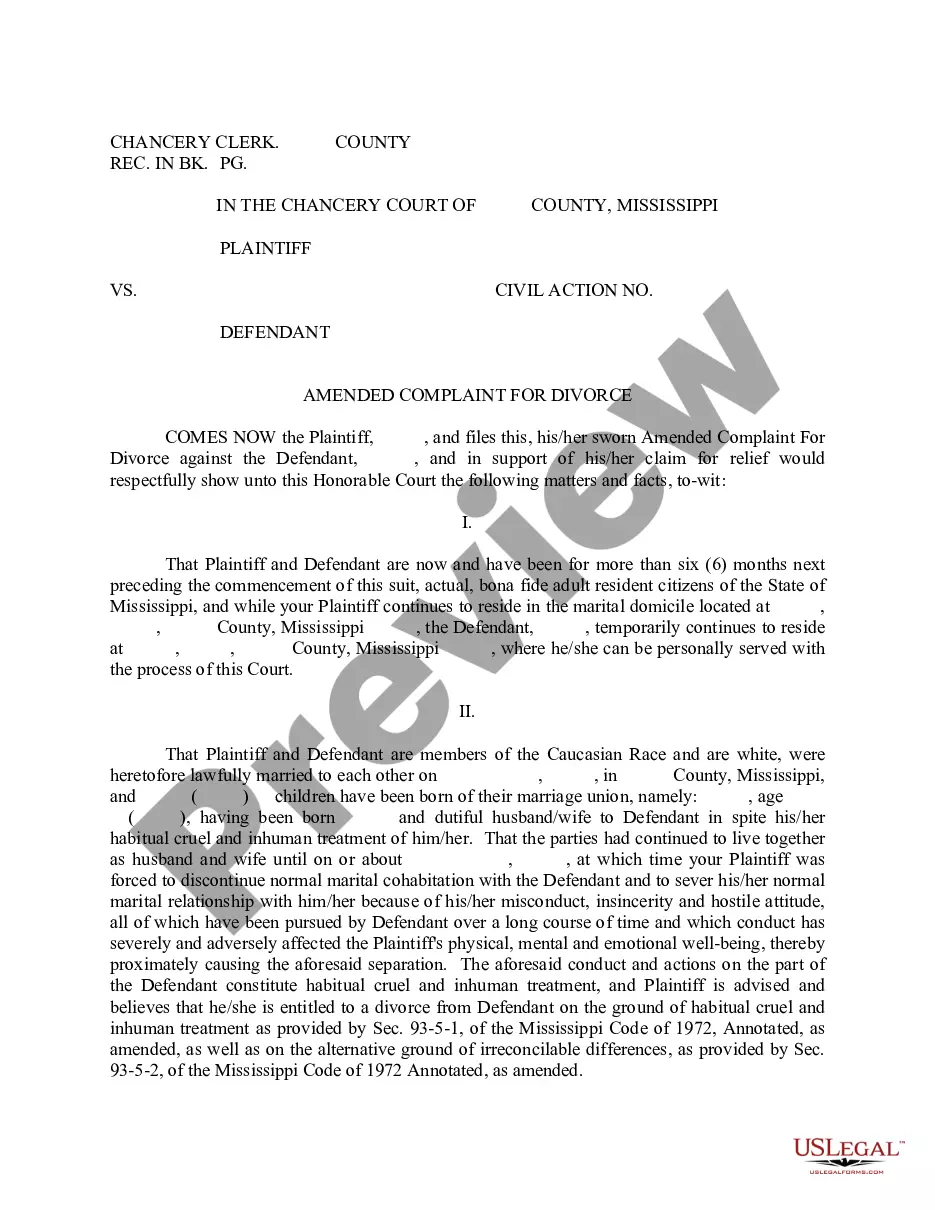
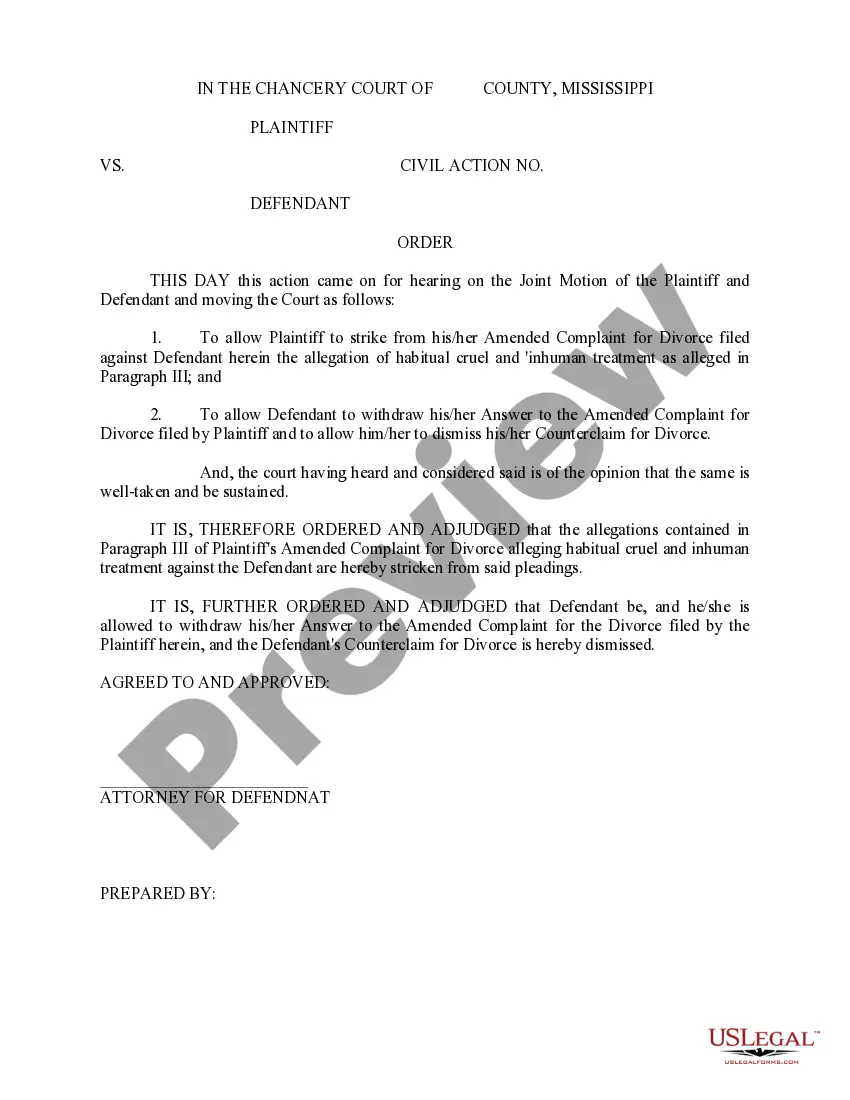
A Joint Motion is a written request made to the court, where both parties seek to have the court take a specific action. This document is particularly used in divorce proceedings to allow a defendant to withdraw their answer to an amended complaint for divorce and dismiss any counterclaims. Unlike other types of motions, the Joint Motion is filed jointly by both parties, reflecting their mutual agreement on the requested actions.
Key components of this form
- Information about the parties involved in the divorce.
- A request for the defendant to withdraw his/her answer to the amended complaint for divorce.
- A request to dismiss the counterclaim for divorce.
- A statement highlighting the existence of a Marital Dissolution Agreement for custody, child support, and property rights.
- A request for the court to grant a divorce based on irreconcilable differences.
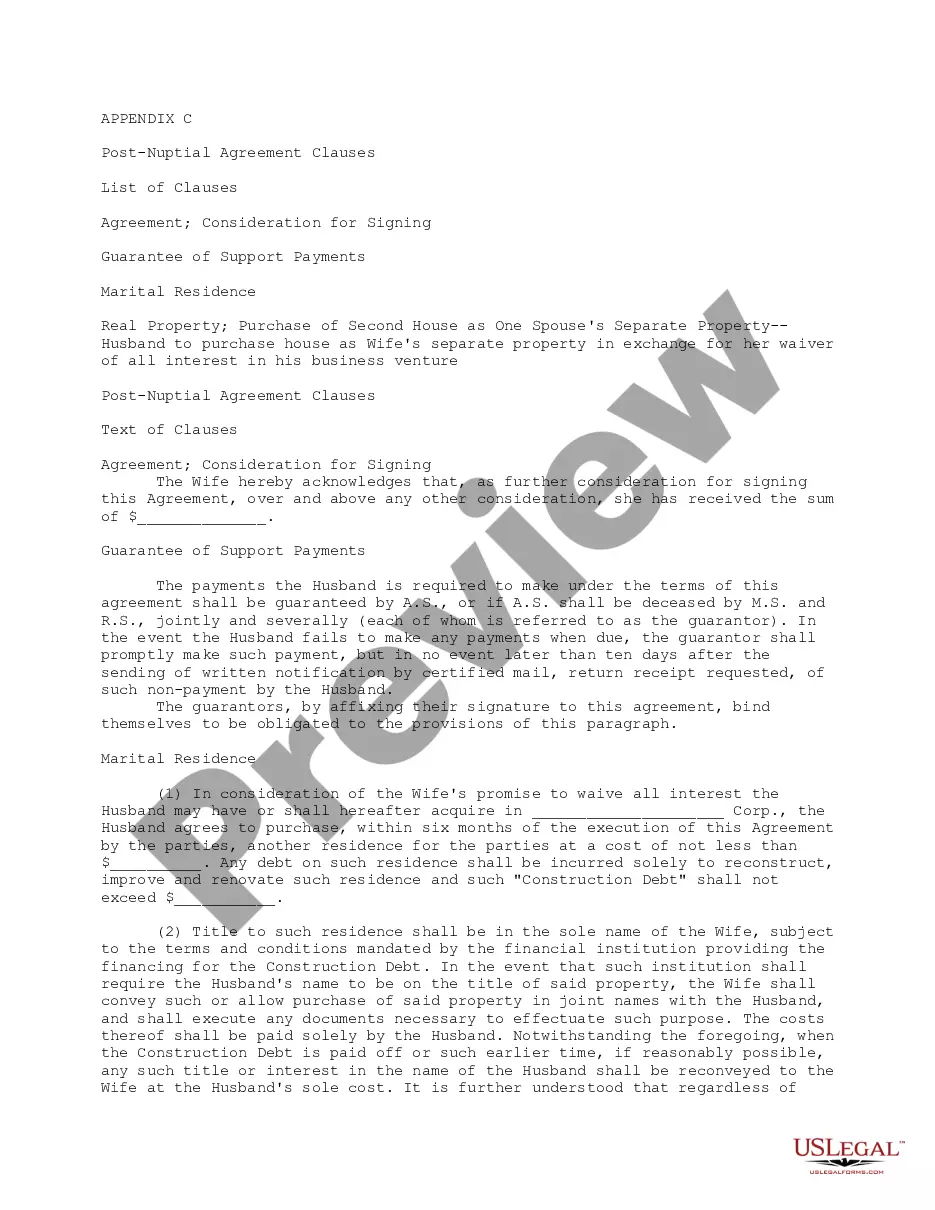
When to use this document
This form is used in divorce cases when both parties have reached an agreement regarding the terms of their divorce. It is particularly applicable if one party wishes to withdraw their initial answer to the divorce complaint, and both parties have decided to settle matters related to custody, support, and property distribution. Filing a Joint Motion can streamline the process and help achieve a mutual resolution with the court's approval.
Who can use this document
- Individuals involved in a divorce proceeding who wish to jointly request specific actions from the court.
- Couples who have mutually agreed on the terms of their divorce, including child custody and support agreements.
- Defendants who need to withdraw their response to an amended divorce complaint.
How to complete this form
- Identify the parties by including their full names and contact information.
- Detail the defendant's request to withdraw their answer to the amended complaint.
- Include a clear statement requesting the dismissal of the counterclaim for divorce.
- Attach or reference the Marital Dissolution Agreement for custody and support arrangements.
- Sign and date the Joint Motion, ensuring both parties agree to the terms outlined.
Does this document require notarization?
This form usually doesn’t need to be notarized. However, local laws or specific transactions may require it. Our online notarization service, powered by Notarize, lets you complete it remotely through a secure video session, available 24/7.
Get your form ready online
Our built-in tools help you complete, sign, share, and store your documents in one place.
Make edits, fill in missing information, and update formatting in US Legal Forms—just like you would in MS Word.
Download a copy, print it, send it by email, or mail it via USPS—whatever works best for your next step.
Sign and collect signatures with our SignNow integration. Send to multiple recipients, set reminders, and more. Go Premium to unlock E-Sign.
If this form requires notarization, complete it online through a secure video call—no need to meet a notary in person or wait for an appointment.
We protect your documents and personal data by following strict security and privacy standards.

Make edits, fill in missing information, and update formatting in US Legal Forms—just like you would in MS Word.

Download a copy, print it, send it by email, or mail it via USPS—whatever works best for your next step.

Sign and collect signatures with our SignNow integration. Send to multiple recipients, set reminders, and more. Go Premium to unlock E-Sign.

If this form requires notarization, complete it online through a secure video call—no need to meet a notary in person or wait for an appointment.

We protect your documents and personal data by following strict security and privacy standards.
Mistakes to watch out for
- Failing to include details about the Marital Dissolution Agreement.
- Not having both parties sign the motion, which is required for it to be valid.
- Omitting necessary information regarding the custody and support arrangements.
Advantages of online completion
- Convenience of downloading the form at any time from the comfort of your home.
- Editability allows customization to fit specific circumstances and legal requirements.
- Access to templates prepared by licensed attorneys, ensuring legal compliance and accuracy.
Looking for another form?
Form popularity
FAQ
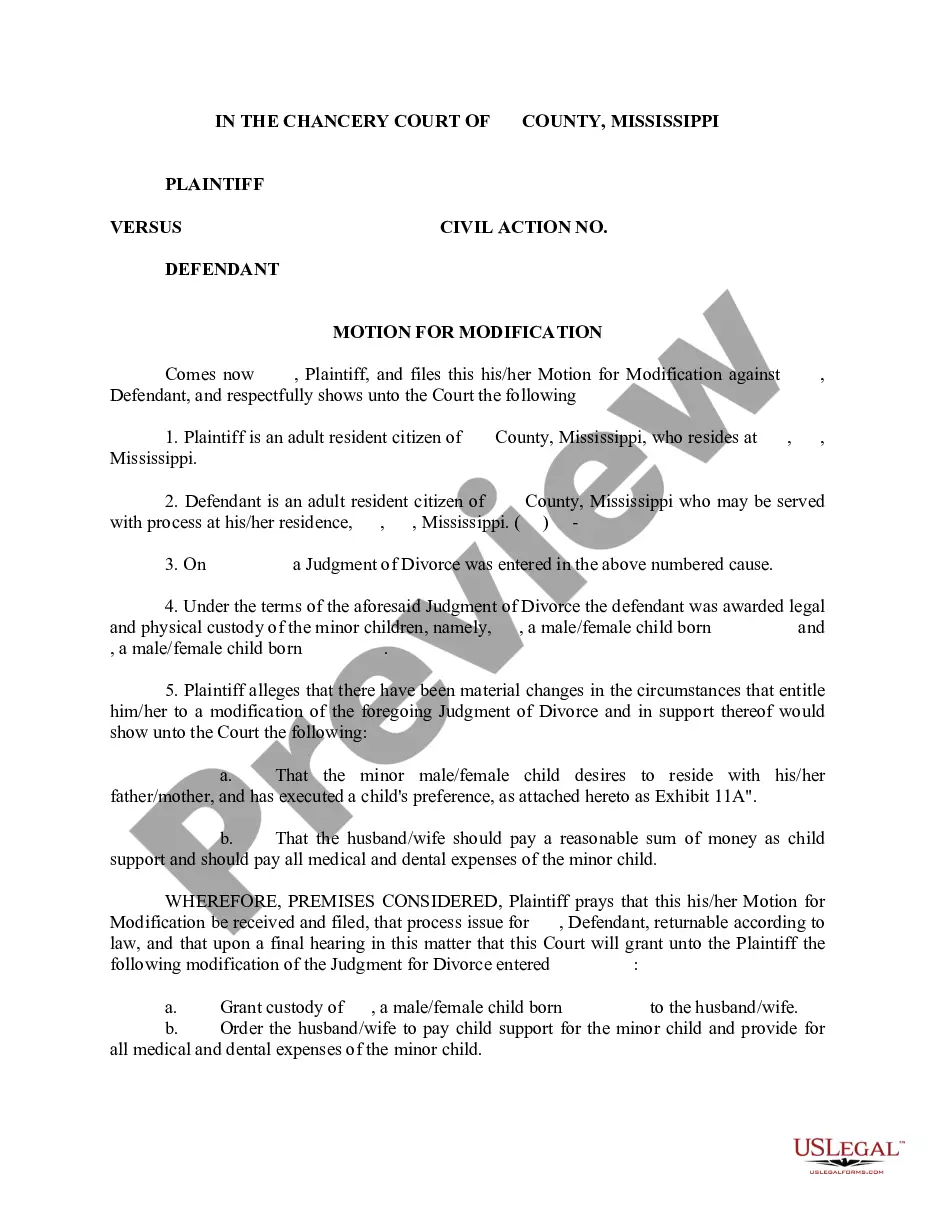
If child is 14 or older, child has the right to choose the custodial parent. If the child is 14 or older, child has the right to testify in court regarding the preference of custodial parent. If the child is 14 or older, the judge may consider the wishes of the child.
At age 18 years, you are legally an adult. You can move out of state if you want to. If you move out, your parents are under no obligation to continue to support you.When you turn 18 you can move out of your parents house.
1 attorney answer Although a child's wishes are one factor among many the court must consider in determining the child's best interests, a minor child never gets to "decide" which parent to live with.
Each parent can receive joint legal and physical custody. Both parents might receive joint legal custody, but one parent will have physical custody. Both parents might receive joint physical custody, but one parent will have legal custody. One parent could be given both legal and physical custody.
The legal definition of an unfit parent is when the parent through their conduct fails to provide proper guidance, care, or support. Also, if there is abuse, neglect, or substance abuse issues, that parent will be deemed unfit.
There is no legal age for a child to refuse to go to the court-ordered visitation while the child remains a minor. In the state of Mississippi, a child remains a minor until the child turns 21. Games with visitation should be AVOIDED because as the...
When can my child decide which parent to live with? A child never has an automatic right to choose which parent to live with; however, a child that is age 12 or older will have the right to state a preference that will be considered as part of the Albright best interest of the child test.