Mississippi Motion to Approve Final Accounting, Close Estate and for Other Relief (after finalization of disbursement plan)
What this document covers
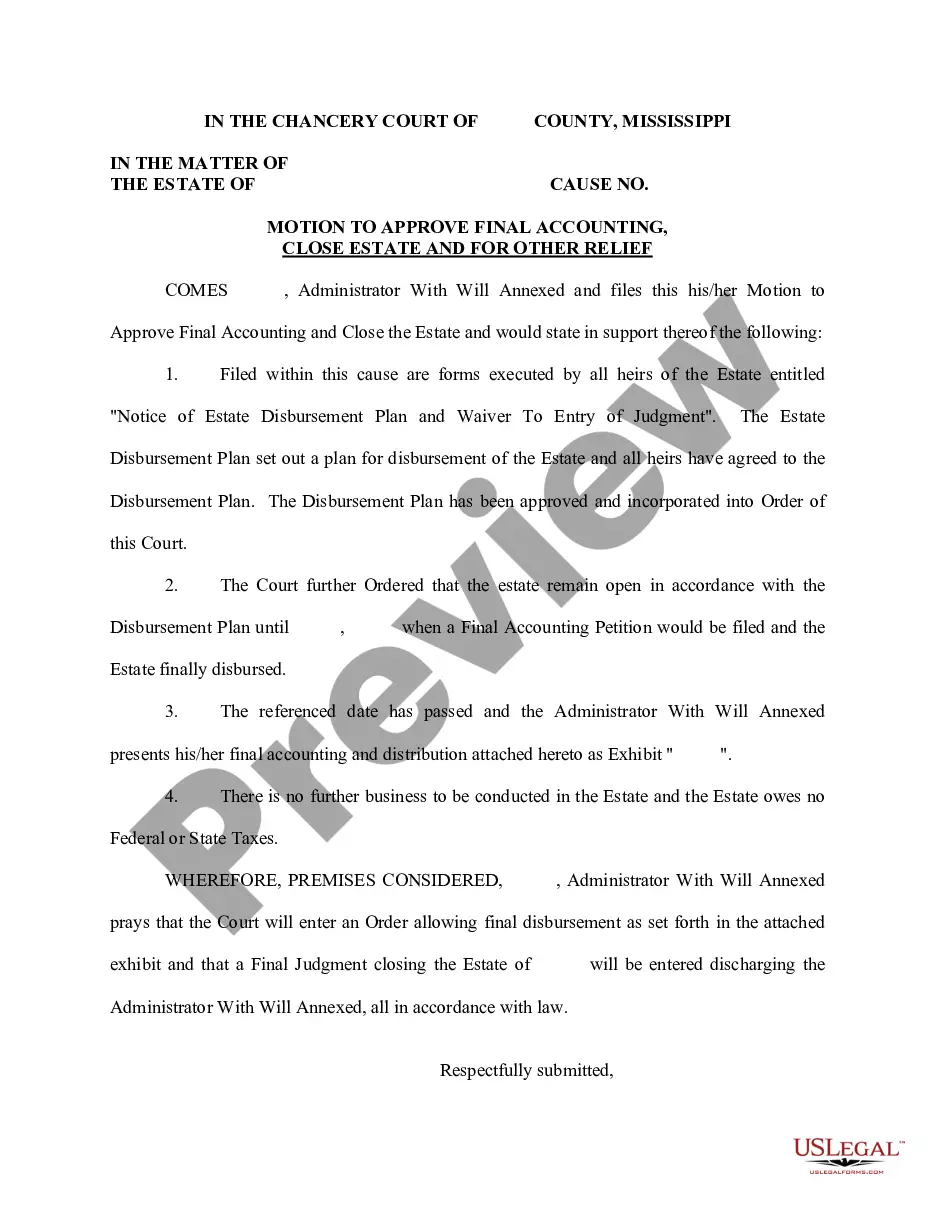
The Motion to Approve Final Accounting, Close Estate and for Other Relief is a formal request submitted to the court. This document specifically serves the purpose of asking the court to approve the final accounting of an estate, ensure the proper closing of the estate, and allow for any other requested relief after a disbursement plan has been finalized. It differs from other motions in that it focuses on concluding estate matters, rather than reopening or contesting them.
Main sections of this form
- Parties involved: Identification of the executor or administrator and beneficiaries.
- Final accounting: A detailed report of all financial transactions related to the estate.
- Request for relief: Specific requests for the court's consideration beyond the final accounting.
- Signature and date: Required signatures from the executor and any necessary dates for compliance.

Common use cases
This form is typically used when an executor or administrator has completed the administration of an estate and is ready to finalize the financial accounting. It is necessary to ensure that all debts have been settled, assets distributed, and the estate properly closed. Use this motion to seek court approval of the final accounting before concluding estate-related activities.
Who needs this form
- Executors or administrators of an estate who are finalizing the estate closure process.
- Beneficiaries or interested parties seeking to understand or contest the final accounting.
- Legal representatives assisting clients with estate administration and closure.
Instructions for completing this form
- Identify the parties involved, including the executor and beneficiaries.
- Provide a detailed final accounting that includes all income, expenses, and distributions.
- Clearly state your requests for any additional relief from the court.
- Ensure that the form is signed and dated by the executor or administrator.
Does this document require notarization?
Notarization is required for this form to take effect. Our online notarization service, powered by Notarize, lets you verify and sign documents remotely through an encrypted video session, available 24/7.
Get your form ready online
Our built-in tools help you complete, sign, share, and store your documents in one place.
Make edits, fill in missing information, and update formatting in US Legal Forms—just like you would in MS Word.
Download a copy, print it, send it by email, or mail it via USPS—whatever works best for your next step.
Sign and collect signatures with our SignNow integration. Send to multiple recipients, set reminders, and more. Go Premium to unlock E-Sign.
If this form requires notarization, complete it online through a secure video call—no need to meet a notary in person or wait for an appointment.
We protect your documents and personal data by following strict security and privacy standards.

Make edits, fill in missing information, and update formatting in US Legal Forms—just like you would in MS Word.

Download a copy, print it, send it by email, or mail it via USPS—whatever works best for your next step.

Sign and collect signatures with our SignNow integration. Send to multiple recipients, set reminders, and more. Go Premium to unlock E-Sign.

If this form requires notarization, complete it online through a secure video call—no need to meet a notary in person or wait for an appointment.

We protect your documents and personal data by following strict security and privacy standards.
Common mistakes
- Failing to include all beneficiaries in the motion.
- Not providing complete financial records in the final accounting.
- Neglecting to sign or date the motion before submission.
- Requesting relief that is not clearly justified or documented.
Benefits of completing this form online
- Convenience of downloading and completing the form at your own pace.
- Access to templates that are drafted by licensed attorneys for reliability.
- Ability to edit the form according to your specific circumstances.
Summary of main points
- The Motion to Approve Final Accounting is essential for finalizing estate matters.
- Ensure all sections are completed accurately to avoid delays.
- Consult state-specific rules regarding the use and submission of this form.
Looking for another form?



Form popularity
FAQ
Before distributing assets to beneficiaries, the executor must pay valid debts and expenses, subject to any exclusions provided under state probate laws.The executor must maintain receipts and related documents and provide a detailed accounting to estate beneficiaries.
Most expenses that a fiduciary incurs in the administration of the estate or trust are properly payable from the decedent's assets. These include funeral expenses, appraisal fees, attorney's and accountant's fees, and insurance premiums.
Keeping estate accounts as an executor of a will Finally, to demonstrate they have administered the estate properly the executor should keep full records and prepare a final set of accounts for the estate. These accounts should be shown to beneficiaries and their approval of the accounts sought.
Estate accounting is accounting which pertains to the settling of an estate. When someone dies, his or her property is handled by someone appointed as an executor and the executor must keep accurate accounting records as the estate is wrapped up and distributed in keeping with the wishes expressed in the will.
Summary of the terms of the Will/Rules of Intestacy. balance sheetcapital statementincome statement. securities (investments) schedule. distribution statement.
An Estate account is a different kind of account it is a new account opened after someone has passed away, into which the Executor deposits the deceased person's money, from which the Executor pays the deceased person's debts and bills, and from which the Executor ultimately distributes funds to the beneficiaries of
Go to the county courthouse where the probate petition was filed and the estate was formally discharged. File a request for documents, specifically the reconciliation of assets and accounting.
Before distributing assets to beneficiaries, the executor must pay valid debts and expenses, subject to any exclusions provided under state probate laws.The executor must maintain receipts and related documents and provide a detailed accounting to estate beneficiaries.
When the Estate Closes An executor cannot simply gather assets, pay bills and expenses and then distribute the remaining assets to the beneficiaries. She needs court approval for closing the estate, and in most states, this involves giving a full accounting of everything on which she spent money.