Mississippi Assignment of Declarant's Right
What this document covers
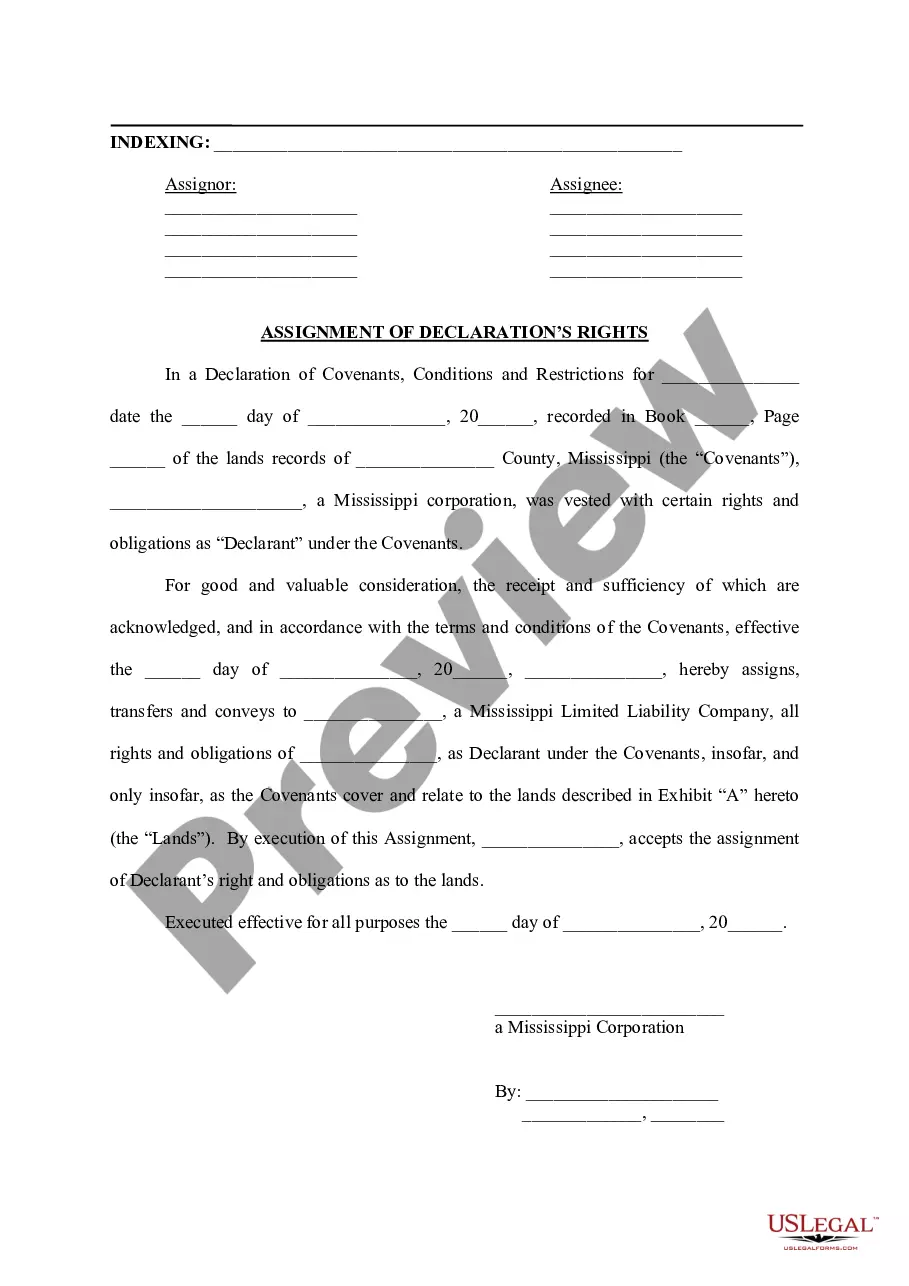
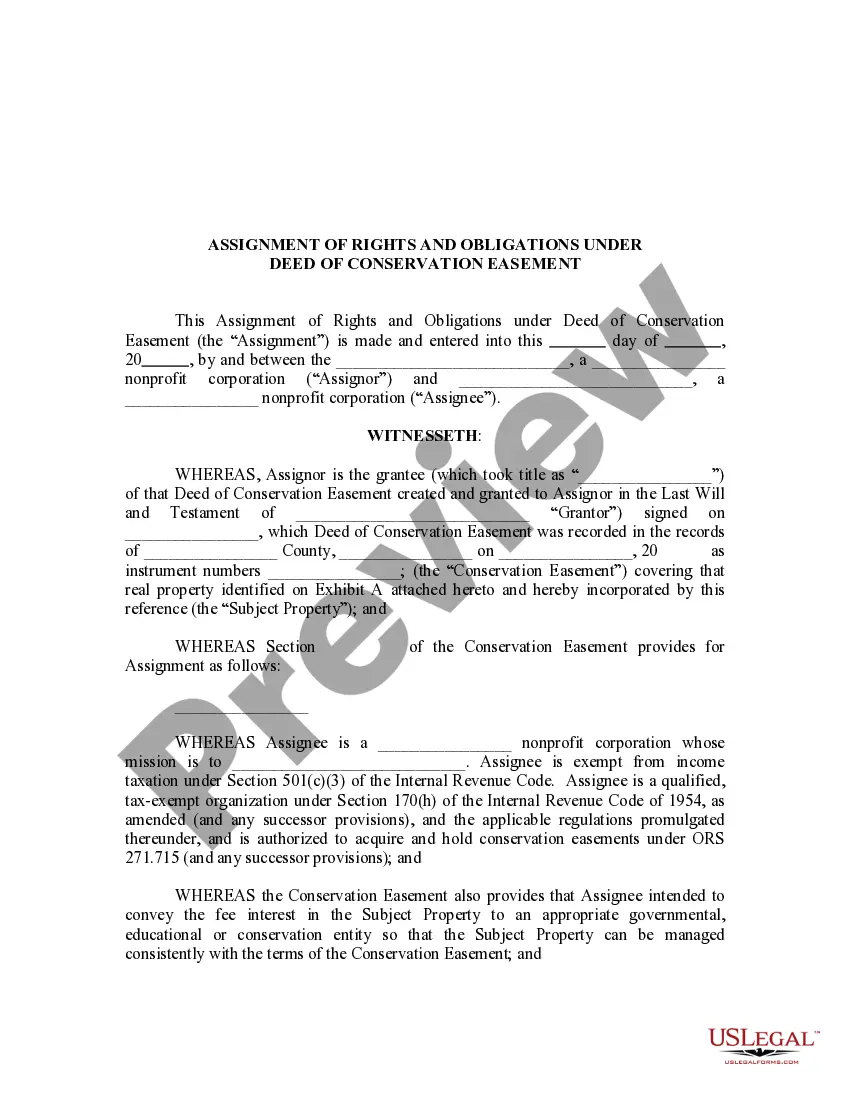
The Assignment of Declarant's Right is a legal document used to assign the rights and obligations of a declarant, typically a corporation, to another party. This form specifically applies in Mississippi and is used in the context of declarations recorded in land records. It enables a smooth transition of responsibilities outlined in covenants, ensuring that the new assignee can act on behalf of the declarant effectively.
Key parts of this document
- Assignor and assignee details: Names and addresses of both parties involved.
- Declaration reference: Information about the original declaration, including date and recording details.
- Assignment statement: Formal transfer of rights and obligations from the assignor to the assignee.
- Acceptance clause: Confirmation by the assignee of the acceptance of the rights and obligations.
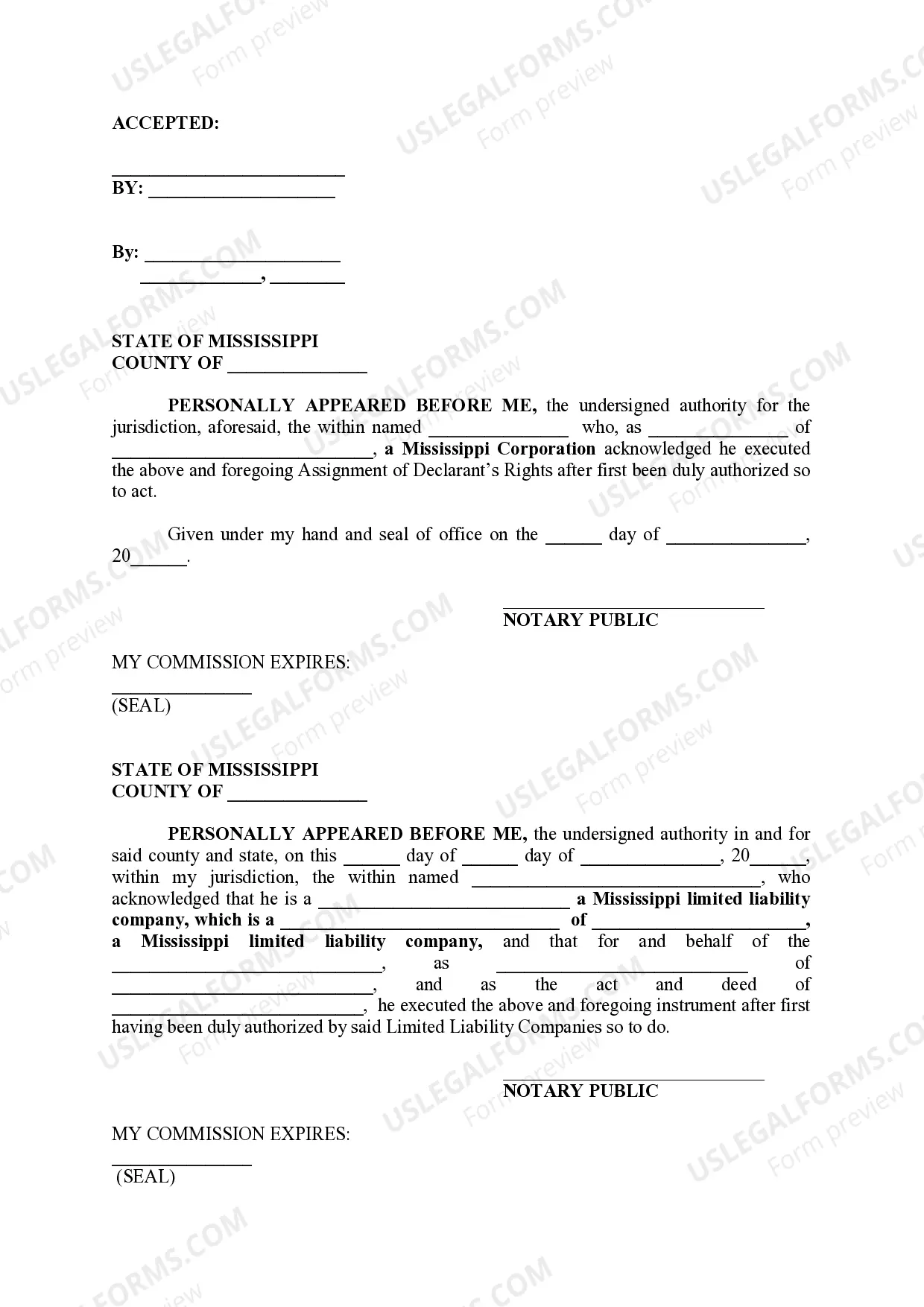
- Notary section: Spaces for notary public acknowledgment to ensure legal validity.

When to use this form
This form should be used when a corporation in Mississippi is transferring its declarant rights to another party. Common scenarios include changes in property management, shifts in corporate ownership, or fulfilling obligations in property developments where the declarant's powers need to be reassigned under existing covenants.
Who can use this document
- Corporations operating as declarants under existing covenants.
- Limited liability companies looking to acquire declarant rights.
- Legal professionals managing property rights transfers.
- Property developers involved in the assignment of management responsibilities.
How to prepare this document
- Identify the assignor and assignee: Fill in the names and addresses of both parties.
- Reference the declaration: Provide details about the original declaration, including the date and record information.
- Enter the effective date: Specify when the assignment will take effect.
- Complete the assignment statement: Clearly state the rights and obligations being transferred.
- Sign the document: Ensure both the assignor and assignee sign in the designated areas, along with the notary public.
Notarization requirements for this form
Yes, this form must be notarized to be legally valid. The notarization process ensures that the identities of the signers are confirmed, thereby providing legal protections. US Legal Forms provides integrated online notarization, allowing you to complete this process securely through a video call without needing to travel.
Get your form ready online
Our built-in tools help you complete, sign, share, and store your documents in one place.
Make edits, fill in missing information, and update formatting in US Legal Forms—just like you would in MS Word.
Download a copy, print it, send it by email, or mail it via USPS—whatever works best for your next step.
Sign and collect signatures with our SignNow integration. Send to multiple recipients, set reminders, and more. Go Premium to unlock E-Sign.
If this form requires notarization, complete it online through a secure video call—no need to meet a notary in person or wait for an appointment.
We protect your documents and personal data by following strict security and privacy standards.

Make edits, fill in missing information, and update formatting in US Legal Forms—just like you would in MS Word.

Download a copy, print it, send it by email, or mail it via USPS—whatever works best for your next step.

Sign and collect signatures with our SignNow integration. Send to multiple recipients, set reminders, and more. Go Premium to unlock E-Sign.

If this form requires notarization, complete it online through a secure video call—no need to meet a notary in person or wait for an appointment.

We protect your documents and personal data by following strict security and privacy standards.
Avoid these common issues
- Failing to include complete and accurate names and addresses of parties.
- Not referencing the correct declaration details, which can invalidate the form.
- Neglecting to have the form notarized properly, which is essential for legal validity.
Benefits of using this form online
- Instant access to a legally compliant template tailored for Mississippi.
- Ability to fill out the form at your own pace, saving time and reducing stress.
- Easy to download and print the completed document for record-keeping.
Looking for another form?


Form popularity
FAQ
Declarant Control relates to the Declarant's right to control the operation of an association by means of appointing members to the Board of Directors. The Declarant Control provision permits the Declarant to establish budgets, execute contracts, retain vendors, etc.
Declarant Control relates to the Declarant's right to control the operation of an association by means of appointing members to the Board of Directors. The Declarant Control provision permits the Declarant to establish budgets, execute contracts, retain vendors, etc.
Declarant rights are reserved in the recorded Declaration for a planned community or condominium and are part of the contract among the lot or unit owners, the owners association, and the Declarant. The developer of real property is generally free to restrict that real property however it sees fit.
A declarant is person who makes a statement they allege to be true. Typically, such statements are written and signed.
The declarant is the owner of a property that becomes the condominium/common interest community. The declarant gives life to the condominium or common interest community by recording a declaration against the property that will ultimately comprise the association.
A declarant, generally speaking, is anyone who composes and signs a statement or declaration alleging that the information he has given therein is true.
N. the person making a statement, usually written and signed by that person, under "penalty of perjury" pursuant to the laws of the state in which the statement, called a declaration, is made.
A declarant, generally speaking, is anyone who composes and signs a statement or declaration alleging that the information he has given therein is true.The word declarant, when discussing the hearsay rule and its exceptions, refers to the person who makes an out-of-court statement.