Mississippi Agreed Order Setting Trial Date
Understanding this form
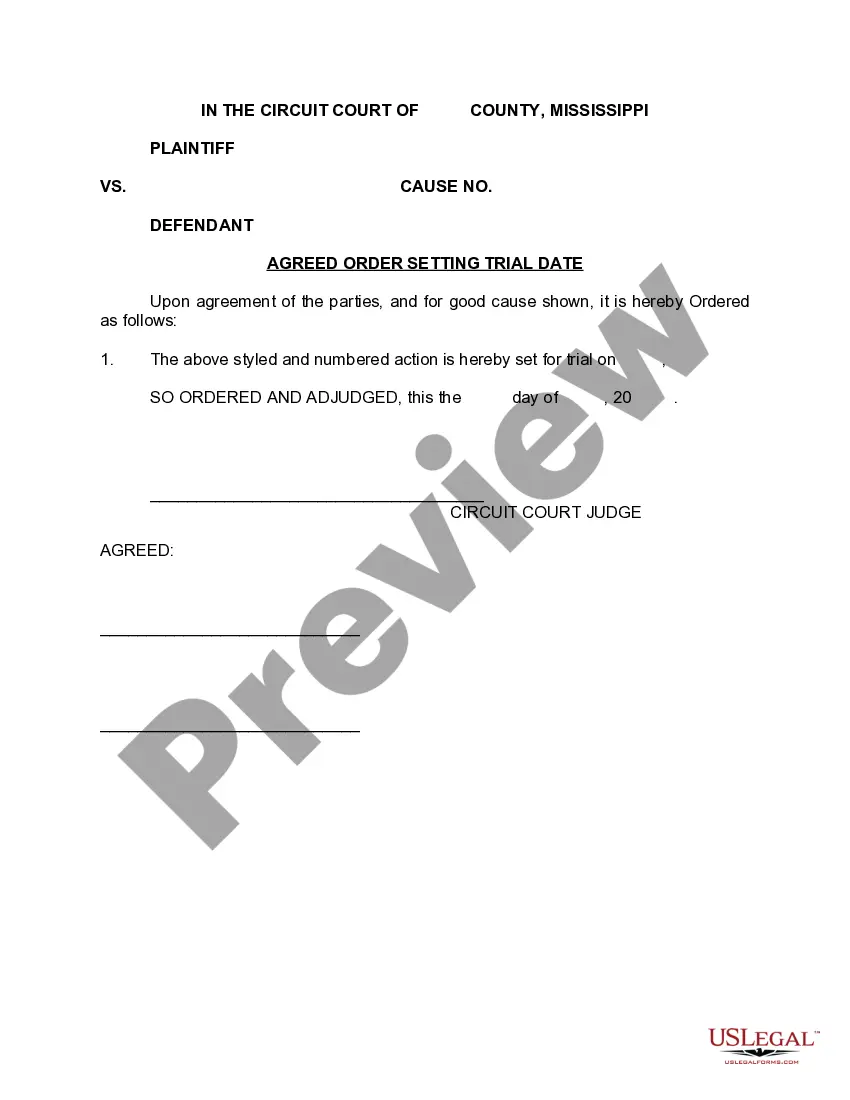
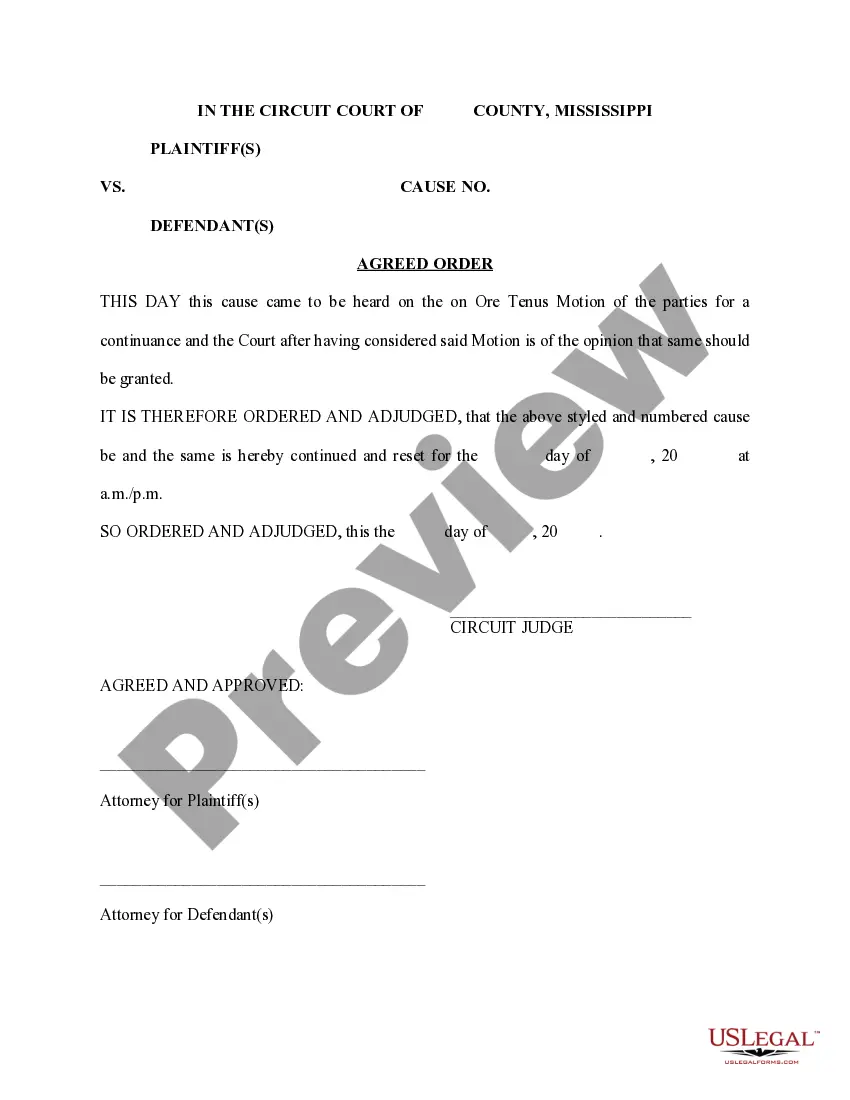
The Agreed Order Setting Trial Date is a Mississippi legal document that establishes a specific date and time for a trial, as agreed upon by both parties involved in a legal dispute. This form is essential for ensuring clarity and mutual consent about when a trial will occur. Unlike other court documents, this form specifically focuses on trial scheduling, streamlining the process for all parties involved.
Key parts of this document
- Identification of the parties involved in the case.
- The agreed-upon date and time for the trial.
- Signatures of both parties indicating their consent to the trial date.
- Reference to the applicable Mississippi statutes governing the trial process.
- Any additional terms relevant to the scheduling of the trial.
When to use this document
This form should be used when both parties in a civil case have reached an agreement on the date and time for their trial. It serves to formalize their decision and ensures that the court is aware of the agreed schedule. Typical scenarios may include settling a dispute in family law, business disagreements, or other civil matters requiring judicial resolution.
Who needs this form
- Individuals or organizations involved in a legal dispute in Mississippi.
- Parties who have agreed on a specific trial date.
- Attorneys representing clients in civil litigation.
Steps to complete this form
- Identify the names and contact information of the parties involved.
- Clearly state the agreed-upon trial date and time.
- Ensure both parties sign the form to validate their agreement.
- Verify that the form complies with local court requirements.
- Submit the completed form to the appropriate court clerk's office.
Notarization guidance
This form does not typically require notarization unless specified by local law.
Get your form ready online
Our built-in tools help you complete, sign, share, and store your documents in one place.
Make edits, fill in missing information, and update formatting in US Legal Forms—just like you would in MS Word.
Download a copy, print it, send it by email, or mail it via USPS—whatever works best for your next step.
Sign and collect signatures with our SignNow integration. Send to multiple recipients, set reminders, and more. Go Premium to unlock E-Sign.
If this form requires notarization, complete it online through a secure video call—no need to meet a notary in person or wait for an appointment.
We protect your documents and personal data by following strict security and privacy standards.

Make edits, fill in missing information, and update formatting in US Legal Forms—just like you would in MS Word.

Download a copy, print it, send it by email, or mail it via USPS—whatever works best for your next step.

Sign and collect signatures with our SignNow integration. Send to multiple recipients, set reminders, and more. Go Premium to unlock E-Sign.

If this form requires notarization, complete it online through a secure video call—no need to meet a notary in person or wait for an appointment.

We protect your documents and personal data by following strict security and privacy standards.
Typical mistakes to avoid
- Failing to include the full names of both parties.
- Leaving the trial date or time blank.
- Not obtaining signatures from both parties.
- Submitting the form without checking local court requirements.
Benefits of completing this form online
- Convenient download and access from anywhere.
- Easy to fill out and edit before finalizing.
- Updated regularly to ensure compliance with current laws.
Legal use & context
- Establishes a clear record of agreed trial dates.
- Helps avoid scheduling conflicts and misunderstandings.
- May be enforceable in court if properly completed and filed.
Summary of main points
- The Agreed Order Setting Trial Date is essential for formalizing trial schedules in Mississippi.
- Both parties must agree and sign the document for it to be valid.
- Understanding how to accurately complete the form can help avoid common errors that might delay the trial.
Looking for another form?
Form popularity
FAQ
Everyone has the right to a speedy trial, but in California, with a misdemeanor charge that is defined as within 45 calendar days from the day they were arraigned if they're not in custody, or 30 days if they are in custody. However, most people waive their right to a speedy trial, in order to mount a good defense.
In terms of a trial date, the U.S. Constitution and the constitution of individual states guarantee defendants the right to a speedy trial. For felony cases, this means defendants have the right to have a case be brought to trial within 60 days after the date of the arraignment.
If the defendant enters a not guilty plea, the judge will set a trial date. If the defendant enters a guilty plea or declares no contest to the charges, the judge will set a date to sentence the defendant for the crime.
Defense attorneys sometimes want independent analysis of scientific evidence to dispute findings by prosecution witnesses. These type of issues take time to investigate and resolve and judges generally authorize the delays.Serious illness by witnesses or attorneys can also delay a trial.
A Trial Setting is simply just a time when the judge sets your case for trial. Sometimes the Judge will ask how long a case would take and then puts it in the appropriate date etc.
If you are not being held in custody, the court must set trial within 45 days following your arraignment or plea. You are permitted to waive the right to a speedy trial in order to allow additional time for your attorney to prepare your defense.
A: A setting is typically an appointment for an attorney to call the court and set a future court date.
You will get a trial date when you have a hearing called a Trial Setting Conference. The judge wants everyone who will be trying the case to be at the hearing. This means your lawyer, if you have one.After you get trial date, get ready to go to trial on that date.
Typically, a motion setting means that someone, either the defense or prosecution, has requested that the case be set to hear motions. They may or may not have filed any motions.
WHAT HAPPENS WHEN THE CASE IS SET FOR TRIAL? Once a felony case is set for trial the Federal Criminal Lawyer for the accused requests Discovery. This means that the prosecution will provide evidence to the accuser's attorney for review.