Mississippi Answer
Overview of this form
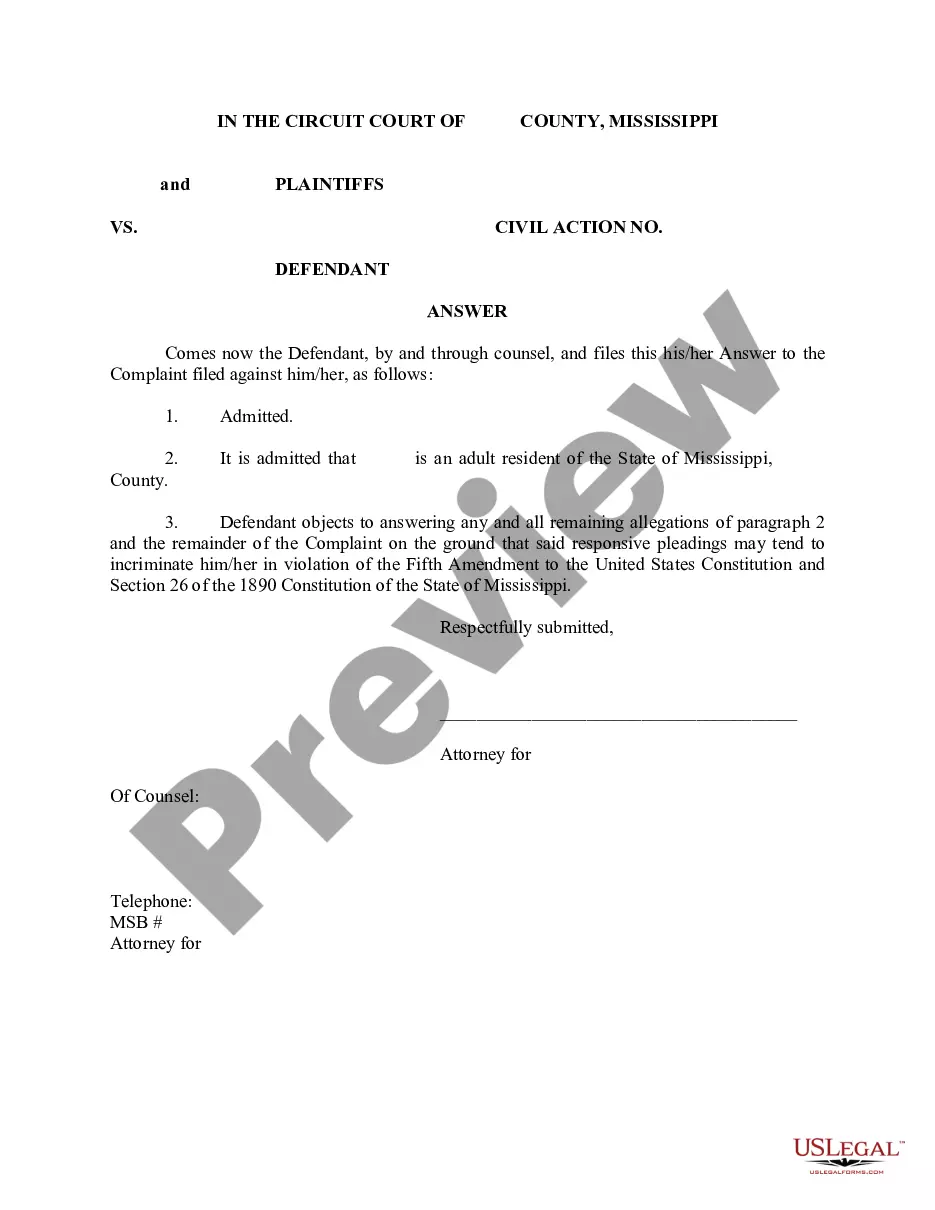
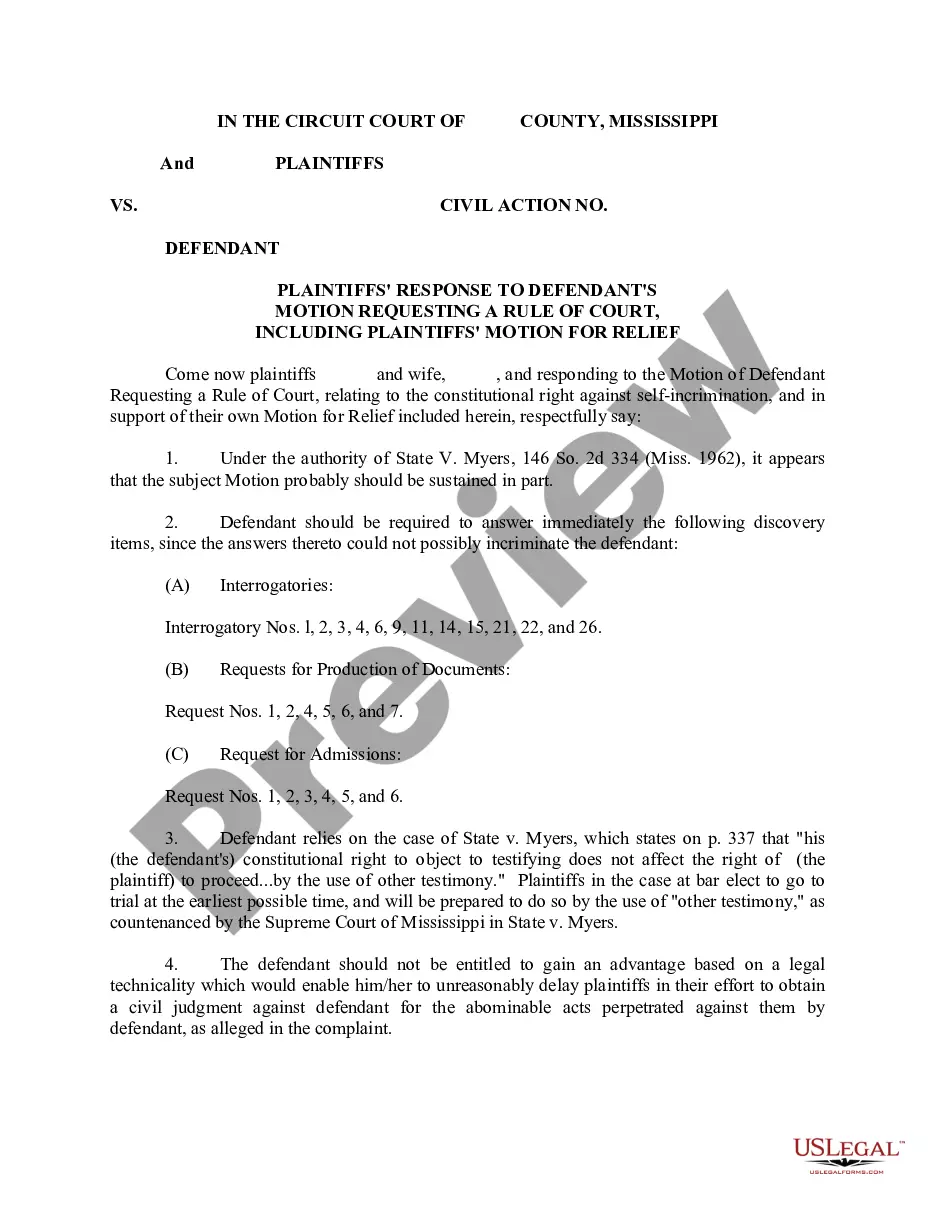
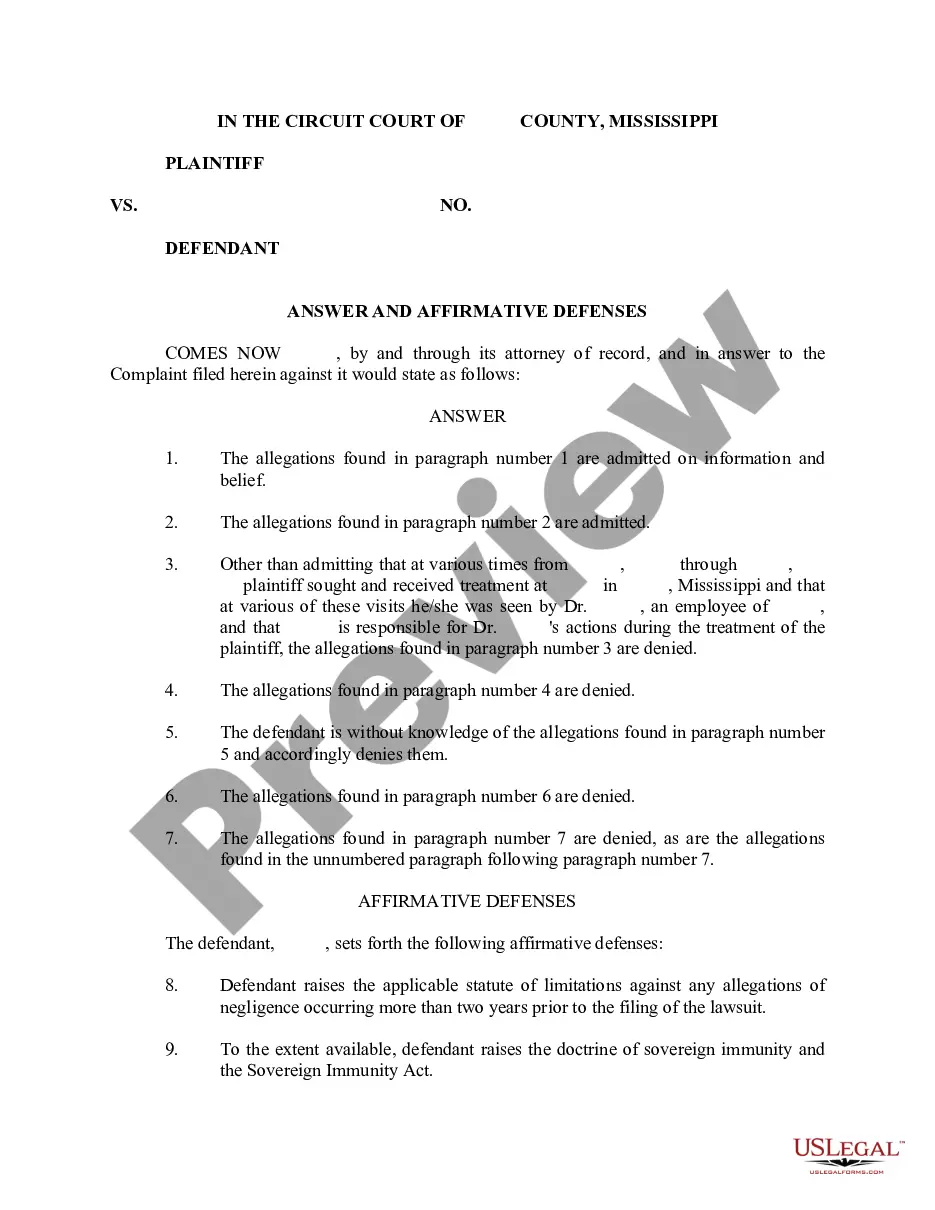
The Answer form is a legal document filed in response to a Complaint in a lawsuit. It allows a defendant to present their defenses and responses to the allegations made against them. This form differs from similar documents as it not only addresses the claims but also includes affirmative defenses, which are specific reasons why the plaintiff's claims should not succeed. The Answer can be tailored for various lawsuit types and is available for download in both Word and Rich Text formats.
Key components of this form
- Identification of the parties involved in the lawsuit.
- Response to each allegation made in the Complaint.
- Affirmative defenses that may prevent the plaintiff from winning the case.
- Signature line for the defendant or their attorney.

Situations where this form applies
This form should be used when you have received a Complaint initiating a lawsuit against you. By filing an Answer, you can formally respond to the allegations, assert your defenses, and prevent a default judgment. You would typically submit this form after the complaint has been served and within the specified timeframe set by the court.
Intended users of this form
- Defendants in civil lawsuits who receive a Complaint.
- Individuals representing themselves in court proceedings.
- Attorneys preparing a defense for their clients in a lawsuit.
How to prepare this document
- Identify the parties by entering your name and the plaintiff's name.
- Carefully read each allegation in the Complaint, and respond to each by indicating whether you admit, deny, or lack sufficient knowledge to respond.
- Include any affirmative defenses that apply to your case.
- Sign the document, indicating the date, and provide contact information if necessary.
Notarization guidance
Notarization is generally not required for this form. However, certain states or situations might demand it. You can complete notarization online through US Legal Forms, powered by Notarize, using a verified video call available anytime.
Get your form ready online
Our built-in tools help you complete, sign, share, and store your documents in one place.
Make edits, fill in missing information, and update formatting in US Legal Forms—just like you would in MS Word.
Download a copy, print it, send it by email, or mail it via USPS—whatever works best for your next step.
Sign and collect signatures with our SignNow integration. Send to multiple recipients, set reminders, and more. Go Premium to unlock E-Sign.
If this form requires notarization, complete it online through a secure video call—no need to meet a notary in person or wait for an appointment.
We protect your documents and personal data by following strict security and privacy standards.

Make edits, fill in missing information, and update formatting in US Legal Forms—just like you would in MS Word.

Download a copy, print it, send it by email, or mail it via USPS—whatever works best for your next step.

Sign and collect signatures with our SignNow integration. Send to multiple recipients, set reminders, and more. Go Premium to unlock E-Sign.

If this form requires notarization, complete it online through a secure video call—no need to meet a notary in person or wait for an appointment.

We protect your documents and personal data by following strict security and privacy standards.
Common mistakes
- Failing to respond to all allegations in the Complaint.
- Missing the deadline for filing the Answer.
- Not including affirmative defenses, which could weaken your position.
- Submitting the form without a necessary signature.
Why use this form online
- Convenient download and access to the form from any device.
- Editable formats allow you to tailor the form to your specific needs.
- Access to reliable and attorney-drafted templates for legal clarity.
Summary of main points
- The Answer is essential for defendants to formally respond to a lawsuit.
- Ensure to address each allegation and include any legal defenses.
- This form is flexible and suitable for multiple jurisdictions.
- Filing deadlines must be adhered to for the response to be valid.
Looking for another form?
Form popularity
FAQ
Multiple studies have concluded that misdiagnosis is the most common cause of malpractice claims. Misdiagnosis includes failure to diagnose a medical problem that exists or making a diagnosis that is incorrect.
Experts in Attorney Malpractice. Legal malpractice occurs when a lawyer commits an error, omission or breach of duty to the client or the justice system that results in a negative legal outcome or monetary loss for the client or a third party.
To prove legal malpractice you must establish the following four elements: (1) duty, (2) breach, (3) causation, and (4) harm. These are the basic elements for most torts in California. Duty. A plaintiff must show the existence of an agreement, either express or implied, that creates an attorney-client relationship.
To prevail in a legal malpractice lawsuit in most jurisdictions, you will need to prove an attorney-client relationship between you and the lawyer, a breach of the duty to provide skillful and competent representation (negligence), causation, and a financial loss.
Although the general rule in California bars the assignment of a cause of action for legal malpractice, a narrow exception is appropriate on the particular facts here because White Mountains did not simply buy a malpractice claim, like buying a fraud claim without buying the money or property obtained by the fraud.
Legal malpractice is the term for negligence, breach of fiduciary duty, or breach of contract by a lawyer during the provision of legal services that causes harm to a client.
To prove legal malpractice you must establish the following four elements: (1) duty, (2) breach, (3) causation, and (4) harm. These are the basic elements for most torts in California. Duty. A plaintiff must show the existence of an agreement, either express or implied, that creates an attorney-client relationship.
Time Limits to File a Medical Malpractice Claim in Mississippi. So long as the healthcare provider is legally allowed to be sued for the wrongdoing, then the statute of limitations is two years. Anything that was not obvious immediately can be filed up to two years from when it became obvious to the injured party.
To prove a case of medical malpractice, an attorney must demonstrate that a healthcare provider: Had a duty of care to the patient. Breached the standard of care (or acted in a way that a reasonable, similarly trained person would not have acted) That the breach, or error, caused actual harm to the patient.