Mississippi Authorization to Satisfy Lien Notice - Individual
What this document covers
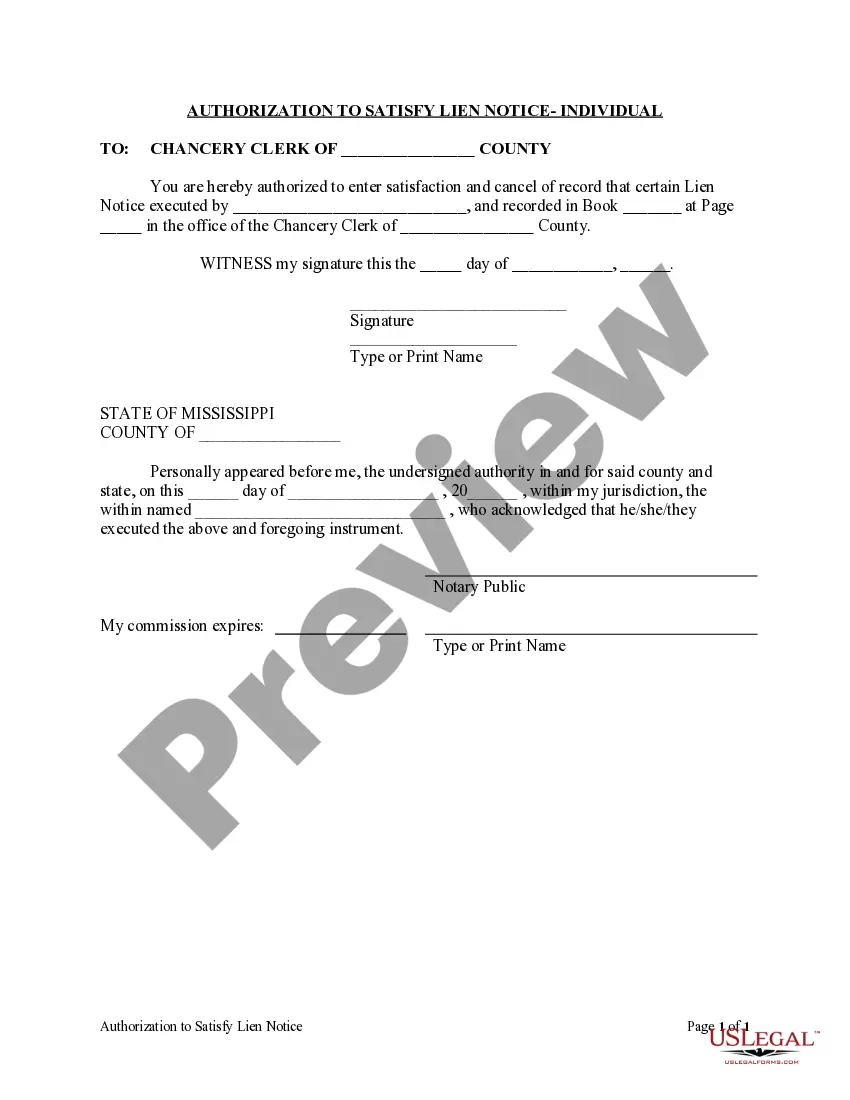
The Authorization to Satisfy Lien Notice is a legal document used by individuals to formally notify the relevant authorities that a lien on a property has been satisfied. This form is signed by the court clerk's office and serves to remove the lien from the official records, indicating that it no longer encumbers the property. Unlike other lien documents, this notice specifically confirms the satisfaction of the lien and the necessity for its removal from public records.
Main sections of this form
- Authorization section specifying the chancery clerk and county.
- Details of the original Lien Notice, including its book and page numbers.
- Signature line for the individual authorizing the satisfaction.
- Date on which the authorization is executed.
- Notarial verification section, if applicable.
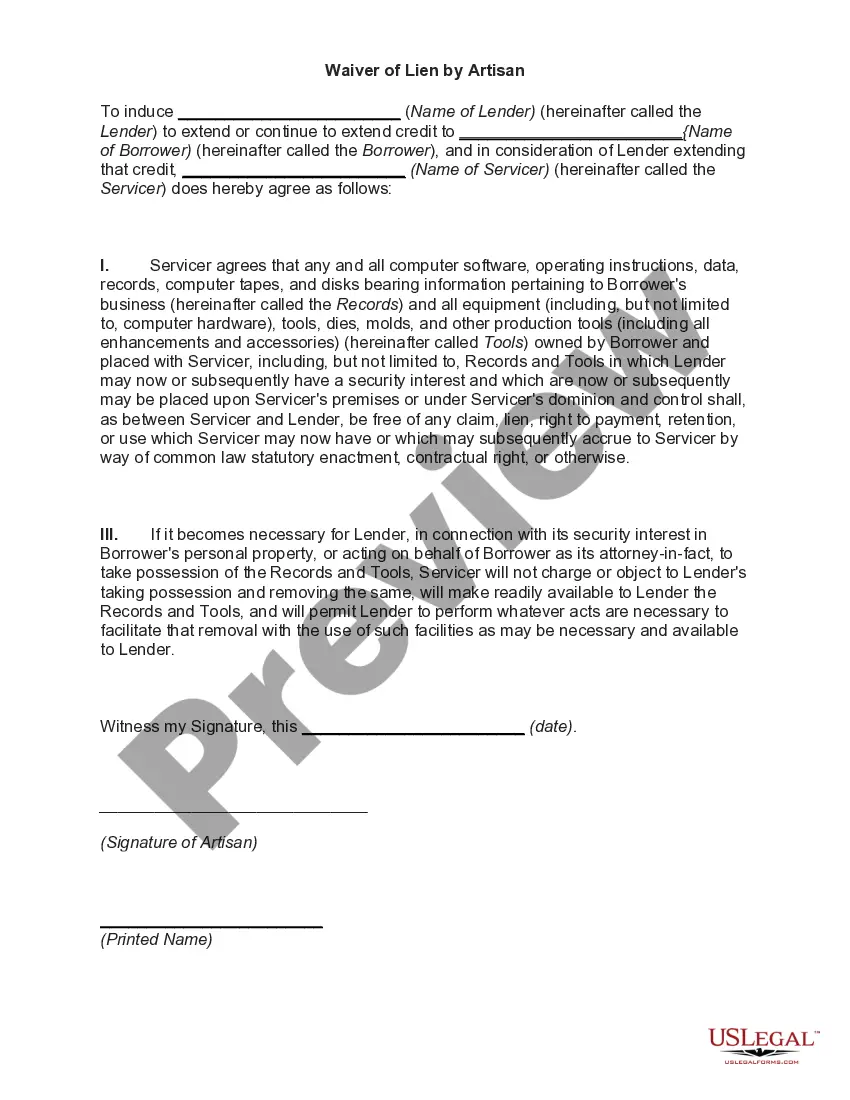
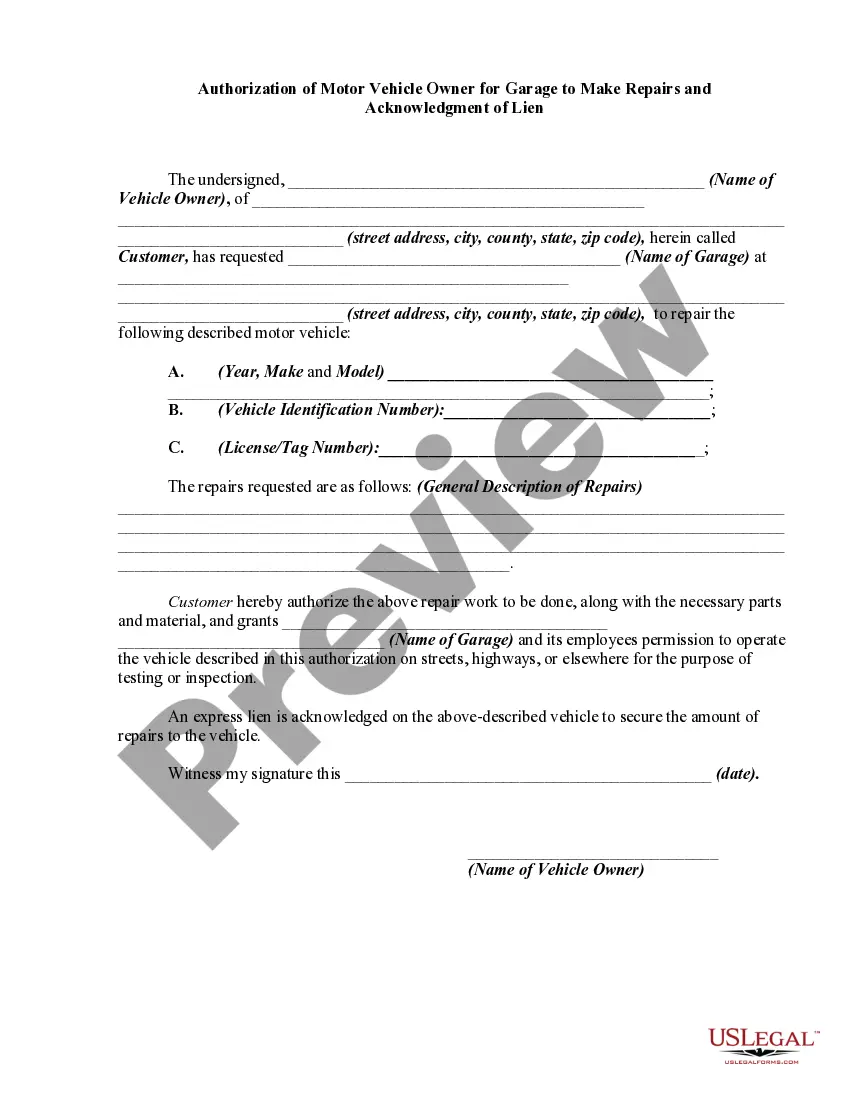
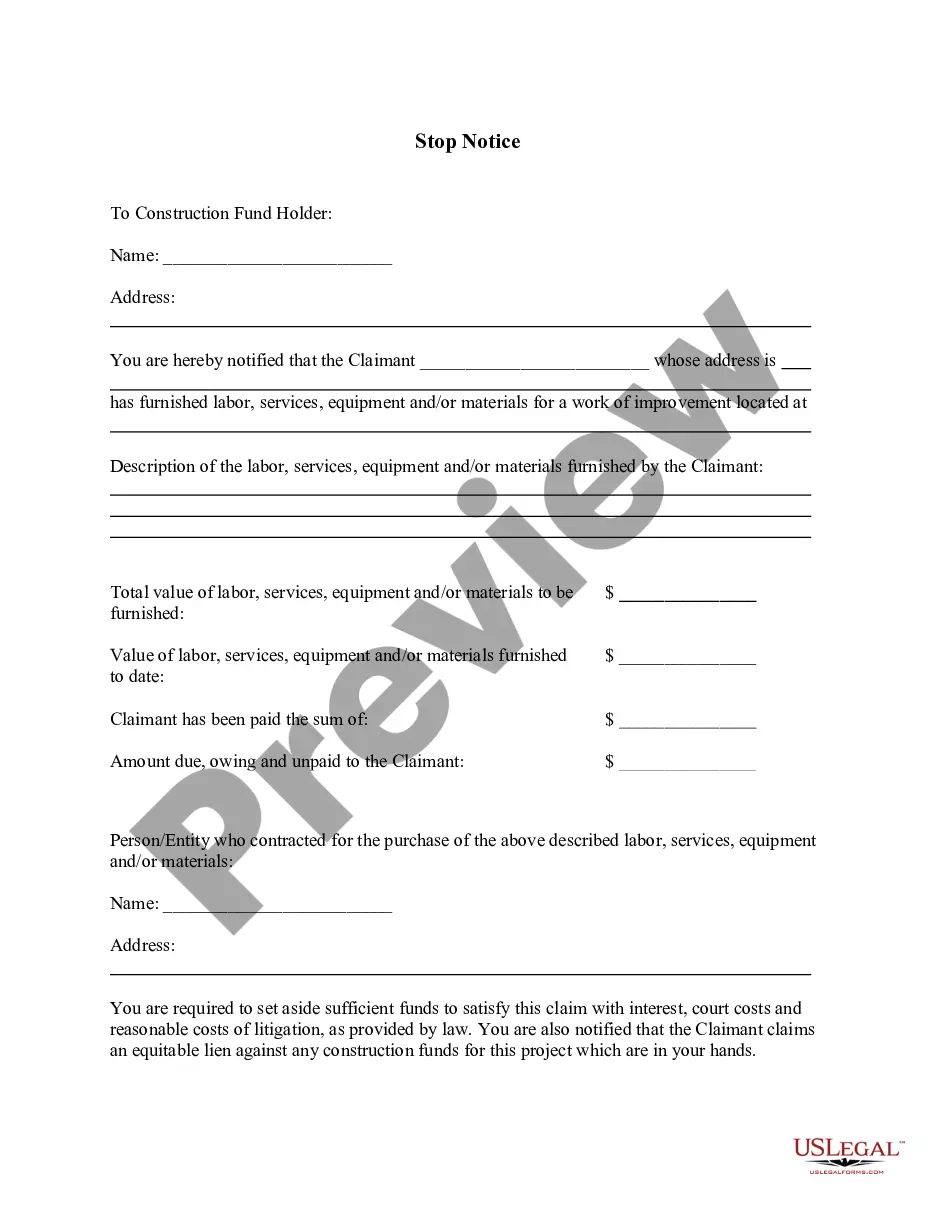
Common use cases
This form should be used when an individual has fulfilled all obligations related to a lien against a property and needs to officially notify the chancery clerk to cancel the lien from the public records. Typical scenarios include paying off a mortgage or settling a debt secured by a lien on the property.
Who this form is for
- Homeowners who have paid off or settled a lien on their property.
- Individuals acting on behalf of family members who are no longer able to manage their property.
- Real estate agents or attorneys who are handling the documentation for individuals in these situations.
Completing this form step by step
- Fill in the name of the county where the lien is recorded.
- Enter the details of the lien, including the executing party and the book and page numbers.
- Sign the form to authorize the clerk to enter the satisfaction.
- Print your name clearly beneath your signature.
- Provide the date of signing.
Does this document require notarization?
This form must be notarized to be legally valid. US Legal Forms provides secure online notarization powered by Notarize, allowing you to complete the process through a verified video call.
Get your form ready online
Our built-in tools help you complete, sign, share, and store your documents in one place.
Make edits, fill in missing information, and update formatting in US Legal Forms—just like you would in MS Word.
Download a copy, print it, send it by email, or mail it via USPS—whatever works best for your next step.
Sign and collect signatures with our SignNow integration. Send to multiple recipients, set reminders, and more. Go Premium to unlock E-Sign.
If this form requires notarization, complete it online through a secure video call—no need to meet a notary in person or wait for an appointment.
We protect your documents and personal data by following strict security and privacy standards.

Make edits, fill in missing information, and update formatting in US Legal Forms—just like you would in MS Word.

Download a copy, print it, send it by email, or mail it via USPS—whatever works best for your next step.

Sign and collect signatures with our SignNow integration. Send to multiple recipients, set reminders, and more. Go Premium to unlock E-Sign.

If this form requires notarization, complete it online through a secure video call—no need to meet a notary in person or wait for an appointment.

We protect your documents and personal data by following strict security and privacy standards.
Common mistakes to avoid
- Failing to include the correct book and page numbers for the lien.
- Not signing the form or signing it inappropriately.
- Omitting the date of authorization.
- Providing inaccurate information about the lien or property.
Benefits of completing this form online
- Convenient access to legal documents from home without the need for physical visits.
- Editable templates allow for easy customization to fit individual situations.
- Reliability in terms of having attorney-drafted forms that meet legal standards.
Looking for another form?

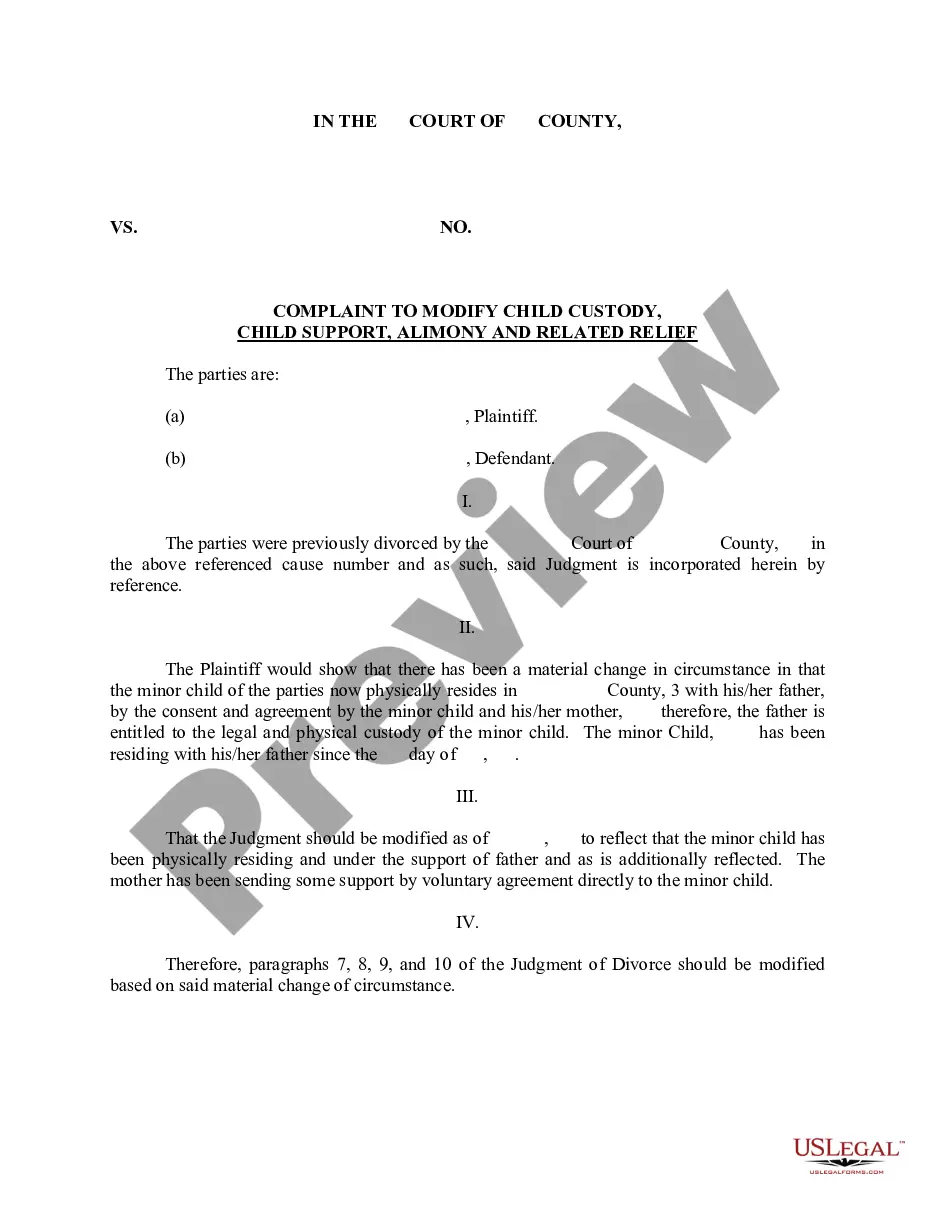

Form popularity
FAQ
Formalize a defense for disputing the amount of the lien. Gather supporting documentation for your rebuttal, depending on the type of lien. Contact the agent representing the creditor to dispute the amount of the claim. Negotiate a payment settlement with the creditor if you cannot pay the amount you owe in full.
The simplest way to prevent liens and ensure that subcontractors and suppliers are paid is to pay with joint checks. This is when both parties endorse the check. Compare the contractor's materials or labor bill to the schedule of payments in your contract and the Preliminary Notices.
Be in substantial compliance with the contract or purchase order; File claim of lien within 90 days; Include in the lien a statement of amount due and due date of the claim; Notice the filing of claim of lien within 2 days to contractor and owner;
A lien is a legal claim against your property to secure payment of your tax debt, while a levy actually takes the property to satisfy the tax debt.When filed, the Notice of Federal Tax Lien is a public document that alerts other creditors that the IRS is asserting a secured claim against your assets.
What Is a Fraudulent Lien?the claimant is owed money on another job by the same general contractor or property owner, but didn't file a lien on that project before time expired; or. the claimant wants to file a lien because of personal reasons generally related to the identity of the property owner.
If a creditor puts a lien on your property, you may make an offer to settle the amount for less than you owe. As part of the negotiations, get the creditor to agree to release the lien. If you need help in the negotiations, consider hiring a debt settlement lawyer to help you.
While it's unlikely that just anyone can put a lien on your home or land, it's not unheard of for a court decision or a settlement to result in a lien being placed against a property.
If a creditor gets a judgment against you, it can then place a lien on your property. The lien gives the creditor an interest in your property so that it can get paid for the debt you owe.And in some cases, the lien gives the creditor the right to force a sale of your property in order to get paid.
The Tax-Forfeited Inventory200b link provides access to the properties available for sale or you may contact the Public Lands Division in the Secretary of State's Office at 601-359-5156 or toll free (in-state) at 1-866-TFLANDS(835-2637). Approximately how long does the process take?