Incorporators Consent To Action Mississippi Nonprofit
Understanding this form
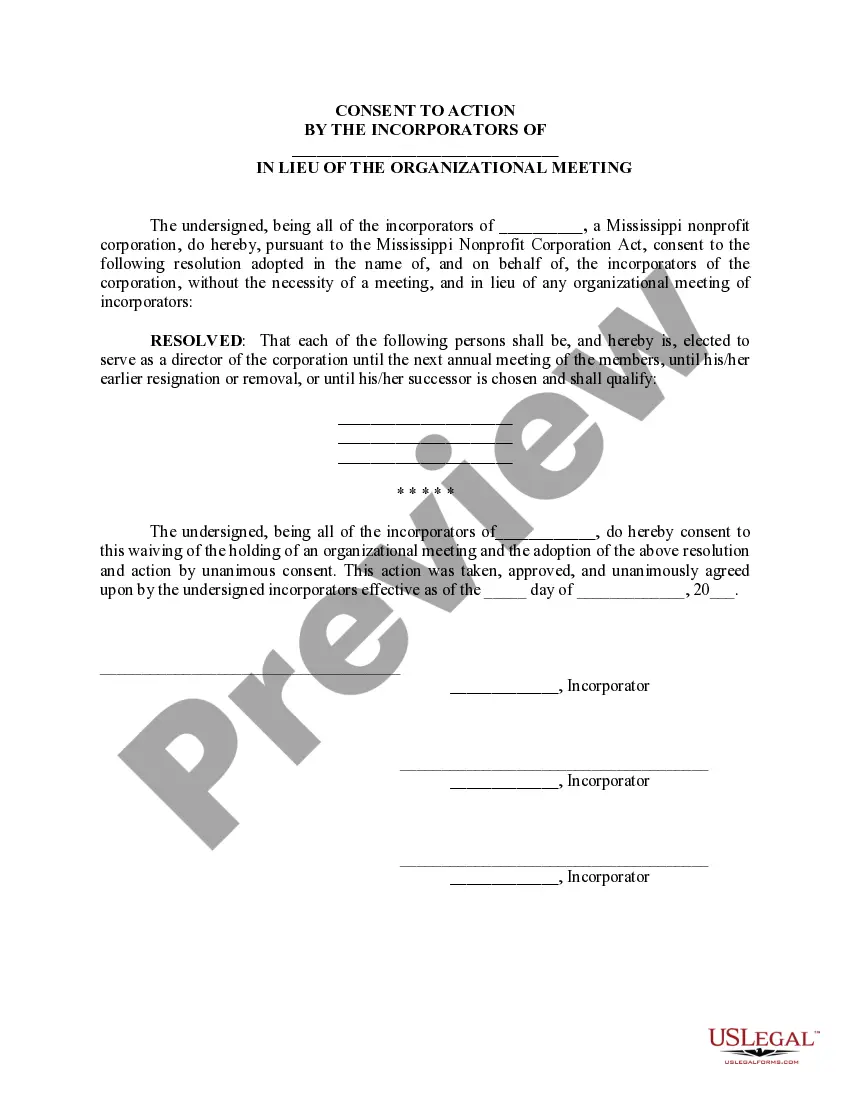
This Incorporators Consent to Action for a Mississippi Nonprofit allows the incorporators to approve the election of directors without holding an organizational meeting. This form streamlines the process, enabling directors to be elected efficiently and facilitates the establishment of the nonprofit corporation in compliance with the Mississippi Nonprofit Corporation Act.
Key components of this form
- Identification of the nonprofit corporation name.
- Names of the elected directors with applicable term conditions.
- Statement of consent by all incorporators waiving the organizational meeting.
- Signature lines for each incorporator indicating their agreement.
- Date of consent for official record-keeping.

Common use cases
This form is used when the incorporators of a Mississippi nonprofit wish to formalize the election of directors without convening a meeting. It is particularly useful in scenarios where incorporators may be unable to meet in person or prefer a more expedient method to establish leadership for the organization.
Who can use this document
- Individuals acting as incorporators for a Mississippi nonprofit corporation.
- Organizations seeking to establish a nonprofit and elect directors promptly.
- Legal representatives or advisors assisting with the formation of a nonprofit entity.
Instructions for completing this form
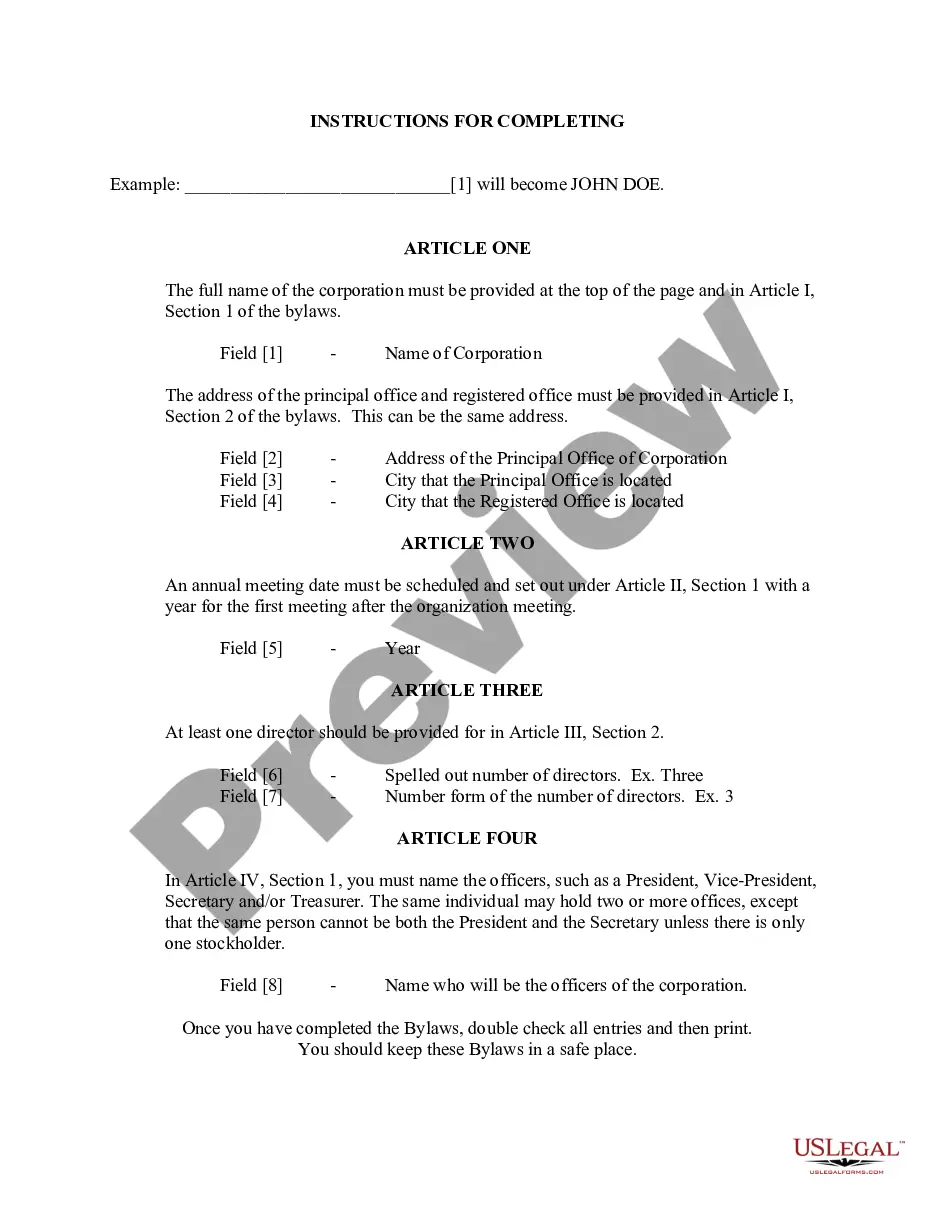
- Enter the name of the nonprofit corporation at the top of the form.
- List the names of individuals being elected as directors.
- Ensure all incorporators sign the document to signify their consent.
- Indicate the date the consent is effective.
- Store the completed form in a secure location for organizational records.
Does this document require notarization?
This form does not typically require notarization unless specified by local law. It is essential to check local regulations to ensure compliance with any specific requirements.
Get your form ready online
Our built-in tools help you complete, sign, share, and store your documents in one place.
Make edits, fill in missing information, and update formatting in US Legal Forms—just like you would in MS Word.
Download a copy, print it, send it by email, or mail it via USPS—whatever works best for your next step.
Sign and collect signatures with our SignNow integration. Send to multiple recipients, set reminders, and more. Go Premium to unlock E-Sign.
If this form requires notarization, complete it online through a secure video call—no need to meet a notary in person or wait for an appointment.
We protect your documents and personal data by following strict security and privacy standards.

Make edits, fill in missing information, and update formatting in US Legal Forms—just like you would in MS Word.

Download a copy, print it, send it by email, or mail it via USPS—whatever works best for your next step.

Sign and collect signatures with our SignNow integration. Send to multiple recipients, set reminders, and more. Go Premium to unlock E-Sign.

If this form requires notarization, complete it online through a secure video call—no need to meet a notary in person or wait for an appointment.

We protect your documents and personal data by following strict security and privacy standards.
Common mistakes to avoid
- Failing to include the complete name of the nonprofit corporation.
- Not obtaining signatures from all incorporators.
- Leaving the consent date blank.
Benefits of using this form online
- Convenience of downloading the form any time from anywhere.
- Editability allows for customization to meet specific organizational needs.
- Access to professionally drafted documents ensures legal compliance.
- The form serves as a legal acknowledgment of the decisions made by the incorporators.
- It provides a written record that can be referenced in future dealings or disputes.
- Using the form properly ensures that the nonprofit's governance structure is established in compliance with Mississippi law.
Main things to remember
- The Incorporators Consent to Action form facilitates the immediate election of directors for a nonprofit in Mississippi.
- It is essential for all incorporators to sign the form without exclusions.
- Ensure to enter all requested information accurately to avoid common mistakes.
Looking for another form?
Form popularity
FAQ
Name Your Organization. Recruit Incorporators and Initial Directors. Appoint a Registered Agent. Prepare and File Articles of Incorporation. File Initial Report. Obtain an Employer Identification Number (EIN) Store Nonprofit Records. Establish Initial Governing Documents and Policies.
Definition: A business organization that serves some public purpose and therefore enjoys special treatment under the law. Unlike a for-profit business, a nonprofit may be eligible for certain benefits, such as sales, property and income tax exemptions at the state level.
Section 501(c)(4): civic leagues and social welfare organizations, homeowners associations, and volunteer fire companies. Section 501(c)(5): such as labor unions. Section 501(c)(6): such as chambers of commerce.
In the absence of a standard definition, let's consider a small organization as having 20 or fewer staff members and a large organization as having 100 or more.
Name Your Organization. Recruit Incorporators and Initial Directors. Appoint a Registered Agent. Prepare and File Articles of Incorporation. File Initial Report. Obtain an Employer Identification Number (EIN) Store Nonprofit Records. Establish Initial Governing Documents and Policies.
A nonprofit designation and tax-exempt status are given only to organizations that further religious, scientific, charitable, educational, literary, public safety or cruelty-prevention causes or purposes. Examples of nonprofit organizations include hospitals, universities, national charities, churches, and foundations.
Fiscal sponsorship is an arrangement in which one entity agrees to accept and manage funds for another.Having a fiscal sponsor, like ioby, can help you fundraise if you're not a 501(c)3 nonprofit. Better still, your donations can be tax deductible!
What is a nonprofit organization? A nonprofit organization is one that qualifies for tax-exempt status by the IRS because its mission and purpose are to further a social cause and provide a public benefit. Nonprofit organizations include hospitals, universities, national charities and foundations.
The highest-paid nonprofit leaders CEOs, Executive Directors, etc. all earn at least $900k per year, and into the tens of millions for the largest of hospitals and health systems.