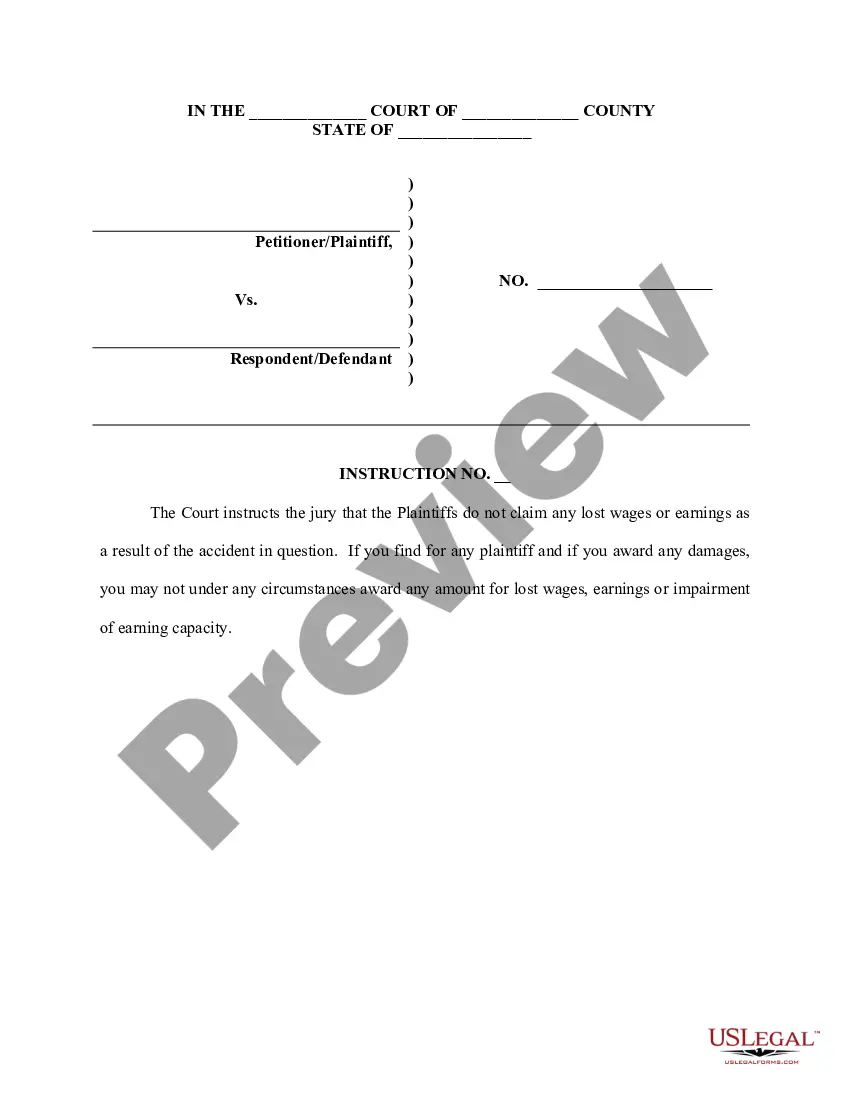
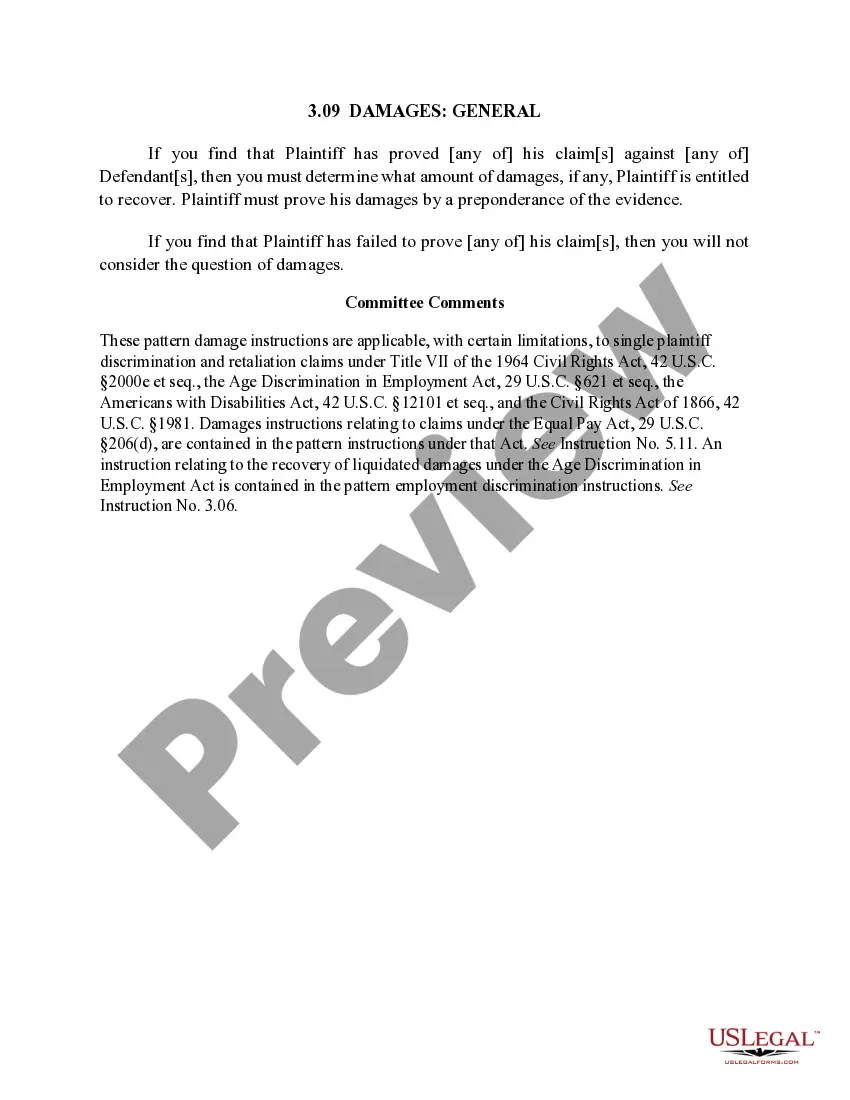
This form is a sample set of jury instructions regarding the type of damages to be awarded.
Missouri Jury Instruction - Personal Injury
State:
Multi-State
Control #:
US-PI-0273
Format:
Word;
Rich Text
Instant download
Description
Get your form ready online
Our built-in tools help you complete, sign, share, and store your documents in one place.
Built-in online Word editor
Make edits, fill in missing information, and update formatting in US Legal Forms—just like you would in MS Word.
Export easily
Download a copy, print it, send it by email, or mail it via USPS—whatever works best for your next step.
E-sign your document
Sign and collect signatures with our SignNow integration. Send to multiple recipients, set reminders, and more. Go Premium to unlock E-Sign.
Notarize online 24/7
If this form requires notarization, complete it online through a secure video call—no need to meet a notary in person or wait for an appointment.
Store your document securely
We protect your documents and personal data by following strict security and privacy standards.

Make edits, fill in missing information, and update formatting in US Legal Forms—just like you would in MS Word.

Download a copy, print it, send it by email, or mail it via USPS—whatever works best for your next step.

Sign and collect signatures with our SignNow integration. Send to multiple recipients, set reminders, and more. Go Premium to unlock E-Sign.

If this form requires notarization, complete it online through a secure video call—no need to meet a notary in person or wait for an appointment.

We protect your documents and personal data by following strict security and privacy standards.
Looking for another form?







How to fill out Jury Instruction - Personal Injury?
Choosing the right lawful papers design can be quite a have a problem. Naturally, there are plenty of web templates available online, but how can you get the lawful type you will need? Utilize the US Legal Forms site. The support gives a large number of web templates, for example the Missouri Jury Instruction - Personal Injury, which can be used for company and private needs. All the types are examined by professionals and meet up with state and federal requirements.
In case you are previously listed, log in to the profile and then click the Obtain option to obtain the Missouri Jury Instruction - Personal Injury. Utilize your profile to look throughout the lawful types you have purchased in the past. Visit the My Forms tab of your profile and obtain an additional backup in the papers you will need.
In case you are a whole new end user of US Legal Forms, listed below are easy guidelines for you to stick to:
- Very first, make sure you have chosen the appropriate type for your city/area. You may look through the form utilizing the Review option and study the form description to make certain this is basically the right one for you.
- In the event the type will not meet up with your needs, utilize the Seach field to discover the right type.
- Once you are sure that the form is suitable, click on the Acquire now option to obtain the type.
- Opt for the rates prepare you desire and enter the needed info. Build your profile and purchase your order making use of your PayPal profile or Visa or Mastercard.
- Pick the file formatting and down load the lawful papers design to the product.
- Total, modify and print and signal the attained Missouri Jury Instruction - Personal Injury.
US Legal Forms will be the biggest local library of lawful types for which you will find numerous papers web templates. Utilize the company to down load expertly-manufactured files that stick to express requirements.
Form popularity
FAQ
Section 22(a) Right of trial by jury?qualification of jurors?two-thirds verdict. render a verdict; and that in every criminal case any defendant may, with the assent of the court, waive a jury trial and submit the trial of such case to the court, whose finding shall have the force and effect of a verdict of a jury.
Under Missouri Supreme Court Rule 70.02(b), the use of MAI instructions is mandatory ?whenever Missouri Approved Instructions contains an instruction applicable in a particular case.?
Florida Statute Section 768.72 allows punitive damages only when ?there is a reasonable showing by evidence in the record or proffered by the claimant which would provide a reasonable basis for recovery of such damages.?
Punitive damages are warranted against (defendant) if you find by clear and convincing evidence that (managing agent, primary owner, or other person whose conduct may warrant punitive damages without proof of a superior's fault) [was] [were] personally guilty of [intentional misconduct] [or] [gross negligence], which ...
Punitive damages are awarded in a civil lawsuit in order to punish the defendant for their willful or intentional conduct. In Florida, punitive damages award no more than three times the amount of the compensatory damages award or $500,000, whichever is greater.
You may award punitive damages only if you find that the defendant's conduct that harmed the plaintiff was malicious, oppressive or in reckless disregard of the plaintiff's rights. Conduct is malicious if it is accompanied by ill will, or spite, or if it is for the purpose of injuring the plaintiff.
418, the California Supreme Court articulated 'three guideposts' for courts reviewing punitive damages: ?(1) the degree of reprehensibility of the defendant's misconduct; (2) the disparity between the actual or potential harm suffered by the plaintiff and the punitive damages award; and (3) the difference between the ...