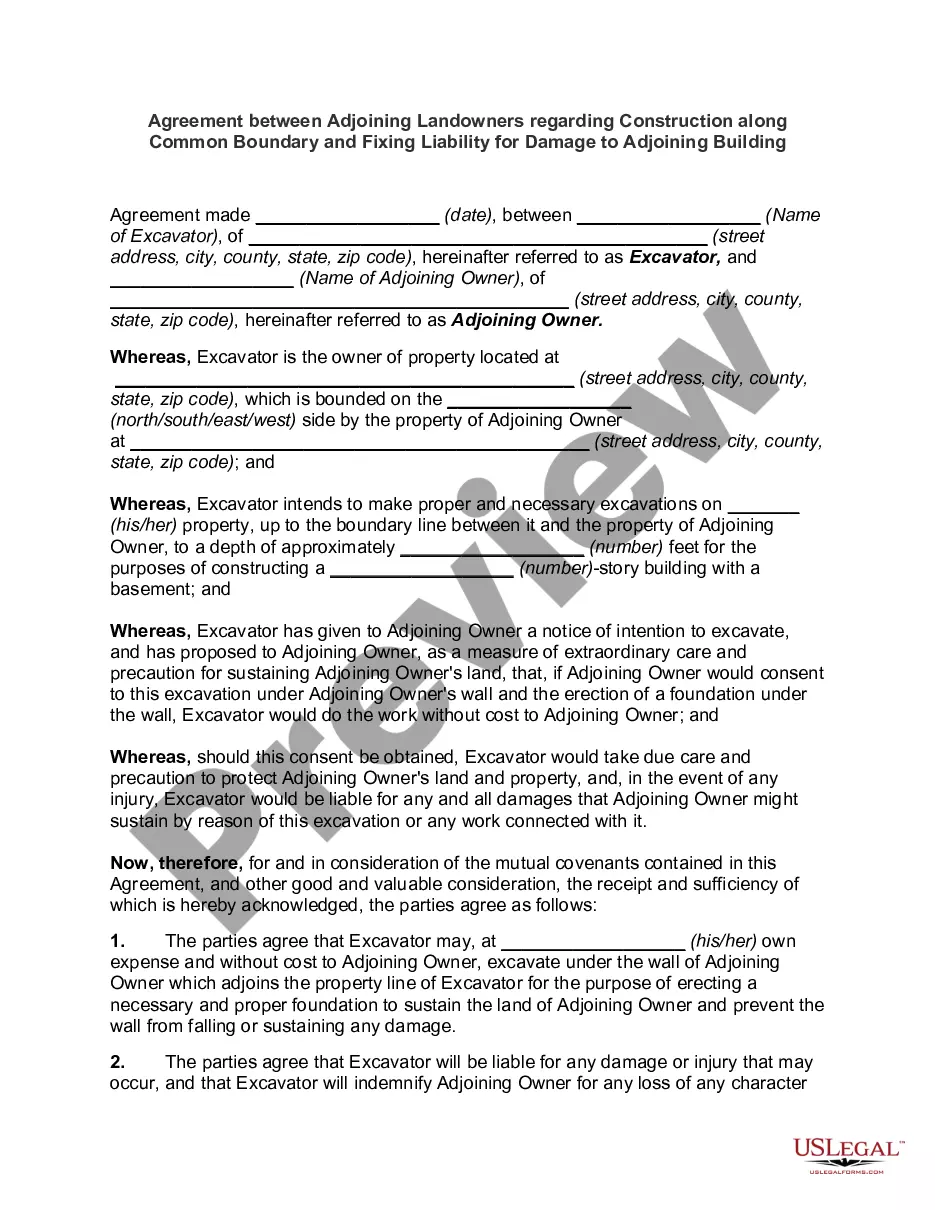
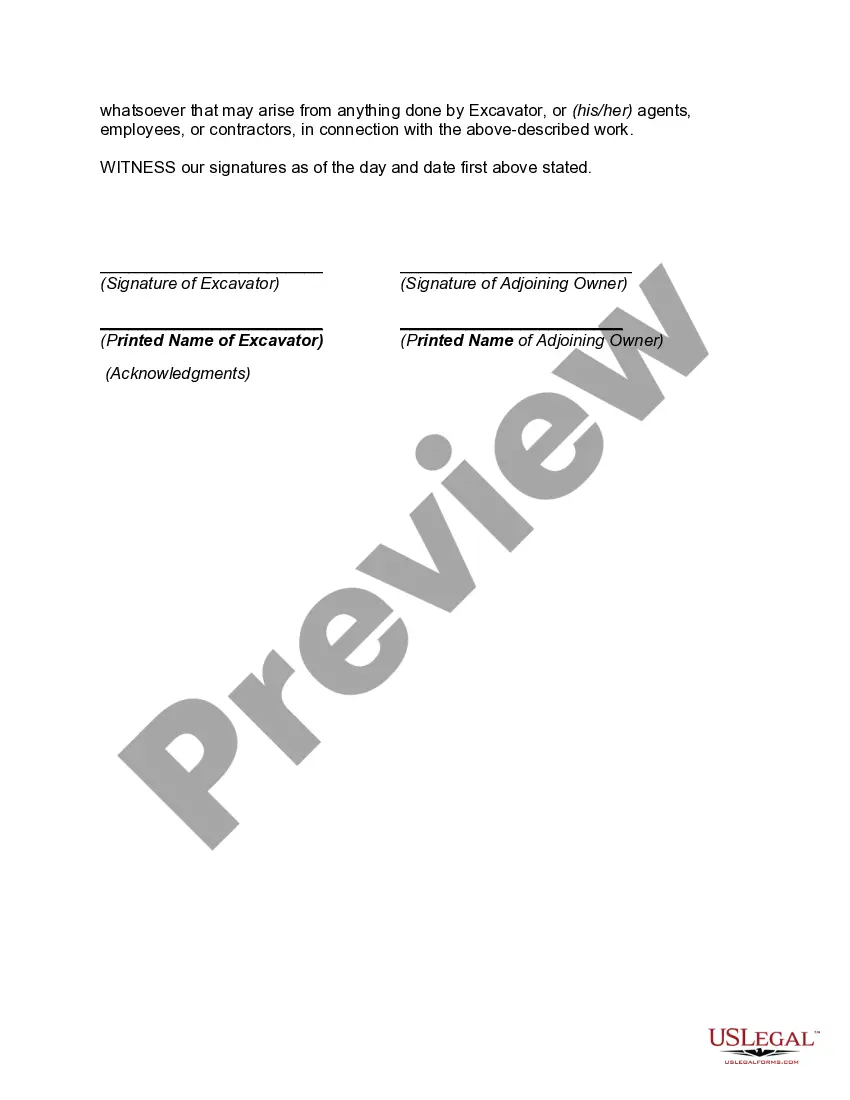
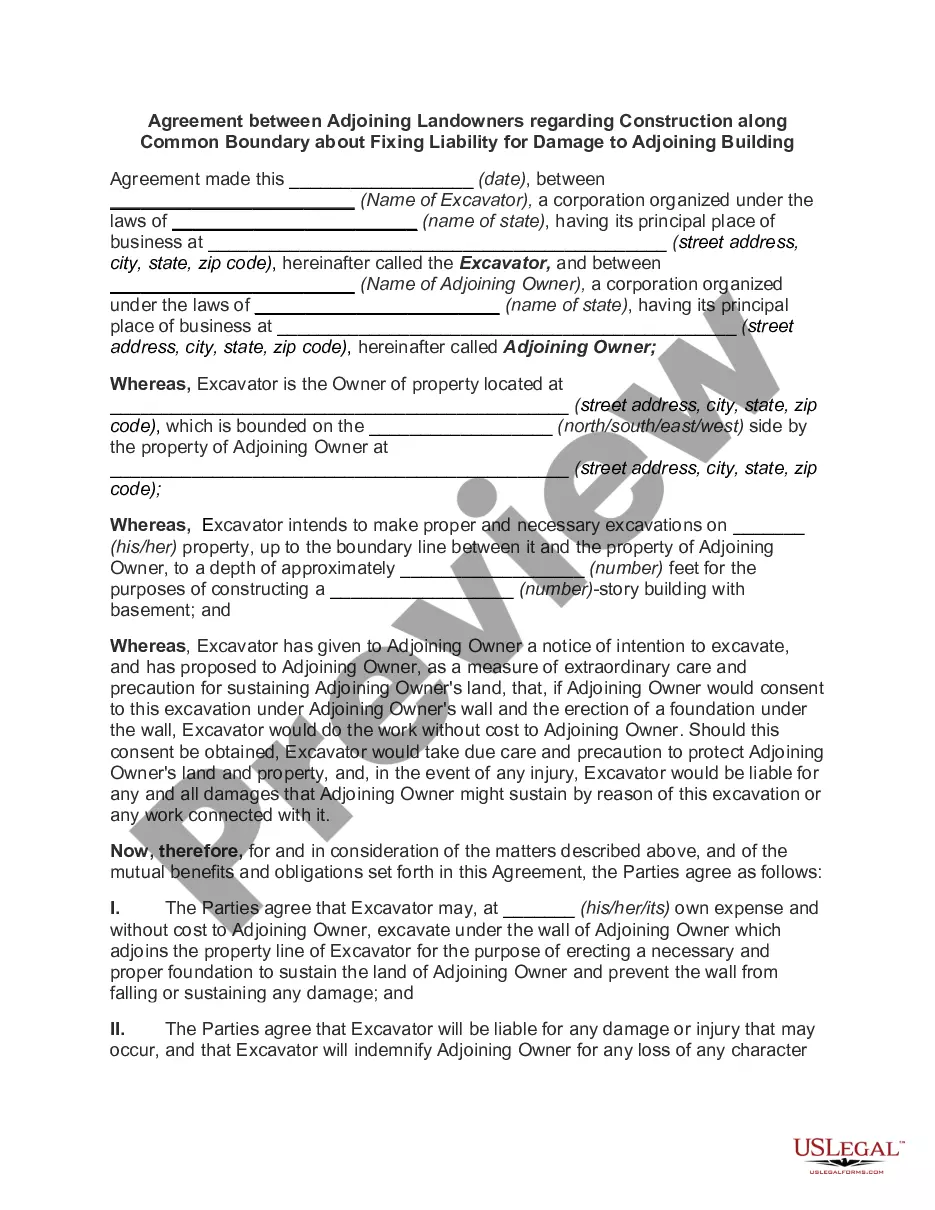
Missouri Agreement between Adjoining Landowners Regarding Construction along Common Boundary and Fixing Liability for Damage
Description
Get your form ready online
Our built-in tools help you complete, sign, share, and store your documents in one place.
Make edits, fill in missing information, and update formatting in US Legal Forms—just like you would in MS Word.
Download a copy, print it, send it by email, or mail it via USPS—whatever works best for your next step.
Sign and collect signatures with our SignNow integration. Send to multiple recipients, set reminders, and more. Go Premium to unlock E-Sign.
If this form requires notarization, complete it online through a secure video call—no need to meet a notary in person or wait for an appointment.
We protect your documents and personal data by following strict security and privacy standards.

Make edits, fill in missing information, and update formatting in US Legal Forms—just like you would in MS Word.

Download a copy, print it, send it by email, or mail it via USPS—whatever works best for your next step.

Sign and collect signatures with our SignNow integration. Send to multiple recipients, set reminders, and more. Go Premium to unlock E-Sign.

If this form requires notarization, complete it online through a secure video call—no need to meet a notary in person or wait for an appointment.

We protect your documents and personal data by following strict security and privacy standards.
Looking for another form?


How to fill out Agreement Between Adjoining Landowners Regarding Construction Along Common Boundary And Fixing Liability For Damage?
It is feasible to allocate time online searching for the sanctioned document template that matches the federal and state requirements you have. US Legal Forms offers numerous legal templates that are reviewed by experts.
You can obtain or print the Missouri Agreement between Neighboring Landowners Regarding Construction along Common Boundary and Establishing Liability for Damage through my services.
If you already own a US Legal Forms account, you can Log In and select the Download option. After that, you can complete, modify, print, or sign the Missouri Agreement between Neighboring Landowners Regarding Construction along Common Boundary and Establishing Liability for Damage. Every legal document template you purchase is yours indefinitely.
Complete the transaction using your credit card or PayPal account to purchase the legal form. Choose the format of the document and download it to your device. Make alterations to your document if needed. You can complete, edit, sign, and print the Missouri Agreement between Neighboring Landowners Regarding Construction along Common Boundary and Establishing Liability for Damage. Download and print thousands of document templates from the US Legal Forms website, which provides the largest selection of legal forms. Utilize professional and jurisdiction-specific templates to address your business or personal needs.
- To get an additional copy of any purchased form, navigate to the My documents tab and click the appropriate option.
- If you are using the US Legal Forms site for the first time, follow the simple instructions below.
- First, ensure that you have selected the correct document template for the area/jurisdiction of your choice. Review the form description to confirm you have chosen the correct form.
- If available, utilize the Review option to browse through the document template as well.
- If you wish to obtain another version of the form, use the Search field to locate the template that meets your requirements and needs.
- Once you have found the template you desire, click on Buy now to proceed.
- Select the pricing plan you prefer, enter your details, and register for a US Legal Forms account.
Form popularity
FAQ
In Missouri, the placement of a fence near the property line depends on local ordinances and agreements among neighbors. Typically, you should consult local zoning regulations to determine any specific restrictions. The Missouri Agreement between Adjoining Landowners Regarding Construction along Common Boundary and Fixing Liability for Damage can provide guidelines on proper placement, ensuring that all parties are satisfied. Proper planning and communication will promote a smooth fencing process.
Under the local option fence law, a legal fence must meet the same qualifications as required under the general law, or alternatively, a fence is legal if it is at least four feet high with posts no more than 15 feet apart, and with a wire or wood stay placed over the strands at the center point between each post.
Missouri's two fence laws will provide two very different solutions to a typical neighbor dispute. For the most part, the general law places responsibility for the construction and maintenance on the neighbor who "needs" the fence. So if you have a horse, or any other livestock, the fence is your responsibility.
Check Rules and Regulations Typically, fences are installed anywhere from 2 to 8 inches from a property line in most areas. Some areas might allow to go right up to a property line, especially if you live in an urban row house where every inch makes a difference!
As of May 2016, 19 Missouri counties are thought to have adopted the Optional County Fencing Statute: Bates, Cedar, Clinton, Daviess, Gentry, Grundy, Harrison, Knox, Linn, Macon, Mercer, Newton, Putnam, Schuyler, Scotland, Shelby, Sullivan, Saint Clair and Worth.
For the most part, the general law places responsibility for the construction and maintenance on the neighbor who "needs" the fence. So if you have a horse, or any other livestock, the fence is your responsibility. If your neighbor is also keeping livestock, then the cost is shared.
In Missouri, as in other states, an individual who openly inhabits an otherwise neglected piece of property for a certain period of time may legally obtain title. This is called "adverse possession" and it's essentially a loophole in the law, closely related to trespassing.
RSMo Sections 272.210 to 272.370 state that when one landowner requires a boundary fence, both landowners are legally responsible for their portion of the fence.