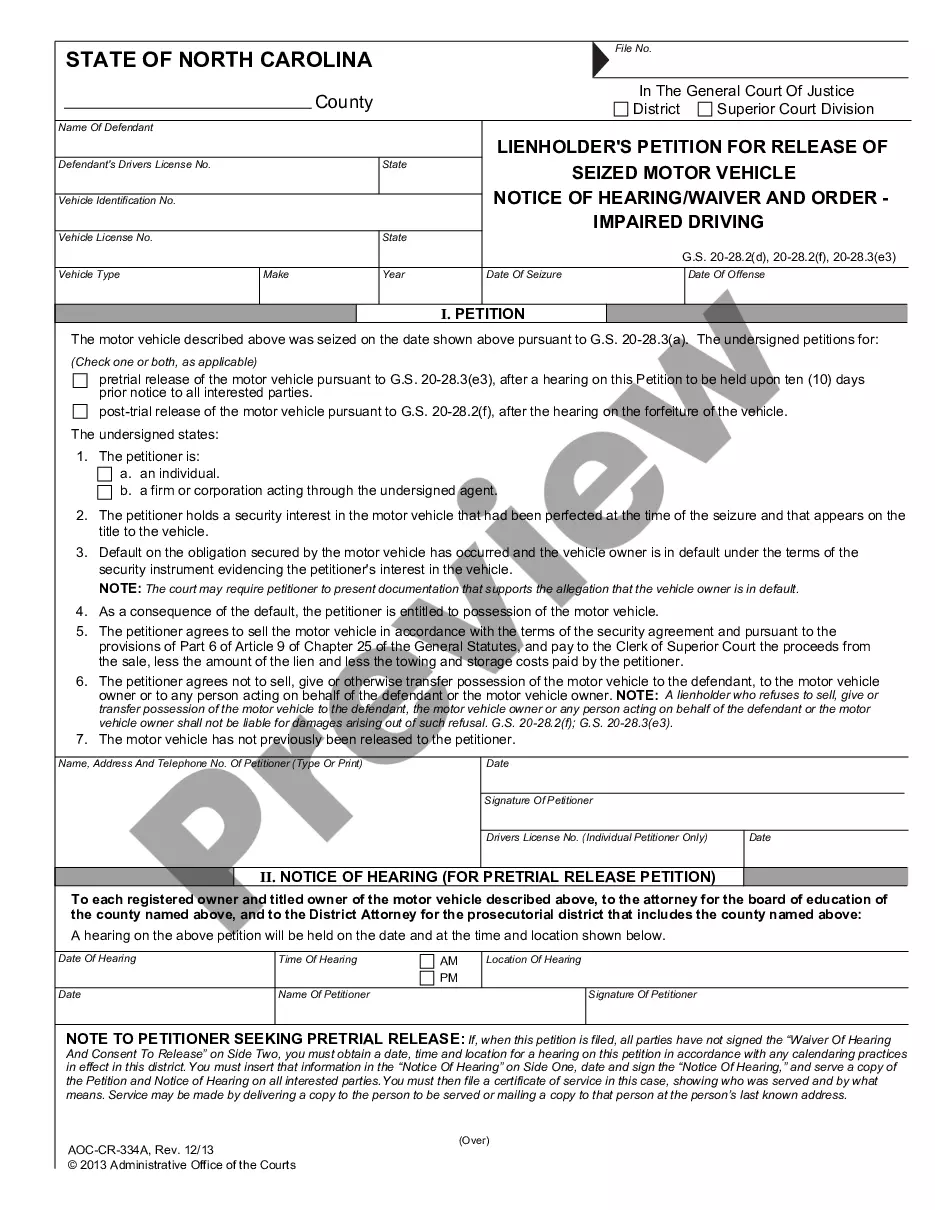
North Carolina Lienholder's Petition for Release of Seized Motor Vehicle Notice of Hearing - Waiver and Order
What is this form?
The Lienholder's Petition for Release of Seized Motor Vehicle Notice of Hearing - Waiver and Order is an official document from the North Carolina Administrative Office of the Courts. This form is used by lienholders to petition for the release of a motor vehicle that has been seized due to driving offenses. Unlike other release forms, this document specifically addresses pretrial and post-trial release under North Carolina statutes.
Key components of this form
- Petitioner Information: Includes details about the lienholder and the seized vehicle.
- Grounds for Petition: Statements confirming the lienholder's interest and the vehicle owner's default.
- Notice of Hearing: Information regarding the scheduled hearing date, time, and location.
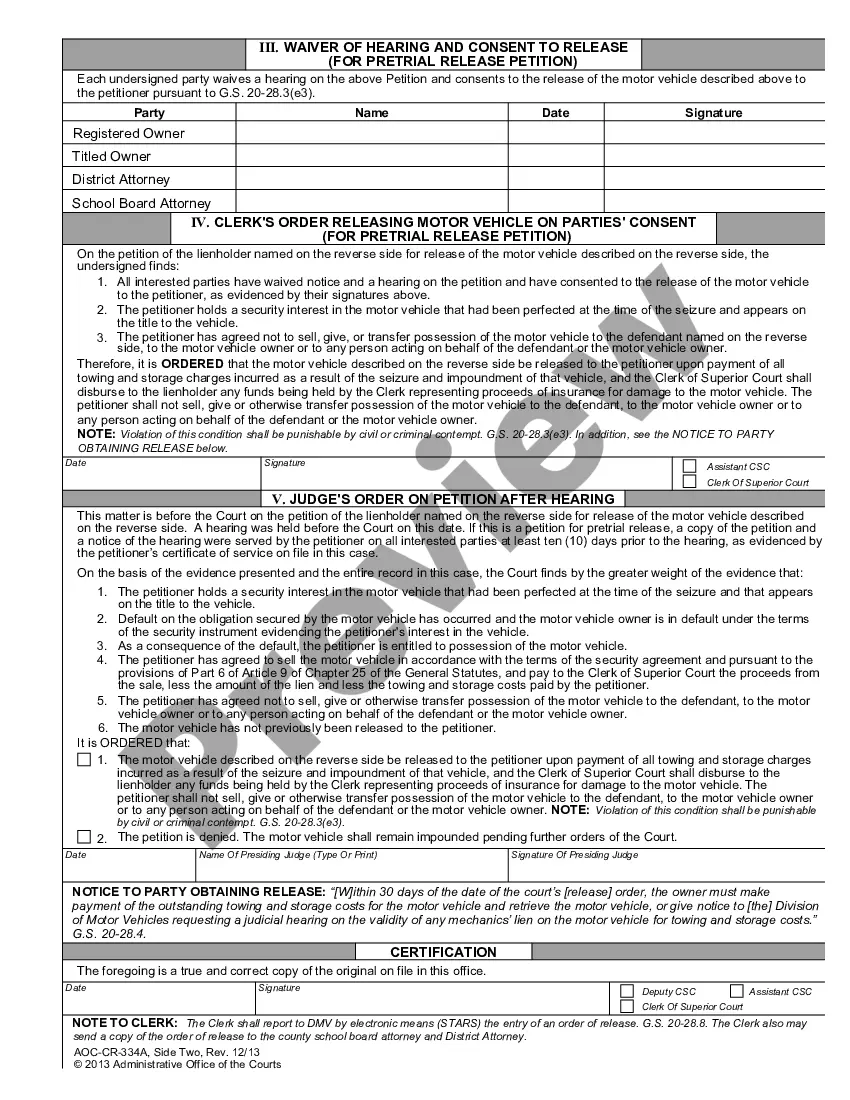
- Waiver of Hearing: Consent from interested parties to waive a hearing on the petition.
- Clerk's and Judge's Orders: Sections for official orders regarding the release of the vehicle following legal requirements.
When to use this document
This form should be used when a lienholder needs to reclaim possession of a motor vehicle that has been seized because the owner is in default on their financial obligations. It is applicable in situations involving impaired driving and can be utilized both pretrial and post-trial, depending on the specific circumstances of the case.
Who can use this document
- Creditors or lienholders with a financial interest in a motor vehicle.
- Individuals or companies holding title to the vehicle and seeking its release.
- Legal representatives acting on behalf of the lienholder or creditor.
Completing this form step by step
- Identify the petitioner: Provide the name and details of the lienholder.
- Detail the vehicle information: Enter the make, model, VIN, and license number of the vehicle.
- State the grounds for the petition: Confirm the lienholder's perfected security interest and the owner's default.
- Set the hearing details: Insert the date, time, and location for the hearing, if applicable.
- Obtain necessary signatures: Ensure that all interested parties sign the Waiver of Hearing and Consent to Release if applicable.
Does this document require notarization?
This form does not typically require notarization unless specified by local law. However, it is advisable to check with local rules to confirm any requirements regarding notarization.
Get your form ready online
Our built-in tools help you complete, sign, share, and store your documents in one place.
Make edits, fill in missing information, and update formatting in US Legal Forms—just like you would in MS Word.
Download a copy, print it, send it by email, or mail it via USPS—whatever works best for your next step.
Sign and collect signatures with our SignNow integration. Send to multiple recipients, set reminders, and more. Go Premium to unlock E-Sign.
If this form requires notarization, complete it online through a secure video call—no need to meet a notary in person or wait for an appointment.
We protect your documents and personal data by following strict security and privacy standards.

Make edits, fill in missing information, and update formatting in US Legal Forms—just like you would in MS Word.

Download a copy, print it, send it by email, or mail it via USPS—whatever works best for your next step.

Sign and collect signatures with our SignNow integration. Send to multiple recipients, set reminders, and more. Go Premium to unlock E-Sign.

If this form requires notarization, complete it online through a secure video call—no need to meet a notary in person or wait for an appointment.

We protect your documents and personal data by following strict security and privacy standards.
Typical mistakes to avoid
- Failing to provide accurate vehicle or petitioner information.
- Not scheduling the hearing in compliance with state requirements.
- Neglecting to obtain signatures from all interested parties on the Waiver of Hearing.
- Submitting the petition without supporting documentation of default.
Why use this form online
- Convenience: Easily fill out and submit the form from home.
- Editability: Make changes to your form at any time before finalizing.
- Accuracy: Forms are based on the latest legal standards and statutes.
- Access to attorney-drafted templates ensures compliance with state laws.
Legal use & context
- The form serves as a legal request for the return of a motor vehicle by a lienholder.
- It is crucial to follow all statutory requirements to ensure the petition's enforceability in court.
- Failure to comply with procedural rules can result in delays or rejection of the petition.
Looking for another form?
Form popularity
FAQ
If a vehicle is part of a financing agreement, the legal owner will be the individual or entity that provides the financing, and is referred to as the lienholder. The registered owner is responsible for maintaining compliance with DMV laws and regulations.
Go to the North Carolina Division of Motor Vehicles (ncdot.org) and click on the "Vehicle Services" link located across the top. Click on "Liens on a Title." Click on "Lien Recording Application (MVR-6)" to download the form. Sign the form in front of a notary.
Remove a Lien from an NC Title Once you've paid off your auto loan, you can apply for a clear title (i.e. remove the lien) by submitting the following at your local NC DMV office: Application for Removal of Lien from the Certificate of Title (Form MVR-8). Application for Duplicate Title (Form MVR-4).
When there is a lien holder on the vehicle, the settlement check for the car's ACV goes to that financial institution and any money left over after the payout would come to you.
If you finance a car, a lienholder may be listed on your car's title and your car insurance policy until you pay it off. A lienholder is a lender that legally has an interest in your property until you pay it off in full.
A lien lasts as long as a car has an outstanding balance on it, so if you purchase a car with a lien on it, you must pay it out in full.The DMV will have details on the title holders of the vehicle, so it's a good place to start when it comes to buying or selling a car with a lien on it.
200b200b200b200b200b200b200b200bTitle applications require 10-15 business days for processing, but the N.C. Division of Motor Vehicles offers an expedited titling service referred to as an instant title in which titles are processed and issued the same day or next business day.
Release ownership by signing on line one on the front of the title. If the vehicle is, or was financed, the lienholder's name appears in the legal owner section and their release with counter signature is required on line two. For step-by-step instructions see the California DMV instructional video here.
If you are financing your car through a bank, private lender, or dealership, they are the lienholder. The lienholder owns your car while you make payments on it. If you default on the loan, the lienholder can repossess the vehicle.