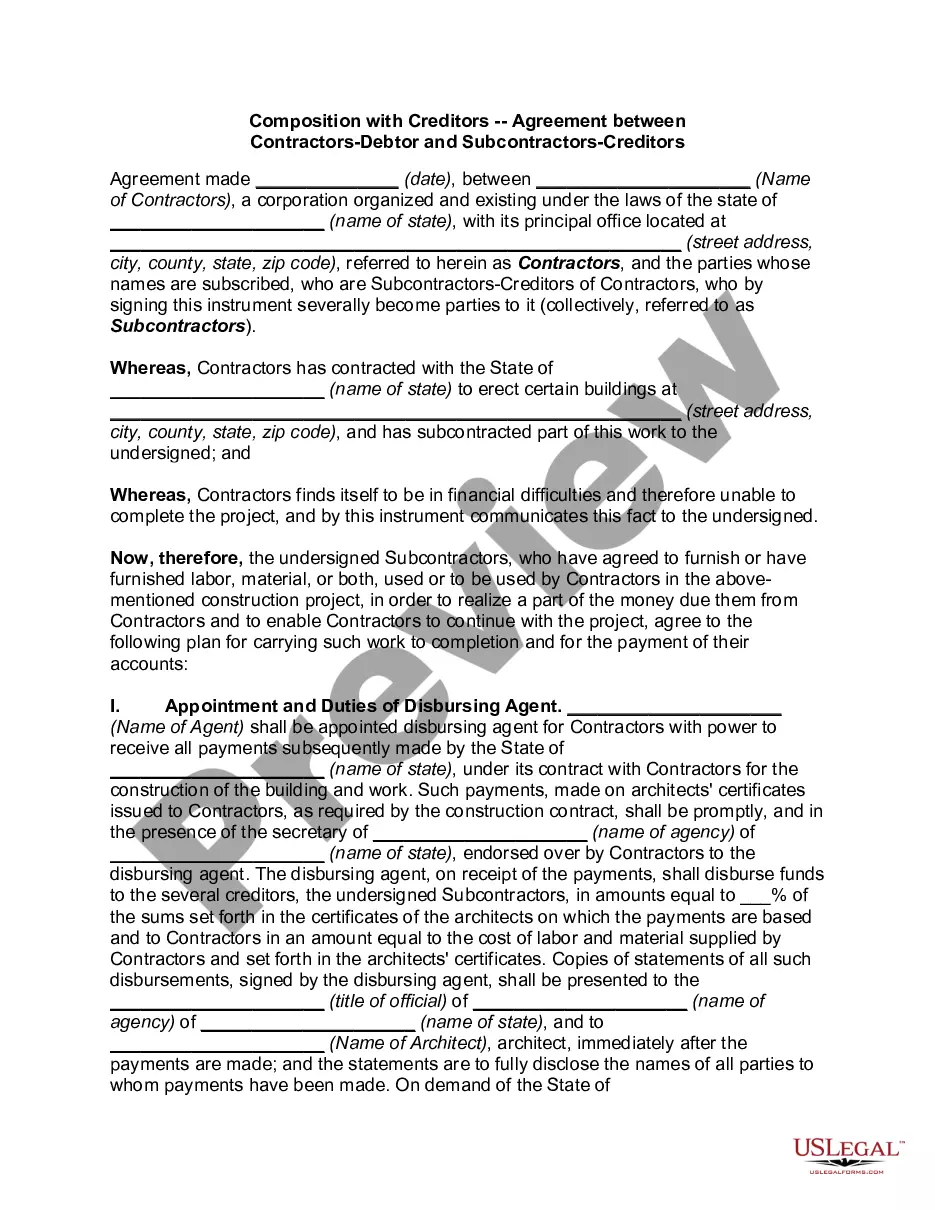
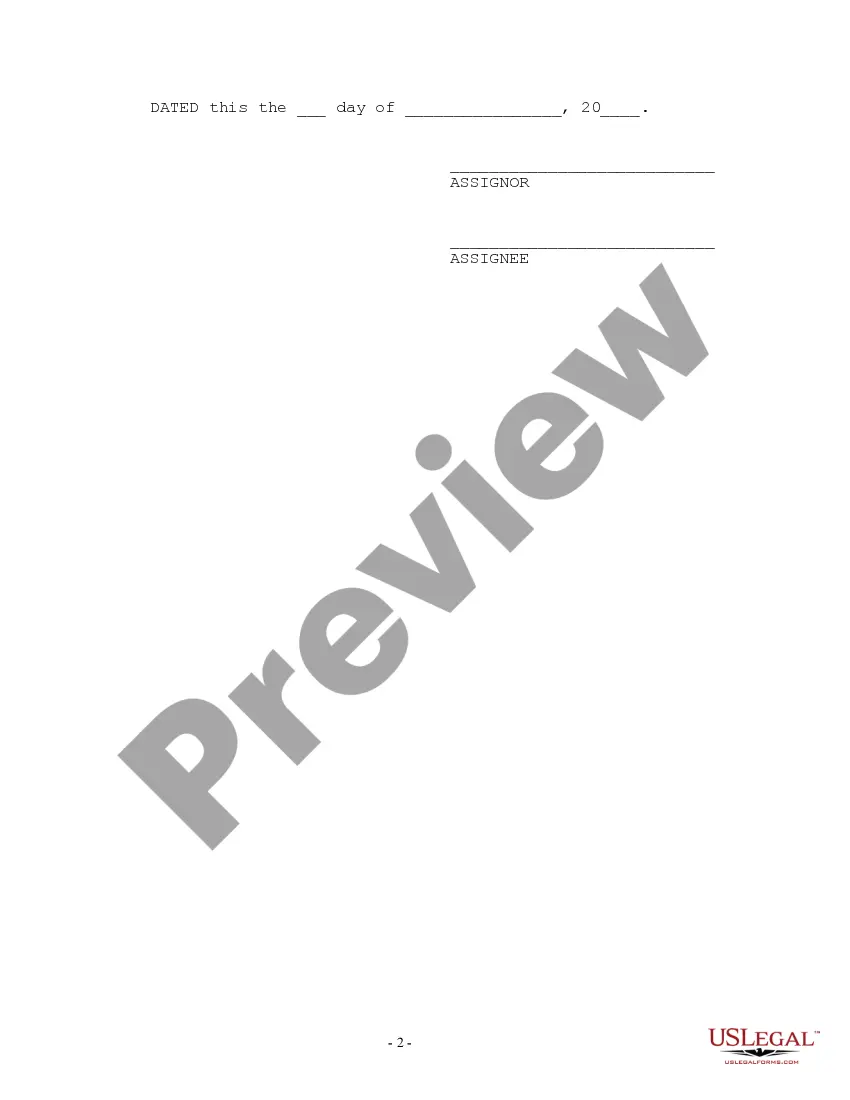
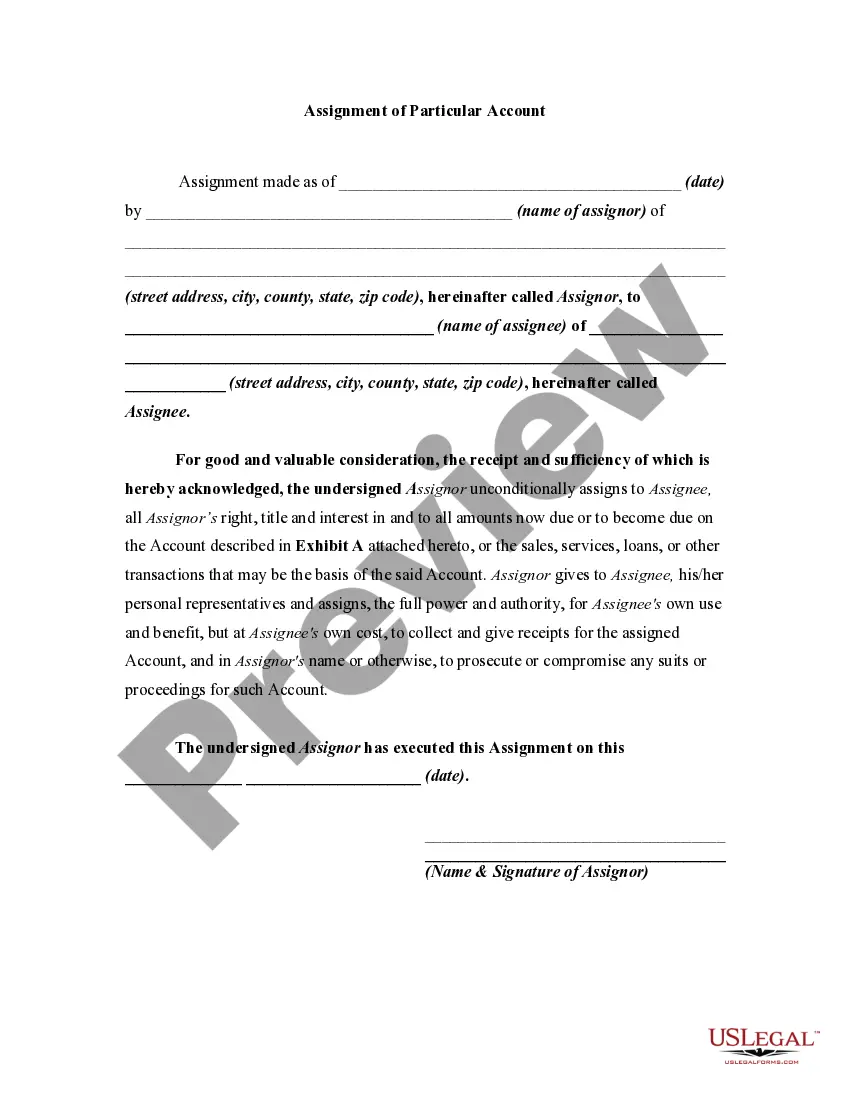
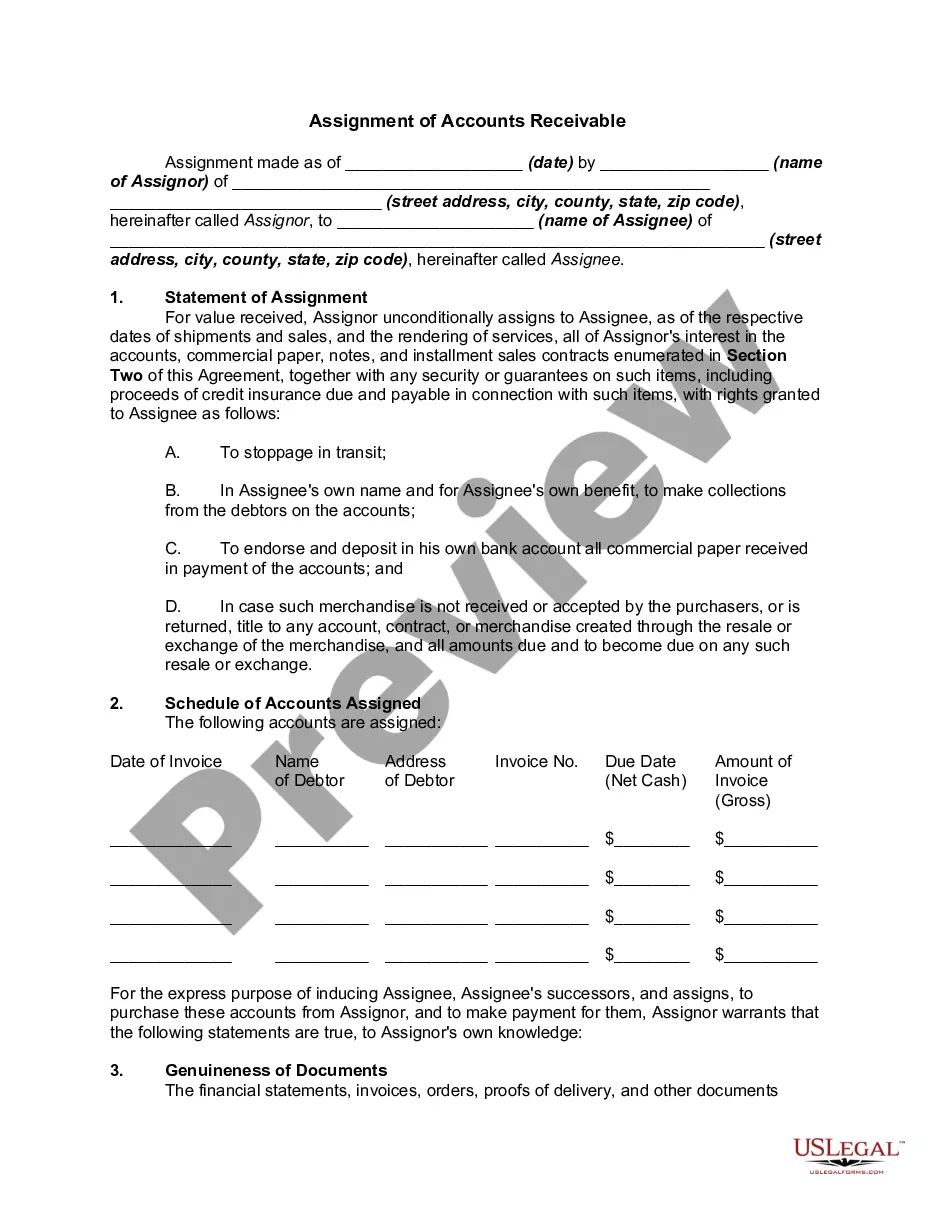
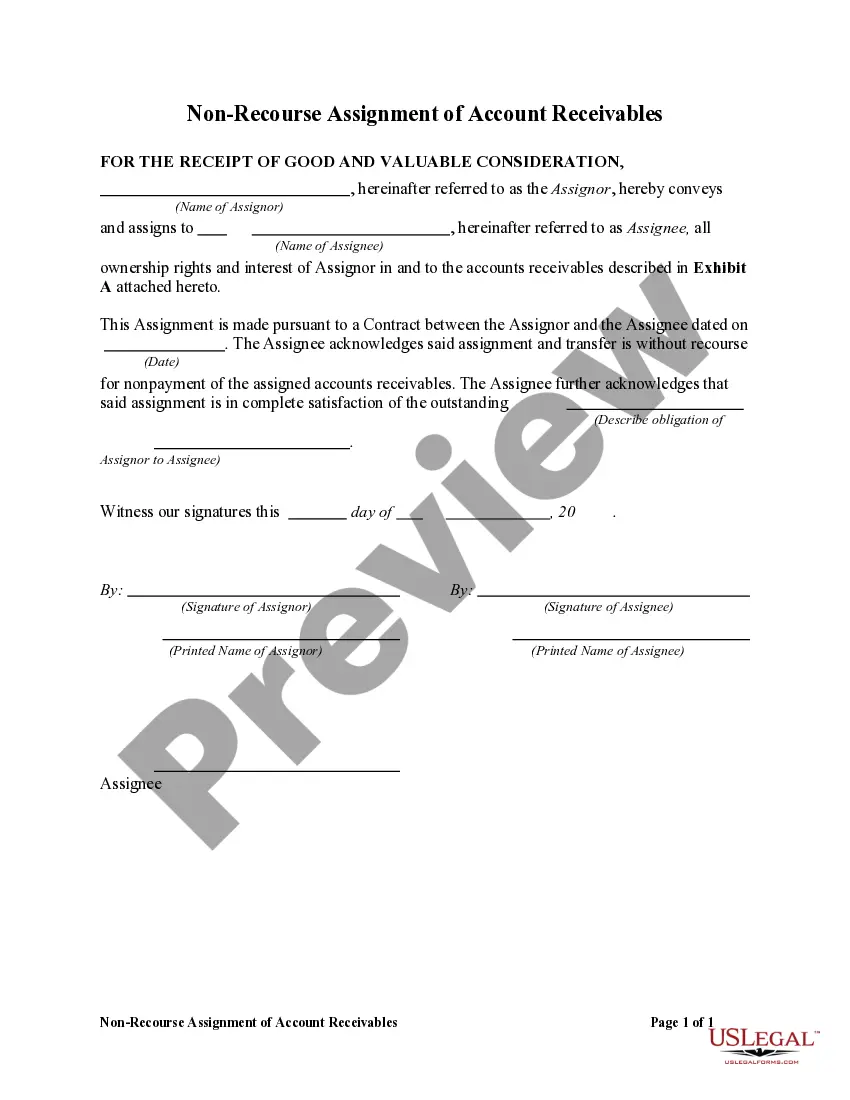
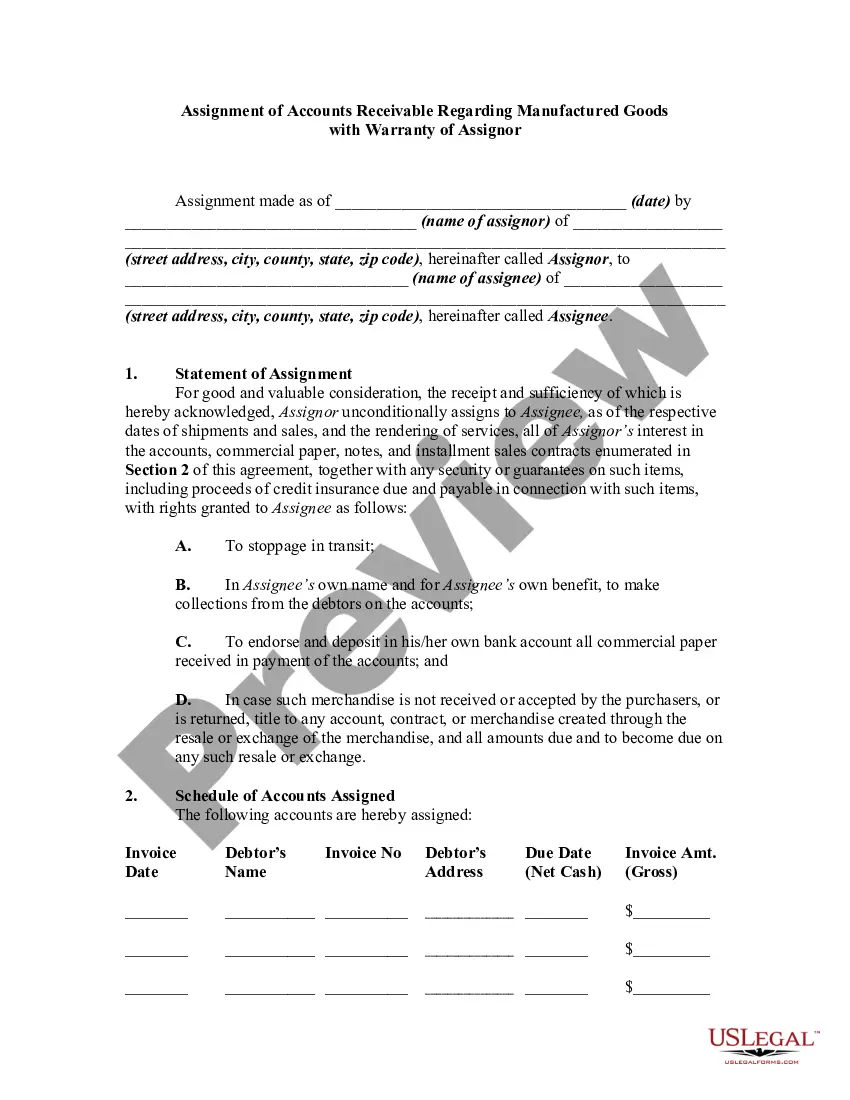
This form is an Assignment of Accounts Receivable. The assignor conveys all interest in the accounts listed on the Attachment included in the form. The accounts represent all outstanding accounts of the assignor from the sale of products or services.
Missouri Accounts Receivable - Assignment
Category:
State:
Multi-State
Control #:
US-00400
Format:
Word;
Rich Text
Instant download
Description
Free preview


Get your form ready online
Our built-in tools help you complete, sign, share, and store your documents in one place.
Built-in online Word editor
Make edits, fill in missing information, and update formatting in US Legal Forms—just like you would in MS Word.
Export easily
Download a copy, print it, send it by email, or mail it via USPS—whatever works best for your next step.
E-sign your document
Sign and collect signatures with our SignNow integration. Send to multiple recipients, set reminders, and more. Go Premium to unlock E-Sign.
Notarize online 24/7
If this form requires notarization, complete it online through a secure video call—no need to meet a notary in person or wait for an appointment.
Store your document securely
We protect your documents and personal data by following strict security and privacy standards.

Make edits, fill in missing information, and update formatting in US Legal Forms—just like you would in MS Word.

Download a copy, print it, send it by email, or mail it via USPS—whatever works best for your next step.

Sign and collect signatures with our SignNow integration. Send to multiple recipients, set reminders, and more. Go Premium to unlock E-Sign.

If this form requires notarization, complete it online through a secure video call—no need to meet a notary in person or wait for an appointment.

We protect your documents and personal data by following strict security and privacy standards.
Looking for another form?


How to fill out Accounts Receivable - Assignment?
US Legal Forms - one of the largest collections of legal templates in the United States - provides a broad selection of legal document templates that you can download or print. By using the website, you can access thousands of forms for business and personal purposes, organized by categories, states, or keywords. You will find the latest versions of forms like the Missouri Accounts Receivable - Assignment in moments.
If you have an account, Log In and download Missouri Accounts Receivable - Assignment from the US Legal Forms library. The Download button will appear on every form you view. You can access all previously downloaded forms in the My documents section of your account.
To use US Legal Forms for the first time, here are simple steps to help you get started: Ensure you have selected the correct form for your city/region. Click the Preview button to review the form’s contents. Check the form details to confirm you have chosen the right form. If the form does not meet your needs, use the Search box at the top of the screen to find one that does. If you are satisfied with the form, confirm your selection by clicking the Get now button. Then, select the payment plan you want and provide your credentials to create an account. Complete the transaction. Use your Visa or Mastercard or PayPal account to finalize the transaction. Choose the file format and download the form to your device. Make edits. Fill out, modify, print, and sign the downloaded Missouri Accounts Receivable - Assignment. Every template you added to your account does not have an expiration date and belongs to you forever. Therefore, if you wish to download or print another copy, simply navigate to the My documents section and click on the form you desire.
With US Legal Forms, you will have a reliable resource for your legal documentation needs, ensuring you have the correct forms for any situation.
Explore the convenience and efficiency of managing your legal forms online with US Legal Forms.
- Access the Missouri Accounts Receivable - Assignment with US Legal Forms, the most extensive collection of legal document templates.
- Utilize a vast number of professional and state-specific templates that meet your business or personal requirements and preferences.
- Enjoy unlimited access to a comprehensive range of legal forms.
- Easily navigate through categories, states, or keywords to find your desired forms.
- Benefit from the latest updates and versions of legal documents.
- Take advantage of user-friendly instructions for first-time users.
Form popularity
FAQ
The 407.675 law in Missouri pertains to the regulation of certain consumer transactions, specifically focusing on fraudulent practices. This law offers protections to consumers against deceitful sales tactics. For businesses handling Missouri Accounts Receivable - Assignment, it is essential to comply with this law to ensure fair dealings and maintain a positive reputation in the market.
Missouri does not have a specific buyer's remorse law that allows consumers to cancel purchases after a transaction. However, certain types of contracts, such as door-to-door sales, may offer a brief cooling-off period. It is wise for consumers to familiarize themselves with their rights under Missouri Accounts Receivable - Assignment, as this can help them navigate potential disputes.
Statute 537.100 in Missouri addresses the assignment of accounts receivable, allowing creditors to pursue collection of debts through legal means. This statute clarifies the rights and responsibilities of both debtors and creditors concerning receivables. Understanding this law is crucial for anyone involved in Missouri Accounts Receivable - Assignment, as it outlines the framework for lawful debt collection practices.
In Missouri, a resident can face imprisonment for debt only under specific circumstances, such as failing to comply with a court order regarding repayment. This situation typically arises from a judgment against the individual, which can lead to contempt of court charges. However, Missouri law prohibits imprisonment solely for unpaid debts, emphasizing the importance of understanding the legal ramifications surrounding Missouri Accounts Receivable - Assignment.
Accounts Receivable are amounts due from customers from the sale of services or merchandise on credit. They are usually due in 30 ? 60 days. They are classified on the Balance Sheet as current assets.
Example of the Assignment of Accounts Receivable ABC Corp. approaches XYZ Bank to obtain financing using its accounts receivable as collateral. XYZ Bank agrees to provide a loan of 85% of the total accounts receivable value, which amounts to $170,000 (85% of $200,000).
A factoring agreement can be used to transfer an account receivable referenced in the underlying sale contract, whilst assignment can also apply to accounts receivable resulting from loan agreements, business co-operation agreements, and the like.
In the accounts receivable assignment process, a company assigns receivables to a lending institution to borrow money. The borrower pays interest plus additional fees. The borrowing company retains ownership of the accounts receivable and collects payment from its customers.
Firstly, factoring is a financial service of selling and purchasing, which implies consideration, unlike assignment, which may take place either with or without consideration. In addition, non-matured or future accounts receivable can be subject to factoring.
Assignment of receivables would mean sale of the lease rentals, not the asset. In that case, the leased asset still remains the property of the assignor ? that is, the assignor has retained the residual interest in the asset. However, it would be different if the lessor sells the asset that has been leased out.