Missouri Tenant Welcome Letter
What this document covers
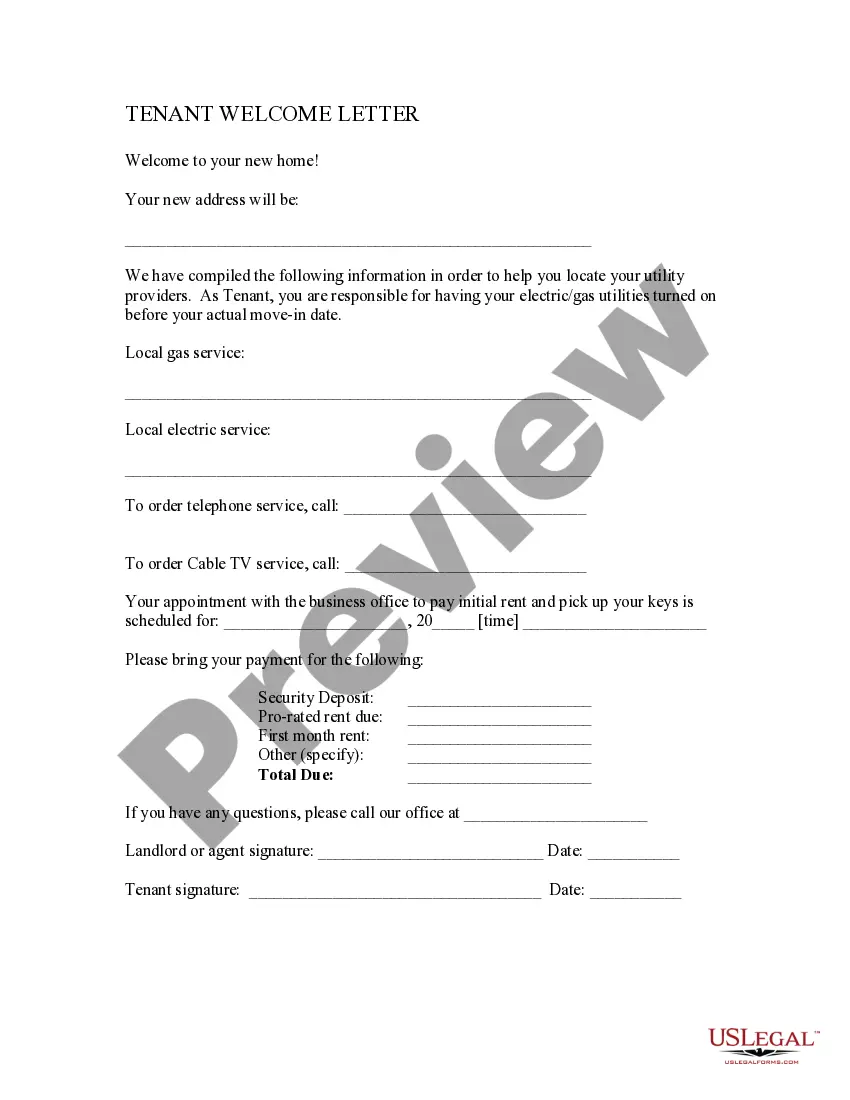
The Tenant Welcome Letter is a document designed to provide new tenants with essential information about their new residence. This letter serves as an introduction to the landlord and includes details about contacting utility providers, rental payment expectations, and other reminders specific to the lease agreement. Unlike other forms, the welcome letter focuses on facilitating a smooth transition for tenants into their new home by offering crucial information upfront.
Main sections of this form
- Security deposit payment details.
- Pro-rated rent due information.
- First-month rent amount.
- Any additional charges that may apply.
- Total amount due at move-in.
When to use this document
This form is used when a landlord wants to welcome new tenants to their rental property. It should be provided before or at the time of move-in to ensure tenants have all necessary information regarding their lease terms, payment processes, and contact points for utilities and maintenance. This letter can help establish clear communication and set expectations right from the start of the landlord-tenant relationship.
Who this form is for
- Landlords and property managers welcoming new tenants.
- Real estate agents assisting clients with rental properties.
- Tenants receiving instructions and information from their landlord.
Steps to complete this form
- Enter the amount for the security deposit required from the tenant.
- Specify the pro-rated rent due, if applicable.
- Indicate the first month's rent amount that needs to be paid.
- List any other fees that may apply, detailing each one clearly.
- Calculate and fill in the total amount due at the time of move-in.
Notarization guidance
This form does not typically require notarization unless specified by local law. It's important to check local regulations to ensure compliance.
Get your form ready online
Our built-in tools help you complete, sign, share, and store your documents in one place.
Make edits, fill in missing information, and update formatting in US Legal Forms—just like you would in MS Word.
Download a copy, print it, send it by email, or mail it via USPS—whatever works best for your next step.
Sign and collect signatures with our SignNow integration. Send to multiple recipients, set reminders, and more. Go Premium to unlock E-Sign.
If this form requires notarization, complete it online through a secure video call—no need to meet a notary in person or wait for an appointment.
We protect your documents and personal data by following strict security and privacy standards.

Make edits, fill in missing information, and update formatting in US Legal Forms—just like you would in MS Word.

Download a copy, print it, send it by email, or mail it via USPS—whatever works best for your next step.

Sign and collect signatures with our SignNow integration. Send to multiple recipients, set reminders, and more. Go Premium to unlock E-Sign.

If this form requires notarization, complete it online through a secure video call—no need to meet a notary in person or wait for an appointment.

We protect your documents and personal data by following strict security and privacy standards.
Mistakes to watch out for
- Failing to specify all charges, leading to tenant confusion.
- Omitting contact information for utility providers.
- Not updating the form for changes in lease agreements or amounts due.
Why complete this form online
- Immediate access to a professionally drafted template.
- Easy customization to fit the specific lease agreement.
- Ability to download and print the form for immediate use.
Main things to remember
- The Tenant Welcome Letter helps ensure a smooth transition for new tenants.
- Clear communication of payment details is crucial for landlord-tenant relations.
- Adapting the form for specific state requirements can enhance its effectiveness.
Looking for another form?
Form popularity
FAQ
Yes, landlords do verify Emotional Support Animal (ESA) letters as part of their responsibilities. It's crucial for landlords to confirm the legitimacy of such letters to comply with legal requirements and ensure proper documentation. If you need guidance on how to handle ESA letters in your property management, consider using resources from platforms like US Legal Forms, which provide templates and legal insights to streamline the process.
To effectively welcome a new tenant, craft a thoughtful Missouri Tenant Welcome Letter that addresses their needs and interests. Provide information about the local area, including parks, grocery stores, and restaurants. Also, remind them of any upcoming community events that they can join. This approach not only makes them feel welcome but also helps them settle into their new environment.
You can say welcome to a new tenant by expressing genuine enthusiasm in your Missouri Tenant Welcome Letter. Use phrases like, 'We are thrilled to have you join our community,' or 'Welcome to your new home!' Personalize the message by mentioning something unique about the property or neighborhood. This personal touch can make a significant difference in how welcomed the tenant feels.
To create an effective introduction letter for a new tenant, begin with a welcoming tone. Introduce yourself as the landlord or property manager, and briefly explain your role and how you can assist them. Include essential property information, such as rules and regulations, and invite them to contact you with questions. This initial communication fosters a sense of community and openness.
An example of a Missouri Tenant Welcome Letter might begin with a warm greeting, followed by the tenant's name. Include important information like the move-in date, utility setup instructions, and nearby services that may be useful. Ensure it emphasizes your commitment to providing a comfortable living experience, making the tenant feel valued right from the start.
To write a Missouri Tenant Welcome Letter, start with a friendly greeting that includes the tenant's name. Clearly outline important details about the property, such as key information about amenities, maintenance procedures, and contact details for your management team. Make sure to express your excitement about having them as a tenant, and encourage them to reach out with any questions. This sets a positive tone for your landlord-tenant relationship.
Clean the Unit and Repair Damage. Provide Information About Utilities. Assemble a Welcome Package. Help With Logistics During the Move. A Warm Welcome for Your Tenant.
A tenant welcome letter provides an informal way for a landlord to say hello or a more formal way to provide helpful information. The document can refer to a list of apartment rules and regulations and include a checklist of the unit's move-in condition.
Your contact information. Time and date of the rental walkthrough. Time and location for key collection. Instructions on setting up utilities.
A tenant welcome letter provides an informal way for a landlord to say hello or a more formal way to provide helpful information. The document can refer to a list of apartment rules and regulations and include a checklist of the unit's move-in condition.