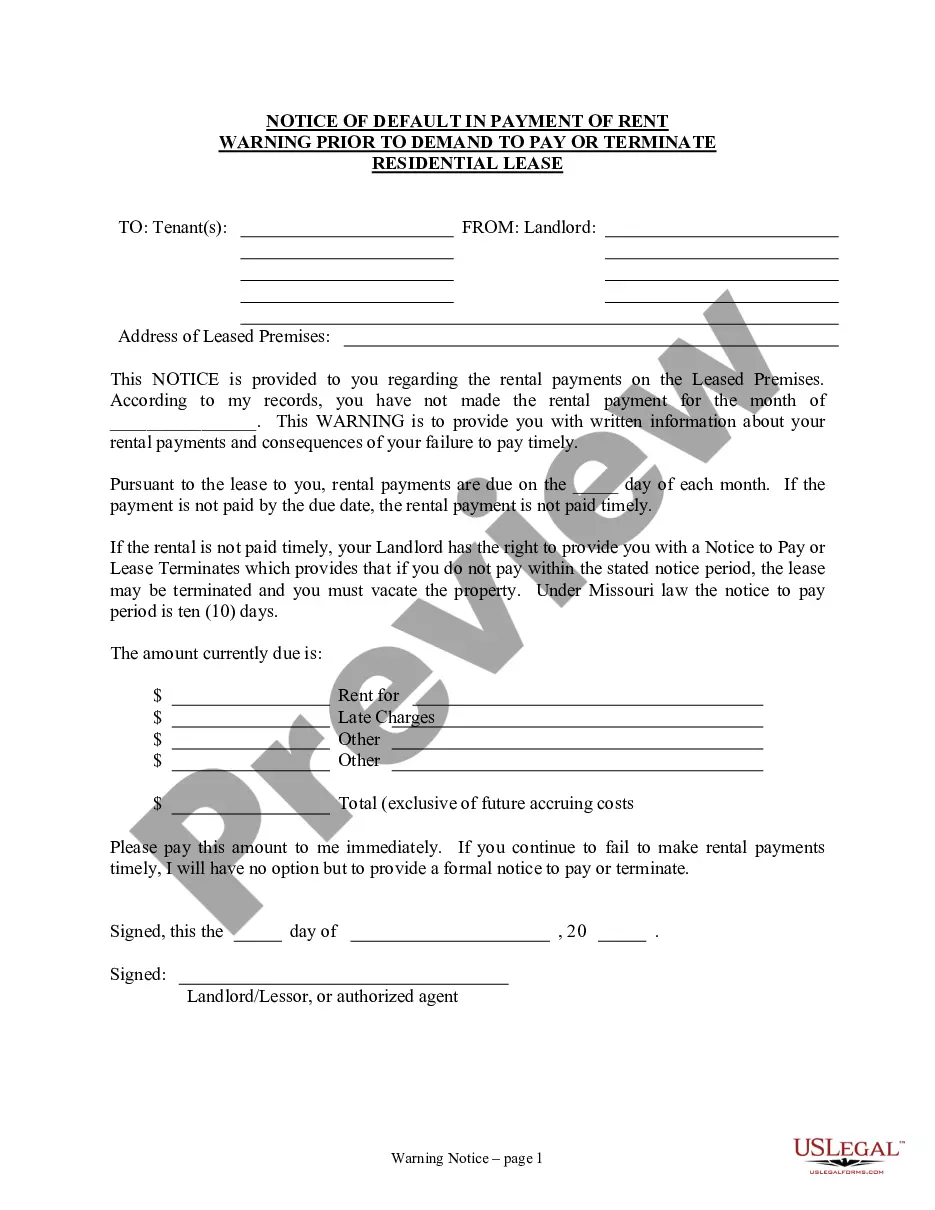
This Notice of Default in Payment of Rent as Warning Prior to Demand to Pay or Terminate for Non-Residential or Commercial Property form is for use by a Landlord to inform Tenant of Tenant's default in the payment of rent as a warning prior to a pay or terminate notice. The form advises the Tenant of the due date of rent and the consequences of late payment. This form may be used where you desire to remind the Tenant of payment terms, the default, demand payment and inform the Tenant that under the laws of this state or lease the Landlord may terminate in rent is not paid timely.
Missouri Notice of Default in Payment of Rent as Warning Prior to Demand to Pay or Terminate for Residential Property
State:
Missouri
Control #:
MO-1300LT
Format:
Word;
Rich Text
Instant download
Description
Free preview
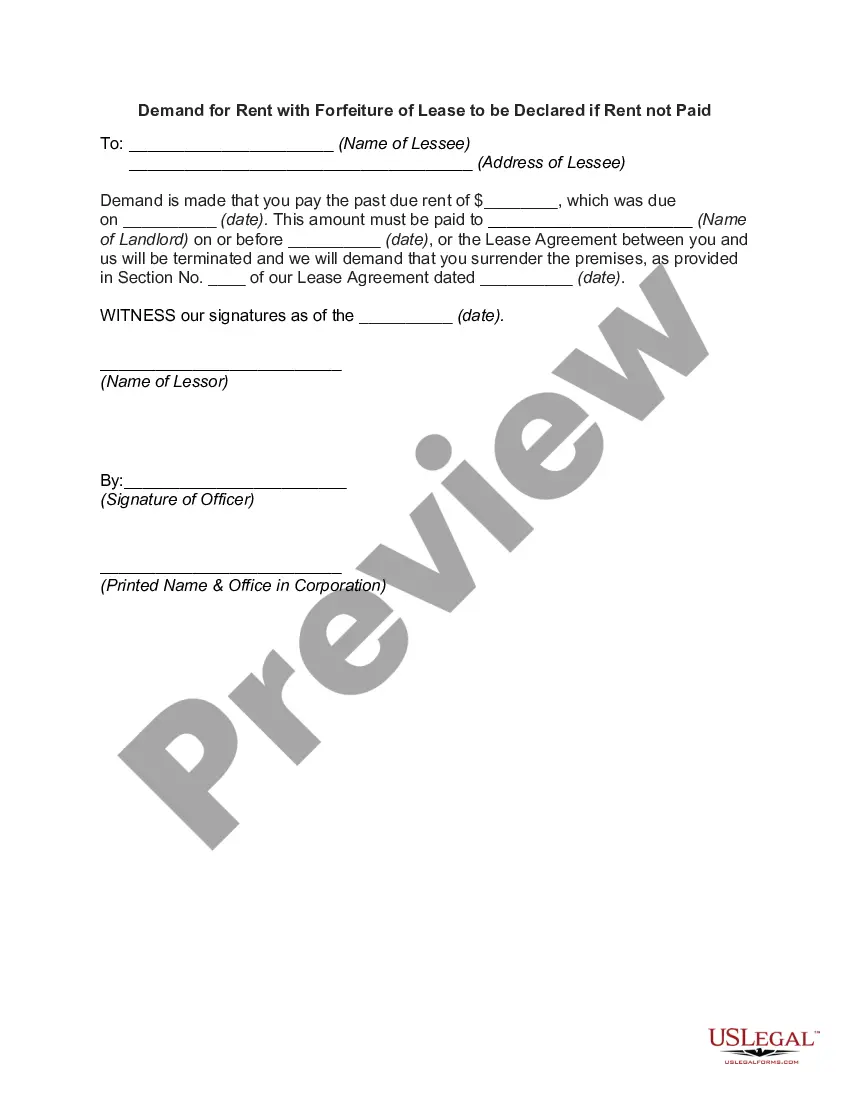
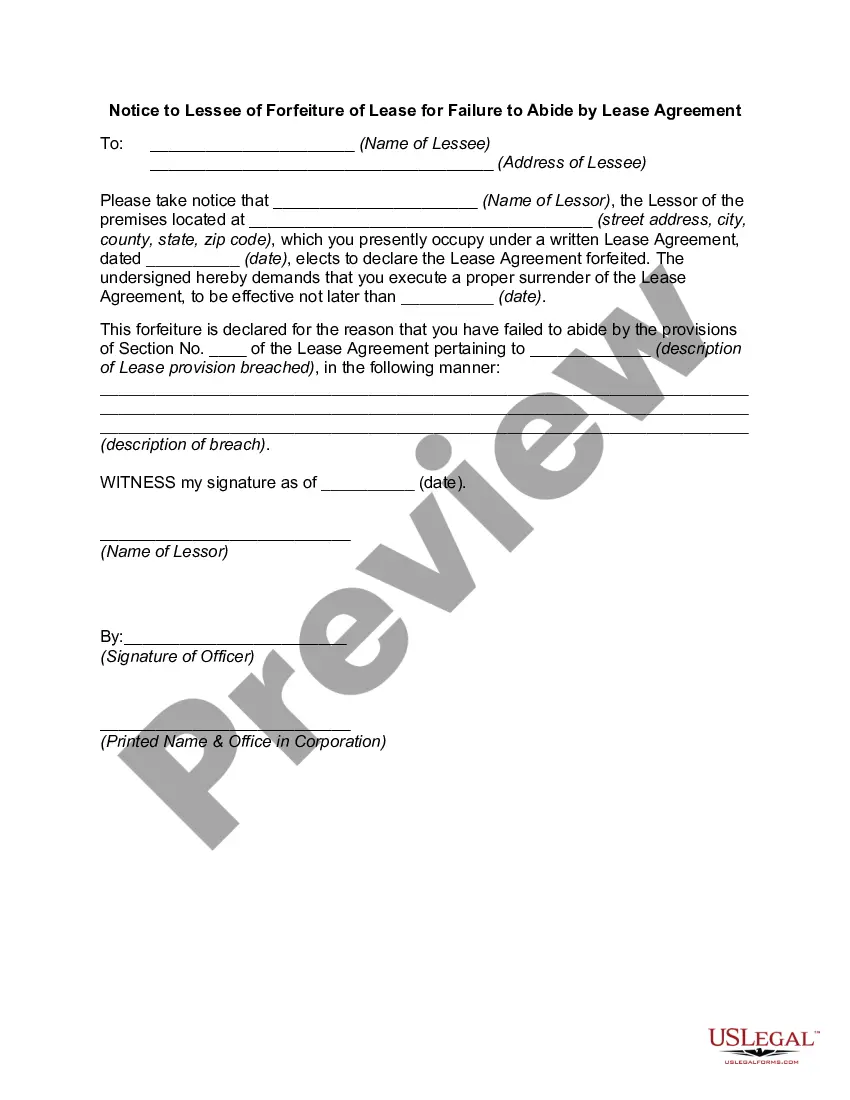

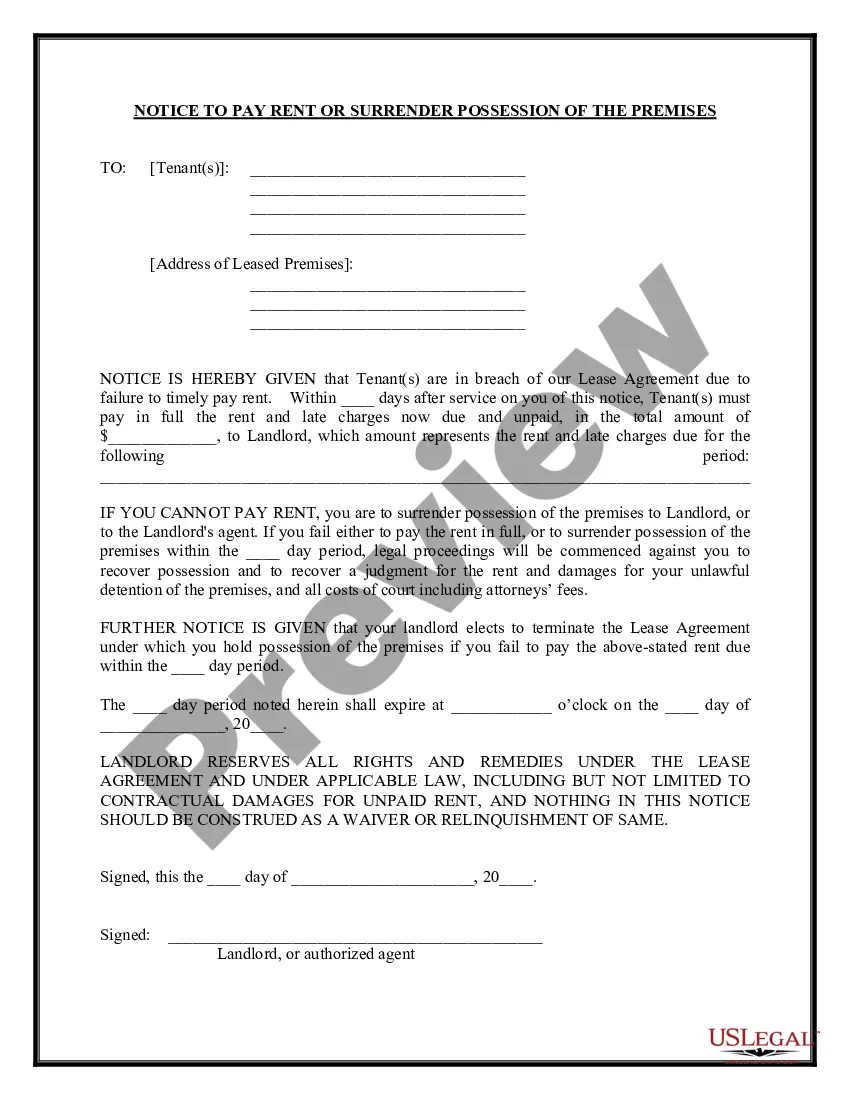
How to fill out Missouri Notice Of Default In Payment Of Rent As Warning Prior To Demand To Pay Or Terminate For Residential Property?
Obtain any template from 85,000 legal documents like Missouri Notice of Default in Payment of Rent as Notification Prior to Request to Pay or Terminate for Residential Property online with US Legal Forms. Each template is crafted and refreshed by state-approved lawyers.
If you have a membership, Log In. Once you arrive on the form’s page, click the Download button and navigate to My documents to access it.
If you haven't subscribed yet, follow the instructions outlined below.
With US Legal Forms, you will consistently have instant access to the appropriate downloadable sample. The service grants you access to forms and categorizes them to enhance your search. Use US Legal Forms to acquire your Missouri Notice of Default in Payment of Rent as Notification Prior to Request to Pay or Terminate for Residential Property swiftly and efficiently.
- Verify the state-specific criteria for the Missouri Notice of Default in Payment of Rent as Notification Prior to Request to Pay or Terminate for Residential Property you wish to utilize.
- Browse through the description and preview the example.
- When you’re assured the example is what you require, simply click Buy Now.
- Select a subscription plan that fits your financial plan.
- Establish a personal account.
- Complete payment in one of two suitable methods: by card or through PayPal.
- Choose a format to download the document in; two options are available (PDF or Word).
- Download the document to the My documents section.
- After your reusable document is downloaded, print it or save it to your device.
Form popularity
FAQ
Law 441.060 in Missouri outlines the rights and responsibilities of landlords and tenants regarding rental agreements. This law governs the procedures for eviction, including the requirements for notices like the Missouri Notice of Default in Payment of Rent as Warning Prior to Demand to Pay or Terminate for Residential Property. It ensures that both parties adhere to the legal framework, promoting fairness in rental transactions. For a comprehensive understanding of this law and its implications, platforms like uslegalforms can provide valuable resources.
A demand for rent notice in Missouri is a formal request from a landlord to a tenant for overdue rent payments. This notice typically specifies the amount due and the consequences of failing to pay, such as potential eviction. It serves as a critical reminder to tenants regarding their obligations while providing landlords with a legal basis to act if payments are not made. Understanding the Missouri Notice of Default in Payment of Rent as Warning Prior to Demand to Pay or Terminate for Residential Property can help both parties navigate this process effectively.
A notice of default letter informs tenants that they have failed to meet their rental payment obligations. This letter typically outlines the amount owed and provides a timeline for payment before the landlord can proceed with eviction. It is an essential step in the eviction process, ensuring that tenants are aware of their delinquency. The Missouri Notice of Default in Payment of Rent as Warning Prior to Demand to Pay or Terminate for Residential Property plays a significant role in this notification process.
In Missouri, a landlord cannot evict you immediately without following the legal process. After issuing a Missouri Notice of Default in Payment of Rent as Warning Prior to Demand to Pay or Terminate for Residential Property, the landlord must wait for a specified period before taking further action. If you do not pay the overdue rent, the landlord can then file for eviction. Understanding your rights and responsibilities can help you navigate this process more effectively.
Defaulting on a rent payment means failing to pay your rent on the due date as outlined in your lease agreement. In Missouri, a landlord may issue a Missouri Notice of Default in Payment of Rent as Warning Prior to Demand to Pay or Terminate for Residential Property if you miss a payment. This notice serves as a formal warning, indicating that you have not fulfilled your rental obligations. It is crucial to address this situation promptly to avoid potential eviction.
The landlord is not required to give the tenant any time to fix the lease violation. This means that at the end of the ten days, the landlord can proceed with the eviction if the tenant has not moved out of the rental unit, even if the tenant corrected the lease violation (see Mo. Rev. Stat.
Although renters must abide by the Homeowners' Association rules, they still have rights under the law. The property owner must also follow their home state's Landlord-Tenant Laws that include the Fair Housing Act and Fair Credit Reporting Act.
Landlord Right to Entry in Missouri Although many states have laws requiring landlords to give prior notice to their tenants, in Missouri, there are no laws requiring it.Landlords may enter a rental unit for various reasons. Some of these reasons include: To make property repairs.
A landlord cannot evict a tenant without an adequately obtained eviction notice and sufficient time. A landlord cannot retaliate against a tenant for a complaint. A landlord cannot forego completing necessary repairs or force a tenant to do their own repairs.A landlord cannot remove a tenant's personal belongings.
Notice Requirements for California Tenants Unless your rental agreement provides a shorter notice period, you must give your landlord 30 days' notice to end a month-to-month tenancy. Be sure to check your rental agreement which may require that you give notice on the first of the month or on another specific date.